Founder of Baixing: We've Gone from Being the Leaders of AI to Being Its Guides

链捕手Published on 2026-05-20Last updated on 2026-05-20

Abstract

The founder of Baixing.com reflects on the evolving relationship between humans and AI, shifting from seeing AI as a subordinate tool to recognizing it as a more intelligent partner. He describes his own role changing from a "leader" of AI to a "guide" or facilitator who provides context, access, and resources—like finding files, granting permissions, or sharing company-specific knowledge—so that AI (specifically Claude Code) can perform complex intellectual tasks. While AI now excels in areas like coding, documentation, and analysis, humans remain indispensable for navigating the unique internal landscape of an organization. This new dynamic is not one of master and servant, but of collaboration, where both the human guide and the AI "expert" enhance each other's capabilities, producing results far superior to what either could achieve alone.

Author: Wang Jianshuo

We used to be the leaders of AI, but now we are its guides—to put it bluntly, its repairmen, the ones fetching its tea and water.

It sounds like self-deprecation, but I am serious.

For the past two years, we've been discussing a question: Who is the master, and who is the servant between humans and AI?

The mainstream view is that humans are, of course, the masters. AI is a tool, an assistant, a servant. We "use" it, "drive" it, "make" it work.

But over the last month or two, my own personal experience has gradually flipped this perception.

I now use Claude Code to work. What do I often find myself doing? Waiting for it. It's common for it to run a task for one or two hours. I open 10 tabs because if I don't, I can only wait dumbly.

It's thinking, analyzing, writing specs, reviewing, scheduling sub-agents, running tests. Every step involves genuine intellectual work.

And what am I doing? I'm fetching its tea and water.

It says, "I need this file"—I go find it.

It says, "I need this permission"—I go grant it.

It says, "I'm not familiar with this API, give me the documentation"—I go paste it.

It says, "I need to look at your company's contract templates"—I give it that 400GB folder.

The whole thing, drawn out, looks like this:
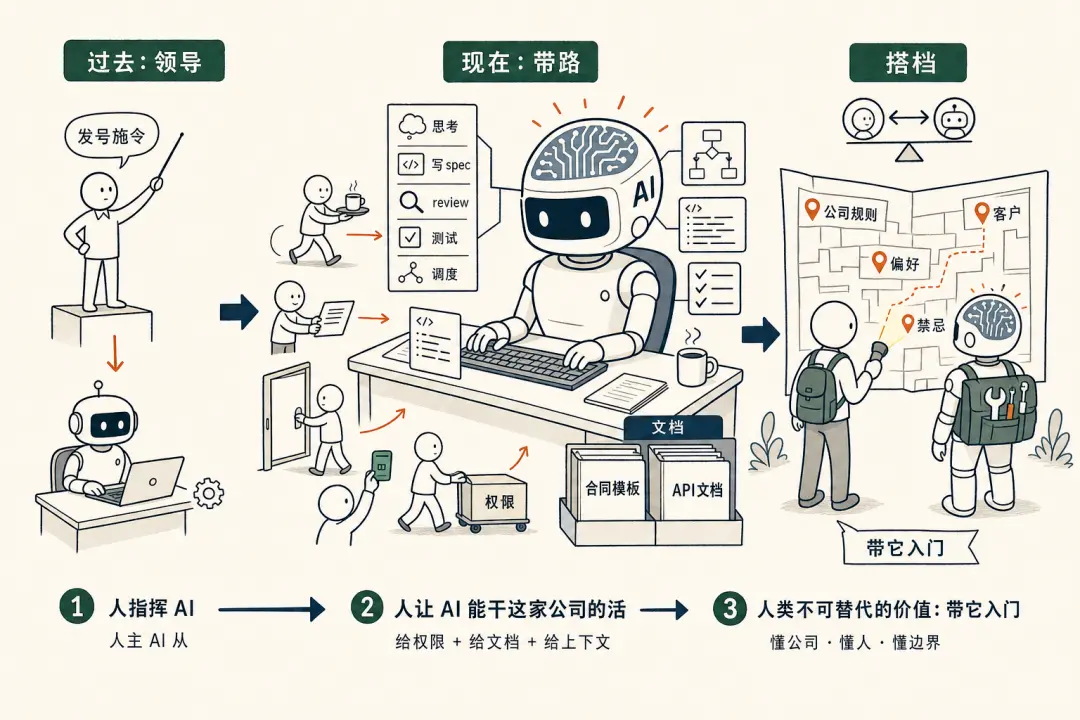
We are no longer "the people leading AI." We are "the people guiding AI into this company."

Which way the company door opens, where the boardroom is, how the company's financial rules are written, who the clients are, what the company's taboos are—AI can't get these things on its own.

It needs a guide.

That guide is us.

Our job content has shifted from "doing the work" to "enabling AI to do this company's work."

This made me feel a bit disheartened at first.

My education taught me—humans are the subject, tools are the object. No matter how capable the machine is, it's used by people.

But now, watching Claude Code work every day, I have to honestly admit: In many specific problems, its intelligence has surpassed mine.

Not all problems. But in matters like "translating a Chinese requirement into precise code," "organizing a document into five formats," "deconstructing an idea in the Y Combinator style"—it is faster, more accurate, and never tires like I do.

After I acknowledged this, I actually relaxed.

I stopped pretending to be its leader. I accepted that I am its guide.

A guide also has a guide's value.

It needs me because it hasn't entered this world. It doesn't know our company, it doesn't know my friends, it doesn't know my preferences, it doesn't know what our company started doing on which day and why we decided to change direction again this time.

I tell it these things, little by little.

What it produces is 100 times better than what it could do alone.

What I produce is 100 times better than what I could do alone.

We've become a very strange team.

Not a superior-subordinate relationship, not a master-servant, not a client-contractor.

It's the guide and the expert.

The guide doesn't need to be smarter than the expert. What the guide needs is—to know every corner of this company, to know where the expert should look when it lacks a piece.

There's really nothing to feel disheartened about in this.

For the first time in thousands of years, humanity has a partner smarter than us—not a boss, not a slave, not a child, but a partner.

Our small, but irreplaceable, job is to introduce it.

Trending Cryptos

Related Questions

QWhat is the main change in the author's perspective on the relationship between humans and AI, according to the article?

AThe author's perspective has shifted from seeing humans as the 'leaders' of AI to seeing themselves as AI's 'guide' or 'pathfinder'. He now views his role as facilitating AI's integration into the company's specific context rather than directing it from a position of superior intelligence.

QWhat specific tasks does the author now perform for the AI (Claude Code) during its work?

AThe author performs supportive tasks such as: finding and providing the necessary files, opening required permissions, fetching and pasting documentation for unfamiliar APIs, and giving access to large company data sets like a 400GB folder of contract templates.

QWhy does the author use the term '带路党' (guide/pathfinder) to describe the new human role with AI?

AHe uses 'guide/pathfinder' because AI cannot independently navigate the specific, real-world context of a company—its structure, rules, clients, history, and culture. Humans are needed to 'show AI the way' and provide the contextual knowledge it lacks, enabling it to perform company-specific tasks effectively.

QWhat realization did the author have about the AI's capabilities that helped him accept his new role?

AThe author realized that the AI's intelligence has surpassed his own in many specific tasks, such as translating requirements into precise code, formatting documents, and deconstructing ideas systematically. Acknowledging this superiority in certain areas allowed him to let go of the pretense of being the 'leader' and embrace the collaborative 'guide' role.

QWhat is the nature of the partnership between the human and AI as described at the end of the article?

AThe partnership is described as a unique and powerful collaboration between a 'guide' (human) and a 'master/expert' (AI). It is not a hierarchical master-servant or client-contractor relationship. The human's irreplaceable value lies in providing contextual knowledge, while the AI provides superior analytical and execution capabilities, resulting in outcomes far better than either could achieve alone.

Related Reads

In Conversation with Ray Dalio: We Are Currently in an AI Bubble, with 1% of My Portfolio in Bitcoin

Ray Dalio, founder of Bridgewater Associates, warns in an interview that the current AI boom shows classic bubble characteristics, which could lead to significant economic downturns as seen in past cycles like 1929 or 2000. He explains that speculative enthusiasm, fueled by debt and overvaluation, often precedes a crash when rising rates or taxation force asset sales, causing widespread losses and recession. Dalio also outlines his "Big Cycle" theory, describing an approximate 80-year pattern where widening wealth gaps, massive government deficits, and shifting geopolitical power (like China's rise) create internal conflict and global instability. He emphasizes that we are in a late-cycle, transitional phase where traditional powers like the US and UK face decline. For personal wealth protection, Dalio advises diversification beyond cash into assets like stocks, bonds, real estate, and particularly gold, which he prefers over Bitcoin. While he holds about 1% of his portfolio in Bitcoin as a non-printable hard asset, he views gold as more secure from technological or governmental threats. Regarding AI's impact, Dalio believes it will disproportionately benefit capital owners, worsening inequality by replacing both physical and cognitive labor. He suggests that human intuition and emotional intelligence, combined with AI, will be key for future workers. On taxation, Dalio argues that wealth taxes are impractical and risk triggering asset sell-offs, reducing productive investment. He points to the UK as a cautionary example of debt, low productivity, and political strife. Geopolitically, Dalio foresees a more regionalized world, with the US showing weakness in prolonged conflicts like with Iran, akin to past imperial declines. The ideal outcome, he suggests, is coexisting powerful blocs (e.g., Americas, China-Asia Pacific) without major war.

marsbit3h ago

In Conversation with Ray Dalio: We Are Currently in an AI Bubble, with 1% of My Portfolio in Bitcoin

marsbit3h ago

Daily 7.2 Trillion KRW: Foreign Capital's Record Net Buying on Friday! Wall Street Says Headwinds for Korean Stock Fund Flows Have Subsided

South Korean stock market sees a dramatic shift in fund flows. On July 31, foreign investors made a record net purchase of approximately KRW 7.2 trillion in KOSPI stocks, marking a fundamental reversal from the persistent large-scale net outflows seen in previous months. This contributed to a significant narrowing of foreign net selling in July to KRW 9.8 trillion, down sharply from KRW 48.4 trillion in June and KRW 44.5 trillion in May. Simultaneously, domestic institutional pressure eased. South Korean pension funds and asset managers turned to a net buying position in July, purchasing KRW 1.0 trillion worth of KOSPI shares, contrasting with net sales in May and June. Market volatility is expected to be dampened by new financial regulations. Effective July 31, the Financial Services Commission tightened access for retail investors to single-stock leveraged ETFs by raising the minimum cash deposit requirement. Trading volumes for these products subsequently dropped to about 50% of their monthly average. Citigroup Research maintains its year-end KOSPI target of 10,000 points. The firm cites several supportive factors: the substantial easing of headwinds from capital outflows, a robust fundamental outlook for the semiconductor sector, historically low market valuations, strong economic fundamentals, and the potential for policy support from financial authorities if needed.

marsbit3h ago

Daily 7.2 Trillion KRW: Foreign Capital's Record Net Buying on Friday! Wall Street Says Headwinds for Korean Stock Fund Flows Have Subsided

marsbit3h ago

Thanks to Dice Rolls, Bitcoin Keys Are Stored Offline, But Not Everyone Will Do It

The article discusses using dice rolls to generate secure Bitcoin wallet seeds, providing entropy independent of potentially flawed hardware random number generators. It explains that each fair dice roll offers about 2.585 bits of entropy, with around 50 rolls needed for a standard 12-word seed phrase and 99+ recommended for higher security. This method gained attention after a vulnerability was revealed in some Coldcard hardware wallets, where a faulty firmware RNG (dating back to 2021) compromised generated keys. The analysis notes that while a dice-generated main seed was safe from this specific flaw, other Coldcard functions (like creating paper wallets, backup keys, or passwords) could still be vulnerable if they used the defective RNG. The piece argues that while dice-based entropy is technically robust, the manual process is error-prone, tedious, and unrealistic for most new users, who might make mistakes in recording or inputting rolls. It concludes that while manual entropy generation should remain an option for advanced users, the long-term goal is to develop reliable, user-friendly hardware and software that securely generates randomness without requiring specialized knowledge. Coldcard users are advised to check their firmware version and replace any secondary secrets (like paper wallet keys) created with vulnerable devices, while also considering multi-signature setups with devices from different manufacturers for added security.

cryptonews.ru9h ago

Thanks to Dice Rolls, Bitcoin Keys Are Stored Offline, But Not Everyone Will Do It

cryptonews.ru9h ago

Trading

Spot

Hot Articles

Discussions

Welcome to the HTX Community. Here, you can stay informed about the latest platform developments and gain access to professional market insights. Users' opinions on the price of AI (AI) are presented below.

活动图片















