Fortune Teller Predicted Hantavirus 4 Years in Advance, Are Market 'Prophets' Among the People?

marsbitPublished on 2026-05-08Last updated on 2026-05-08

Abstract

A mysterious 2022 tweet from a user claiming to be a fortune teller, predicting the end of COVID-19 and the emergence of a Hantavirus, has recently gone viral. The tweet resurfaced amid reports of a real Hantavirus outbreak on a cruise ship in May 2025, which resulted in several deaths. The article discusses how this event fueled speculation and anxiety online, which was quickly absorbed by the cryptocurrency market. A Hantavirus-themed meme coin, HANTA, was launched, and prediction markets like Polymarket and Predict.fun created events for users to bet on whether the Hantavirus would be declared a pandemic by the end of 2026. The piece highlights the crypto market's tendency to convert public attention, fear, and speculation into tradable assets. It concludes by noting the internet's role in blending coincidence, emotion, and imagination, creating narratives that straddle the line between reality and urban legend.

Original|Odaily Planet Daily(@OdailyChina)

Author|Wenser(@wenser 2010 )
Last night, an old tweet from June 11, 2022, detonated like a nuclear bomb across the X platform's public opinion sphere. The tweet came from a fortune teller who claimed to be able to "read the future," prophesying not only the end of the COVID-19 pandemic in 2023 but also, with the accuracy of a prophet, pinpointing the recent emergence of the Hantavirus.

For a moment, countless people flocked to the post, leaving various comments. Yet, the account vanished after posting only 5 tweets, disappearing into thin air, adding a mysterious, urban legend-like quality to the entire affair.

Amidst the lingering sense of uncertainty left by the post-pandemic era, discussions about the Hantavirus quickly spilled over from public health topics and evolved into an amplifier of emotions on social media. It was also rapidly absorbed by the crypto market as a new trading narrative. From meme coins to prediction markets, speculative funds always find the points of intense emotion first.

In the stream of information, where truth is hard to discern, and amidst the resonance of group sentiment, the crypto market once again displayed its instinct: to rapidly convert attention, anxiety, and expectations into tradable products and prices.

A Mysterious Tweet from 4 Years Ago, Tied to the Recent Cruise Ship Virus that Killed 3

The story begins with the account @soothsayer.

This account, which has only posted 5 tweets, had received little attention until now. If you ignore that "Hantavirus prophecy" tweet, you might think this account was no different from the ordinary ones on the X platform that post daily "inspirational quotes" and "motivational sayings."

But as the topic of the Hantavirus has gained momentum in recent days, this old tweet has taken on a flavor of "cyber mysticism."

In April of this year, a cruise ship named "Hondius" set sail from Argentina in South America, originally planning to cross the Atlantic to the Canary Islands in Spain. However, during the voyage, a Dutch man suddenly died on board and was later confirmed to have died from the Hantavirus. As of May 6th, the death toll has increased to 3, and the number of infections has risen to 8, including tourists from the Netherlands, the UK, Germany, and other countries. Currently, the cruise ship has been temporarily denied docking due to the Hantavirus, and the WHO is closely monitoring the situation. It's worth noting that around 30 passengers disembarked from the ship in the two weeks prior without a tracking program, spreading across 12 countries.

Therefore, although the WHO clarified that the virus has not shown signs of large-scale spread before, it has inevitably caused public anxiety, with many exclaiming "it reminds me of the fear of being dominated by COVID."

It is worth noting that, according to test results from the South African National Institute for Communicable Diseases and the Geneva University Hospital in Switzerland, the virus type for this outbreak has been confirmed as the Andes Hantavirus.

The vast majority of Hantaviruses are not transmissible between humans, but the Andes virus is the only exception. Such transmission usually occurs among close family members or healthcare workers. Additionally, Hantaviruses mostly infect humans through "rodent-borne" routes. The main transmission methods are divided into three types: respiratory infection, i.e., inhaling aerosols contaminated by rodent excreta; contact infection, i.e., direct contact of broken skin or mucous membranes with excreta from infected rodents; and digestive tract infection, i.e., consuming food contaminated by rodent excreta.

Regarding many people's concern about whether the virus will spread domestically, reliable sources indicate that in China, the disease caused by Hantavirus is known as "Epidemic Hemorrhagic Fever." China has achieved significant results in the prevention and treatment of this virus and its associated diseases, with no current risk of a large-scale outbreak. The Chinese Embassy in Cape Verde previously issued an announcement confirming there were no Chinese citizens on the ship.

Looking back at the fortune teller's tweet, one finds that it not only directly mentions Hantavirus but also dates back four years, which is indeed highly topical.

Hantavirus in Crypto: Meme Coins and Prediction Markets

Following the emergence of the Hantavirus, the crypto market also experienced tremors. Meme coins and prediction markets immediately began their performances.

Community members dug up a Meme coin created a year ago, which officially launched on external platforms on May 4th: HANTA (Hantavirus) Meme coin (2tXpgu2DLTsPUf9zFmuZmA4xrYxXKBTpVq9wAM7hzs9y). Its current market cap is reported to be $12 million, making it a veritable "OG play."

Additionally, on the prediction market front, both Polymarket and Predict.fun have launched betting events related to the Hantavirus.

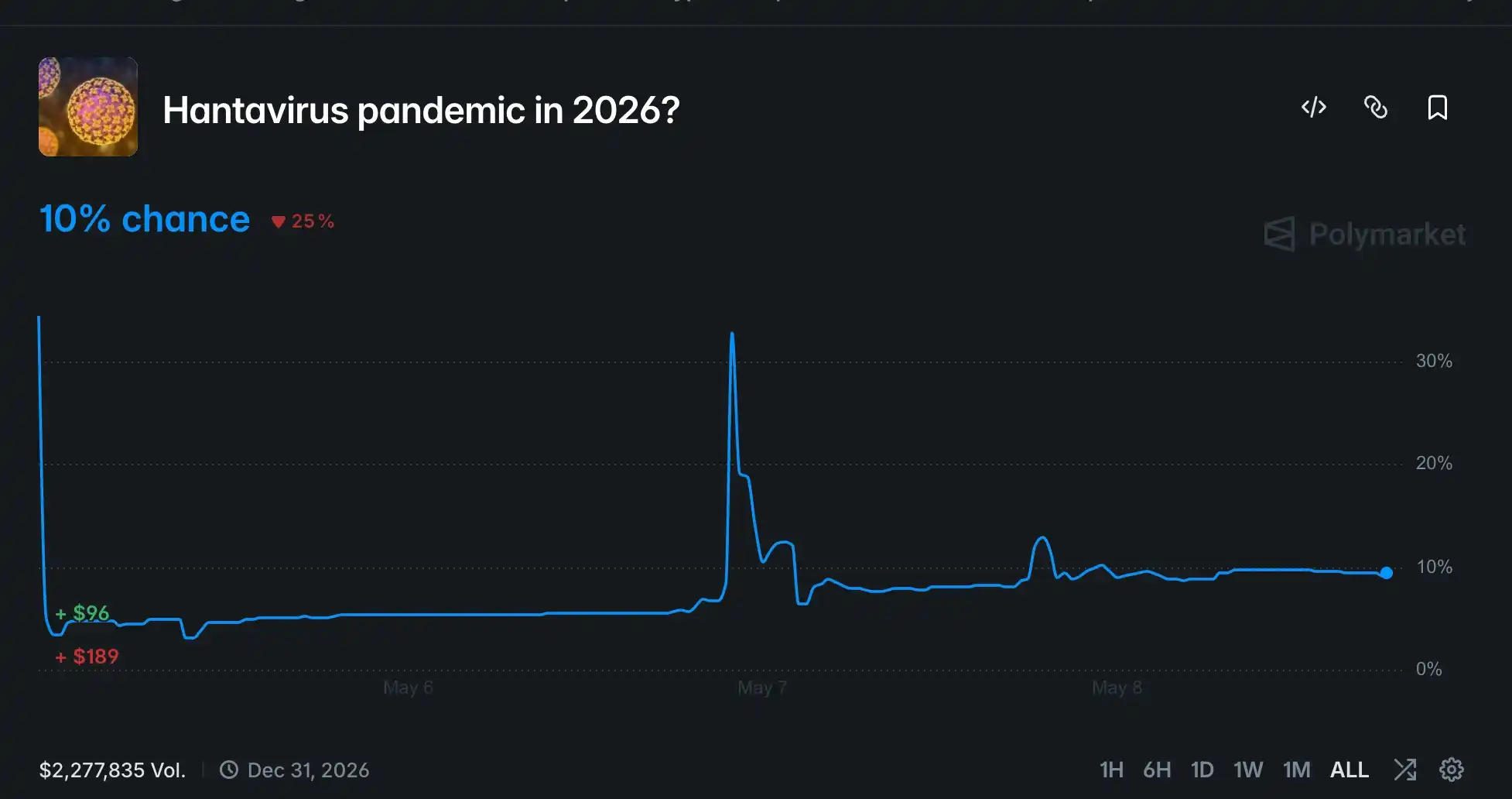
On Polymarket, the probability of the event "Hantavirus Pandemic by 2026" is currently reported at 10%, having previously surged to nearly 35%; the betting amount is currently around $2.27 million. Its resolution rules are: "If the World Health Organization, in official public communications from the time of market creation until 11:59 PM EST on December 31, 2026, explicitly characterizes the Hantavirus, Hantavirus Pulmonary Syndrome (HPS), Hemorrhagic Fever with Renal Syndrome (HFRS), or a Hantavirus-related outbreak as a 'pandemic,' then this market will resolve to 'YES'; otherwise, it will resolve to 'NO.' An explicit characterization includes official WHO statements, reports, press conferences, or publications that explicitly describe the outbreak as a 'pandemic.' Merely declaring it a Public Health Emergency of International Concern (PHEIC) does not qualify unless it is also described as a pandemic. The primary settlement basis for this market will be WHO official communications. Consensus from credible reporting may also serve as a basis."
On the Predict.fun platform, the probability for the identically named betting event is currently reported at 11%, slightly higher than Polymarket's data; the betting volume is smaller, only around $4,400. Its resolution rules are similar to Polymarket's, also relying on the WHO's public statements.
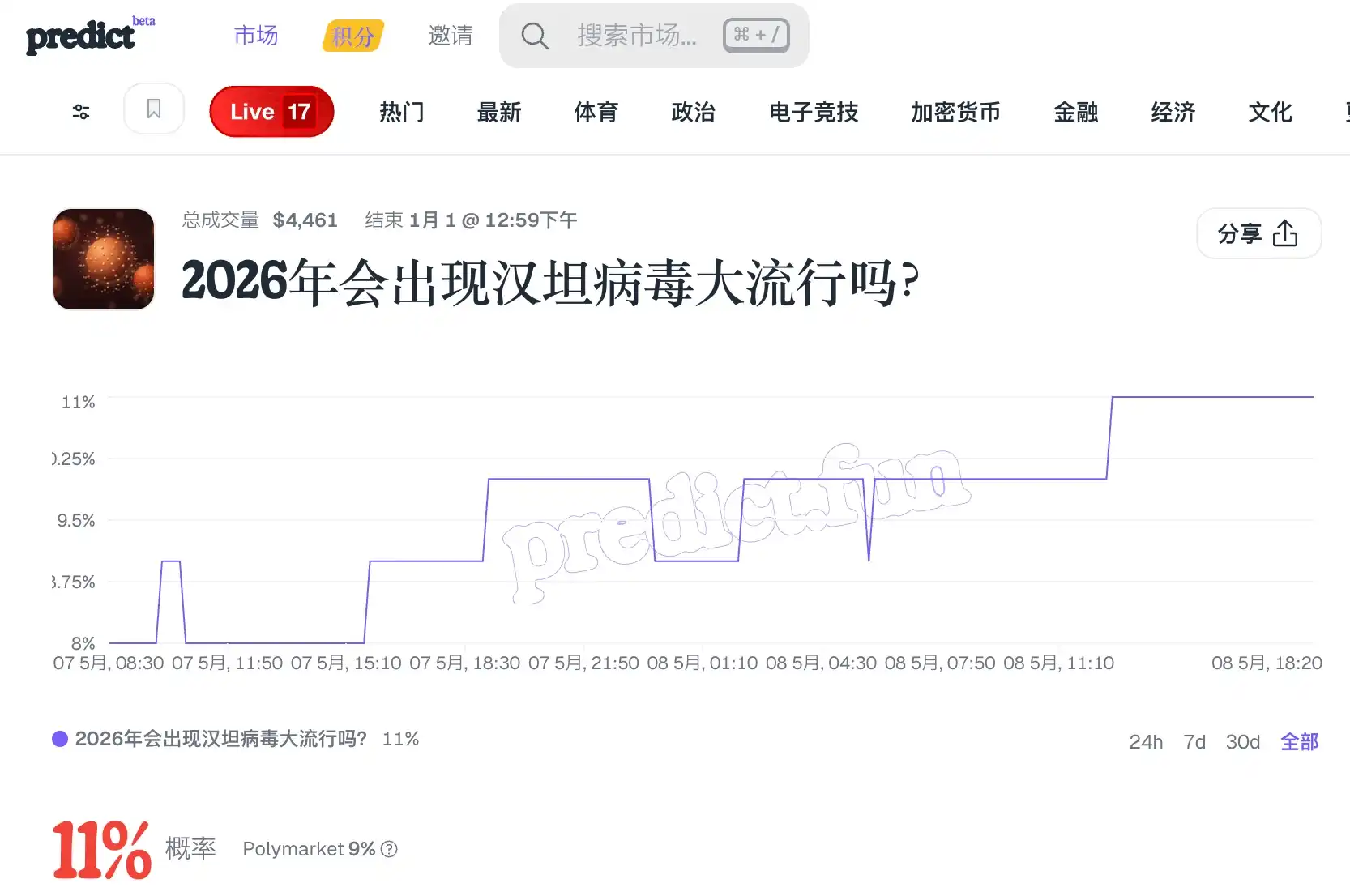
For many, betting real money on the future is inherently addictive. The reason prediction markets are becoming increasingly popular is precisely because they turn humanity's anxiety, curiosity, and desire for the unknown directly into tradable commodities.

At the end of the article, let's bring our focus back to the X platform. There are still numerous ancient posts about "Hantavirus" scattered there, some from 2020, some even traceable back to 2012. Some people dig out fragments of text as "divine prophecies," some piece together blurry screenshots into complete stories, and others firmly believe everything was written in advance.

Truth is not important. What truly fascinates people is how the internet always mixes coincidence, fear, emotion, and imagination into something between reality and urban legend, making you can't help but want to click and take a look.

Just as the fortune teller @soothsayer left behind: "Laugh today, weep tomorrow."

Related Questions

QWhat is the core event described in the article that sparked widespread discussion?

AThe article describes how an old tweet from a user named @soothsayer, posted in 2022, went viral because it seemed to predict the recent Hantavirus outbreak on a cruise ship, along with the end of COVID-19 in 2023.

QHow did the cryptocurrency market react to the Hantavirus news according to the article?

AThe cryptocurrency market absorbed the Hantavirus news as a new trading narrative. A Meme coin named HANTA (Hantavirus) was launched, and prediction markets like Polymarket and Predict.fun created events for users to bet on the probability of a Hantavirus pandemic by 2026.

QWhat specific type of Hantavirus was confirmed in the cruise ship outbreak, and why is it notable?

AThe confirmed virus type is the Andes Hantavirus. It is notable because, unlike most other Hantaviruses, the Andes virus is known to be capable of human-to-human transmission, usually among close contacts like family members or healthcare workers.

QWhat are the main transmission routes for Hantaviruses mentioned in the article?

AThe main transmission routes for Hantaviruses mentioned are: respiratory infection (inhaling aerosols contaminated by rodent excreta), contact infection (broken skin or mucous membranes contacting infected rodent excreta), and digestive tract infection (consuming food contaminated by rodent excreta).

QWhat is the article's perspective on the allure of prediction markets in the context of events like the Hantavirus?

AThe article suggests that prediction markets are increasingly popular because they transform human anxiety, curiosity, and desire regarding the unknown into a tradable commodity. People find it addictive to bet real money on future outcomes.

Related Reads

380,000 Apps Exposed, 2,000+ Apps Leaked Secrets: AI Programming Turns 'Intranet' into Public Internet

Israeli cybersecurity firm RedAccess uncovered a severe data exposure trend linked to "vibe coding" or AI-powered software development tools. Their research found approximately 38,000 publicly accessible web applications built with platforms like Lovable, Base44, Netlify, and Replit. Of these, an estimated 2,000 apps exposed sensitive corporate and personal data, including medical records, financial information, internal strategic documents, and customer chat logs. In some cases, access even granted administrative privileges. The core issue stems from default privacy settings that make applications public by default, combined with a lack of built-in security controls (like authentication) in the AI-generated code. This allows employees without security expertise—"citizen developers"—to easily create and deploy applications that bypass standard corporate security reviews. The exposed apps, often indexed by search engines, are trivially discoverable. While some platform providers (Replit, Lovable, Wix/Base44) argue that security configuration is the user's responsibility and question the validity of some findings, security researchers confirm the widespread reality of such exposures. This pattern, also noted in prior studies, highlights a critical security gap as AI democratizes app creation, potentially leading to massive, unintentional data leaks.

marsbit37m ago

380,000 Apps Exposed, 2,000+ Apps Leaked Secrets: AI Programming Turns 'Intranet' into Public Internet

marsbit37m ago

Attracting Global Capital, Asia's New 'Super Cycle' Is Unfolding

Investors are turning to Asia as the next frontier for global equity growth, with a new "super cycle" unfolding across the region. Driven by the AI revolution, Asian markets, particularly South Korea, have seen significant rallies. According to Morgan Stanley analysis, the underlying drivers of Asia's industrial cycle are shifting from traditional sectors like real estate and manufacturing to massive investments in AI infrastructure, energy security and transition, and supply chain resilience. Fixed asset investment in Asia is projected to grow from around $11 trillion in 2025 to $16 trillion by 2030, with a 7% annual growth rate from 2026-2030. The AI wave is a primary catalyst, driving immense capital expenditure for chips, servers, data centers, and power systems. Asia is central to this hardware supply chain. In China, AI investment is focused on building a full-system domestic capability, with the local AI chip market potentially reaching $86 billion by 2030. Beyond AI, China's export story is expanding from EVs and batteries to robotics. The country already captures about half of new global industrial robot demand and over 90% of humanoid robot shipments. This growth phase mirrors the early stages of China's EV export boom. Simultaneously, energy security investments, spurred by AI's massive power needs, are rising, with China benefiting from its leadership in solar, batteries, and EVs. Regional defense spending is also increasing structurally, supporting demand for advanced manufacturing. The main beneficiaries are China, South Korea, and Japan, positioned in core supply chain areas. However, risks remain, including potential overcapacity, profit margin pressures from competition, persistent technological restrictions, geopolitical friction, and workforce displacement due to AI-driven automation. Market volatility is also expected to increase as investor expectations diverge on the realization of these capital investment and export themes.

marsbit38m ago

Attracting Global Capital, Asia's New 'Super Cycle' Is Unfolding

marsbit38m ago

Funding Weekly Report | 14 Public Funding Events, Kalshi Completes $10B New Funding Round at $220B Valuation Led by Coatue Management

Weekly Funding Roundup: 14 Deals and $10.49B+ in Total Funding, Led by Kalshi's $1B Round Last week (5.4-5.10) saw 14 notable funding events in the global blockchain ecosystem, raising over $10.49 billion in total. Key highlights include Kalshi, a prediction market platform, securing a $1 billion round led by Coatue Management, reaching a $22 billion valuation. The platform now boasts ~2 million MAUs and $178B in annualized trading volume. In DeFi, regulated on-chain reinsurer OnRe raised $5 million in Series A funding, and Bitcoin-backed credit protocol Saturn Credit completed a $2 million seed round. For Infrastructure & Tools, OpenTrade raised $17 million to expand its stablecoin yield infrastructure, and RWA platform Balcony secured $12.7 million to deploy its property settlement service in the US. Centralized Finance saw one deal: AI-driven trading platform Stockcoin.ai completed a seed round led by Amber Group. In the prediction market sector alongside Kalshi, AI-powered platform Elastics raised $2 million. Other notable deals include SC Ventures' strategic investment in crypto market maker GSR and Centrifuge securing a "seven-figure" investment from Coinbase to become a core RWA partner for Base. On the investor side, Haun Ventures raised a new $1 billion fund targeting crypto and AI, and Multi Investment raised ~$616 million to focus on blockchain and Web3 investments.

marsbit1h ago

Funding Weekly Report | 14 Public Funding Events, Kalshi Completes $10B New Funding Round at $220B Valuation Led by Coatue Management

marsbit1h ago

Trading

Spot
Futures

Hot Articles

How to Buy 4

Welcome to HTX.com! We've made purchasing 4 (4) simple and convenient. Follow our step-by-step guide to embark on your crypto journey.Step 1: Create Your HTX AccountUse your email or phone number to sign up for a free account on HTX. Experience a hassle-free registration journey and unlock all features.Get My AccountStep 2: Go to Buy Crypto and Choose Your Payment MethodCredit/Debit Card: Use your Visa or Mastercard to buy 4 (4) instantly.Balance: Use funds from your HTX account balance to trade seamlessly.Third Parties: We've added popular payment methods such as Google Pay and Apple Pay to enhance convenience.P2P: Trade directly with other users on HTX.Over-the-Counter (OTC): We offer tailor-made services and competitive exchange rates for traders.Step 3: Store Your 4 (4)After purchasing your 4 (4), store it in your HTX account. Alternatively, you can send it elsewhere via blockchain transfer or use it to trade other cryptocurrencies.Step 4: Trade 4 (4)Easily trade 4 (4) on HTX's spot market. Simply access your account, select your trading pair, execute your trades, and monitor in real-time. We offer a user-friendly experience for both beginners and seasoned traders.

3.9k Total ViewsPublished 2025.10.20Updated 2025.10.29

How to Buy 4

Discussions

Welcome to the HTX Community. Here, you can stay informed about the latest platform developments and gain access to professional market insights. Users' opinions on the price of 4 (4) are presented below.

活动图片