Former Ripple CTO Lied to XRP Holders? David Schwartz Makes Key Clarification

bitcoinistPublished on 2026-05-05Last updated on 2026-05-05

David Schwartz, former CTO at Ripple, has pushed back against accusations that he misled XRP holders, addressing claims of secret government agreements and hidden price mechanisms in a series of posts on X that appear to have reignited a long-running debate within the community.

The controversy surfaced after X user @uptownsaul raised questions about whether Schwartz had been less than transparent with the XRP community regarding Ripple’s undisclosed agreements. The exchange prompted the Ripple veteran to step in with a direct clarification — one that touched on NDAs, price theories, and what he described as persistent misinformation circulating in the space.

Schwartz Draws A Line Between NDAs And Conspiracy Theories

According to his posts on X, Schwartz did not deny that Ripple maintains confidential agreements. He acknowledged that many of the company’s partners require NDAs to protect their business arrangements. What he pushed back on was the interpretation of those agreements as evidence of something larger.

In his posts, Schwartz appeared to categorize recurring claims — that the U.S. government has a secret plan for XRP, or that Ripple is holding back a mechanism to drive prices sharply higher — as conspiracy theories that are “almost always” false. He stated that no secret agreements with the government exist and that Ripple’s escrow releases follow a fixed, publicly verifiable schedule on the XRP Ledger.

A Pointed Challenge To Price Theories

Schwartz also addressed long-standing speculation about extreme XRP price targets. In one post on X, he questioned why well-capitalized investors who truly believed in a multi-thousand-dollar XRP scenario would not already be bidding the price significantly higher — framing the absence of such activity as its own form of market data.

When X user @NeilBilon weighed in on the discussion, Schwartz responded again, reiterating that Ripple’s operations and goals are communicated through public channels, even if certain commercial details remain confidential.

Separately, @TGMoney85 raised additional questions about Schwartz’s past statements, which Schwartz addressed by clarifying that his earlier remarks on XRP’s role were economic in nature, not price predictions.

As of this writing, XRP trades at around $2.11, with Schwartz’s comments drawing significant attention across the community but appearing to have had little immediate impact on the asset’s price action.
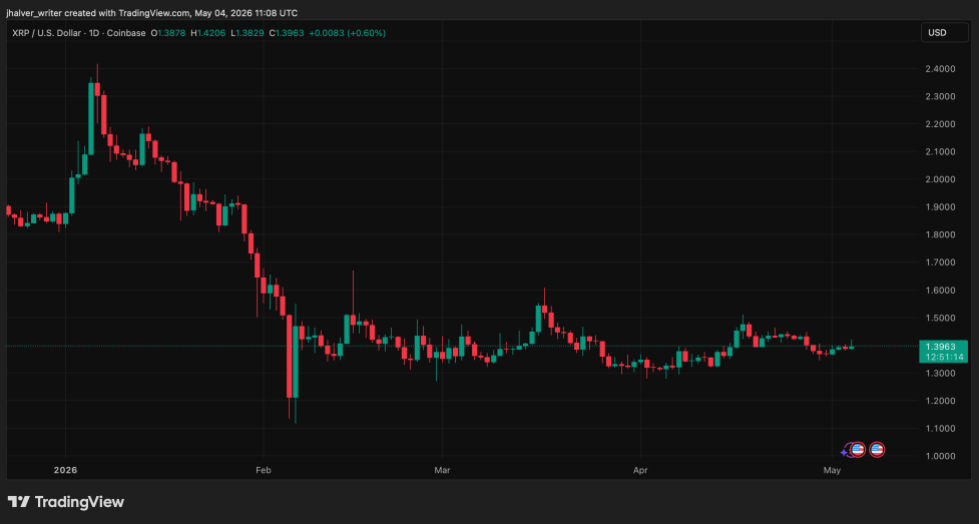
XRP's trends sideways on the daily chart. Source: XRPUSD on Tradingview

Cover image from Grok, XRPUSD chart from Tradingview

Related Reads

QCP Capital Analysts Explained Why Bitcoin Stalled at $63,000

QCP Capital's latest report explains that Bitcoin has stalled around $63,000, testing the lower boundary of its recent trading range ($62,500–$64,000). The retreat wasn't due to a single catalyst but stems from several cross-market pressures: heightened geopolitical risks, rising oil prices, uncertainty around global liquidity, and a muted reaction to positive U.S. macroeconomic data. While U.S. inflation and jobs data softened, reducing expectations of imminent Fed tightening, Bitcoin's price response has been subdued. This highlights the importance of other factors like trader positioning, liquidity conditions, and overall risk appetite. The regulatory landscape is progressing on two tracks: congressional legislation (like the CLARITY Act) is delayed, but SEC rulemaking continues. Corporate treasury activity, exemplified by Strategy's new Bitcoin monetization program, now creates a potential two-way flow, adding complexity to supply dynamics. Geopolitical tensions around the Strait of Hormuz keep oil prices elevated, impacting crypto indirectly through inflation expectations and financial conditions. Historical seasonality shows August and September are typically weak for Bitcoin, but this is descriptive, not predictive, in today's ETF-driven market. In conclusion, Bitcoin has shown resilience by absorbing multiple negative forces without a decisive breakdown. However, it has failed to convert improving macro fundamentals into sustained upward momentum. The market awaits key events like the U.S. PCE data, the Jackson Hole symposium, and the September FOMC meeting for a potential catalyst to break the current range.

cryptonews.ru2m ago

QCP Capital Analysts Explained Why Bitcoin Stalled at $63,000

cryptonews.ru2m ago

Did DeepSeek Intentionally Make an Unfriendly Agent?

DeepSeek is shifting its strategy from being a low-cost model provider to building a foundational ecosystem for AI agents. This pivot is marked by two recent moves: increasing the price of its flagship V4 Pro model and launching the DeepSeek Harness agent framework. Previously, DeepSeek's success was built on creating powerful, affordable models and open-sourcing them to drive adoption. Now, the focus is moving "beyond the model" to the runtime environment where agents operate. Harness is key to this new approach. Unlike integrated agent products from competitors, Harness deconstructs the agent stack—separating the model, tools, skills, workflows, and UI into modular, replaceable components. Its core innovation is the Cordis kernel, which enables dynamic loading, unloading, and management of plugins, allowing agents to modify their own capabilities during execution. Significantly, Harness does not lock users into DeepSeek's models; it allows integration with third-party models. This suggests DeepSeek's ambition is not to control the model layer but to establish the standard runtime environment for future agents—akin to an operating system for the agent era. The V4 Pro price increase aligns with this shift: the model transitions from a loss-leading acquisition tool to a core revenue engine within a broader ecosystem. Harness is currently complex and developer-focused, prioritizing ecosystem builders over end-users. Its success will be measured not by immediate user numbers, but by the plugins, agents, and platforms built upon it. DeepSeek's long-term bet is that controlling the agent runtime will be more valuable than merely providing the underlying models, potentially redefining how AI agents are created and evolved.

marsbit38m ago

Did DeepSeek Intentionally Make an Unfriendly Agent?

marsbit38m ago

Metrics Ventures Market Observation: Talk is Cheap

This monthly market analysis extends its timeline to incorporate critical July comments from the Fed Chair, noting that bond markets have already priced in perceived policy shortcomings. The report observes a growing divergence: equity markets, after some deleveraging, continue a "trust-based" rally, while bond and currency markets signal persistent distrust. Precious metals bottoming suggests a central bank consensus that the era of "competitive currency devaluation" is ending, with verbal interventions losing power. Looking forward to Q3-Q4, the analysis remains bullish on supply-constrained global resources like copper and power, as well as gold, which prices ongoing monetary失信. It argues that digital assets are unlikely to see major outperformance until excess liquidity is released and AI growth rates are fully priced. Key market views include: 1. Commodities like gold remain primary liquidity absorbers over Bitcoin, with recent consolidation seen as healthy. 2. The bull trend for RMB-denominated assets (e.g., STAR 50 Index) is firmly established. 3. Key resource country indices and currencies are near inflection points, with spot copper already at new highs. The report suggests resource equities, particularly in China's market, are at the end of their consolidation phase, offering attractive valuations with embedded optionality on rising metal prices. It highlights the predictive significance of recent US-Japan FX interventions and Treasury-Fed dynamics, suggesting a shift towards less communication and data management to maintain stability. A long position in resource assets is presented as a positive expected-value strategy over a multi-year horizon.

marsbit2h ago

Metrics Ventures Market Observation: Talk is Cheap

marsbit2h ago

The Value, Growth, and Risks of Prediction Markets

The article discusses the explosive growth and complex nature of prediction markets in the United States, focusing on their value, risks, and regulatory challenges. Key drivers include sports betting, which fueled a 1795% year-over-year trading volume increase in Q2 2026, with platforms like Kalshi and Polymarket dominating. These markets offer significant potential as superior hedging tools for businesses and more efficient price discovery mechanisms than traditional polls or derivatives for events like Fed rate decisions, elections, or GPU prices. They also serve as customer acquisition channels for platforms like Robinhood. However, major challenges persist. A central conflict exists between federal regulators (CFTC), which classify event contracts as derivatives under its jurisdiction, and state authorities, which view sports-related contracts as illegal gambling, leading to numerous lawsuits. There is significant consumer protection risk: data shows most retail users lose money to professional traders, platforms market high-risk products like parlays, and protections (e.g., age limits, addiction help) are weaker than in state-regulated sports betting. The "self-certification" process allows rapid contract launches but creates regulatory uncertainty. The author argues prediction markets are fundamentally "better markets" but currently fail to provide adequate consumer safeguards. Proposals include integrating protection mechanisms (cooling-off periods, position limits), aligning risk warnings with product risks, creating paths from speculation to long-term investing, and applying specific consumer protections and taxes to sports contracts. The piece concludes by urging stakeholders to address these issues before a potential regulatory backlash undermines the markets' legitimate utility.

marsbit2h ago

The Value, Growth, and Risks of Prediction Markets

marsbit2h ago

Trading

Spot
活动图片