Author: Curry, Deep Tide TechFlow
Bitcoin recently hit $60,000, marking the largest single-day drop since the FTX collapse.
Michael Saylor's company, Strategy (formerly MicroStrategy), holds 713,000 bitcoins with an average cost of $76,052. As of last night, the unrealized loss reached $6.5 billion. The stock price has plummeted from a high of $457 last year to $110, wiping out more than three-quarters of its value.
However, a year ago, Saylor graced the cover of the renowned magazine Forbes. The headline read:
The Bitcoin Alchemist. At that time, Bitcoin was priced at $104,000, and Saylor's net worth was $9.4 billion.
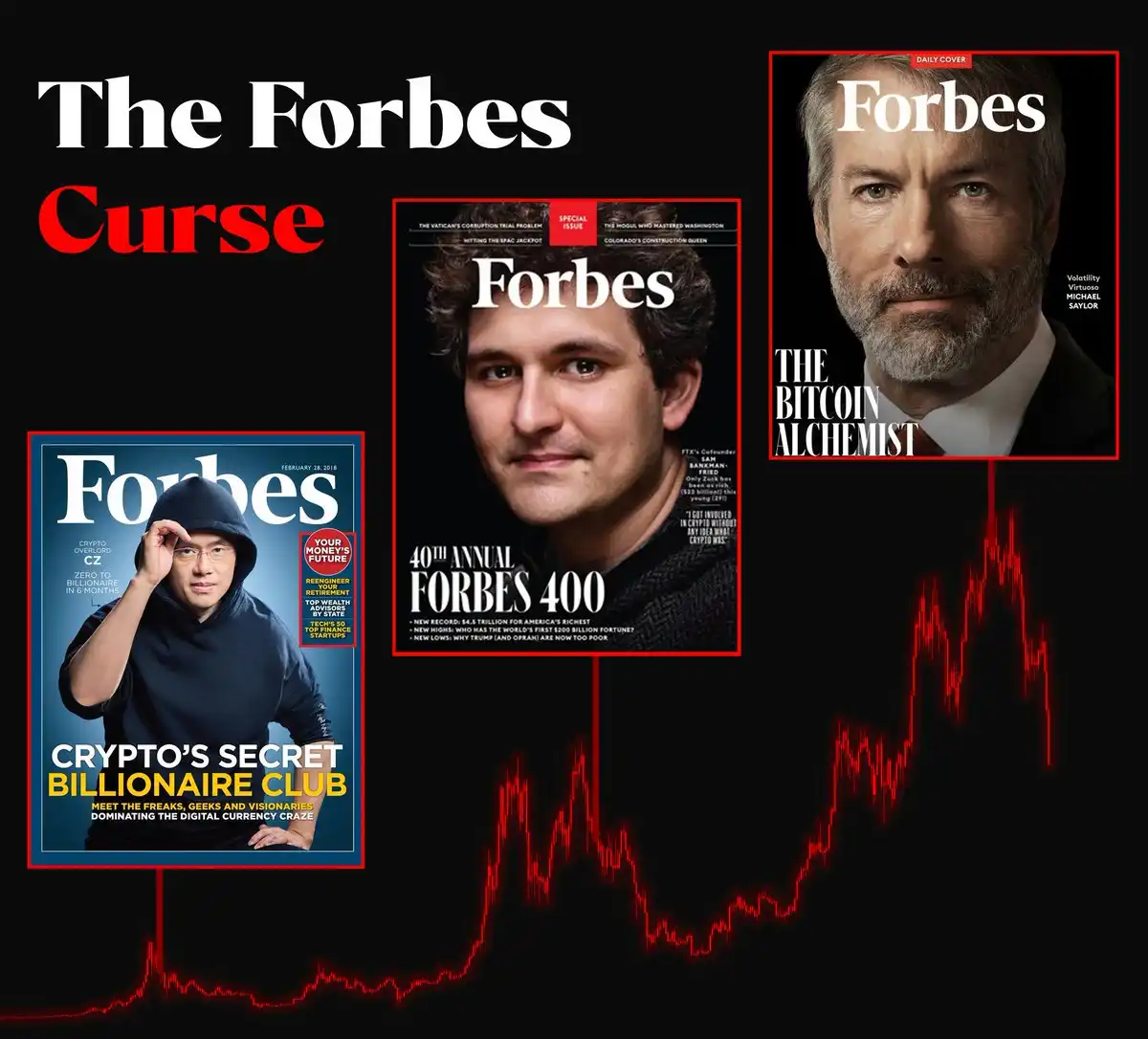
Now, a chart circulating on Twitter lines up three Forbes covers with Bitcoin's price chart. Each cover perfectly marks the starting point of a sharp decline.
Of these three individuals, one has been to prison, one is currently in prison, and the third just lost $6.5 billion.
The Cover: Captured at the Peak of Hype
The first crypto figure to appear on a Forbes cover was CZ.
In February 2018, Forbes featured a cover titled "Crypto's Secret Billionaire Club," with CZ standing in the center, hoodie on, exuding a rugged aura. The fine print read:
From zero to billionaire in just 6 months.
At that time, Bitcoin had just fallen from nearly $20,000 at the end of 2017 to around $7,600. Forbes estimated CZ's net worth to be at least $1.1 billion. Binance, only six months old, was already the world's largest exchange by trading volume.
After the cover was released, Bitcoin briefly rebounded to $10,000. Then, it went nowhere but down.
By December 2018, Bitcoin had fallen to $3,156. From the day the cover was published, the decline was:
58%.
CZ's later story is well-known. On Forbes' 2025 global billionaires list, CZ's net worth was $62.9 billion, ranking first in the crypto industry.
But he hasn't appeared on the cover since.
The second Forbes cover featured Sam Bankman-Fried.
In October 2021, Forbes released its 40th Forbes 400 Richest Americans list, with SBF as the cover star. Under 30 years old, with a net worth of $26.5 billion, he ranked as the 41st richest person in the U.S.
On the cover, he wore his signature gray T-shirt, with curly hair, looking like a college student who had just pulled an all-nighter playing League of Legends.
In hindsight, the magazine's tone was surreal. Forbes called him "the most powerful person in the crypto industry," praising him for building an exchange while donating to charity, a blend of Wall Street and Silicon Valley.
When the cover was released, Bitcoin was around $60,000, just a step away from its then-all-time high of $69,000.
Thirteen months later, FTX collapsed.
SBF had misappropriated over $8 billion in customer funds to cover losses at his other company, Alameda Research. In November 2022, users rushed to withdraw their assets, and FTX couldn't meet the demand. Within a week, the world's third-largest exchange went bankrupt. Bitcoin plummeted from $20,000 to $16,000.
Eventually, SBF was arrested in his luxury apartment in the Bahamas.
He was convicted on all seven charges and sentenced to 25 years in prison. Forbes later created a "30 Under 30 Hall of Shame," with SBF prominently featured.
From cover to handcuffs:
13 months.
The third was Michael Saylor.
On January 30, 2025, the Forbes cover featured "The Bitcoin Alchemist." Bitcoin had just broken through $100,000, and Saylor's net worth had surged from $1.9 billion the previous year to $9.4 billion, nearly a fivefold increase. His company, MicroStrategy, saw its stock price rise 700% in a year and was newly included in the Nasdaq 100 index.
The Forbes article recorded a detail:
On New Year's Eve, Saylor hosted a 500-person party at his estate in Miami. Dancers waved orange Bitcoin glow balls, and outside, a 154-foot yacht named Usher ferried institutional investors and crypto industry leaders to the event.
At the time, Saylor told Forbes:
"We've put a crypto reactor in the middle of the company, sucking in capital and spinning it. Volatility drives everything." This statement was, of course, sincere. Saylor's alchemy boils down to one thing: issuing debt to buy Bitcoin.
When the Forbes cover was released, Bitcoin was at $104,000. One year and six days later, it's at $63,000. A decline of:
40%.
Saylor said on an earnings call that Strategy had built a "digital fortress."
The last crypto mogul to call his company a "fortress" was SBF. That was in June 2022. Five months later, FTX went bankrupt.
The Cover: Both Praise and Curse
There's an old Wall Street concept called the "magazine cover indicator":
When a trend makes it to the cover of a mainstream magazine, that trend has often already peaked.
The reasoning is simple. Forbes editors aren't prophets; like all retail investors, they only notice a story when it's at its most hyped.
The moment a magazine deems "someone in some industry worthy of a cover" is precisely the moment when market frenzy has reached its peak.
The cover isn't the cause of the curse; it's a symptom of the bubble.
However, there was one brief exception to this rule.
In March of last year, Justin Sun graced the Forbes cover with the headline "The Crypto Billionaire Who Helped the Trump Family Make $400 Million."
When the cover was released, Bitcoin was at $87,000. It didn't crash; instead, it rallied to a historic high of $126,000 in October.

Did the curse fail?
Not entirely. When Sun appeared on the cover, it was only two months after Saylor's. One cover in January, another in March—the密集 appearance of crypto figures on mainstream magazine covers was itself a signal. It indicated that the industry's narrative had become so hot that even Forbes editors felt one issue wasn't enough.
When covers start appearing in clusters, in hindsight, the peak of a bull market might have a checklist of symptoms:
Forbes covers, taxi drivers discussing crypto, relatives asking how to open an account... If two out of three signals appear, it's time to think about your position.
So, the real question isn't "Is the Forbes cover accurate?" but rather:
When everyone around you is telling the same story, when that story is so good that even people who don't trade crypto have heard of it, when mainstream media starts deifying figures in an industry...
Are you the one still buying, or the one already selling?
Bull markets don't end in panic. They end on magazine covers.
It's just that the cover stars may change, but the long bear market is always paid for by me.