Five Meme Coins Soar Against the Market Trend, Which Is the Next Potential Star?

marsbitPublished on 2025-12-18Last updated on 2025-12-18

Abstract

Despite a generally bearish crypto market, five tokens have recently surged against the trend. PIPPIN, an AI concept token, saw a 1000% rise driven by insider accumulation and coordinated buying, with internal addresses controlling up to 80% of supply. FOLKS, a DeFi protocol token, surged nearly 24x from its low following an incentive announcement but later dropped 80%. BEAT, a Web3 AI entertainment token on BNB Chain, rapidly grew from a $25M to $440M market cap. AIA, a decentralized AI agent token, plummeted 90% after Binance delisted its futures but rebounded 160% post-contract migration. RAVE, a music and culture DAO, gained over 410% after support from Donald Trump Jr. and CZ, alongside listings on major exchanges. These tokens share traits like low initial market caps, hype-driven pumps, and significant volatility, often influenced by insider activity or major announcements.

Original / Odaily Planet Daily (@OdailyChina)

Author / Wenser(@wenser2010)
The cryptocurrency market continues to fluctuate and trend lower. However, even in a sluggish market, a few tokens defy the trend, maintaining their own independent rhythm of "sharp rises and falls." Odaily Planet Daily will梳理 (sort out) the recent "meme coins" with impressive price performance in this article, attempting to summarize common characteristics to help discover the next investment target with potential for a surge.

PIPPIN: The Orphan of the AI Agent Craze, a Masterpiece of "Insider Trading"

From late last year to January this year, AI Agent tokens once captured the absolute focus of the crypto market. Tokens like ai16z(ELIZAOS) and swarms frequently topped the token gain charts. PIPPIN was also a product of the same batch of AI-themed tokens at that time.

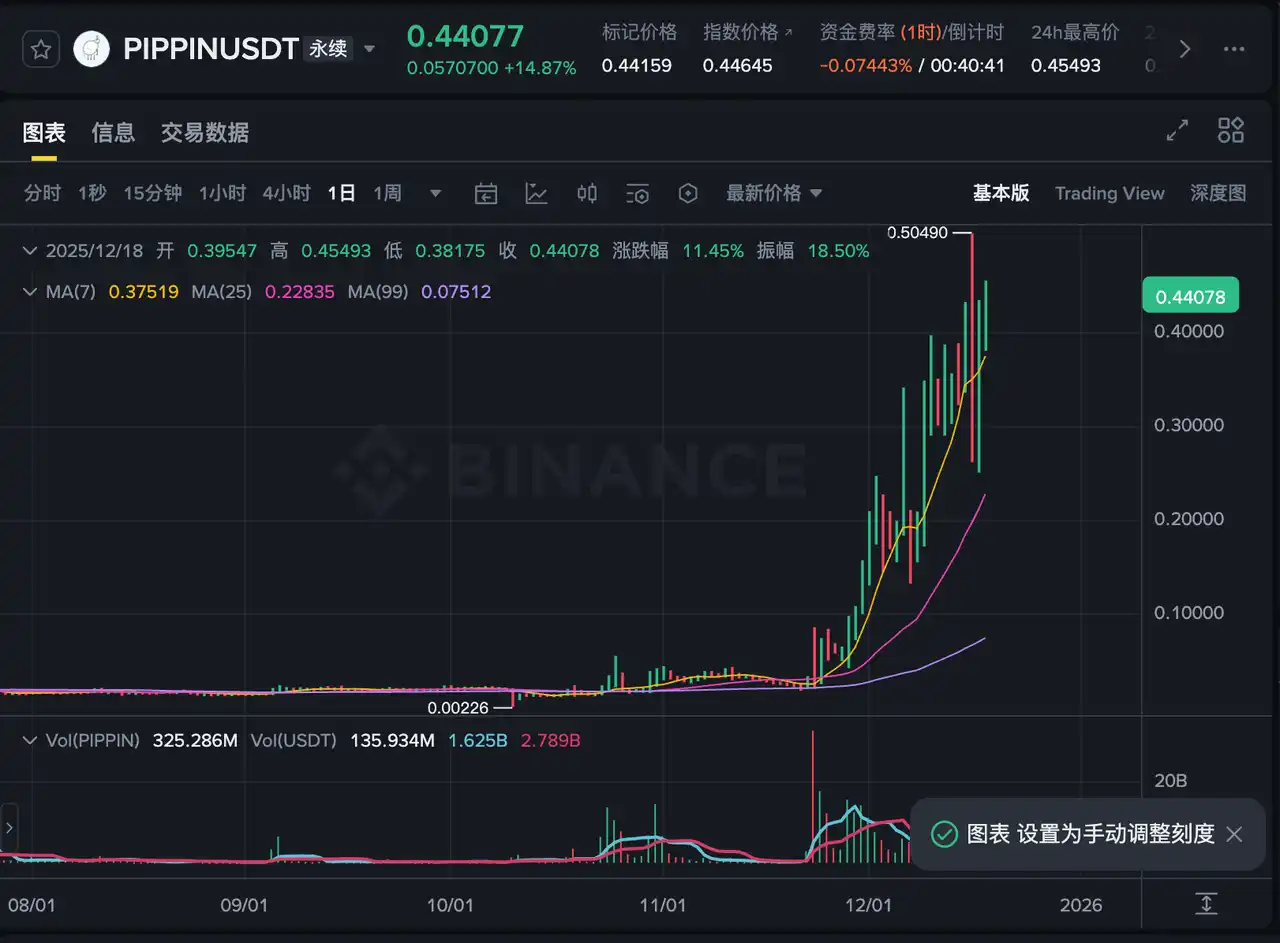
But nearly a year later, only PIPPIN remains, possibly selected by wildcat market makers for its ease of price manipulation. It has been on a upward trend for nearly half a month. It's worth noting that on November 23rd, its price was only around $0.05. Just a week later, its price had skyrocketed to over $0.17:

On December 1st, PIPPIN defied the market trend, surging over 60%, with its price approaching $0.18. At that time, analyst @frontrunnersx提醒 (warned) that PIPPIN showed characteristics of concentrated accumulation. Some addresses continued to buy without significant selling, causing the price to continuously hit short positions during the upward movement, triggering chain liquidations. One address bought about $200,000 worth of PIPPIN 6 days prior, sold after the price doubled, and is currently conducting similar operations with ARC.

On December 2nd, Bubblemaps monitoring revealed that 50 linked addresses purchased PIPPIN tokens worth $19 million. It was also found that 26 addresses withdrew 44% of the PIPPIN token supply, totaling $96 million, from the Gate platform over two months, with most wallets being recently funded. Most PIPPIN token withdrawals occurred on October 24th and November 23rd. By then, the PIPPIN token price had already surged by 1000%, and its insiders controlled half of the token supply, worth $120 million.

In other words, the wildcat market makers' accumulation period for PIPPIN started even a month earlier, with the真正的 (real) violent拉升 (pump) occurring about a month and a week after accumulation began.

Subsequently, a diamond hands address liquidated its previously hoarded 24.8 million PIPPIN tokens, with floating profits shrinking from a peak of $7.6 million to $3.65 million.

On December 6th, Onchain Lens monitoring showed a whale spent 23,736 SOL (worth approximately $3.3 million) to buy 16.35 million PIPPIN at $0.20 over 3 days, with floating profits exceeding $740,000 at that time.

On December 16th, Bubblemaps issued another reminder. The PIPPIN price continued to rise, but internal addresses now held about 80% of the supply, worth approximately $380 million. Bubblemaps pointed out: Since the last disclosure (December 2nd), 16 new wallets with the same pattern have appeared (funded by HTX, received similar amounts of SOL, no history, large withdrawals of PIPPIN from CEX); Another group of 11 wallets linked to Bitget was identified, collectively holding about 9% of the supply. Fund flows and time windows were highly consistent, suspected to be controlled by the same entity.

That night, as the PIPPIN price fell below $0.3, this "meme coin spectacle"宣告 (declared) a阶段性 (phase)收网 (wind-down). But the next day, December 17th, PIPPIN一度 (once) surged to around $0.5, causing another large-scale short squeeze. It has to be said, the violent methods of bear market wildcat makers are堪称 (can be called) brutal.

As of writing, the PIPPIN price is temporarily reported at $0.44, with a 24-hour increase of over 15%. Its performance continues.
FOLKS: Cross-Chain DeFi Protocol Token, Up Nearly 24x From Low Point Due to S2 Incentive Announcement

As a cross-chain DeFi protocol providing lending, staking, and trading services, primarily operating on the Algorand chain, Folks Finance originally had few followers. But with the official launch of the S2 incentive activity, market enthusiasm for its token reignited.

It's worth mentioning that Folks Finance distributed 1.5 million FOLKS tokens during the S1 incentive activity, including Chainlink incentives. On November 6th, FOLKS officially launched on Binance Alpha, with a historical low price of around $2.

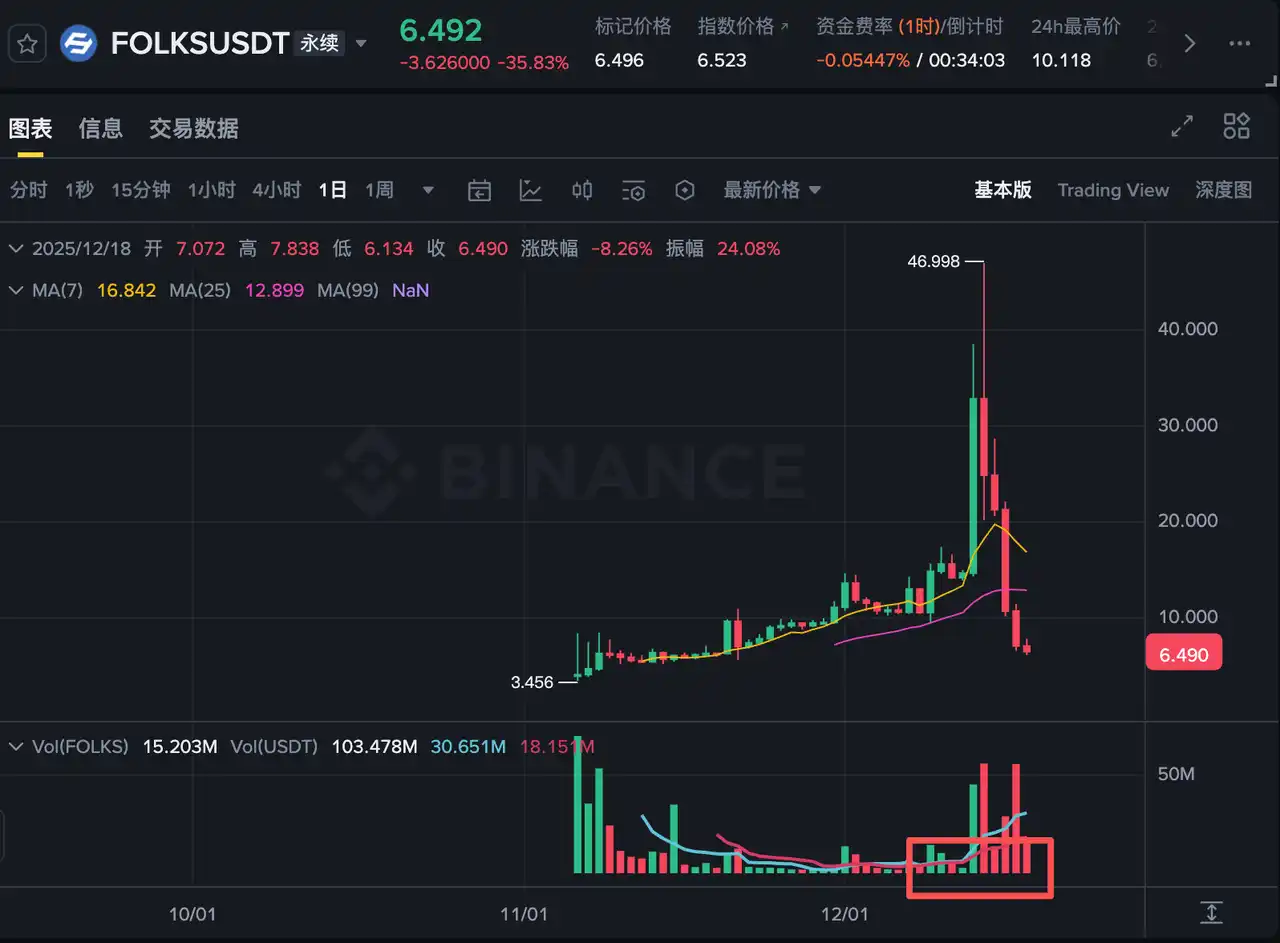
After the official announcement from Folks Finance on December 9th, the FOLKS token price soared from under $10;

On December 14th, after nearly a week of speculation, the FOLKS token price broke through $40 for the first time, eventually rising to nearly $47, an increase of nearly 24 times from the low point;

Subsequently, the FOLKS price quickly retreated, falling by about 80%.

As of writing, the FOLKS price is temporarily reported at $6.4, with a 24-hour decrease of over 24%. The circulating supply is 12.7 million tokens (25.4% of total supply), with a temporary market cap of around $81 million.
BEAT: A True Meme Coin Needs Few Words

As another altcoin choosing to root itself in the BNB Chain ecosystem, similar to previous meme coins like MYX and COAI, BEAT's rise is another classic case.

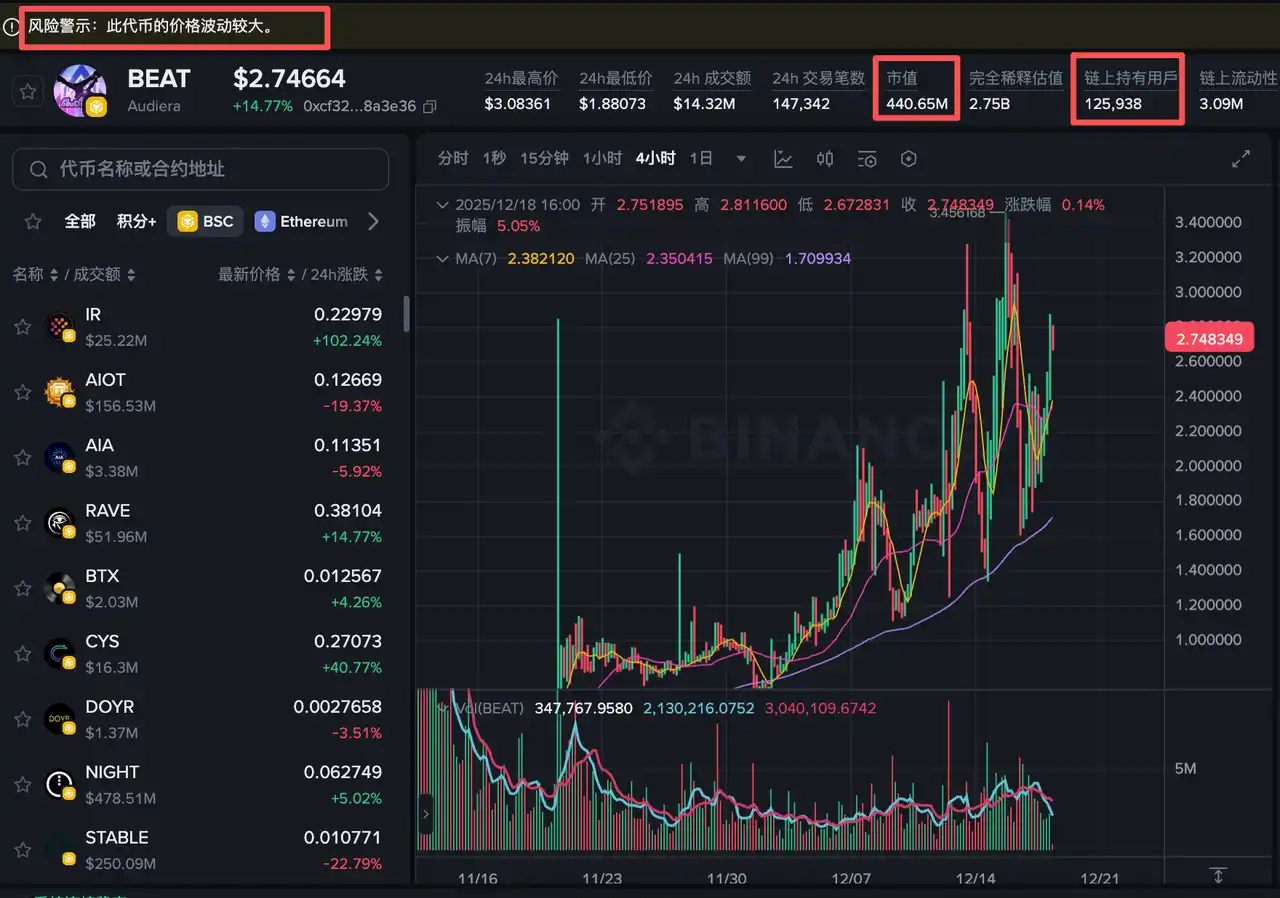
It is worth noting that the official account behind the BEAT token project promotes the concept of a "Web3 AI entertainment platform + IP creation platform" – a repackaged version of hot concepts. After listing on Binance Alpha and futures in early November, BEAT officially claimed over 1.2 million independent on-chain holding addresses. One must say, "Audacity leads to great production."

Similar to the price action of previous meme coins, BEAT still started with a low market cap – after an initial rise upon listing on Binance Alpha, its market cap remained around $25 million. Subsequently, the price飞速上涨 (rapidly increased) amidst repeated pumps and dumps.

As of writing, the BEAT price is temporarily reported at around $2.7, with a 24-hour increase of over 14%. The circulating market cap is temporarily reported at $440 million, with about 1.26 million on-chain holding addresses. (Note: Original said 12.6, likely meant 1.26 million based on context)
AIA: Decentralized AI Agent Concept Token, Contract Swap Causes Volatility

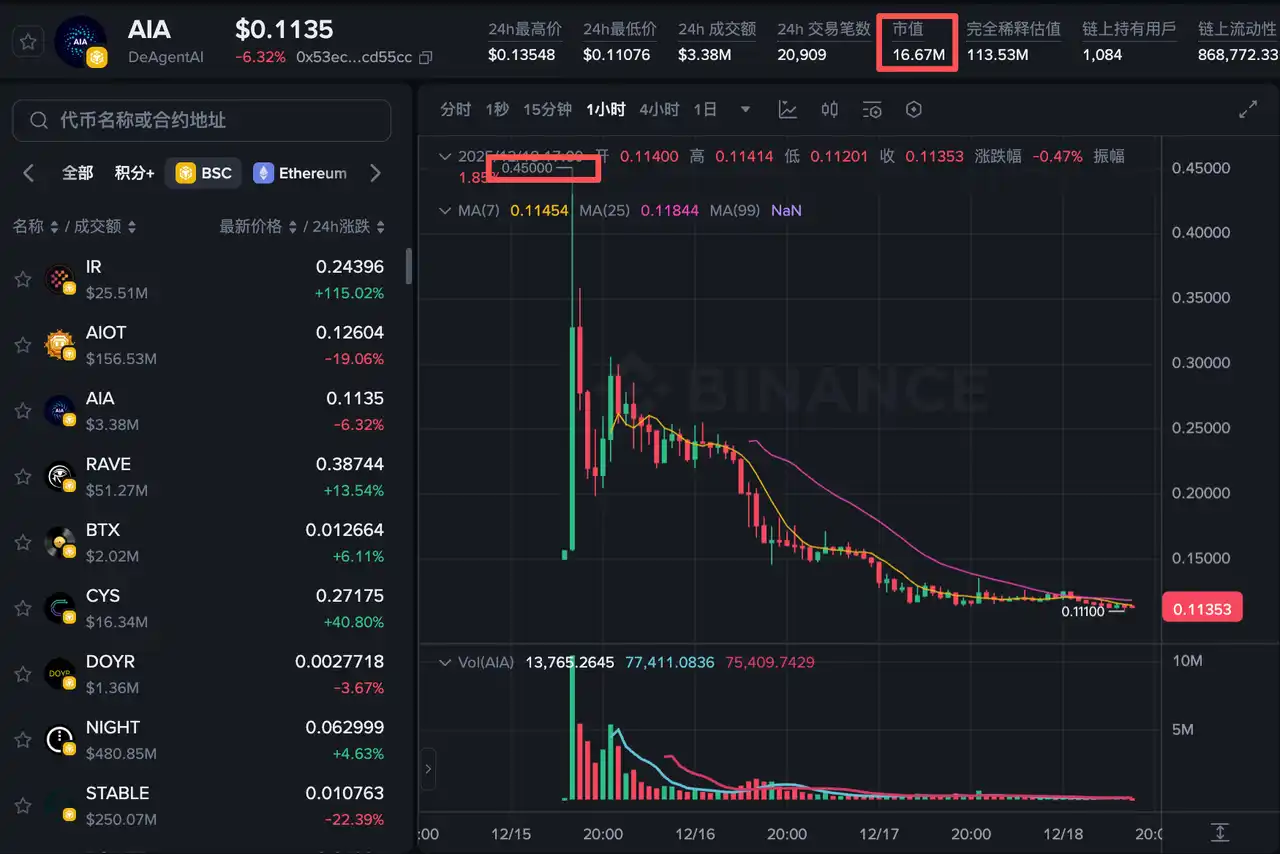
As the project token for DeAgent AI, AIA previously attracted significant market liquidity and attention due to a massive surge after listing on Binance futures, its price once skyrocketing over $1. However, limited by the increasingly quiet market environment and the gradual cooling of the AI concept, the token price gradually fell into silence,阴跌 (slipping downward).

But the incident of "Binance delisting AIA futures" injected volatile energy into its liquidity again.

On December 11th, according to an official announcement, Binance Futures announced it would close all AIAUSDT perpetual contracts at 20:15 (UTC+8) on December 11, 2025, for automatic settlement. After settlement, the contract would be delisted. AIA一度 (once) plummeted over 90%.

But subsequently, Binance announced that Alpha 2.0 would support the contract swap for DeAgentAI (AIA). Starting from 20:00 (UTC+8) on December 11, 2025, Binance Alpha 2.0 had temporarily closed AIA trading to execute this contract swap. The swap would be executed at a 1:1 ratio. The snapshot time was 20:00 (UTC+8) on December 11, 2025. Binance Alpha 2.0 would resume DeAgentAI (AIA) trading at 16:00 (UTC+8) on December 15, 2025.

On December 15th, official data from Binance Alpha showed that DeAgentAI (AIA) had completed the smart contract swap and officially resumed trading at 16:00 (UTC+8) on December 15th. Market data showed AIA surged significantly after opening, with gains一度 (once) exceeding 160%, topping the Binance Alpha sector gain chart.

As of writing, the AIA price is temporarily reported at $0.11, with a 24-hour decrease of 6.3%. The circulating market cap is temporarily reported at $16 million.
RAVE: Offline Community-Driven Culture Platform, Supported by Trump Jr. and CZ Reposts

As a DAO organization promoting the concept of a "decentralized music and culture community and platform ecosystem," RaveDAO's development speed has been like a cheat code. After months of community and project building, RaveDAO has previously completed multiple member NFT sales.

On November 10th, RaveDAO officially announced its token economic model and airdrop details. The official stated that the token aims to connect artists, organizers, and fans through token economics, promoting a decentralized entertainment ecosystem of "culture as protocol." RAVE has a total supply of 1 billion tokens, allocated as follows: Community 30%, Ecosystem 31%, Team & Co-builders 20%, Early Supporters 5%, Liquidity 5%, Airdrop 3%, Foundation & Public Goods Pool 6%. Approximately 23.03% will be in circulation after the Token Generation Event (TGE), with the rest subject to a 12-month cliff and a 36-month linear unlock period.

A month later, on December 10th, Binance Alpha announced it would soon list RaveDAO(RAVE).

The next day, news of RaveDAO receiving support from both the WLFI and Aster ecosystems spread quickly. Within an hour of listing on Binance Alpha on December 12th, trading volume exceeded $25 million.

Moreover, RaveDAO's "upper echelon strategy" was extremely bright – On the evening of the 12th, Trump Jr. reposted and followed the dynamics of Aster's cooperation with USD1. RaveDAO, as one of the cooperation participants, gained massive exposure. CZ also reposted this tweet later. The RAVE price subsequently rose.

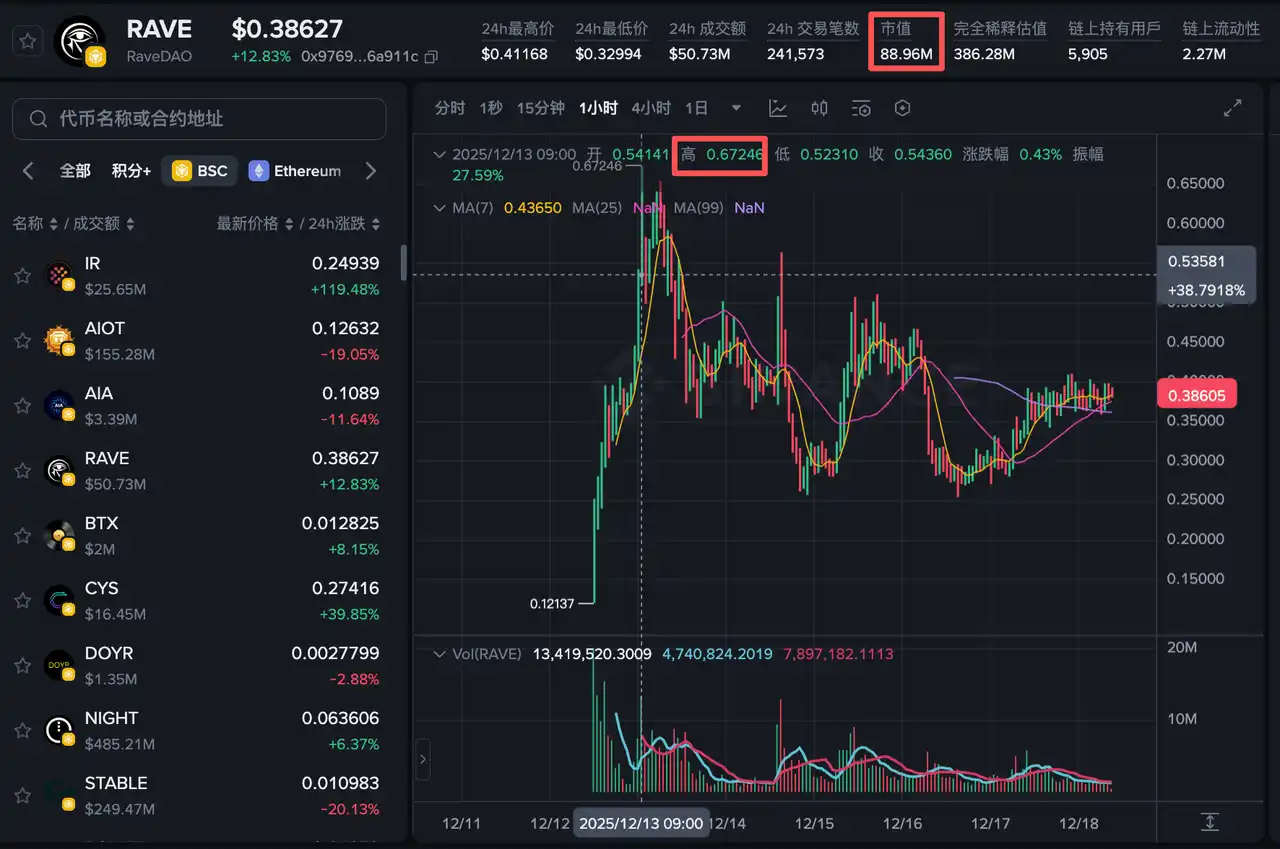
On December 13th, the RAVE price一度 (once) reached $0.67, with a 24-hour increase of over 410%;

On December 14th, Binance Futures launched RAVE U-based contracts;

On December 15th, RAVE was successively listed on centralized exchanges like OKX, Bybit, Bitget, Aster, Gate, Kucoin, and MEXC. The price at that time fell back to around $0.41.

As of writing, the on-chain price of RAVE is temporarily reported at $0.38, with a 24-hour increase of over 12%. The circulating market cap is temporarily reported at $88 million.
Related Questions

QWhat are the five 'meme coins' mentioned in the article that have surged against the market trend?

AThe five coins are PIPPIN, FOLKS, BEAT, AIA, and RAVE.

QAccording to the analysis, what was a key characteristic of PIPPIN's price surge that suggested market manipulation?

AAnalysis by Bubblemaps showed that internal addresses controlled about 80% of the supply, worth approximately $380 million, indicating a high likelihood of manipulation by a single entity.

QWhich coin experienced a near 24x price increase from its low point due to an S2 incentive announcement?

AThe FOLKS token experienced a near 24x price increase from its low point after the Folks Finance protocol announced its S2 incentive program.

QWhat event caused the AIA token to plummet over 90% before it later surged more than 160%?

AThe AIA token plummeted after Binance Futures announced it would delist and settle all AIAUSDT perpetual contracts. It later surged over 160% when trading resumed on Binance Alpha 2.0 following a 1:1 contract swap.

QWhich project's token (RAVE) gained significant exposure and a price boost after receiving social media endorsements from prominent figures?

AThe RAVE token gained significant exposure and a price boost after receiving social media endorsements and a repost from Donald Trump Jr. and a subsequent repost from CZ (Changpeng Zhao).

Related Reads

TechFlow Intelligence Bureau: Chip Stocks Lose Trillions in a Single Day, Bitcoin Falls Below $60,000, US-Iran Conflict Escalates

**Daily Tech & Markets Roundup: AI Advances, Market Turmoil, and Geopolitical Tensions** **AI / LLMs**: Anthropic's internal report on AI self-improvement sparked serious discussions about Recursive Self-Improvement (RSI). Meanwhile, debate continues on AI coding tools after Claude was accused of introducing bugs into the rsync codebase. In positive news, DeepSeek V4 Flash impressed in local deployment tests, and GitHub Copilot now supports custom endpoints for local models. A surprising research turn suggests removing chain-of-thought prompting can sometimes improve LLM performance. **Crypto / Web3**: Bitcoin plunged below $60,000, with its RSI hitting levels last seen during the COVID-19 crash, driven by strong U.S. jobs data reviving interest rate hike fears. Discussions highlight Ethereum DeFi's continued lack of a smooth consumer payment layer. **Chips / Hardware**: Chip stocks suffered a massive sell-off, with the Philadelphia Semiconductor Index posting its worst single-day drop in six years, erasing over a trillion dollars in value. Marvell, Micron, AMD, and Intel were among the biggest losers. **Tech Companies**: A leaked Microsoft document revealing goals to make Copilot "addictive" drew criticism. LinkedIn founder Reid Hoffman left Microsoft's board to focus full-time on his AI agent startup, Manus. Google was revealed to be paying SpaceX $920 million monthly for AI training compute. **Markets & Macro**: A blowout U.S. jobs report (172k vs. 80k expected) crushed hopes for near-term rate cuts, sending Treasury yields soaring and triggering a broad market sell-off. CEOs from Kraft, McDonald's, and Whirlpool simultaneously warned U.S. consumers are exhausting their savings. **Geopolitics**: U.S.-Iran tensions escalated with missile/drone interceptions and U.S. strikes on Iranian radar sites, keeping the critical Strait of Hormuz largely closed since late February and posing ongoing oil supply risks. **The Bottom Line**: The strong jobs data acted as a single trigger for correlated sell-offs across equities, crypto, and chips. Underlying the volatility is a stark contradiction between robust employment data and warnings of consumer weakness, alongside geopolitical risks that could reignite inflation, leaving markets to price in a fraught macro outlook with no clear "soft landing" path.

marsbit1h ago

TechFlow Intelligence Bureau: Chip Stocks Lose Trillions in a Single Day, Bitcoin Falls Below $60,000, US-Iran Conflict Escalates

marsbit1h ago

It Took Me a Year to See the Bitter Truth About Agent Payments

After a year building infrastructure for the Agent economy, engaging with major players like Stripe, Visa, and Coinbase, the author shares a sobering analysis of the current state of Agent payments. The core finding is a stark lack of genuine, immediate demand across most envisioned use cases. The article breaks down four key market segments: 1. **Agent-to-Merchant (Consumer Shopping):** For most product categories (e.g., clothing, electronics), conversational AI shopping is a step backwards from visual e-commerce interfaces. While agents excel at understanding needs, they can't replace side-by-side product comparison. Real merchant interest is defensive "Agent Engine Optimization," not driven by current customer demand. Potential exists for high-frequency, low-decision purchases (like food delivery) or navigating complex store UIs, but these require massive B2C distribution channels dominated by giants like Amazon. 2. **Agent-to-API (Developer Services):** Developers already have subscriptions and billing relationships for APIs (compute, data). Prepaid balances solve micro-payment issues for low transaction volumes. A deeper structural problem is that major SaaS vendors' business models rely on enterprise contracts, resisting granular pay-per-call pricing. While protocols like MPP and x402 serve the long tail of niche services, this market is small and developers are historically low-willingness-to-pay. 3. **Agent-to-Agent:** This remains largely theoretical with minimal transaction volume. While it represents a long-term bet on a fundamentally new transaction infrastructure (sub-second, micro-penny to million-dollar, multi-party settlements), it does not constitute a present market. 4. **Agent-to-Finance:** This is the only category with existing, paying demand. Integrating AI into financial workflows (trading, portfolio management) is a natural evolution and enables new capabilities like autonomous rebalancing. However, competition favors established, regulated institutions. The "real problem" is not moving money between agents, but the broader challenge of **coordination**—orchestrating work between agents and humans, verifying outcomes, and settling results. Payment is just one component of settlement, which is itself part of coordination. Companies that solve the coordination layer will subsume payment, not the other way around. While well-funded incumbents build defensively for a long-term future, startups must find where the market is today—which, for the author's team, lies outside these four categories in an area of real, growing, and underserved activity.

marsbit1h ago

It Took Me a Year to See the Bitter Truth About Agent Payments

marsbit1h ago

It Took Me a Year to See the Hard Truth About Agent Payments

**Title: It Took Me a Year to See the Hard Truth About Agent Payments** Over the past year, I've worked on infrastructure for the Agent economy, engaging with major players like Stripe, Visa, Coinbase, and numerous startups. The findings reveal a stark reality: genuine, widespread demand for Agent-based payments does not yet exist. **Key Observations:** * **Agent-to-Merchant (Shopping):** The user experience for AI shopping often falls short, especially for visual product discovery. While AI excels at understanding needs, conversational interfaces can't yet replace browsing and comparing multiple products visually. Current merchant interest is largely defensive ("Agent Engine Optimization") for a future that hasn't arrived. High-frequency, low-friction purchases (like food delivery) are potential fits, but lack open APIs and face high AI inference costs. Simpler, more affordable, or cross-language interactions for complex UIs are a niche opportunity but require massive consumer distribution to scale. * **Agent-to-API (Developer Tools):** Developer payment needs for APIs (computing, data, models) are already met through subscriptions and prepaid credits. The core challenge is not payment friction but supplier economics: most large SaaS providers prefer enterprise contracts over micropayments for API calls. Protocols like MPP and x402 suit the long-tail of smaller services but cater to a developer market historically reluctant to pay for these tools. Major infrastructure needs at the top of the stack are already being addressed. * **Agent-to-Agent (Machine Commerce):** This is a long-term vision with almost no current transaction volume. While a future with high-speed, high-frequency, multi-party machine-to-machine transactions would require novel infrastructure, it remains theoretical. The market is not here yet. * **Agent-to-Finance:** This is the only category with clear, present demand. Financial professionals and DeFi users already pay for tools, and AI augmentation is a natural evolution. Autonomous AI agents can enable entirely new financial strategies. However, competition is fierce from established, regulated incumbents who can more easily layer AI onto their existing products. **The Core Insight:** Companies, especially giants with long time horizons, are building defensively for a potential future of mass machine commerce. For them, early investment is a low-cost hedge. For startups, the current market reality is different. The primary challenge isn't just moving money between agents (payments). The larger, unsolved problem is **orchestration** – coordinating work between agents and humans, verifying outcomes, and then settling. Payment is just a part of settlement, which is just a part of orchestration. Companies that solve the orchestration problem will subsume payments, not the other way around. After a year of building, we see the real, growing, and underserved market opportunity lies in this broader domain of orchestration.

链捕手2h ago

It Took Me a Year to See the Hard Truth About Agent Payments

链捕手2h ago

Claude Opus 4.8 Finds a $4.5 Billion Bug: The AI Era is Mass-Producing Hackers

A researcher discovered a critical "infinite mint" vulnerability in the Zcash cryptocurrency's Orchard protocol using Claude Opus 4.8, leading to a swift fix but also a 50% market drop, erasing billions in value. This incident highlights a new era where powerful, accessible AI models are dramatically lowering the barrier to finding software vulnerabilities. Previously, the security community feared specialized models like Claude Mythos Preview, capable of finding decades-old zero-day exploits. The Zcash case, however, involved a publicly available, general-purpose model. This shift makes advanced security auditing—and attack capabilities—accessible to far more people, not just experts. The mass democratization of vulnerability discovery brings a dual challenge: a flood of low-quality, AI-generated false reports that overwhelm maintainers, and the real, rapid uncovering of deep, dangerous bugs. Open-source projects, often understaffed and unfunded, are particularly vulnerable to this "attention DDoS." The article cites examples like curl shutting down its bug bounty program due to the unsustainable workload. Our perceived digital safety has often been luck, relying on the high cost and effort required to find deeply hidden flaws in complex systems, as seen with historical vulnerabilities like Heartbleed or Baron Samedit. AI changes this cost structure, effectively "mass-producing flashlights" to illuminate every corner of our codebase. While large companies operate extensive security chains involving external white-hat hackers and massive defensive operations, the global cybersecurity workforce faces a severe shortage, especially of experienced personnel capable of analyzing complex threats and coordinating fixes. The core dilemma emerges: AI makes *finding* bugs cheap and scalable, but *fixing* them remains a slow, expensive, and human-intensive process. The article concludes that AI won't destroy the internet but acts as a bright light, revealing that our digital existence is not inherently secure but is precariously maintained by ongoing human effort. The true cost in the AI era may not be discovery, but whether there will be enough people left willing and able to do the hard work of repair.

marsbit2h ago

Claude Opus 4.8 Finds a $4.5 Billion Bug: The AI Era is Mass-Producing Hackers

marsbit2h ago

Trading

Spot
Futures

Hot Articles

Discussions

Welcome to the HTX Community. Here, you can stay informed about the latest platform developments and gain access to professional market insights. Users' opinions on the price of MEME (MEME) are presented below.

活动图片