Five Meme Coin Case Studies: A Look into the Short-Term Profit Models of Market Manipulation and Hype-Driven Speculation

比推Published on 2025-12-18Last updated on 2025-12-18

Abstract

"Five Meme Coin Case Studies: Analyzing Short-Term Profit Models Through Market Manipulation and Hype" This article analyzes five meme coins (PIPPIN, FOLKS, BEAT, AIA, RAVE) that experienced extreme price volatility despite a bear market, highlighting common manipulative tactics. PIPPIN, an AI concept token, saw a 1000%+ pump driven by coordinated buying from 50 linked addresses that controlled 44% of the supply, demonstrating classic "insider trading and pump-and-dump" patterns. FOLKS surged nearly 24x following a Season 2 incentive announcement before crashing 80%, showing how announcements can trigger volatile hype cycles. BEAT, a low-cap token on BNB Chain, exemplified the "pump-and-dump" model with inflated claims of 1.2 million holders despite on-chain data showing only 126,000 addresses. AIA's volatility was driven by external events, crashing 90% after Binance delisted its futures contract, then pumping 160% after a 1:1 token swap announcement. RAVE gained momentum through celebrity endorsements (Donald Trump Jr. and CZ) and multi-exchange listings, pumping 410% before retracing. The analysis concludes that these "wild coins" share low float, coordinated accumulation, hype-driven narratives, and exchange listings as common drivers for short-term, high-risk profit opportunities largely controlled by insiders.

Author / Wenser(@wenser2010)

Original Title: Five Meme Coins Soar Against the Market Trend, Which is the Next Potential Coin?


The crypto market continues to experience a downward trend with high volatility. However, even in such a cold market, a few tokens defy the trend, maintaining their own independent rhythm of "sharp rises and dramatic falls." Odaily Planet Daily will梳理(review) the recent standout "meme coins" with impressive price performance in this article, attempting to summarize their common characteristics to help discover the next investment target with potential for explosive growth.

PIPPIN: The Orphan of the AI Agent Craze, a Masterpiece of "Insider Trading"

From late last year to January this year, AI Agent tokens once captured the absolute focus of the crypto market. Tokens like ai16z(ELIZAOS) and swarms frequently topped the token gain charts. PIPPIN was also a product of that same batch of AI-themed tokens.

But now, nearly a year later, only PIPPIN remains, possibly selected by wildcat market makers for its ease of price manipulation. In the past half month, it has been on a continuous upward climb. It's worth noting that on November 23rd, its price was merely around $0.05. Just one week later, its price had skyrocketed to over $0.17:

On December 1st, PIPPIN defied the market trend, surging over 60%, with its price approaching $0.18. At that time, analyst @frontrunnersx warned that PIPPIN showed characteristics of concentrated accumulation, with some addresses continuously buying and holding without significant selling, causing the price to continuously hit short positions during the rise, triggering chain liquidations. One address bought about $200,000 worth of PIPPIN 6 days prior, sold after the price doubled, and was currently performing a similar operation on ARC.

On December 2nd, Bubblemaps monitoring revealed that 50 linked addresses purchased $19 million worth of PIPPIN tokens. They also found that 26 addresses withdrew 44% of PIPPIN's token supply, totaling $96 million, from the Gate platform over two months, with most wallets being newly funded. Most PIPPIN token withdrawals occurred on October 24th and November 23rd. By then, the PIPPIN token price had already surged 1000%, with insiders controlling half of the token supply, valued at $120 million.

In other words, the wildcat market makers' accumulation period for PIPPIN started even earlier, about a month prior, with the truly violent pump occurring about a month and a week after accumulation began.

Subsequently, a diamond hands address liquidated its previously hoarded 24.8 million PIPPIN tokens, with floating profits shrinking from a peak of $7.6 million to $3.65 million.

On December 6th, Onchain Lens monitoring showed a whale spent 23,736 SOL (worth approximately $3.3 million) to buy 16.35 million PIPPIN at $0.20 per token over 3 days, resulting in a floating profit of over $740,000 at that time.

On December 16th, Bubblemaps issued another warning: PIPPIN's price continued to rise, but internal addresses now held about 80% of the supply, valued at approximately $380 million. Bubblemaps pointed out: Since the last disclosure (December 2nd), 16 new wallets with the same pattern have appeared (funded from HTX, received similar amounts of SOL, no history, large PIPPIN withdrawals from CEXs); another set of 11 wallets linked to Bitget was identified, collectively holding about 9% of the supply, with highly consistent fund flow patterns and timing windows, suspected to be controlled by the same entity.

That night, as PIPPIN's price fell below $0.3, this "meme coin spectacle" was declared阶段性收网(phase concluded/stage wrapped up). But the next day, December 17th, PIPPIN surged to around $0.5, causing another large wave of short liquidations. It must be said, the brutal methods of bear market wildcat market makers are堪称残忍(deservingly called cruel).

As of writing, PIPPIN's price is temporarily reported at $0.44, with a 24-hour increase of over 15%. Its performance continues.
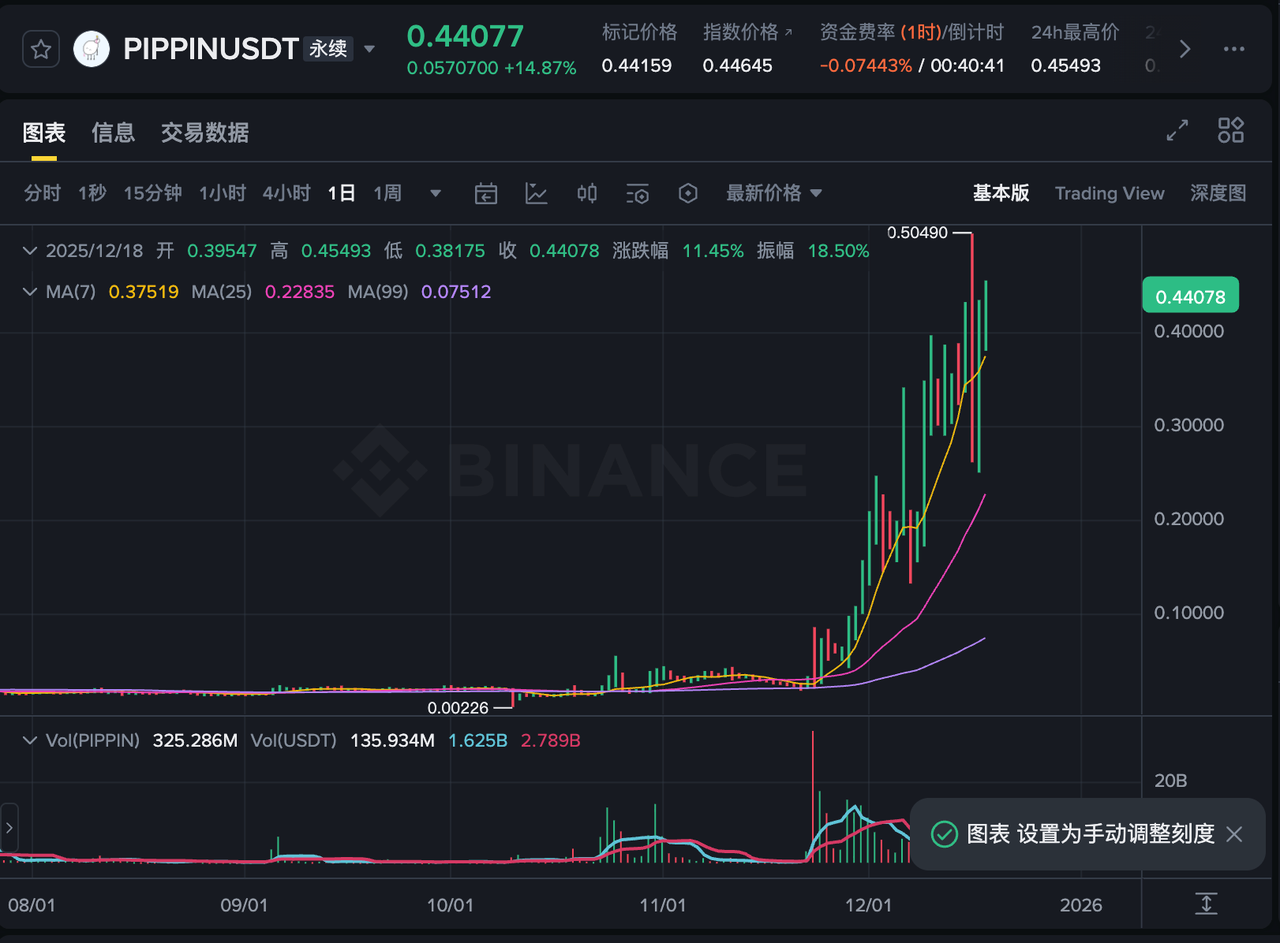
FOLKS: Cross-Chain DeFi Protocol Token, Surged Nearly 24x from Low Point Following S2 Incentive Announcement

As a cross-chain DeFi protocol offering lending, staking, and trading services, primarily operating on the Algorand chain, Folks Finance originally didn't attract much attention. However, with the official announcement of the S2 incentive campaign, market enthusiasm for its token reignited.

It's worth mentioning that Folks Finance distributed 1.5 million FOLKS tokens during the S1 incentive campaign, including Chainlink incentives. On November 6th, FOLKS officially launched on Binance Alpha, with a historical low price around $2.

After the official Folks Finance announcement on December 9th, the FOLKS token price soared from under $10;

On December 14th, after nearly a week of speculation, the FOLKS token price broke through $40 for the first time, eventually rising to nearly $47, representing a gain of nearly 24 times from its low point;

Subsequently, the FOLKS price rapidly retreated, falling by about 80%.

As of writing, the FOLKS price is temporarily reported at $6.4, with a 24-hour decrease of over 24%. The circulating supply is 12.7 million tokens (25.4% of total supply), with a temporary market cap of around $81 million.
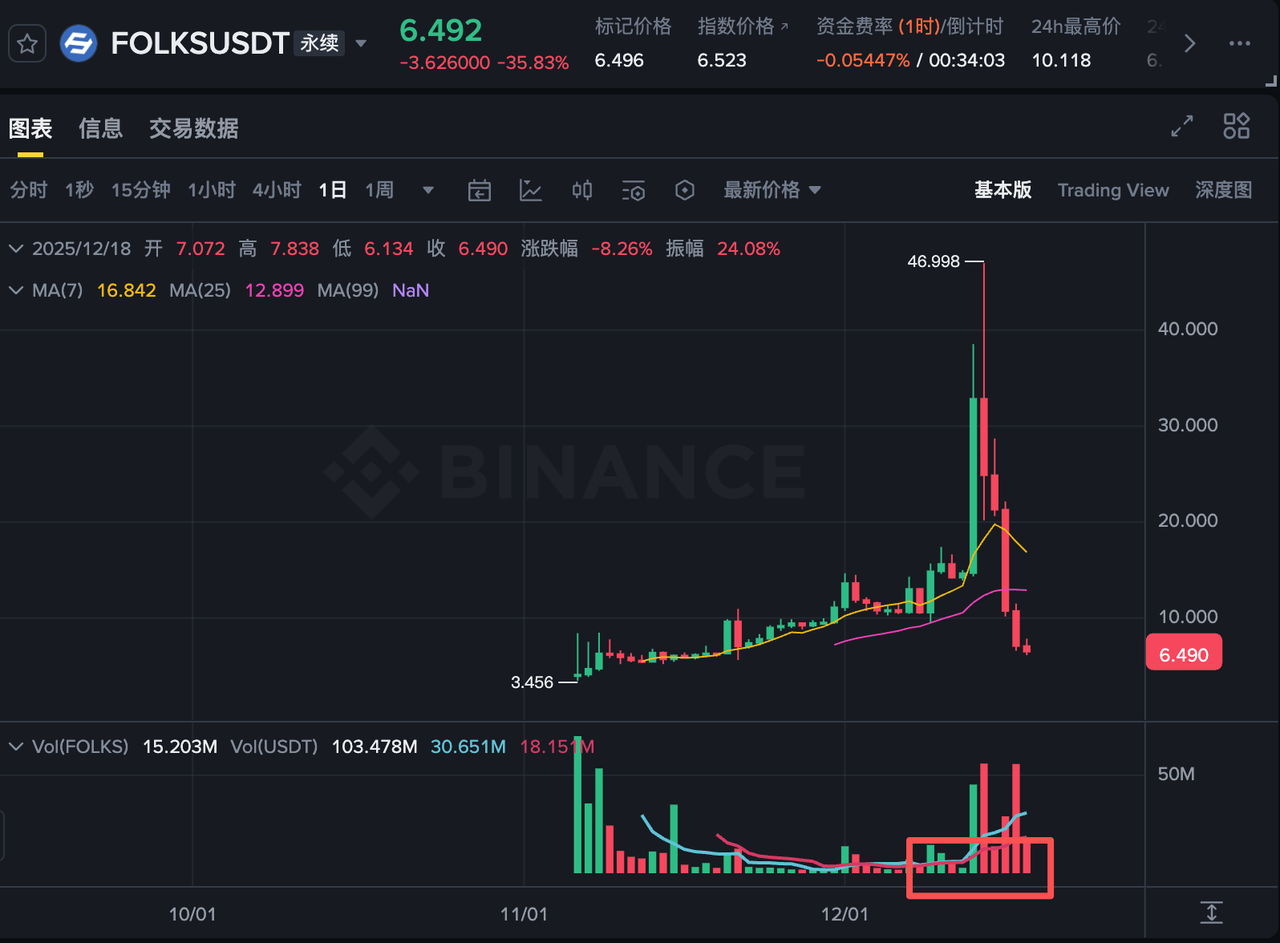
BEAT: A True Meme Coin Needs Few Words

As another altcoin choosing to root itself in the BNB Chain ecosystem, similar to previous meme coins like MYX and COAI, BEAT's rise is another classic case.

It is worth noting that the official account behind the BEAT token project promotes the concept of a "Web3 AI entertainment platform + IP creation platform" – essentially a repackaged version of hot concepts. After listing on Binance Alpha and futures in early November, BEAT's official claims甚至超(surpassed) 1.2 million unique on-chain holding addresses, prompting the remark "audacity leads to high yield".

Similar to the price action of previous meme coins, BEAT started with a low market cap – initially rising after listing on Binance Alpha but still staying around $25 million; subsequently, the price飞速上涨(rapidly increased) amidst repeated pumps and dumps.

As of writing, the BEAT price is temporarily reported around $2.7, with a 24-hour increase of over 14%. The circulating market cap is temporarily reported at $440 million, with about 126,000 on-chain holding addresses.
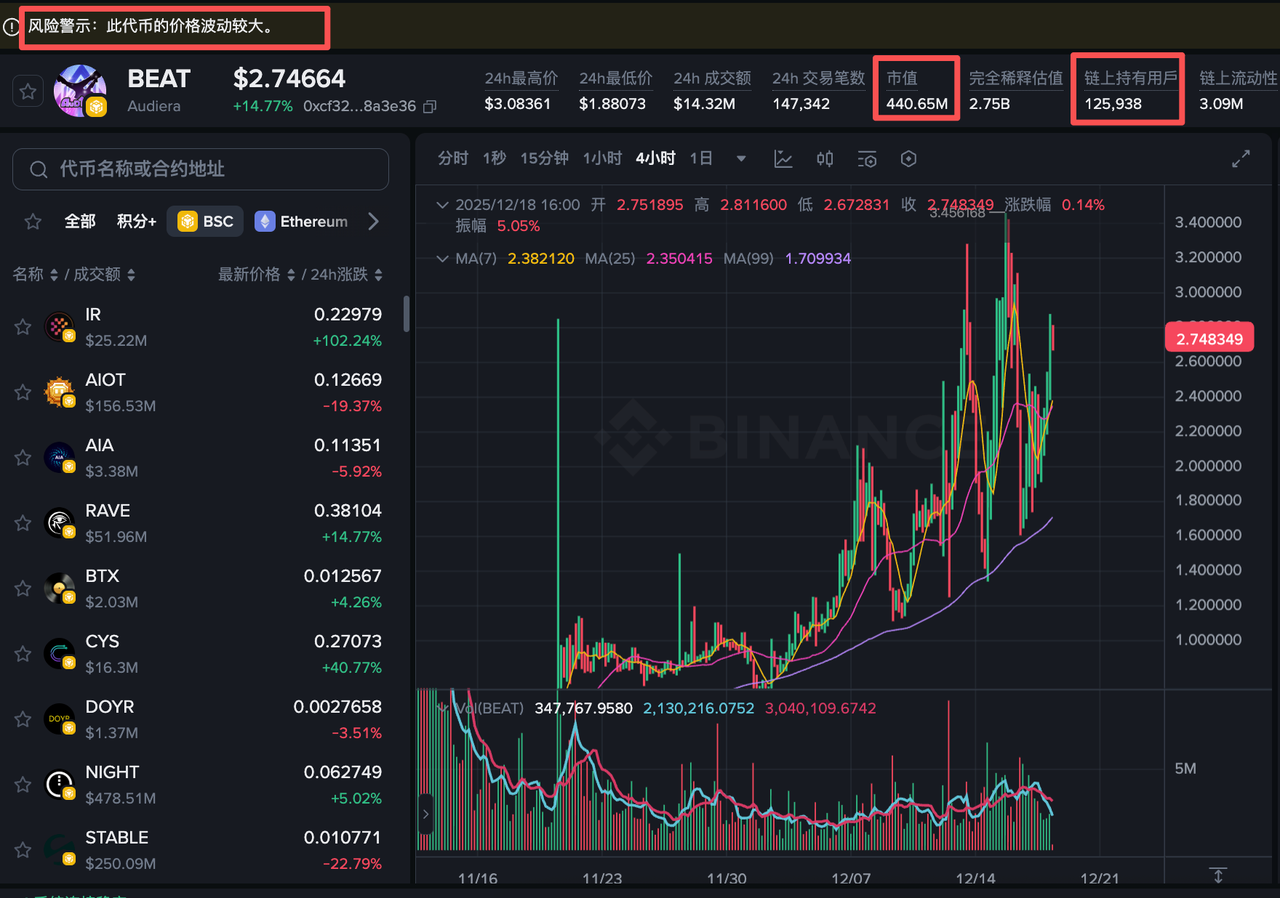
AIA: Decentralized AI Agent Concept Token, Volatility from Contract Migration

As the project token for DeAgent AI, AIA previously attracted significant market liquidity and attention due to a massive surge after listing on Binance futures, its price once skyrocketing over $1. However, constrained by the increasingly cold market environment and the gradual cooling of the AI narrative, the token price gradually fell into silence, experiencing a continuous slow decline.

But the incident of "Binance delisting AIA futures" injected volatile energy into its liquidity once again.

On December 11th, according to an official announcement, Binance Futures announced it would close all AIAUSDT perpetual contract positions at 20:15 on December 11, 2025 (UTC+8) and perform automatic settlement. After settlement, the contract would be delisted. AIA plummeted over 90%.

But subsequently, Binance announced that Alpha 2.0 would support a contract migration for DeAgentAI (AIA). Starting from 20:00 on December 11, 2025 (UTC+8), Binance Alpha 2.0 had closed AIA trading to execute this contract migration. This migration would be executed at a 1:1 ratio. The snapshot time was 20:00 on December 11, 2025 (UTC+8). Binance Alpha 2.0 would resume DeAgentAI (AIA) trading at 16:00 on December 15, 2025 (UTC+8).

On December 15th, official data from Binance Alpha showed that DeAgentAI (AIA) had completed its smart contract migration and officially resumed trading at 16:00 (UTC+8) on December 15th. Market data showed AIA surged significantly after opening, with gains一度超过(exceeding) 160%, topping the Binance Alpha gainers chart.

As of writing, the AIA price is temporarily reported at $0.11, with a 24-hour decrease of 6.3%. The circulating market cap is temporarily reported at $16 million.
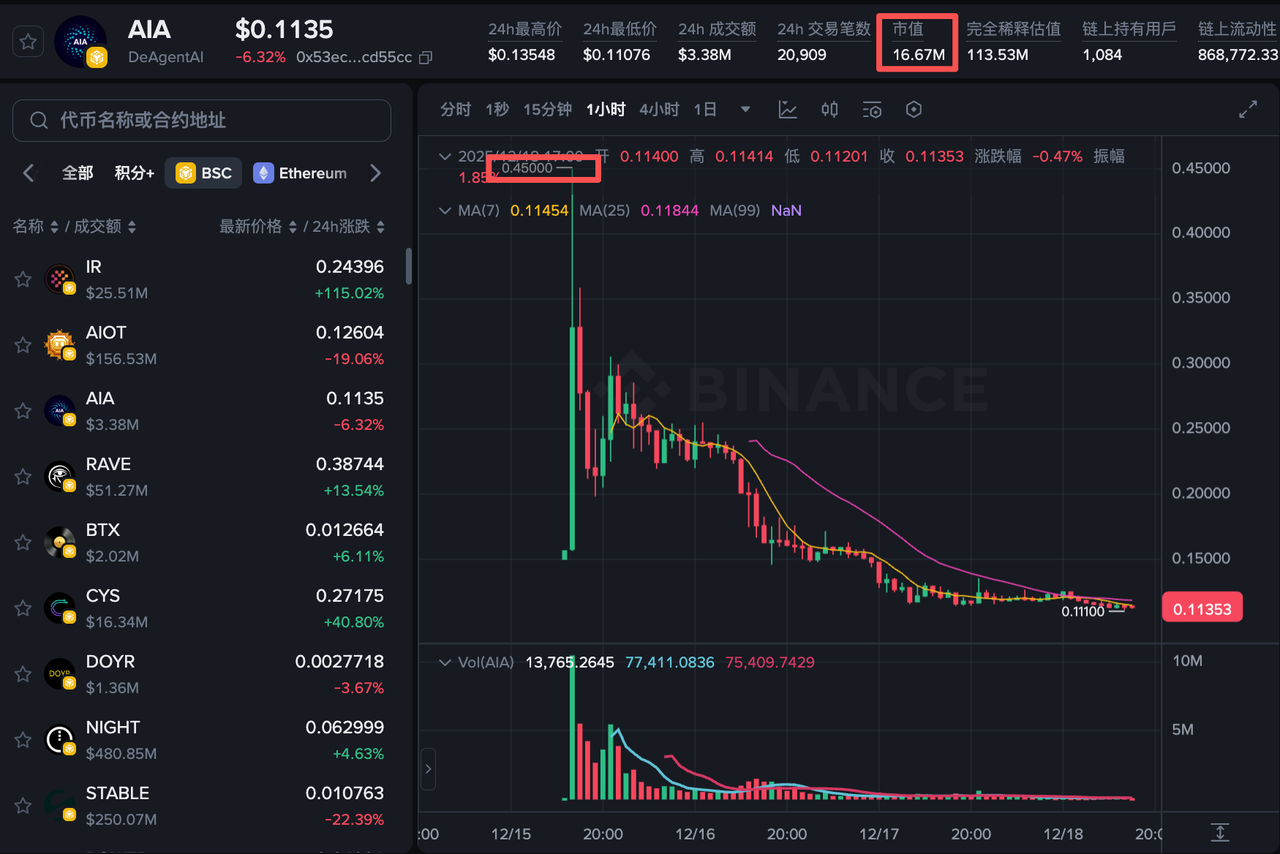
RAVE: Offline Community-Driven Culture Platform, Supported by Retweets from Trump's Eldest Son and CZ

As a DAO organization promoting the concept of a "decentralized music and culture community and platform ecosystem," RaveDAO's development speed has been like a cheat code. After months of community building and project development, RaveDAO has previously completed several member NFT sales.

On November 10th, RaveDAO officially announced its token economic model and airdrop details. The official stated that the token aims to connect artists, organizers, and fans through token economics, promoting a "culture as protocol" decentralized entertainment ecosystem. RAVE has a total supply of 1 billion tokens, allocated as follows: Community 30%, Ecosystem 31%, Team & Co-builders 20%, Early Supporters 5%, Liquidity 5%, Airdrop 3%, Foundation & Public Goods Pool 6%. Approximately 23.03% will be in circulation after the Token Generation Event (TGE), with the remainder subject to a 12-month cliff and a 36-month linear vesting period.

A month later, on December 10th, Binance Alpha announced it would soon list RaveDAO(RAVE).

The next day, news spread that RaveDAO received support from both the WLFI and Aster ecosystems. On December 12th, within an hour of listing on Binance Alpha, RAVE's trading volume exceeded $25 million.

Moreover, RaveDAO's "high-level connections" were remarkably prominent – on the evening of the 12th, Trump's eldest son retweeted and followed the dynamic regarding Aster's cooperation with USD1. RaveDAO, as one of the cooperation participants, gained massive exposure from this. CZ subsequently retweeted this post, and the RAVE price也随之水涨船高(rose accordingly).

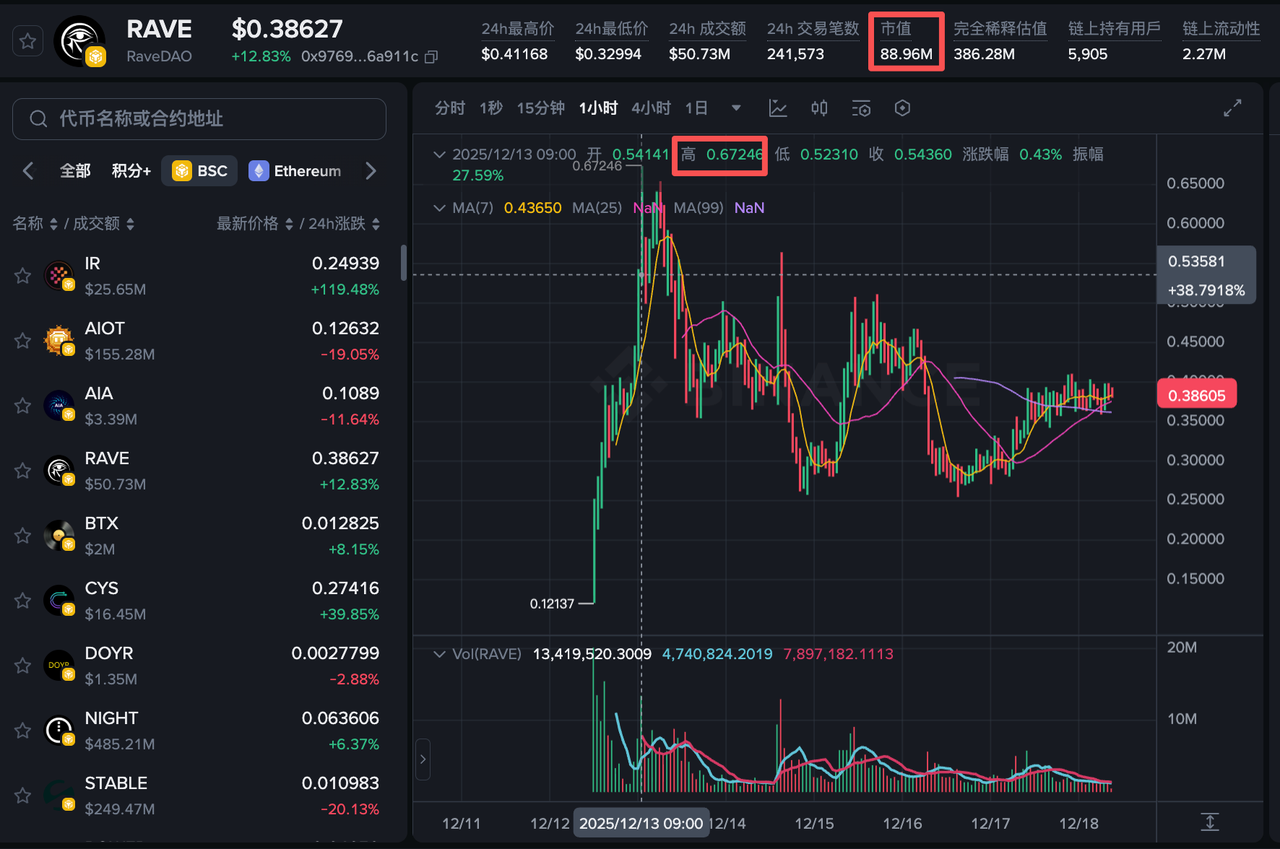
On December 13th, the RAVE price一度触及(reached) $0.67, with a 24-hour increase of over 410%;

On December 14th, Binance Futures launched RAVE U本位(USD-M) futures contracts;

On December 15th, RAVE was successively listed on OKX, Bybit, Bitget, Aster, Gate, Kucoin, MEXC, and other centralized exchanges. The price at that time had回落至(retreated to) around $0.41.

As of writing, the on-chain price of RAVE is temporarily reported at $0.38, with a 24-hour increase of over 12%. The circulating market cap is temporarily reported at $88 million.

Twitter:https://twitter.com/BitpushNewsCN

BitPush TG Discussion Group:https://t.me/BitPushCommunity

BitPush TG Subscription: https://t.me/bitpush

Original article link:https://www.bitpush.news/articles/7596759

Trending Cryptos

Related Questions

QWhat are the common characteristics of the five 'demon coins' mentioned in the article that led to their short-term price surges?

AThe common characteristics include being driven by hype around popular concepts (like AI or DeFi), having low initial market capitalization, being susceptible to market manipulation by 'wild whales' or insiders who accumulate large portions of the supply, and experiencing rapid price pumps followed by sharp corrections due to coordinated trading or exchange-related events.

QHow did the PIPPIN token demonstrate signs of insider manipulation according to the article?

ABubblemaps monitoring revealed that 50 linked addresses purchased $19 million worth of PIPPIN, and 26 addresses withdrew 44% of the token supply from the Gate platform over two months, with most wallets being newly funded. Internal insiders controlled about 80% of the supply, worth $380 million, indicating coordinated accumulation and potential price manipulation.

QWhat event caused the FOLKS token to surge nearly 24 times from its low, and what happened afterward?

AThe FOLKS token surged nearly 24 times from its low after the official announcement of the S2 incentive program by Folks Finance. However, the price quickly corrected by about 80% shortly after reaching its peak, demonstrating the volatile nature of such hype-driven pumps.

QWhy did the AIA token experience a sharp price drop and subsequent recovery in December?

AThe AIA token plummeted over 90% after Binance Futures announced the delisting and automatic settlement of all AIAUSDT perpetual contracts on December 11. However, it recovered significantly when Binance Alpha 2.0 announced support for a contract swap at a 1:1 ratio, leading to a price surge of over 160% upon resuming trading on December 15.

QHow did RAVE gain significant exposure and price momentum in the market?

ARAVE gained significant exposure and price momentum after receiving endorsements from high-profile figures, including a retweet by Donald Trump Jr. and support from CZ (Changpeng Zhao). Additionally, it was listed on multiple major exchanges like Binance Alpha, OKX, Bybit, and others, which boosted trading volume and investor interest, leading to a price increase of over 410% at one point.

Related Reads

From Gold to Bitcoin: Fixed Supply + Institutional Frenzy, Might It Repeat the 'Explosive' Price Trend?

"From Gold to Bitcoin: Fixed Supply and Institutional Frenzy May Lead to 'Explosive' Price Rally Analysts suggest Bitcoin's price action could mirror gold's over the past two decades, following the launch of spot Bitcoin ETFs. Gold ETFs, introduced in 2004, drove gold's price surge to a current market cap near $28 trillion. Both gold and Bitcoin are non-yielding stores of value, with prices driven purely by investor sentiment rather than cash flows or credit. Gold ETFs experienced dramatic cycles: explosive growth, painful drawdowns, and slow recoveries, with each cycle reaching higher peaks. Bitcoin ETFs, approved in early 2024, saw rapid institutional adoption but are now facing similar volatility. Recent warnings highlight the risk of significant ETF outflows disrupting the current rebound. BlackRock's IBIT, a leading Bitcoin ETF, has sold nearly 100,000 BTC to meet redemptions while still holding over 733,000. The core parallel is fixed supply: when demand surges, prices explode, but demand is often volatile and wave-like, not steady. Institutional interest, through ETFs and corporate adoption, remains a key support pillar, helping to cushion sell-offs. If Bitcoin captures even a fraction of gold's role as a store of value, its upside potential is immense, though the path will be marked by high volatility. For investors, focusing on long-term trends and managing risk is crucial as this 'price explosion' narrative unfolds."

Foresight News14m ago

From Gold to Bitcoin: Fixed Supply + Institutional Frenzy, Might It Repeat the 'Explosive' Price Trend?

Foresight News14m ago

Why Is AI Agent Shopping Hard to Popularize?

The article argues that the popular narrative of "AI agent shopping" – equipping AI with a wallet to autonomously handle purchases – is fundamentally flawed and oversimplifies the complexity of shopping. It deconstructs shopping into two core actions: **information retrieval** (standardized, easily automated) and **value judgment** (deeply subjective and human-centric). The narrative mistakenly assumes AI can fully handle both. Value judgment itself has two layers: **evaluation** (assessing options against criteria) and **demand definition** (setting the criteria, weights, and values). The latter is inherently human and dynamic, as preferences are not fixed but constructed during the decision-making process ("constructive preferences"). The real dividing line for automation is not product standardization, but whether the **act of choosing** itself holds experiential value. For mundane purchases (e.g., printer paper), full AI delegation works. For experiential goods (e.g., wine, furniture), the joy of selection is core to consumption, so AI should act as an assistant that narrows options, leaving the final choice to humans. The "AI wallet" concept confuses three separate elements: decision-making, execution, and fund custody. Current payment industry solutions (e.g., from Stripe, Mastercard, Google, Visa) show that limited, scoped payment authorization tokens are sufficient for most consumer scenarios, not full fund custody. The true use case for autonomous AI wallets is in **B2B procurement** and **machine-to-machine (M2M) settlements** for standardized, high-frequency, low-value transactions. The real bottlenecks for AI shopping are not payment technology, but **1) the lack of trusted data sources** (e.g., fake reviews, counterfeit goods) and **2) the impossibility of automating human demand definition**. The conclusion is that the focus should be on safely automating the assessment and filtering process while reserving for humans the rights to define their criteria and enjoy the final act of choice. For experiential goods, the platform's competitive advantage shifts to providing a superior selection experience.

Foresight News1h ago

Why Is AI Agent Shopping Hard to Popularize?

Foresight News1h ago

After Nine Months of Shorting, a Full Turn to Long: Renowned Trader Opens Bitcoin Positions Around 64K, Crypto Market Long-Short Divergence Intensifies

After nine months of being short, prominent crypto trader Doctor Profit has closed all his bearish positions and started buying Bitcoin near $64,000, signaling a complete bullish reversal. He argues that structural market changes—such as impending U.S. regulation (CLARITY Act) and institutional adoption via securities tokenization—are rewriting the traditional four-year cycle script, potentially bringing the market bottom forward from the widely expected September/October timeframe. This view finds some technical support from on-chain analyst gumsays, who notes a bullish divergence on Bitcoin's weekly chart has persisted for 147 days, nearing the 161-day duration seen before the 2022 cycle low. However, cycle researcher Jake Pahor presents a counter-argument based on historical data. Analyzing patterns since 2014, he identifies three common features of past bear market bottoms: a ~12-month duration from peak to trough, a sustained period of extreme fear (with a proprietary risk score below 20), and the price falling below Bitcoin's realized price (~$53,000 currently). The current cycle, only nine months from its October 2025 peak, meets none of these conditions. The debate highlights a market torn between "front-running" a potential early bottom driven by new fundamentals and waiting for confirmation through traditional on-chain and sentiment metrics. While Doctor Profit opts for aggressive buying, Pahor maintains a disciplined, tiered accumulation strategy, continuing weekly buys at current risk levels but reserving larger orders for if more extreme fear emerges.

marsbit1h ago

After Nine Months of Shorting, a Full Turn to Long: Renowned Trader Opens Bitcoin Positions Around 64K, Crypto Market Long-Short Divergence Intensifies

marsbit1h ago

Senior Trader's Confession: How to Trade Market's False Expectations?

Veteran trader's case study: trading the market's "wrong expectations". This trade centered on a textbook "expectation error" after a weak CPI report. While the market initially priced in broad monetary easing (sending Nasdaq to 30,060), the crucial 30-year real yield hit a 20-year high. This signaled a fractured transmission mechanism: short-term rates eased, but long-term funding costs (vital for tech valuations) refused to fall. The trader executed five short positions on the Nasdaq (NQ) as it fell from 30,060 to 28,768. The core methodology: don't just trade the data, but analyze the market's implied causal chain and identify where it breaks. In this case, the chain was: Weak CPI → Policy Easing → Lower Long-Term Funding Costs → NQ Valuation Expansion. The break occurred between policy easing and long-term rates. The "veto variable" – long-term real yields – refused to confirm the bullish narrative. Trades were structured around "fast variables" (price) temporarily repairing while "slow variables" (funding conditions) remained broken. The article outlines a repeatable framework: 1) Map the market's implied causal chain. 2) Identify the veto variable. 3) Observe if it rejects the narrative. 4) Enter when price still follows the old script. 5) Choose the cleanest asset expression (e.g., short NQ, not broad S&P). 6) Define both invalidation and fulfillment exit conditions. The key insight: Alpha often comes not from an information edge, but from a "reaction function edge" – recognizing when the market is applying an outdated causal logic to new data. The critical question: What causal chain is the market's first reaction relying on, and is that chain still valid today?

marsbit2h ago

Senior Trader's Confession: How to Trade Market's False Expectations?

marsbit2h ago

Trading

Spot

Hot Articles

Discussions

Welcome to the HTX Community. Here, you can stay informed about the latest platform developments and gain access to professional market insights. Users' opinions on the price of MEME (MEME) are presented below.

活动图片