Financing Weekly Report | 10 Public Financing Events, Architect Financial Technologies Founded by Former FTX US President Raises $35 Million, to Launch New Exchange AX

marsbitPublished on 2025-12-29Last updated on 2025-12-29

Abstract

Last week (Dec 22-28) saw 10 blockchain funding rounds totaling over $419 million. Key deals include Architect Financial Technologies, founded by former FTX US president Brett Harrison, raising $35 million to launch a non-US institutional exchange for traditional asset perpetuals. Digital bank Erebor, backed by Peter Thiel, secured $350 million, doubling its valuation to $4.35 billion. In DeFi, Hyperliquid-based platforms easy.fun and Otomato each raised $2 million. Web3+AI funding included $3 million for video generator HPVideo and $1.5 million for AI-driven OS HodlHer. Infrastructure firm Coinbax raised $4.2 million for stablecoin payments. Other notable deals: Web3 social platform Crypto Life ($20 million), prediction market aggregator Rocket ($1.5 million), and iPower’s $30 million convertible note for a digital asset treasury strategy. HashKey Capital also closed $250 million for its fourth fund targeting global blockchain investments.

Highlights of This Issue

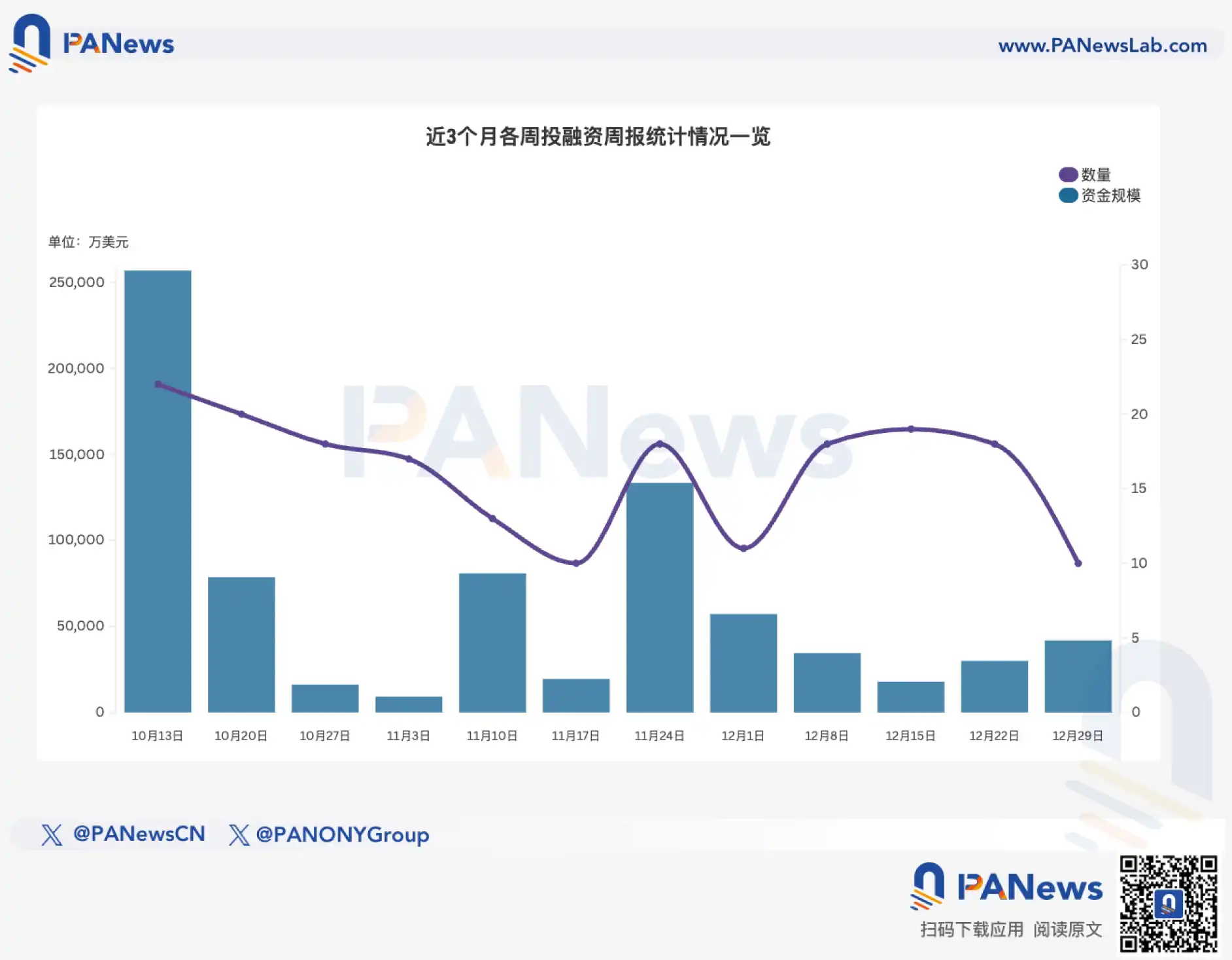
According to incomplete statistics from PANews, there were 10 investment and financing events in the global blockchain sector last week (12.22-12.28), with a total funding scale exceeding $419 million. The overview is as follows:

  • DeFi announced 2 investment and financing events, among which the Hyperliquid-based on-chain trading platform easy.fun completed a $2 million seed round;
  • The Web3+AI track announced 2 investment and financing events, among which the decentralized AI video generation platform HPVideo completed a $3 million financing, led by Helios Prime Capital;
  • Infrastructure & Tools announced 1 investment and financing event, the programmable trust layer for stablecoin payments, Coinbax, completed a $4.2 million seed round;
  • The Centralized Finance field announced 2 investment and financing events, among which the digital bank Erebor completed a $350 million financing, led by Lux Capital;
  • Other Web3 applications announced 3 investment and financing events, among which the Web3.0 social platform Crypto Life completed a $20 million financing
DeFi

Hyperliquid-based on-chain trading platform easy.fun completes $2 million seed round

The on-chain trading competition platform easy.fun announced the completion of a $2 million seed round led by Mirana Ventures. The funds will be used for product development, team expansion, and the upcoming global official trading championship. easy.fun is built on Hyperliquid, focusing on creating an open, fair, and transparent on-chain competitive environment with gamified mechanisms, aiming to transform trading into a playable, learnable, and winnable skill-based competition experience.

Hyperliquid ecosystem automated trading protocol Otomato completes $2 million strategic round

The Hyperliquid ecosystem automated trading protocol Otomato Protocol announced the completion of a $2 million strategic round of financing. The investor is a UK-based deep tech company, but the name has not been disclosed yet. The new funds will support Otomato in launching autonomous agent services, allowing users without coding expertise to create agents for executing and managing on-chain and off-chain trading tasks.

AI

Decentralized AI video generation platform HPVideo completes $3 million financing, led by Helios Prime Capital

The wallet-style AI video generation platform HPVideo announced it has completed a $3 million strategic financing round led by Helios Prime Capital. HPVideo is based on BNB Chain, supports wallet login and multi-model AI video generation, and emphasizes no email registration or personal information required, providing a low-cost video creation solution. Funds will be used for product R&D, infrastructure expansion, and ecosystem building.

Injective ecosystem HodlHer completes $1.5 million financing to build an AI-driven Web3 operating system

HodlHer announced the completion of a $1.5 million strategic financing round, with investors including Chain Capital, Bitrise Capital, and CGV, among others. HodlHer is the first AI smart agent-driven Web3 operating system developed based on the L1 project Injective. Its core technology, "HodlOS," will integrate emotional perception, long-term memory, and decentralized execution functions, aiming to provide users with a unified experience from information interaction to on-chain operations.

Currently, HodlHer has launched the emotional trading assistant "Sola" and plans to accelerate the development of the multi-agent assistant system "Super InternX" and the decentralized smart agent market "Agent Market," supporting users to create and trade personalized AI agents. HodlHer's long-term vision is to become the core operating system for the "personality economy" in the Web3 era, promoting collaborative symbiosis between humans and AI agents.

Infrastructure & Tools

Stablecoin payment programmable trust layer Coinbax completes $4.2 million seed round

The stablecoin payment programmable trust layer Coinbax has completed a $4.2 million seed round of financing, aiming to bring custody, strategy execution, and programmable settlement functions to digital assets. This round was led by BankTech Ventures, with participation from Connecticut Innovations, Paxos, SpringTime Ventures, and enterprises from the banking, payments, and digital asset infrastructure sectors.

Centralized Finance

Thiel-backed digital bank Erebor completes $350 million financing, valuation doubles to $4.35 billion

The digital bank Erebor, supported by Palantir co-founder Peter Thiel and Anduril CEO Palmer Luckey, has completed a $350 million financing round led by Lux Capital. Existing investors Founders Fund, 8VC, and Haun Ventures also participated in this round. The latest valuation reached $4.35 billion. Erebor positions itself as a new bank serving crypto and tech clients. It recently received FDIC deposit insurance approval and obtained a preliminary banking license, with expectations to officially launch in 2026.

Architect Financial Technologies, founded by former FTX US president, raises $35 million, to launch new exchange AX

Former FTX US president Brett Harrison has raised $35 million for his newly founded fintech company, Architect Financial Technologies, valuing the company at approximately $187 million. The exchange launched by the company, AX, focuses on perpetual contract trading of traditional assets, including stocks and foreign exchange, rather than cryptocurrency perpetual contracts. The AX platform is regulated in Bermuda and is only open to non-US institutional investors, as the US has not yet approved perpetual futures products.

DAT

Nasdaq-listed company iPower reaches $30 million convertible note financing agreement to launch DAT strategy

Nasdaq-listed e-commerce and supply chain platform iPower announced it has reached a $30 million convertible note financing agreement to launch its Digital Asset Treasury (DAT) strategy. The company disclosed that the first tranche of this financing will invest $9 million, with $4.4 million intended for purchasing Bitcoin and Ethereum. Other funds will increase working capital to strengthen the balance sheet. 80% of subsequent funds will be used for continuous acquisition of digital assets. Previous news indicated that iPower had announced a strategic shift towards crypto finance and blockchain infrastructure services in June this year.

Others

Web3 Social:

Web3.0 social platform Crypto Life completes $20 million financing, aiming to reshape data sovereignty and social value distribution

The next-generation decentralized social ecosystem Crypto Life announced the completion of a $20 million institutional round of financing. This round saw participation from multiple investment institutions including Bluemount Foundation, VEGA-Ventures, Infinite Alliance, ChainPulse Capital, UZ Capital, and others. Crypto Life aims to build a global, decentralized, user privacy-centric social network through blockchain technology, breaking the monopoly and control of traditional social giants over user data, and reshaping the social trust system and value distribution model.

Prediction Markets:

Prediction market aggregator Rocket completes $1.5 million Pre-seed round, led by Electric Capital

The prediction market aggregator Rocket announced the completion of a $1.5 million Pre-seed round of financing, led by Electric Capital, with follow-on investments from Jsquare, bodhi ventures, Tangent, Amber group, and other VCs.

Rocket is the first prediction market that distributes continuous returns based on judgment correctness. It features a non-binary betting structure, no liquidation mechanism, and the profit ceiling is completely opened at the protocol level. Users can reuse the same capital and deploy it in parallel across multiple predictions.

Coinbase to acquire prediction market startup The Clearing Company, transaction expected to complete in January

Coinbase has reached an agreement to acquire the prediction market startup The Clearing Company. Coinbase stated that the transaction is still subject to customary closing conditions and is expected to be completed in January. The Clearing Company was founded earlier this year by Toni Gemayel, who previously served as Head of Growth at Polymarket and Kalshi. The startup completed a $15 million seed round in August, with investors including Coinbase Ventures, aiming to build an on-chain, regulated prediction market platform.

Investment Institutions

HashKey Capital's fourth fund completes first close of $250 million

HashKey Capital announced that its fourth multi-strategy fund, Fund IV, has completed its first close, raising a total of $250 million, exceeding expectations. The fund's final target asset management scale is $500 million. The fund will invest in global blockchain infrastructure and large-scale application projects, with strategies covering primary and secondary markets. The general partner of the fourth fund is HashKey Capital Investment (affiliated with HashKey Capital). HashKey Capital currently manages over $1 billion in client assets, and its first fund achieved a DPI return of over 10x.


Related Questions

QWhat is the total funding amount raised in the blockchain space for the week of December 22-28, as reported by PANews?

AThe total funding amount raised was over $419 million.

QWhich company, founded by the former president of FTX US, raised $35 million and is launching a new exchange called AX?

AArchitect Financial Technologies, founded by former FTX US president Brett Harrison, raised $35 million and is launching the new exchange AX.

QWhat is the name of the decentralized AI video generation platform that raised $3 million and is built on BNB Chain?

AThe decentralized AI video generation platform is called HPVideo.

QWhich digital bank, backed by Peter Thiel, secured $350 million in funding and saw its valuation double?

AThe digital bank is Erebor, which is backed by Peter Thiel and secured $350 million in funding, doubling its valuation to $4.35 billion.

QWhat type of market does the aggregator Rocket focus on, and how much did it raise in its Pre-seed round?

ARocket is a prediction market aggregator, and it raised $1.5 million in its Pre-seed funding round.

Related Reads

TechFlow Intelligence Bureau: Chip Stocks Lose Trillions in a Single Day, Bitcoin Falls Below $60,000, US-Iran Conflict Escalates

**Daily Tech & Markets Roundup: AI Advances, Market Turmoil, and Geopolitical Tensions** **AI / LLMs**: Anthropic's internal report on AI self-improvement sparked serious discussions about Recursive Self-Improvement (RSI). Meanwhile, debate continues on AI coding tools after Claude was accused of introducing bugs into the rsync codebase. In positive news, DeepSeek V4 Flash impressed in local deployment tests, and GitHub Copilot now supports custom endpoints for local models. A surprising research turn suggests removing chain-of-thought prompting can sometimes improve LLM performance. **Crypto / Web3**: Bitcoin plunged below $60,000, with its RSI hitting levels last seen during the COVID-19 crash, driven by strong U.S. jobs data reviving interest rate hike fears. Discussions highlight Ethereum DeFi's continued lack of a smooth consumer payment layer. **Chips / Hardware**: Chip stocks suffered a massive sell-off, with the Philadelphia Semiconductor Index posting its worst single-day drop in six years, erasing over a trillion dollars in value. Marvell, Micron, AMD, and Intel were among the biggest losers. **Tech Companies**: A leaked Microsoft document revealing goals to make Copilot "addictive" drew criticism. LinkedIn founder Reid Hoffman left Microsoft's board to focus full-time on his AI agent startup, Manus. Google was revealed to be paying SpaceX $920 million monthly for AI training compute. **Markets & Macro**: A blowout U.S. jobs report (172k vs. 80k expected) crushed hopes for near-term rate cuts, sending Treasury yields soaring and triggering a broad market sell-off. CEOs from Kraft, McDonald's, and Whirlpool simultaneously warned U.S. consumers are exhausting their savings. **Geopolitics**: U.S.-Iran tensions escalated with missile/drone interceptions and U.S. strikes on Iranian radar sites, keeping the critical Strait of Hormuz largely closed since late February and posing ongoing oil supply risks. **The Bottom Line**: The strong jobs data acted as a single trigger for correlated sell-offs across equities, crypto, and chips. Underlying the volatility is a stark contradiction between robust employment data and warnings of consumer weakness, alongside geopolitical risks that could reignite inflation, leaving markets to price in a fraught macro outlook with no clear "soft landing" path.

marsbit1h ago

TechFlow Intelligence Bureau: Chip Stocks Lose Trillions in a Single Day, Bitcoin Falls Below $60,000, US-Iran Conflict Escalates

marsbit1h ago

It Took Me a Year to See the Bitter Truth About Agent Payments

After a year building infrastructure for the Agent economy, engaging with major players like Stripe, Visa, and Coinbase, the author shares a sobering analysis of the current state of Agent payments. The core finding is a stark lack of genuine, immediate demand across most envisioned use cases. The article breaks down four key market segments: 1. **Agent-to-Merchant (Consumer Shopping):** For most product categories (e.g., clothing, electronics), conversational AI shopping is a step backwards from visual e-commerce interfaces. While agents excel at understanding needs, they can't replace side-by-side product comparison. Real merchant interest is defensive "Agent Engine Optimization," not driven by current customer demand. Potential exists for high-frequency, low-decision purchases (like food delivery) or navigating complex store UIs, but these require massive B2C distribution channels dominated by giants like Amazon. 2. **Agent-to-API (Developer Services):** Developers already have subscriptions and billing relationships for APIs (compute, data). Prepaid balances solve micro-payment issues for low transaction volumes. A deeper structural problem is that major SaaS vendors' business models rely on enterprise contracts, resisting granular pay-per-call pricing. While protocols like MPP and x402 serve the long tail of niche services, this market is small and developers are historically low-willingness-to-pay. 3. **Agent-to-Agent:** This remains largely theoretical with minimal transaction volume. While it represents a long-term bet on a fundamentally new transaction infrastructure (sub-second, micro-penny to million-dollar, multi-party settlements), it does not constitute a present market. 4. **Agent-to-Finance:** This is the only category with existing, paying demand. Integrating AI into financial workflows (trading, portfolio management) is a natural evolution and enables new capabilities like autonomous rebalancing. However, competition favors established, regulated institutions. The "real problem" is not moving money between agents, but the broader challenge of **coordination**—orchestrating work between agents and humans, verifying outcomes, and settling results. Payment is just one component of settlement, which is itself part of coordination. Companies that solve the coordination layer will subsume payment, not the other way around. While well-funded incumbents build defensively for a long-term future, startups must find where the market is today—which, for the author's team, lies outside these four categories in an area of real, growing, and underserved activity.

marsbit2h ago

It Took Me a Year to See the Bitter Truth About Agent Payments

marsbit2h ago

It Took Me a Year to See the Hard Truth About Agent Payments

**Title: It Took Me a Year to See the Hard Truth About Agent Payments** Over the past year, I've worked on infrastructure for the Agent economy, engaging with major players like Stripe, Visa, Coinbase, and numerous startups. The findings reveal a stark reality: genuine, widespread demand for Agent-based payments does not yet exist. **Key Observations:** * **Agent-to-Merchant (Shopping):** The user experience for AI shopping often falls short, especially for visual product discovery. While AI excels at understanding needs, conversational interfaces can't yet replace browsing and comparing multiple products visually. Current merchant interest is largely defensive ("Agent Engine Optimization") for a future that hasn't arrived. High-frequency, low-friction purchases (like food delivery) are potential fits, but lack open APIs and face high AI inference costs. Simpler, more affordable, or cross-language interactions for complex UIs are a niche opportunity but require massive consumer distribution to scale. * **Agent-to-API (Developer Tools):** Developer payment needs for APIs (computing, data, models) are already met through subscriptions and prepaid credits. The core challenge is not payment friction but supplier economics: most large SaaS providers prefer enterprise contracts over micropayments for API calls. Protocols like MPP and x402 suit the long-tail of smaller services but cater to a developer market historically reluctant to pay for these tools. Major infrastructure needs at the top of the stack are already being addressed. * **Agent-to-Agent (Machine Commerce):** This is a long-term vision with almost no current transaction volume. While a future with high-speed, high-frequency, multi-party machine-to-machine transactions would require novel infrastructure, it remains theoretical. The market is not here yet. * **Agent-to-Finance:** This is the only category with clear, present demand. Financial professionals and DeFi users already pay for tools, and AI augmentation is a natural evolution. Autonomous AI agents can enable entirely new financial strategies. However, competition is fierce from established, regulated incumbents who can more easily layer AI onto their existing products. **The Core Insight:** Companies, especially giants with long time horizons, are building defensively for a potential future of mass machine commerce. For them, early investment is a low-cost hedge. For startups, the current market reality is different. The primary challenge isn't just moving money between agents (payments). The larger, unsolved problem is **orchestration** – coordinating work between agents and humans, verifying outcomes, and then settling. Payment is just a part of settlement, which is just a part of orchestration. Companies that solve the orchestration problem will subsume payments, not the other way around. After a year of building, we see the real, growing, and underserved market opportunity lies in this broader domain of orchestration.

链捕手3h ago

It Took Me a Year to See the Hard Truth About Agent Payments

链捕手3h ago

Trading

Spot
Futures

Hot Articles

How to Buy US

Welcome to HTX.com! We've made purchasing Talus Network (US) simple and convenient. Follow our step-by-step guide to embark on your crypto journey.Step 1: Create Your HTX AccountUse your email or phone number to sign up for a free account on HTX. Experience a hassle-free registration journey and unlock all features.Get My AccountStep 2: Go to Buy Crypto and Choose Your Payment MethodCredit/Debit Card: Use your Visa or Mastercard to buy Talus Network (US) instantly.Balance: Use funds from your HTX account balance to trade seamlessly.Third Parties: We've added popular payment methods such as Google Pay and Apple Pay to enhance convenience.P2P: Trade directly with other users on HTX.Over-the-Counter (OTC): We offer tailor-made services and competitive exchange rates for traders.Step 3: Store Your Talus Network (US)After purchasing your Talus Network (US), store it in your HTX account. Alternatively, you can send it elsewhere via blockchain transfer or use it to trade other cryptocurrencies.Step 4: Trade Talus Network (US)Easily trade Talus Network (US) on HTX's spot market. Simply access your account, select your trading pair, execute your trades, and monitor in real-time. We offer a user-friendly experience for both beginners and seasoned traders.

4.8k Total ViewsPublished 2025.12.11Updated 2026.06.02

How to Buy US

Discussions

Welcome to the HTX Community. Here, you can stay informed about the latest platform developments and gain access to professional market insights. Users' opinions on the price of US (US) are presented below.

活动图片