Fed Expectations and Assault on Highs: A Trader Assesses Bitcoin and Ethereum Movement Scenarios

cryptonews.ruPublished on 2026-07-27Last updated on 2026-07-27

Abstract

**Summary** The article analyzes the near-term technical outlook for Bitcoin (BTC), Ethereum (ETH), and the US Dollar Index (DXY) ahead of key macroeconomic events, primarily the US Federal Reserve (Fed) meeting. * **Bitcoin (BTC):** After bouncing from a key support zone near $64,000, the primary objective is a push toward $67,255. The analysis outlines three scenarios: A) achieving this target, B) a brief pullback to gather liquidity before resuming the uptrend, and C) a less likely sharp correction toward $60,800 if macro surprises trigger risk-off sentiment. * **Ethereum (ETH):** Shows relative strength, trading near $2,000 and targeting the previous month's high (PMH) at $2,020. The dominant scenario is a breakout above this level, targeting $2,100. A pullback toward $1,880-$1,920 for consolidation is also possible. A deep correction to the $1,640-$1,700 zone is considered the least likely outcome. * **US Dollar Index (DXY):** Trading around 101.271, just below a key resistance zone. The Fed decision, Powell's rhetoric, and upcoming US GDP and Core PCE data will determine its direction. Scenarios include: a pullback to support near 100.650 before a renewed rise, an aggressive breakout above 101.544 on hawkish signals, or a rejection leading to a drop toward 100.10-100.25. **Key Triggers:** The Fed's rate decision (expected unchanged) and Powell's press conference (July 29), US Core PCE and Q2 GDP data (July 30), geopolitical developments, and MicroStrategy's upc...

  • Bitcoin bounced from the 4H FVG around $64,000.
  • Ethereum approached $2000 and maintains a stronger structure.
  • DXY is trading near 101,271 ahead of the Fed decision.
  • US PCE, GDP, and Powell's rhetoric will be the main triggers of the week.

Disclaimer: The material is not financial advice or a call to action. The presented analysis is the private opinion of its author. Incrypted is not responsible for readers' investment decisions.

Bitcoin and Ethereum — Fed Expectations, Liquidity Shortage, and Assault on Highs

The past trading week passed without high volatility and pronounced price action. The geopolitical background cooled noticeably by the weekend — despite Trump's loud threats of heavy bombing, the escalation temperature decreased. Consequently, the Bitcoin chart executed a technical bounce from the first zone of interest in the form of a four-hour fair value gap (4H FVG) around $64,000. Entering trades before the weekend against such an unpredictable news background was an unjustified risk, so we decided to preserve capital.

The current structure of a rally without a pullback raises questions, but the market continues to look upward. We analyze the current scenarios for the main assets this week.

Bitcoin — Plan for the Week

Scenario A — Taking Out Key Targets

The current uptrend looks heavy because the market maker barely tests liquidity from below. At the same time, the primary goal of buyers remains the removal of the pool at $67,255 and the complete filling of the upper inefficiency zone.

It is from there that it will be technically justified to look for short positions with the aim of returning to the round $60,000. We are watching the lower timeframes to find a quick speculative long.
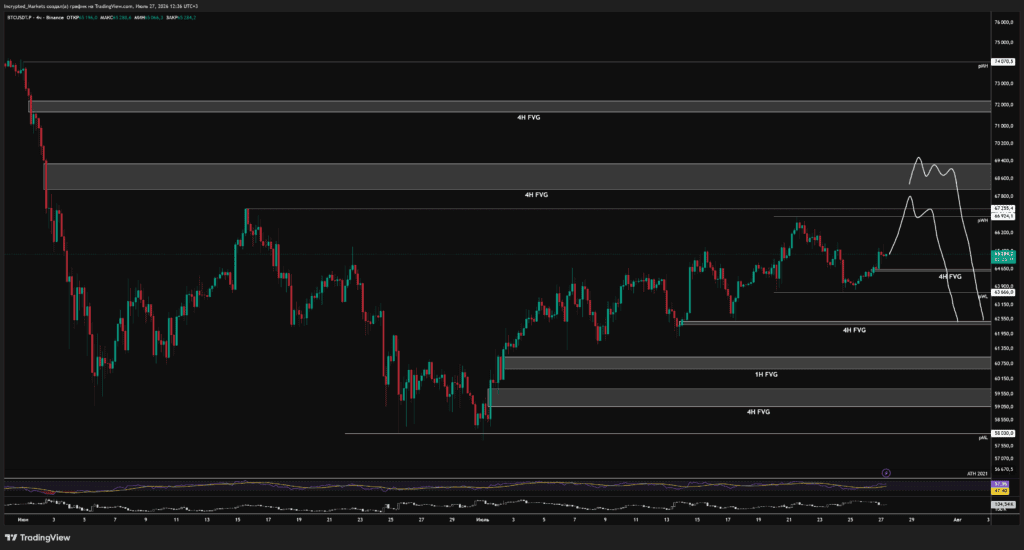
Four-hour chart of $BTC/$USDT.P. Data: TradingView.

Scenario B — A Light Pullback for Local Refueling

Before the week's close, the chart left a small liquidity pool with retail stops. An ideal maneuver is a quick squeeze down to collect them and then continue the rally. Only the mechanics of recent weeks are concerning: corrections usually happen quickly and sharply, while the rally is drawn-out and slow.
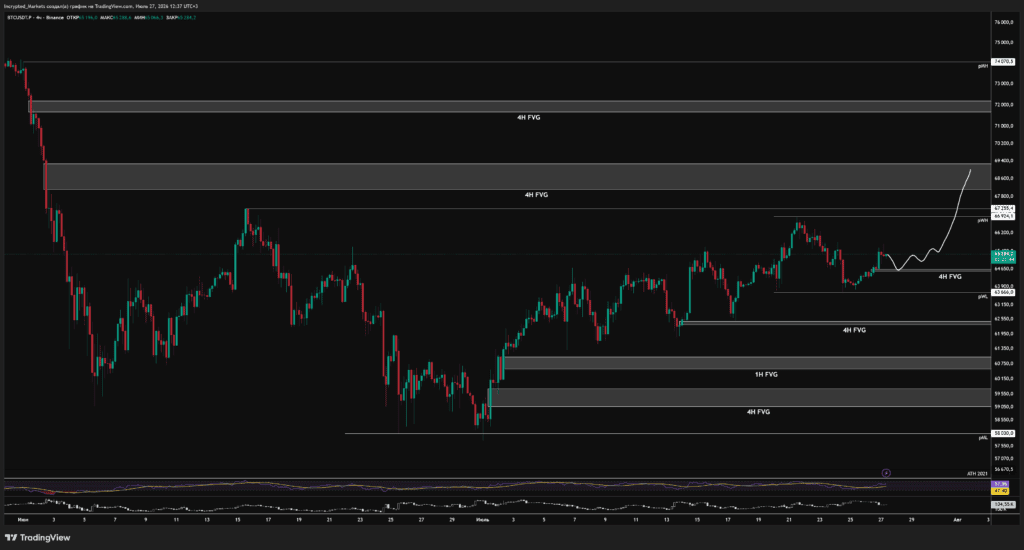
Four-hour chart of $BTC/$USDT.P. Data: TradingView.

Scenario C — A Reversal into Correction from Current Levels

The least likely but possible scenario. The idea involves a deep pullback without first taking out the upper targets, potentially down to interacting with the $60,800 zone. Powerful macroeconomic surprises this week could activate this route, so it cannot be completely ruled out.
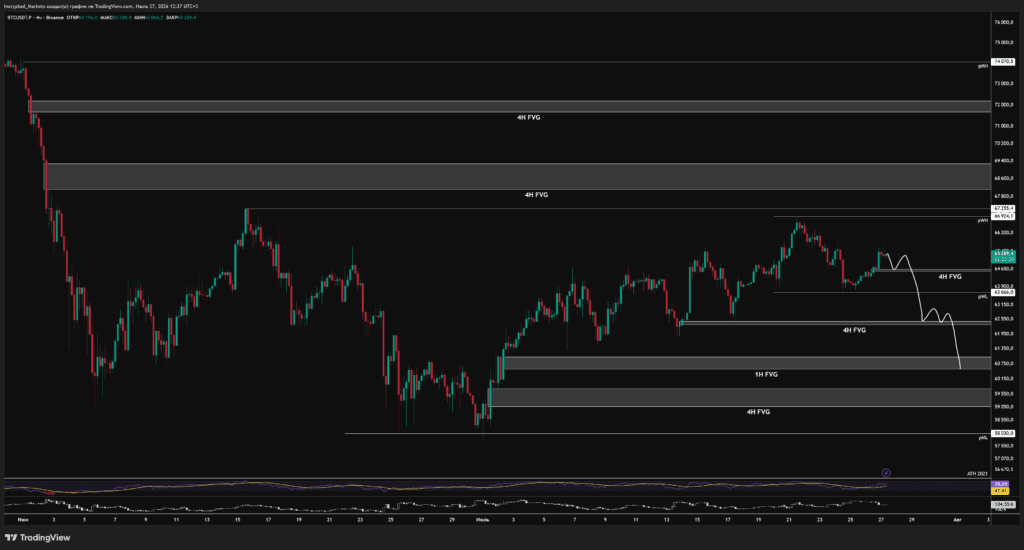
Four-hour chart of $BTC/$USDT.P. Data: TradingView.

What Determines the Balance of Power This Week

  • MicroStrategy report. We await data on Michael Saylor's operations. Yesterday's rumors already heated up the public. The main intrigue — was he buying, selling, or simply redistributing reserves for issuing new shares for future Bitcoin purchases?
  • US Federal Reserve (Fed) meeting. The base rate will almost certainly remain unchanged with 99% probability. The key trigger is Powell's rhetoric: any hints of a possible rate hike in September will become a harsh signal for risk-off.
  • The Middle East and the Trump factor. Delaying tactics historically precede drastic steps. Congress's decision to block unilateral US military action in Iran adds absurdity and unpredictability. Order books may react nervously.
  • Corporate earnings season. Major US companies publish financial results. Decorrelation with stock indices and local impulsive liquidations are possible.

Ethereum — Leading Momentum and Test of $2000

The main altcoin executed the initial scenario from last week strictly by the book. The $1800 level not only held — the price didn't even test it, instantly producing a strong upward reaction.

At one point, we took liquidity from last week's high (PWH) at $1946 and are currently trading around $1964, closely approaching last month's high (PMH) at $2020.

The Ethereum Dominance Index remains on the buyers' side. It is precisely the strength of dominance that allowed Ethereum to capture moves more aggressively than the major. As long as this indicator does not start breaking structure downward, the priority remains on searching for longs. Technically, the chart has entered the final stretch before the PMH. If the $2020 mark is passed on real volume and not just an emotional spike, the direct path to $2100 will open.

At the same time, it's important to remember the unfilled 4H FVG at $1640-$1700 and the level of last week's low (PWL) $1841 below. They remain our hedges in case of a trend change.

Scenario A — Breakout of PMH and Impulse to $2100

The price successfully accumulates volume near the round $2000, breaks the PMH $2020, and continues the rally without a pullback into the $2100 area. This option is valid as long as Ethereum dominance maintains an upward structure and the buyer retains initiative.
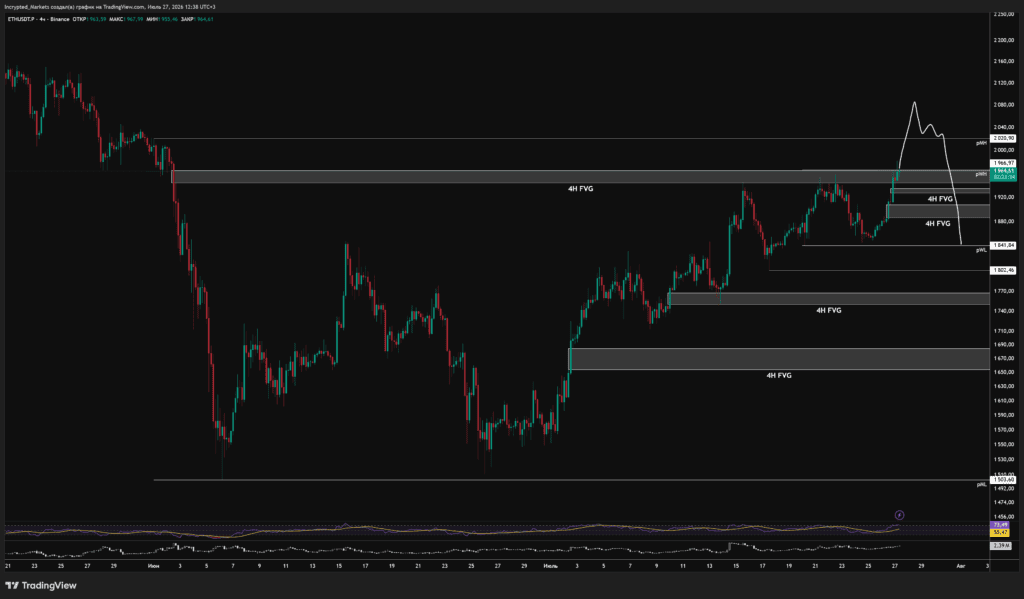
Four-hour chart of $ETH/$USDT.P. Data: TradingView.

Scenario B — Correction Before the Final Push

A small pullback into the zone of nested 4H FVG $1880-$1920 to collect local liquidity. After unloading indicators — a reversal and a renewed attempt to storm the PMH $2020. This is a good working option for refueling.
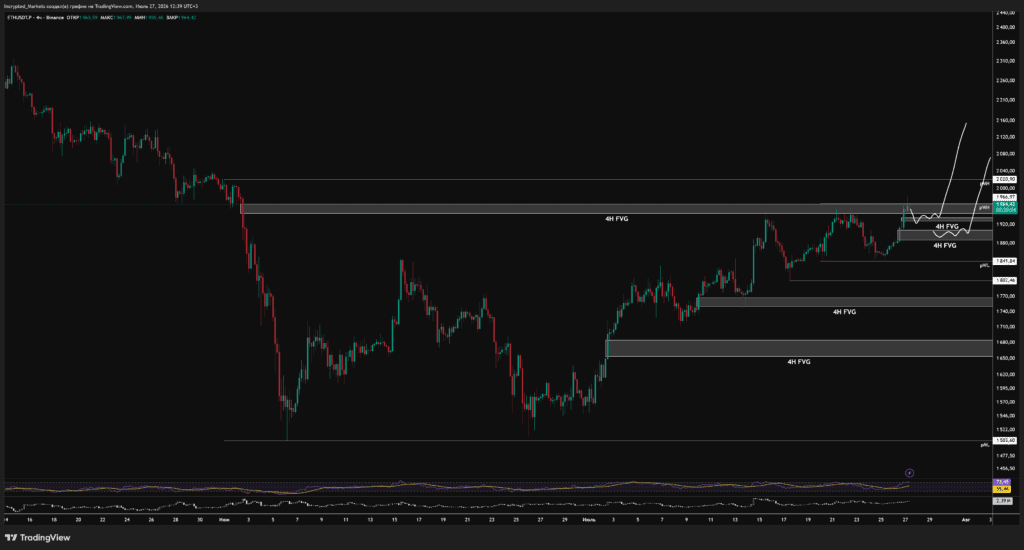
Four-hour chart of $ETH/$USDT.P. Data: TradingView.

Scenario C — Rejection of Growth and Deep Sync with Bitcoin

If the overall macro backdrop worsens, we get an aggressive structure break. The asset goes into a deep correction, dipping into the $1640-$1700 range and potentially testing the PWL $1841. Currently, this is the least likely scenario, but it requires strict stop orders when trading from the long side.
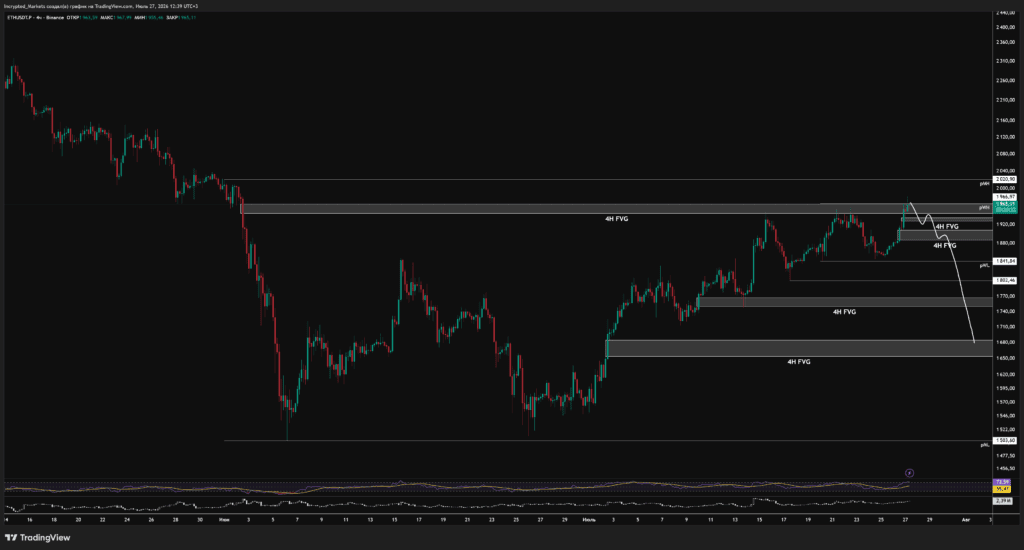
Four-hour chart of $ETH/$USDT.P. Data: TradingView.

Trading Tactics

Rushing now makes no sense. You can always give your stops to the market later, but waiting for a quality setup and taking a clear, grounded take is the number one task. We plan to work precisely, exclusively intraday on lower timeframes, constantly checking against Ethereum dominance and the charts' reaction to the Fed meeting.

Dollar Index — Bounce from Local Lows, Assault on the Upper Imbalance, and Moment of Truth at the Fed Meeting

Retrospective and Current Position

The past trading week made its adjustments to the dollar's dynamics. Despite deflationary signals from the Consumer Price Index (CPI) and Producer Price Index (PPI), the Dollar Index (DXY) found strong limit support near the 100.353 mark and transitioned to a confident recovery.

DXY absorbed local selling volume, rose above key medium-term marks, and formed a new weekly high (PWH) at 101.544.

At the moment, DXY is trading around 101.271, squeezed right under the upper four-hour imbalance zone. The market is in a state of extreme tension: this five-day period will be the culmination of the entire month.

The Fed meeting, Powell's press conference, as well as US Gross Domestic Product (GDP) and Core Personal Consumption Expenditures (Core PCE) data will determine whether the dollar can develop a full-fledged medium-term rally or return to a downtrend.

Technical Picture

On the four-hour timeframe, price boundaries have shifted significantly higher. The index shows signs of a bullish impulse but has hit a key resistance block.

Key structural levels:

  • PWH 101.544 and PMH 101.800 — the fresh weekly high and global monthly resistance, which act as the main barrier for continued growth;
  • PWL 100.650 — the new weekly low, nearest engineering support, and a fixed liquidity pool below;
  • PML 98.919 — the strategic monthly low, which remains the strategic target for bears in case of a global structure break;
  • 4H FVG zones: directly above the current price, around 101.35-101.45, the upper inefficiency zone is being traded. Below, right above the PWL, a fresh bullish 4H FVG 100.55-100.70 has formed, and even deeper lies an unfilled block 100.10-100.25.

Current Trading Scenarios

Scenario A — Local Pullback to the 4H FVG/PWL Zone with Subsequent Bounce

The index cannot find strength for an immediate breakout of the upper boundary and gives a moderate correction to the support area around PWL 100.650 and the lower 4H FVG. New long volume accumulates there, after which DXY reverses and resumes upward movement towards the upper targets.
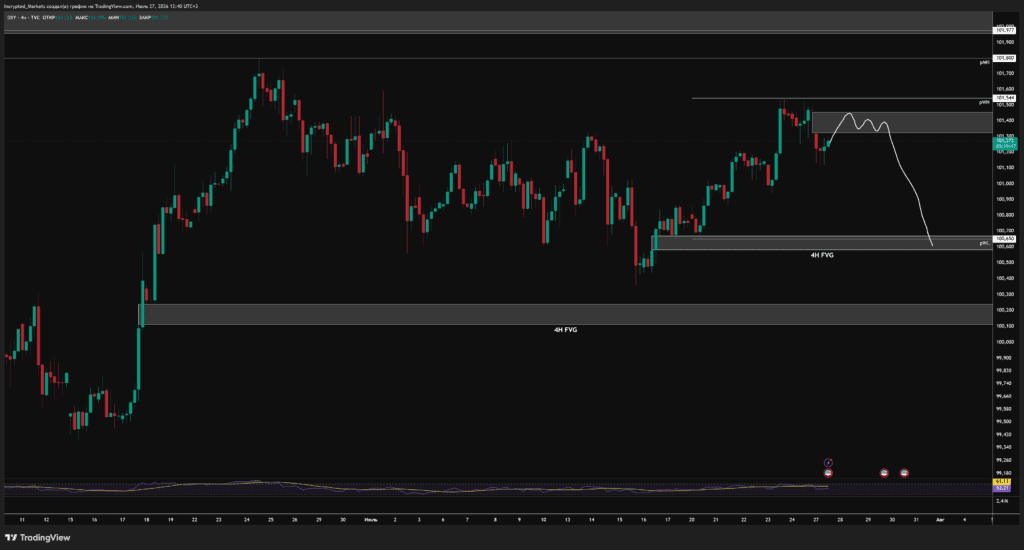
DXY index chart. Data: TradingView.

Scenario B — Aggressive Breakout of PWH and Move Towards Monthly Highs

Against a backdrop of hawkish Powell rhetoric or strong GDP and PCE data, the dollar impulsively breaks through PWH 101.544, consolidates above, and heads for a full test of PMH 101.800, moving into the 102.00+ area.

For the crypto market, such a turn would signal a deep correction and the unwinding of risk positions.
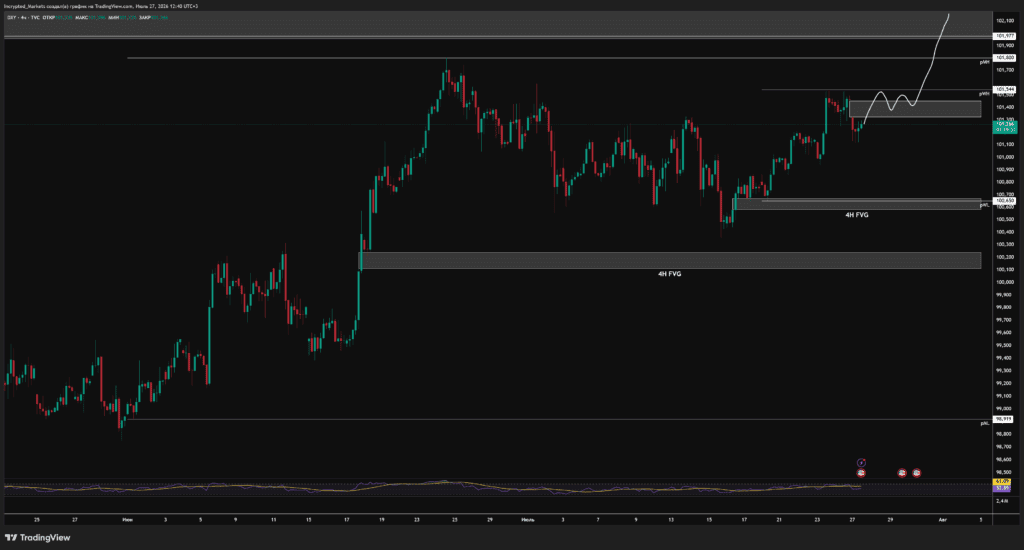
DXY index chart. Data: TradingView.

Scenario C — Sharp Rejection from the Upper Imbalance and Dump Through PWL

The index gets rejected in the current upper 4H FVG zone, breaks the local bullish structure, and goes into an impulsive drop, taking out PWL 100.650 and deeply plunging into the lower inefficiency blocks 100.10-100.25.

Such a dollar sell-off would free the hands of Bitcoin and Ethereum buyers to assault their key resistance levels.
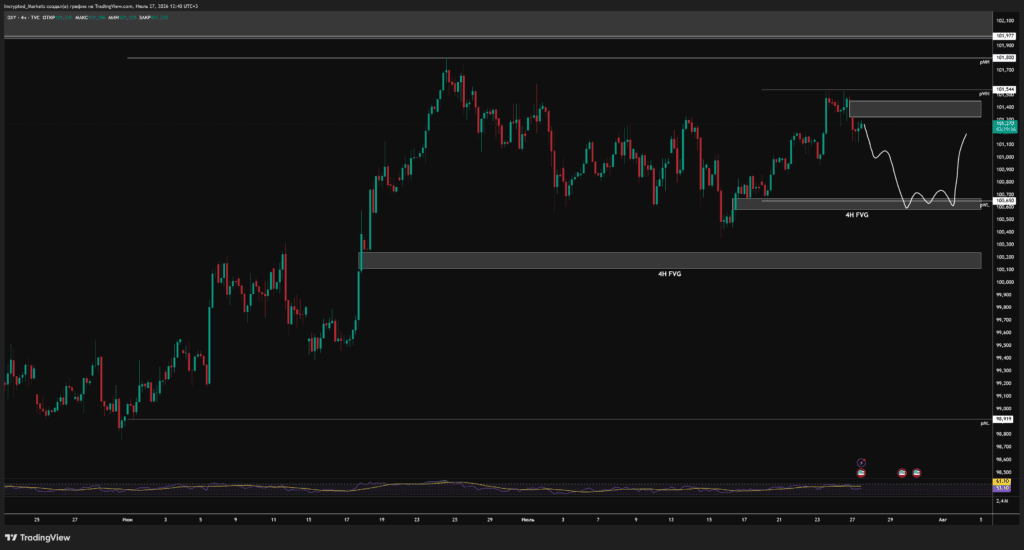
DXY index chart. Data: TradingView.

Weekly News Triggers

  • Tuesday, July 28, 17:00 — CB Consumer Confidence Index for July;
  • Wednesday, July 29, 17:30 — US Crude Oil Inventories;
  • Wednesday, July 29, 21:00 — Fed Interest Rate Decision and FOMC Statement;
  • Wednesday, July 29, 21:30 — FOMC Press Conference and Powell's Speech;
  • Thursday, July 30, 15:30 — Core Personal Consumption Expenditures Price Index for June, US Q2 GDP, and Weekly Jobless Claims.

Sentiment and Tactics

Until Wednesday evening, DXY will likely be squeezed in a consolidation corridor. The real impulse and determination of the medium-term trend will occur during the Fed announcement and the reaction to PCE data on Thursday.

Action plan: Avoid medium-term entries on thin order books until the main fundamental events are resolved.

Trade exclusively on lower timeframes intraday, strictly control stop orders, and make strategic decisions on risk assets only after the DXY daily candles close.


Trending Cryptos

Related Questions

QWhat are the key potential triggers for Bitcoin and Ethereum price movements this week according to the trader's analysis?

AThe key potential triggers are: 1) The Federal Reserve's meeting outcome and Jerome Powell's rhetoric regarding potential rate hikes. 2) US economic data releases, specifically the Core PCE and GDP figures for Q2. 3) The tone of the quarterly report from MicroStrategy regarding Michael Saylor's Bitcoin transactions. 4) Geopolitical tensions, including developments involving Trump and Iran. 5) The general risk-on/risk-off sentiment which correlates with the DXY (US Dollar Index) movement.

QWhat are the three primary scenarios outlined for Bitcoin's price action in the coming week?

A1) Scenario A: The price rises to take out key liquidity at $67,255, which could then lead to a technical short setup targeting a pullback to around $60,000. 2) Scenario B: A quick, shallow pullback to collect liquidity before resuming the upward trend. 3) Scenario C: A deep correction starting from current levels, potentially testing the $60,800 zone, triggered by negative macroeconomic surprises.

QHow does Ethereum's current price structure and dominance index affect its trading outlook compared to Bitcoin?

AEthereum has shown a stronger, more aggressive upward structure, having already reclaimed its Previous Week's High (PWH) and approaching its Previous Month's High (PMH) around $2020. The Ethereum Dominance Index remains bullish, favoring buyers. This stronger dominance suggests Ethereum may outperform Bitcoin in the short term, with the priority being long positions as long as the dominance structure holds.

QWhat is the significance of the 4H FVG (Four-Hour Fair Value Gap) zones mentioned for both Bitcoin and Ethereum?

A4H FVG zones are areas of price inefficiency on the four-hour chart that the market tends to revisit or 'fill'. For Bitcoin, one such zone is around $64,000, which provided support. For Ethereum, a key 4H FVG zone is between $1640-$1700, acting as a safety net in case of a trend reversal. These zones are used as potential support/resistance levels and targets for price movement.

QWhat is the trader's overall trading tactic for the current market environment described in the article?

AThe trader advises patience and caution, avoiding rushed trades. The plan is to work intraday on lower timeframes while closely monitoring the Ethereum Dominance Index and the market's reaction to the Federal Reserve meeting. They emphasize the need for strict stop-loss management and waiting for high-quality, clearly defined setups before entering positions.

Related Reads

Net Profit Soars 1299.9%, Samsung's Q2 Reports the Most Profitable Quarter in History

Samsung Electronics posts record-breaking Q2 2026 results, driven primarily by explosive AI-driven demand for its semiconductor business. Revenue surged 130% year-on-year (YoY) to 171.5 trillion won, while operating profit skyrocketed 1,813.8% to 89.49 trillion won. Net profit reached 71.62 trillion won, a 1,299.9% increase YoY. The Device Solutions (DS) division, which includes memory chips, was the core engine, contributing over 99% of total operating profit. Sales for the DS unit hit a record 127.5 trillion won, with memory revenue reaching 120.8 trillion won, fueled by AI server demand for products like HBM. The company has begun mass production of next-generation HBM4. In contrast, the Device eXperience (DX) division, covering mobile phones and consumer electronics, reported an operating loss of 0.8 trillion won due to rising component costs, highlighting a significant performance split within the company. Other segments showed improvement: Samsung Display's profit rose to 0.7 trillion won, and Harman's profit recovered to 0.4 trillion won. Financially, Samsung's position strengthened dramatically, with cash and equivalents reaching 190 trillion won and operating cash flow hitting a record 105.1 trillion won. The company also engaged in significant share buybacks and dividend payments. Looking ahead, Samsung expects sustained strong demand from AI infrastructure, though acknowledges softer demand in some consumer segments.

marsbit5m ago

Net Profit Soars 1299.9%, Samsung's Q2 Reports the Most Profitable Quarter in History

marsbit5m ago

E Fund "Quits Drinking"

"Yi Fang Da 'Gives Up Alcohol'" - Summary The article analyzes the recent portfolio adjustments of star fund manager Zhang Kun, focusing on his flagship funds, the Yi Fang Da Blue Chip Select and Yi Fang Da Quality Select. The key trend highlighted is a significant and ongoing reduction in exposure to the consumer sector, particularly liquor (baijiu) stocks like Kweichow Moutai and Wuliangye, which were once core holdings. This shift is driven by several factors: a downturn in the consumer sector's business cycle post-pandemic, with slowing earnings growth for major players; a change in consumer behavior towards value over premium brands; and high channel inventory pressures, especially in the liquor industry. These fundamentals have led to a prolonged phase of valuation contraction for consumer stocks. Concurrently, market capital has rotated aggressively towards the high-growth technology sector, especially AI-related chains, which have dominated fund inflows. This style shift has further diminished the attractiveness of traditional consumer "core assets" for many funds. As a result, Zhang Kun's funds have drastically cut their consumer stock allocations. For example, the Blue Chip Select's baijiu holding proportion has fallen from over 40% to around 20%, and its overall top 10 holdings concentration dropped sharply. This mirrors a broader trend in the active equity fund industry, where allocations to consumer staples have plummeted to multi-year lows while technology holdings have surged. The article concludes that while the consumer sector's valuations are now at historical lows, offering some margin of safety, the fundamental outlook remains challenging due to weak macro consumption recovery and intense internal competition. Therefore, the sector is likely to see only sporadic rebounds rather than a sustained recovery, continuing to weigh on the performance of funds still heavily invested in it. Zhang Kun's timely reduction of Korean semiconductor holdings in his Asia Select fund amid a market crash is also noted as a contrast to his domestic strategy.

marsbit34m ago

E Fund "Quits Drinking"

marsbit34m ago

Before the Second Attempt at Hong Kong IPO, Topstar 'Hands Out' 548 Million in Related-Party Orders

Tosda, an industrial robotics firm, is making its second attempt at a Hong Kong listing shortly after its first application lapsed. The company has undergone a significant strategic shift, pivoting away from its lower-margin intelligent energy and environmental management system (IEEMS) business to focus on core robotics and machinery. This "revenue-reduction, profit-growth" strategy saw revenue nearly halve from 2022 to 2025, but resulted in a sharp turnaround to profitability, with a 1147% year-on-year increase in Q1 2026 net profit. This restructuring involved spinning off the IEEMS business, leading to a substantial jump in related-party transactions. Following the departure of a former executive, two newly associated companies are expected to handle up to 548 million RMB worth of IEEMS orders in 2026, with Tosda acting as a platform charging a 3% management fee. While profitability has improved, several financial concerns remain. Accounts receivable collection cycles have lengthened, inventory—particularly for robots—has surged significantly despite falling revenue, and the company faces challenges in overseas market expansion. Notably, overseas business currently has a lower gross margin than domestic operations. The company was also recently reprimanded by regulators for accounting inaccuracies related to revenue recognition and bad debt provisions. The success of its strategic pivot and its second listing attempt will depend on managing these financial risks, the transparency of its new business model, and the long-term performance of its core robotics segment.

marsbit44m ago

Before the Second Attempt at Hong Kong IPO, Topstar 'Hands Out' 548 Million in Related-Party Orders

marsbit44m ago

Trading

Spot

Hot Articles

What is $BITCOIN

DIGITAL GOLD ($BITCOIN): A Comprehensive Analysis Introduction to DIGITAL GOLD ($BITCOIN) DIGITAL GOLD ($BITCOIN) is a blockchain-based project operating on the Solana network, which aims to combine the characteristics of traditional precious metals with the innovation of decentralized technologies. While it shares a name with Bitcoin, often referred to as “digital gold” due to its perception as a store of value, DIGITAL GOLD is a separate token designed to create a unique ecosystem within the Web3 landscape. Its goal is to position itself as a viable alternative digital asset, although specifics regarding its applications and functionalities are still developing. What is DIGITAL GOLD ($BITCOIN)? DIGITAL GOLD ($BITCOIN) is a cryptocurrency token explicitly designed for use on the Solana blockchain. In contrast to Bitcoin, which provides a widely recognized value storage role, this token appears to focus on broader applications and characteristics. Notable aspects include: Blockchain Infrastructure: The token is built on the Solana blockchain, known for its capacity to handle high-speed and low-cost transactions. Supply Dynamics: DIGITAL GOLD has a maximum supply capped at 100 quadrillion tokens (100P $BITCOIN), although details regarding its circulating supply are currently undisclosed. Utility: While precise functionalities are not explicitly outlined, there are indications that the token could be utilized for various applications, potentially involving decentralized applications (dApps) or asset tokenization strategies. Who is the Creator of DIGITAL GOLD ($BITCOIN)? At present, the identity of the creators and development team behind DIGITAL GOLD ($BITCOIN) remains unknown. This situation is typical among many innovative projects within the blockchain space, particularly those aligning with decentralized finance and meme coin phenomena. While such anonymity may foster a community-driven culture, it intensifies concerns about governance and accountability. Who are the Investors of DIGITAL GOLD ($BITCOIN)? The available information indicates that DIGITAL GOLD ($BITCOIN) does not have any known institutional backers or prominent venture capital investments. The project seems to operate on a peer-to-peer model focused on community support and adoption rather than traditional funding routes. Its activity and liquidity are primarily situated on decentralized exchanges (DEXs), such as PumpSwap, rather than established centralized trading platforms, further highlighting its grassroots approach. How DIGITAL GOLD ($BITCOIN) Works The operational mechanics of DIGITAL GOLD ($BITCOIN) can be elaborated on based on its blockchain design and network attributes: Consensus Mechanism: By leveraging Solana’s unique proof-of-history (PoH) combined with a proof-of-stake (PoS) model, the project ensures efficient transaction validation contributing to the network's high performance. Tokenomics: While specific deflationary mechanisms have not been extensively detailed, the vast maximum token supply implies that it may cater to microtransactions or niche use cases that are still to be defined. Interoperability: There exists the potential for integration with Solana’s broader ecosystem, including various decentralized finance (DeFi) platforms. However, the details regarding specific integrations remain unspecified. Timeline of Key Events Here is a timeline that highlights significant milestones concerning DIGITAL GOLD ($BITCOIN): 2023: The initial deployment of the token occurs on the Solana blockchain, marked by its contract address. 2024: DIGITAL GOLD gains visibility as it becomes available for trading on decentralized exchanges like PumpSwap, allowing users to trade it against SOL. 2025: The project witnesses sporadic trading activity and potential interest in community-led engagements, although no noteworthy partnerships or technical advancements have been documented as of yet. Critical Analysis Strengths Scalability: The underlying Solana infrastructure supports high transaction volumes, which could enhance the utility of $BITCOIN in various transaction scenarios. Accessibility: The potential low trading price per token could attract retail investors, facilitating wider participation due to fractional ownership opportunities. Risks Lack of Transparency: The absence of publicly known backers, developers, or an audit process may yield skepticism regarding the project's sustainability and trustworthiness. Market Volatility: The trading activity is heavily reliant on speculative behavior, which can result in significant price volatility and uncertainty for investors. Conclusion DIGITAL GOLD ($BITCOIN) emerges as an intriguing yet ambiguous project within the rapidly evolving Solana ecosystem. While it attempts to leverage the “digital gold” narrative, its departure from Bitcoin's established role as a store of value underscores the need for a clearer differentiation of its intended utility and governance structure. Future acceptance and adoption will likely depend on addressing the current opacity and defining its operational and economic strategies more explicitly. Note: This report encompasses synthesised information available as of October 2023, and developments may have transpired beyond the research period.

1.1k Total ViewsPublished 2025.05.13Updated 2025.05.13

What is $BITCOIN

Discussions

Welcome to the HTX Community. Here, you can stay informed about the latest platform developments and gain access to professional market insights. Users' opinions on the price of BTC (BTC) are presented below.

活动图片