Every Vote on the CLARITY Act Will Be Scored: 3 Million Crypto Supporters Want Senators to Vote 'Yes'

cryptonews.ruPublished on 2026-07-27Last updated on 2026-07-27

Abstract

The advocacy group Stand With Crypto announced it will track and publicize U.S. senators' votes on the CLARITY Act, incorporating them into public legislator scorecards for its 3 million members to use ahead of the November elections. The group is urging a "yes" vote, stating the bill has mobilized cryptocurrency owners who seek regulatory clarity. Their pre-election survey indicates nearly 80% of crypto owners are highly likely to vote, with 70% saying a candidate's crypto stance influences their choice, and 59% identifying as swing voters—potentially making the issue decisive in tight races. The bill, which passed the Senate Banking Committee in May, now awaits a full Senate vote. However, its path is uncertain, with Galaxy Research lowering its 2026 passage odds to 30% due to timing, bipartisan support challenges, and unresolved provisions on ethics and consumer protection.

Stand With Crypto, an American cryptocurrency community advocacy organization, announced on X on July 27 that senators' votes on the CLARITY Act bill will be recorded in its public ratings on behalf of 3 million American crypto supporters.

The organization stated that each senator's vote will become part of its public legislator ratings, which cryptocurrency owners can use to compare candidates ahead of the November elections. It also urged lawmakers to vote 'yes' on this bill.
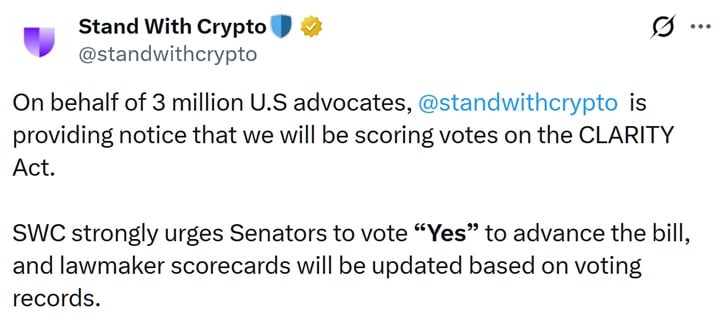
"The CLARITY Act has mobilized millions of cryptocurrency owners who eagerly await the passage of market structure legislation that will provide certainty regarding the technology they rely on," added Stand With Crypto, noting:

"Cryptocurrency-owning voters across the country are watching to see which legislators stand with them at this critical moment."

The updated ratings will record whether each senator supported advancing the bill; the vote on the CLARITY Act will be added to Stand With Crypto's existing ratings based on lawmakers' actions and public stances on cryptocurrency. The CLARITY Act vote will be one of the most prominent positions in these ratings ahead of the November midterm elections.

The organization has expanded its midterm-focused campaign, placing its scoring system at the center of efforts to transform cryptocurrency policy positions into voter-focused political achievements.

Public Scorecards Put Senators' Votes in the Spotlight

With less than 100 days until the midterm elections, Stand With Crypto's report on pre-midterm voter sentiment showed that nearly eight in ten cryptocurrency owners believe they will almost certainly vote.

Nearly 70% indicated that a candidate's stance on cryptocurrency would influence their choice, while 73% were closely following the digital asset policies legislators supported. Another 59% identified themselves as voters who do not consistently support one party, potentially giving cryptocurrency policy greater significance in tight congressional election races.

These findings reinforce the potential impact of the scorecards, especially in competitive races where politically unaffiliated cryptocurrency owners can compare candidates using their recorded positions on the CLARITY Act.

The campaign is taking place during the two-week legislative window before the August recess, with ethics provisions regarding public officials remaining a central issue in negotiations between lawmakers. Several Democratic lawmakers are pushing for stricter ethics measures and consumer protections, complicating vote counting as supporters need to secure the 60 senator votes typically required to advance a bill.

Galaxy Research lowered its assessment of the likelihood of the CLARITY Act passing in 2026 to 30%, as the Senate vote faces challenges related to timing, bipartisan support, and unresolved provisions.

Next Stage: Senate Floor

On May 14, the Senate Committee on Banking, Housing, and Urban Affairs approved the revised market structure bill with a vote of 15 to 9, sending it to the full Senate for consideration. This bipartisan committee vote reflected the outcomes of negotiations on federal oversight, investor protection, enforcement authority, and operational requirements for digital asset companies. The bill now awaits a full Senate vote.

Under the proposed framework, federal regulators would receive clearly defined authority over various digital assets, and exchanges and intermediaries would be required to comply with registration, disclosure, and customer protection requirements.

For senators, the upcoming vote carries two significant implications: it will determine whether the bill moves forward, and it will establish a result that Stand With Crypto will present to millions of supporters.


Related Questions

QWhat is the main purpose of the organization Stand With Crypto's announcement regarding the CLARITY Act?

AThe main purpose is to announce that each U.S. Senator's vote on the CLARITY Act will be recorded in their public legislator scorecards, representing 3 million American crypto supporters, to help voters compare candidates ahead of the November elections.

QAccording to Stand With Crypto's pre-midterm report, what percentage of crypto owners are 'almost certain' they will vote, and why does their vote matter for tight races?

ANearly eight in ten (almost 80%) crypto owners are almost certain they will vote. Their vote matters because 59% identify as non-straight-ticket voters, meaning crypto policy positions could significantly influence their choice in competitive congressional races.

QWhat was the outcome of the CLARITY Act vote in the Senate Banking Committee, and what is the next step for the bill?

AThe Senate Banking Committee approved the amended market structure bill with a 15-9 vote, sending it to the full Senate. The next step is a floor vote in the full Senate.

QHow does Galaxy Research currently assess the likelihood of the CLARITY Act passing in 2026, and why?

AGalaxy Research has lowered its assessment of the bill's chances of passing in 2026 to 30%. This is due to challenges with timing, securing bipartisan support, and unresolved provisions related to ethics and consumer protection.

QWhat are two key implications of the upcoming Senate floor vote on the CLARITY Act for senators, according to the article?

AFor senators, the upcoming vote has two key implications: 1) It will determine whether the bill moves forward in the legislative process. 2) It will establish a result that Stand With Crypto will present to its millions of supporters as part of their public scorecards.

Related Reads

Goldman Sachs: July Smashes Through Crowded Trades, U.S. Stock Bull Market Not Broken but Harder to Navigate

Goldman Sachs: July Sees Crowded Trades Unwound, U.S. Bull Market Intact but Getting Tougher. The U.S. stock market in July did not see an index-level crash, but rather a significant unwinding of speculative positions. While the S&P 500 remained stable—trading within a narrow 3.5% range and staying within 2% of its high—underlying market dynamics were volatile. Heavily crowded trades, particularly in high-momentum tech, AI-linked stocks, and Asian strategies, faced severe pressure and forced deleveraging. Data indicates this was a meaningful cleanse, not a minor adjustment. Global tech exposure saw its largest sell-off in over five years, leverage in Korean equity ETFs plummeted, and Goldman's prime brokerage recorded the largest gross exposure reduction since late 2022. Leverage on momentum factors among fundamental long/short clients fell to the 28th percentile of its one-year range. The AI trade narrative shifted from pure potential to a focus on tangible returns. While Meta failed to show clear AI monetization, Microsoft and Amazon provided evidence that massive capital expenditure is translating into scalable revenue and product growth, preventing a blanket sell-off of the AI sector. The Federal Reserve's more opaque communication style and volatility in long-end Treasury yields have introduced new friction, particularly for rate-sensitive growth and tech stocks. The broader outlook for U.S. equities remains favorable, supported by a strong economy, robust earnings, and substantial AI capital expenditure. However, risk/reward is no longer cheap, and the market's upward elasticity has weakened. The Nasdaq 100's trajectory—up 12% year-to-date despite significant pullbacks—illustrates that the bull trend persists but the path is becoming more difficult. The key lesson from July is that the market no longer rewards crowded, highly leveraged trades, requiring more disciplined and liquid portfolio approaches.

marsbit4h ago

Goldman Sachs: July Smashes Through Crowded Trades, U.S. Stock Bull Market Not Broken but Harder to Navigate

marsbit4h ago

Trading

Spot
活动图片