Evaluating edgeX’s post-TGE crash: Can EDGE bulls defend $0.2950 support?

ambcryptoPublished on 2026-07-12Last updated on 2026-07-12

Abstract

EdgeX (EDGE) continues its post-Token Generation Event (TGE) price discovery, with the token price dropping 19.3% to $0.3756 amid a broader market decline in capitalization and trading volume. This reflects reduced trader activity rather than aggressive selling at lower prices. Despite the project's upgrade to the more independent StarkEx V2 infrastructure, market sentiment remains cautious. Derivatives data shows weakening conviction, with Open Interest falling 25.79% and the OI-Weighted Funding Rate nearing neutral levels. This indicates traders are closing leveraged positions instead of adding new exposure, reducing potential liquidation pressure but also signaling a lack of bullish momentum. Technically, EDGE retested support near $0.38, with $0.2950 as a critical level. A break below could target $0.2330, while reclaiming $0.50 is needed for a bullish shift. Indicators like the Parabolic SAR suggest the recovery structure is intact, but the MACD shows weakening buying strength. In summary, EDGE faces a consolidation phase with neutralized derivatives positioning and subdued participation. Sustained price recovery requires renewed demand and stabilized trader confidence.

edgeX [EDGE] remained under pressure as its post-TGE price discovery continued despite the project’s transition to the StarkEx V2 architecture. The token traded at $0.3756 at press time after falling 19.3% over the past 24 hours.

Market capitalization had also dropped 20.09% to $131.47 million, while trading volume had declined 51.79% to $31.74 million.

Those figures showed that traders reduced activity instead of chasing lower prices.

However, the ongoing infrastructure upgrade reflected a broader shift beyond a simple product update.

The move from StarkEx V1 positioned edgeX toward a more independent derivatives infrastructure with stronger self-custody and higher performance.

Even so, the market continued valuing the token cautiously as participants searched for a sustainable post-launch price.

Why did leveraged traders reduce exposure?

Derivatives traders reduced their exposure throughout the latest decline, reinforcing the weakening participation across the market.

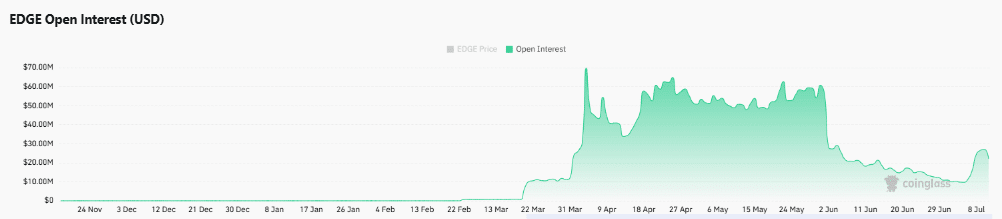
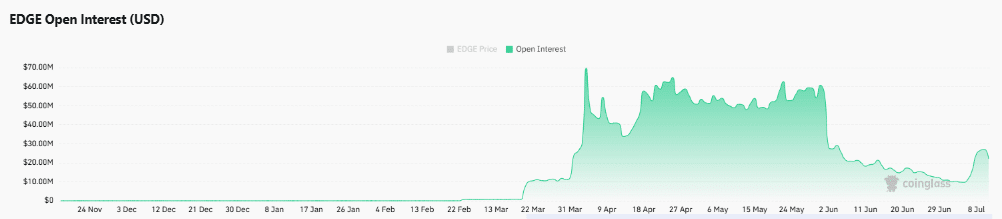
Open Interest dropped 25.79% to $20.96 million, indicating that traders closed positions instead of introducing fresh leverage during the sell-off. That behavior reflected declining speculative conviction rather than aggressive positioning in either direction.

Besides, the sharp fall in trading volume supported the same narrative because fewer participants actively entered new positions.

The combined contraction across spot activity and derivatives suggested that many traders preferred waiting for stronger confirmation before committing additional capital.

Although the decline reflected weaker confidence, it also showed that excessive leverage had gradually left the market, which could reduce liquidation pressure if buyers eventually return.
Source: CoinGlass

Can bulls defend the current support zone?

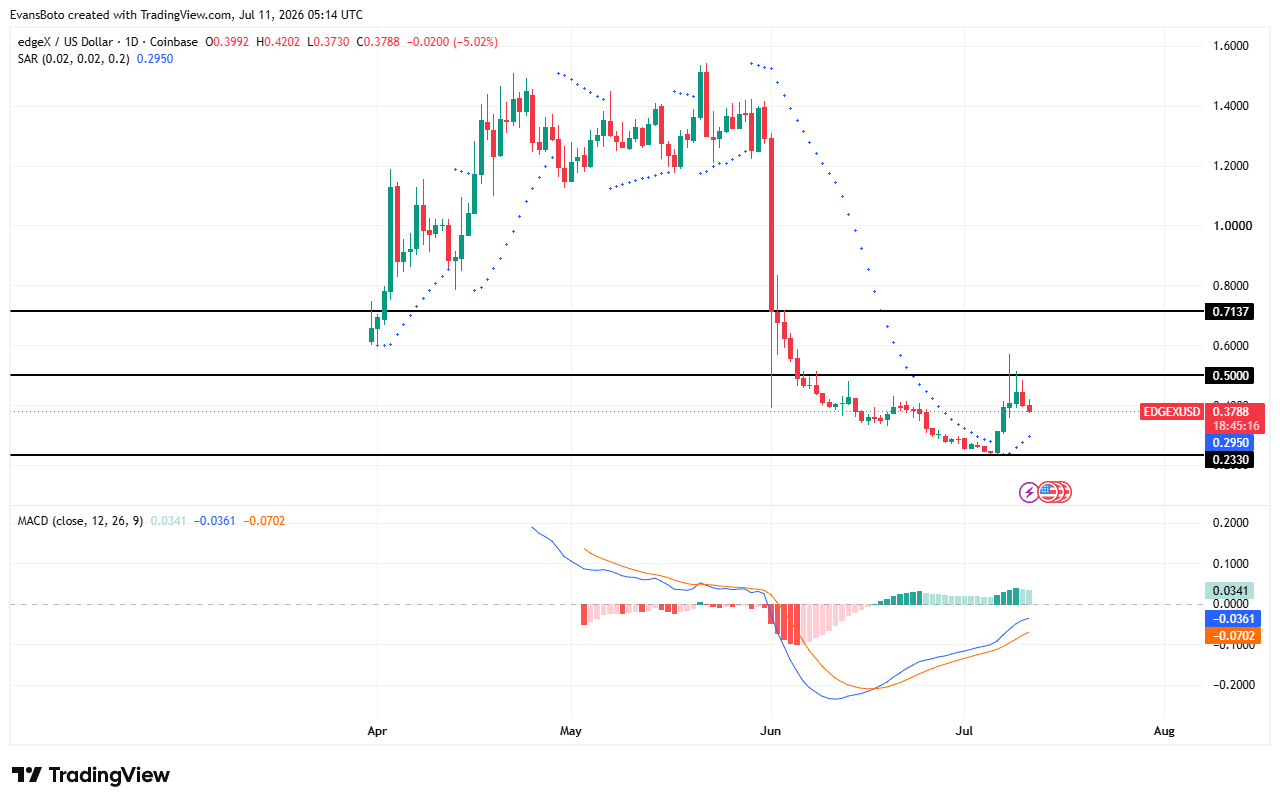
EDGE retested support after failing to sustain its recent rebound above $0.50, leaving buyers under renewed pressure.

Price pulled back toward $0.38, while $0.2950 continued serving as the nearest support level. A break beneath that area could expose $0.2330, whereas reclaiming $0.50 would place $0.7137 back into focus.

Despite the latest decline, the Parabolic SAR remained below the price, showing that the broader recovery structure had not fully broken down.

However, the MACD painted a more cautious picture. The MACD line stayed above the signal line, preserving its bullish crossover.

Even so, the histogram started shrinking while both lines flattened, indicating that buying strength had weakened following the rejection near resistance.

Accordingly, buyers needed renewed demand before the technical outlook could improve meaningfully.
Source: TradingView

Have EDGE funding rates already lost conviction?

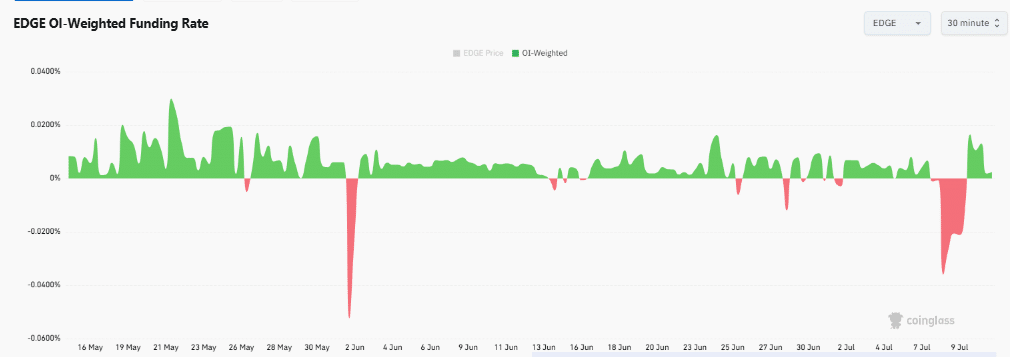
Perpetual market positioning also softened as funding conditions drifted toward neutral levels.

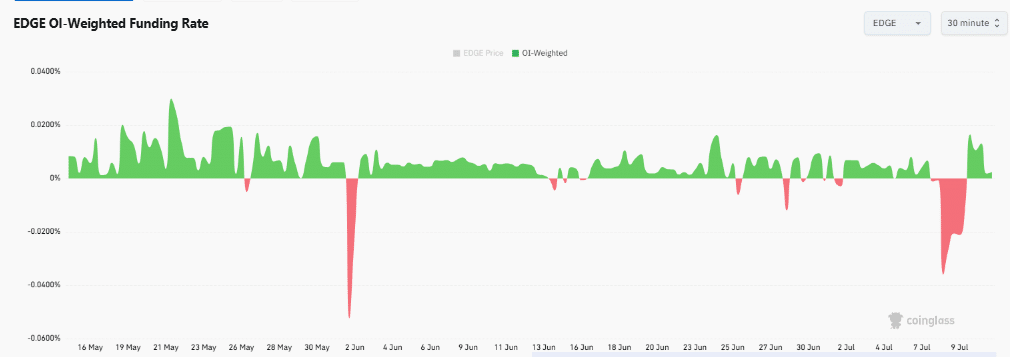
The OI-Weighted Funding Rate stood at approximately 0.0024%, showing that traders no longer paid a meaningful premium to maintain long positions.

Earlier positive readings gradually faded before reaching almost neutral territory, reflecting a balanced market instead of aggressive bullish positioning.

Additionally, the funding shift aligned with the decline in Open Interest, strengthening the view that leveraged traders reduced exposure rather than expanded it.

That combination highlighted a cooling derivatives environment after recent volatility.
Source: CoinGlass

If funding remains close to neutral while participation stabilizes, traders could regain confidence gradually.

Otherwise, another decline in participation would likely keep EDGE within its ongoing post-TGE price discovery phase.


Final Summary

  • edgeX remained in post-TGE price discovery despite continued progress toward StarkEx V2 infrastructure.
  • Falling Open Interest and neutral funding reflected weaker conviction across leveraged EDGE traders.


Trending Cryptos

Related Questions

QWhat was the percentage decline in EDGE's price over the past 24 hours according to the article?

AEDGE's price fell by 19.3% over the past 24 hours, trading at $0.3756 at press time.

QHow did Open Interest (OI) for EDGE change, and what does this indicate about trader behavior?

AOpen Interest dropped by 25.79% to $20.96 million, indicating that traders were closing positions rather than introducing new leverage during the sell-off, reflecting declining speculative conviction.

QWhat are the critical support and resistance levels mentioned for EDGE's price?

AThe nearest support level is $0.2950. A break below could expose $0.2330. Reclaiming $0.50 would place $0.7137 back into focus as a resistance level.

QWhat did the article state about the OI-Weighted Funding Rate and its implication?

AThe OI-Weighted Funding Rate stood at approximately 0.0024%, indicating traders no longer paid a meaningful premium for long positions, reflecting a more balanced and less aggressively bullish market.

QWhat broader infrastructure shift is the edgeX project undergoing, and what are its goals?

AedgeX is transitioning from StarkEx V1 to StarkEx V2 architecture. This move aims to position the project toward a more independent derivatives infrastructure with stronger self-custody and higher performance.

Related Reads

Behind Robinhood's Chain Launch and Tokenized Stocks: No Equity Rights, How Far Can This Packaging Game Go?

Robinhood is launching its own Layer 2 blockchain (Robinhood Chain) and "tokenized stocks," but these are not actual equity shares. The tokens are legally structured as debt securities or derivatives, offering economic exposure to a reference stock without granting voting rights or direct ownership. This move represents Robinhood's strategy to expand from a traditional brokerage into a "financial super app," building a user-friendly, programmable financial interface on top of complex, legally compliant, and jurisdiction-specific backend structures. The company's existing business remains strong, driven by options, event contracts, and stock trading. The new blockchain and tokenization efforts are an ambitious layer of infrastructure built atop this core, aiming to make financial products more portable and globally accessible via crypto rails. Key components include the Robinhood Wallet, Bitstamp acquisition (for institutional reach), the Lighter perpetual contracts platform, and Robinhood Earn (DeFi yield). The central challenge is the "brokerage chain paradox": maintaining a simple, intuitive user experience while the underlying assets are highly structured, regulated, and legally distinct from direct ownership. The success of this strategy depends on users, developers, and regulators accepting this model. If the complexity is misunderstood or deemed misleading, it could create product liability issues and stall expansion. The initiative is a significant infrastructure play, but its long-term viability hinges on navigating this fundamental tension between simplicity and legal reality.

marsbit4m ago

Behind Robinhood's Chain Launch and Tokenized Stocks: No Equity Rights, How Far Can This Packaging Game Go?

marsbit4m ago

Zhipu, Afraid of Becoming the Next MiniMax

Title: Zhipu, Fearing to Become the Next MiniMax In July 2026, amid the success of its coding-focused AI, Zhipu's founder, Tang Jie, issued an internal letter titled "The Giant Wave Has Come." It notably avoided celebrating recent triumphs, such as Zhipu's trillion-HKD market cap and booming MaaS revenue driven by its GLM-5.2 model in coding applications. Instead, the letter pivoted the narrative to future-oriented concepts like Long Horizon Task, Autonomous Agents, Self-Evolving systems, and AGI. This strategic shift in messaging followed the sharp devaluation of its competitor, MiniMax. After its lock-up period expired, MiniMax's stock plummeted as the market began evaluating it with traditional SaaS metrics like ARR and user growth, rather than as a frontier AI pioneer. Seeing this, Tang Jie aimed to preempt a similar revaluation of Zhipu. He fears that if the market starts viewing Zhipu primarily as a profitable "AI coding company," its valuation would become anchored to conventional financial metrics, losing the premium associated with AGI potential. Therefore, the letter reframed Zhipu's mission. While acknowledging that coding was the current commercial driver, Tang positioned Zhipu on the "infrastructure path," akin to OpenAI and Anthropic. The new focus is on developing agents capable of complex, long-term planning and autonomous operation—moving from assisting individuals (OPC: One Person Company) to automating entire organizations (NPC: No People Company). This "Touch High" plan explicitly prioritizes long-term AGI research over short-term monetization. The article frames this as a critical divergence in China's AI landscape: the "commercialization path" (exemplified by MiniMax) versus the "infrastructure path" (chosen by Zhipu). The former risks being judged harshly by internet-era metrics once growth slows, while the latter risks failing if technological breakthroughs stall. Tang Jie's letter is thus a calculated move to secure Zhipu's identity as an AGI contender, buying time before the inevitable market demand for commercial proof. The core question remains: can Zhipu's "mo gao" (reach high) plan achieve genuine technological leaps fast enough to outpace the market's diminishing patience for stories over substance?

marsbit4m ago

Zhipu, Afraid of Becoming the Next MiniMax

marsbit4m ago

Trading

Spot

Hot Articles

Discussions

Welcome to the HTX Community. Here, you can stay informed about the latest platform developments and gain access to professional market insights. Users' opinions on the price of S (S) are presented below.

活动图片