Circle announced that the circulating supply of its euro stablecoin ($EURC) has exceeded the 400 million euro mark roughly four years after launch. While this amount remains small compared to dollar-denominated stablecoins, this gap is part of the bigger picture. Building a serious payment system not reliant on the US dollar has required years of effort even for one of the largest stablecoin issuers in the sector.
For institutions, payment companies, and developers looking to store and transfer euros on the blockchain, this milestone indicates the emergence of a promising alternative. However, the expansion of $EURC suggests that the adoption process has been lengthy due to more advanced regulations and improved infrastructure, rather than a sudden surge in demand.
A Four-Year Journey from One Network to Five
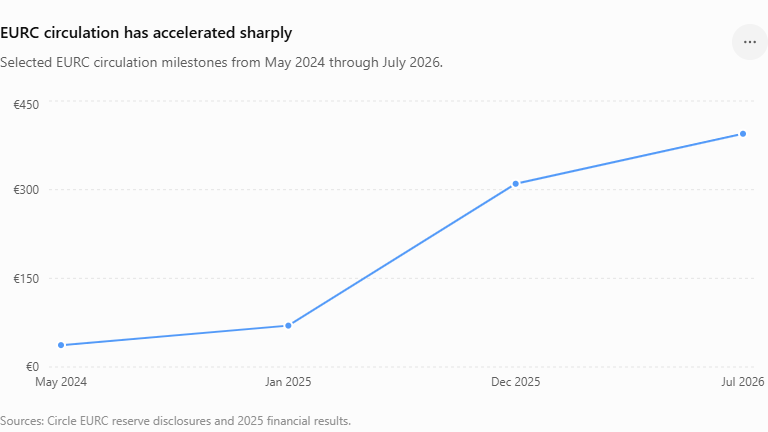
The euro stablecoin $EURC debuted on Ethereum in June 2022 and remained there until 2023, when Circle began launching it on other blockchains, including Avalanche, Stellar, Solana, and Base. By December 2024, it was available on five different blockchains and had a circulating supply of nearly 80 million euros. According to Circle, the $EURC supply doubled in the first half of 2025, increasing by over 100% in the last 12 months.
Circle executives noted that the industry has reached the 400 million euro mark for the first time. On August 14, Patrick Hansen tweeted that $EURC is "officially for the first time in history," which is more than ten times its volume from the start of the MiCA period two years ago. Another colleague, Peter Schroder, also mentioned that $EURC has become the first euro-pegged stablecoin whose supply volume reached 400 million euros.
Why Does the Dollar Still Own the Rails?
In the context of dollar dominance, this milestone looks different. According to an article published by the Bank for International Settlements in May 2026, nearly 98% of the value of stablecoins is denominated in dollars, suggesting that stablecoins will only strengthen the dollar's current position before competing currencies can make a significant dent.
Euro tokens have faced difficulties in practical usage, as noted by Circle, because users typically had to resort to dollar-pegged stablecoins for euro transactions, face low on-chain liquidity, or use bridges that create obstacles and risks.
Regulation has also changed the industry. Cryptopolitan reported that Tether ceased issuance of its euro stablecoin EURT in favor of complying with new European Union rules. Even with significant growth in the number of euro-pegged stablecoins, which reached approximately $900 million by mid-2026, they still account for much less than 1% of the total global stablecoin market, which is approximately $300 billion.
What Changes Did MiCA Bring to Euro Tokens?
In December 2024, the European Union's Markets in Crypto-Assets (MiCA) framework came into force, establishing requirements for reserves, disclosures, governance, and redemption. Circle designed $EURC to be classifiable as an e-money token under MiCA rules and issued it through one of its e-money institutions in France under the supervision of ACPR, with full backing through segregated reserves.
MiCA was not responsible for creating demand for euro stablecoins. Instead, it provided banks, payment companies, and other regulated entities with a clear framework for deciding to adopt euro stablecoins.
This transition can be seen within the $EURC ecosystem. The token trades on major exchanges and payment systems and is supported by institutional custody services. Visa and Mastercard have also expanded their stablecoin settlement functionality to include $EURC, moving this token out of the crypto trading sphere and closer to traditional payment infrastructure.
Where Are Euro Tokens Actually Being Used
When it comes to whether $EURC can become a full-fledged payment system, usage is more important than the number of placements. As reported by Thunes on August 13, the payment system added a $EURC pre-funding feature on the Ethereum, Solana, Base, and Stellar networks. This means network users can transact in euros regardless of bank operating hours or the need to pre-convert to dollars.
Third-party data also indicates a similar trend. A study prepared by Dune for Visa shows that for the period ending February 2026, the total volume of local currency stablecoins grew by approximately 90%, reaching $1.2 billion, significantly outpacing the growth rate of dollar tokens. Most of this capital was generated through euro stablecoins, which account for over 80% of the total market capitalization and 85% of the total transfer volume. $EURC alone processes between $10 and $20 billion per month.
Notably, the number of unique addresses associated with non-dollar-pegged stablecoins has surged from about 40,000 in January 2023 to over 1.2 million in early February 2026.
A Broader Stablecoin Context
The achievement of $EURC reaching 400 million euros is less significant in the context of the threat it poses to the dollar today, but more important as proof that another currency can build its own infrastructure on the blockchain. The euro stablecoin sector is becoming more convenient, regulated, and liquid. However, the scale of the euro stablecoin market is a reminder that the vast majority of the world's stablecoin economy is still dollar-denominated.
| Date | $EURC Circulation | Growth / Context |
|---|---|---|
| May 31, 2024 | €37.0 million | Preliminary baseline; Circle's inventory report |
| January 1, 2025 | ~€70 million | Start-of-year level indicated by Circle |
| December 23, 2025 | >€300 million | $EURC became the largest euro-denominated stablecoin by market capitalization |
| December 31, 2025 | €310 million | Year-end figure: +284% year-over-year. |
| July 27, 2026 | €394.6 million | Latest data from Circle: transaction volume approaching €400 million |