Ethereum’s exit queue spikes after 5% pullback – Are ETH bulls in trouble?

ambcryptoPublished on 2026-03-28Last updated on 2026-03-28

Abstract

Ethereum faces mixed signals and heightened uncertainty after a 5% single-day decline, its worst daily close since the onset of the West Asian conflict. Bulls failed to reclaim $2.2k, putting the $2k support level under pressure. This triggered significant liquidations, with over $112 million in daily liquidations—90% from long positions—marking the largest long squeeze in nearly ten days. Simultaneously, Ethereum's validator exit queue surged from 288 to 63k in less than a week, indicating growing caution among validators. However, exchange reserves dropped to a 10-year low, with consistent net withdrawals, including $1.67 billion removed on March 22. This reflects a deleveraging phase where leveraged traders amplify short-term volatility, while shrinking supply suggests longer-term scarcity. Once selling pressure subsides, the reduced supply could allow bulls to push ETH toward $2.5k.

Mixed signals create uncertainty, leaving traders on edge.

These conflicting signals naturally amplify indecision, triggering liquidity sweeps, short-term swings, and forced liquidations. From a technical standpoint, this sets up a feedback loop: Liquidity sweeps fuel more selling, eroding market sentiment and pushing participants deeper into fear.

Ethereum [ETH] appears to be following this exact pattern. On the 26th of March, a 5% single-day decline marked its worst daily close since the West Asian conflict began. Bulls failed to reclaim $2.2k, leaving the $2k floor under renewed pressure and reinforcing the bearish technical setup.
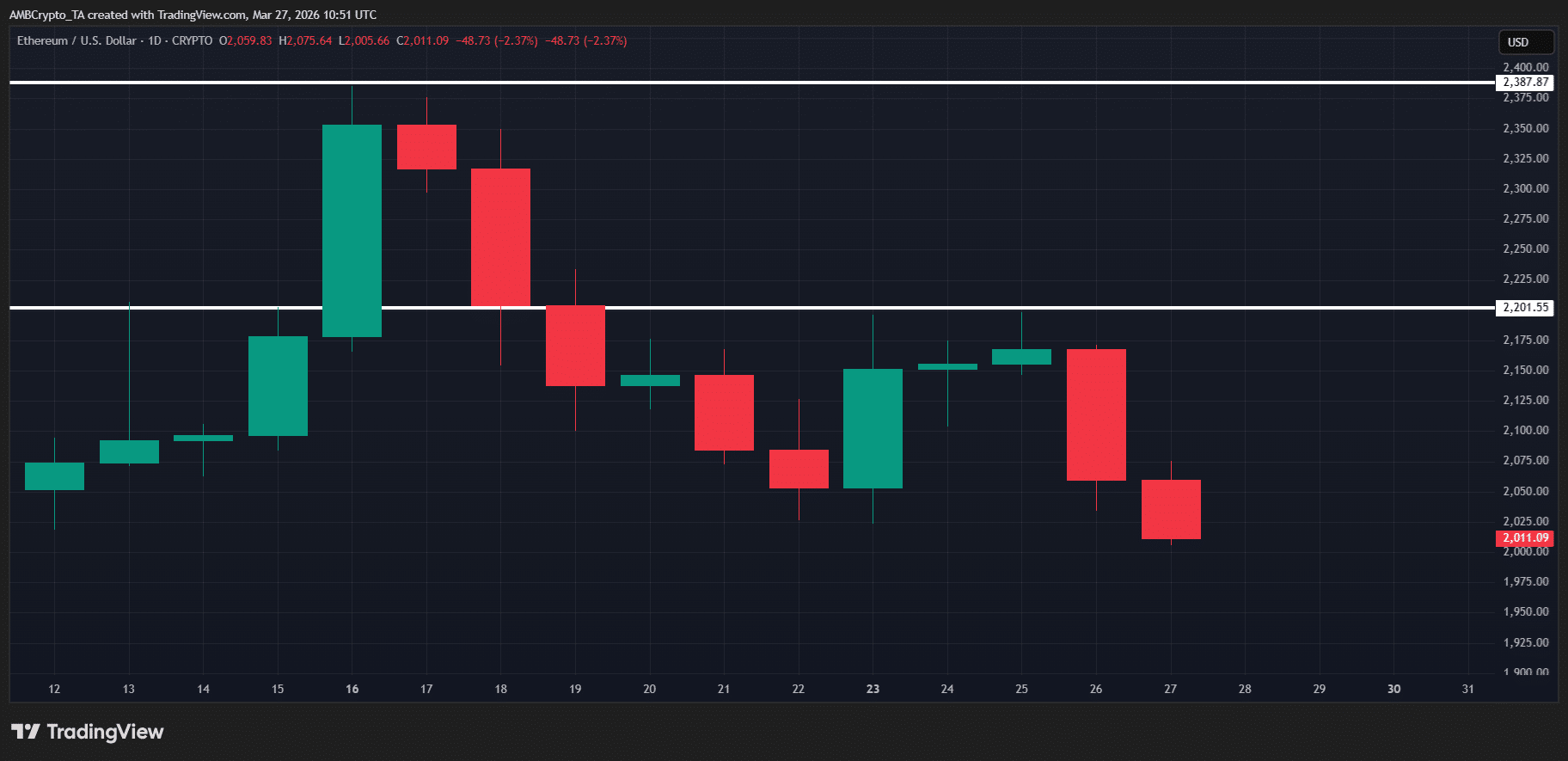
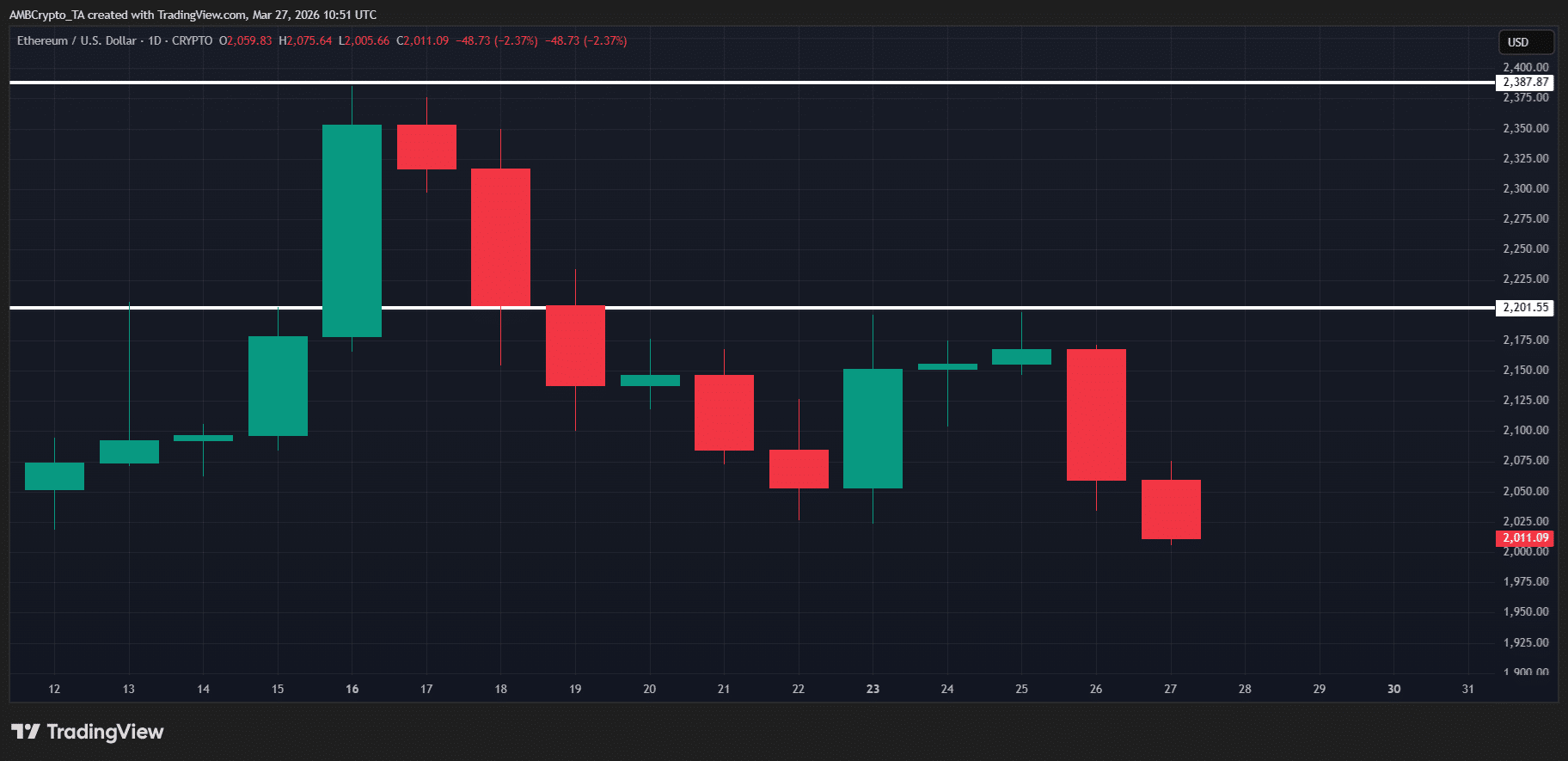
Source: TradingView (ETH/USDT)

Notably, the very next day triggered a massive liquidity outflow.

According to CoinGlass, Ethereum’s daily liquidations hit around $112 million, with over 90% coming from long positions. In fact, this marked the largest long squeeze in nearly ten days, showing how technical resistance quickly cascaded into forced selling.

Moreover, the stress didn’t stop at price action.

Lookonchain shows an Ethereum OG unstaked after four years, selling 7,302 ETH at $2,073. At the same time, Ethereum’s validator exit queue jumped from 288 to 63k in less than a week. For context, a rising exit queue signals that more validators are rushing to withdraw staked ETH, reflecting growing caution.

Taken together, these moves show how technical weakness, liquidations, and on-chain activity feed into a reinforcing bearish cycle for ETH. Naturally, the question becomes: With confidence slipping, is Ethereum at risk of a deeper breakdown?

Liquidations and outflows signal Ethereum’s deleveraging phase

One Ethereum leveraged position perfectly illustrates the current market dynamics.

According to Lookonchain, machibigbrother’s ETH longs were fully liquidated yet again. He had deposited 500k USDC just three days ago, but after a series of liquidations, only $138k remains, with total losses now totaling $30.75 million. And yet, he didn’t step back, immediately opening another 25x long on 1,600 ETH, worth roughly $3.33 million.

From a behavioral perspective, this highlights classic high-risk trading: the chase for quick gains often overrides disciplined positioning, piling more pressure onto Ethereum’s already fragile setup. However, on-chain metrics reveal a critical conflicting signal.
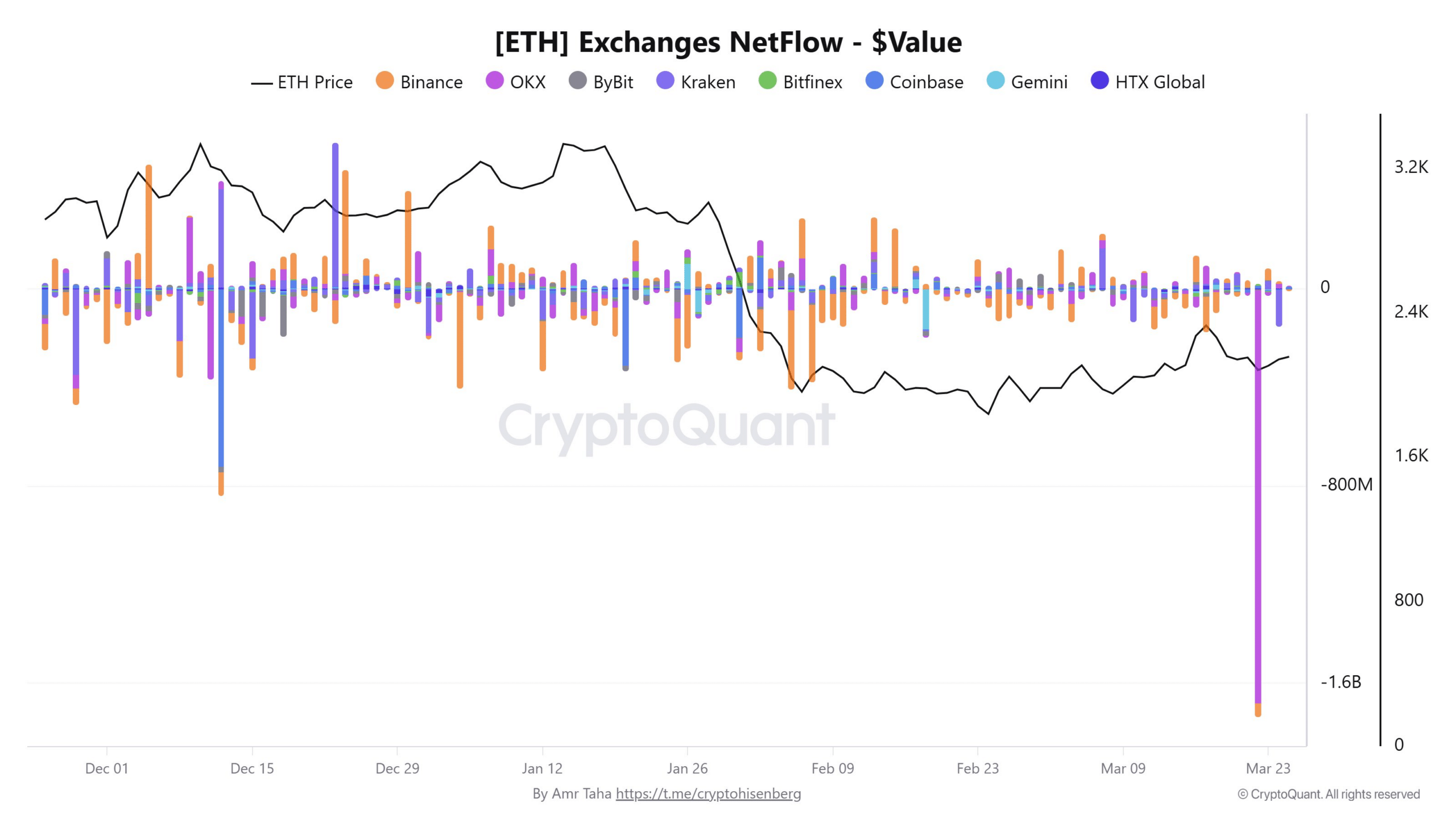
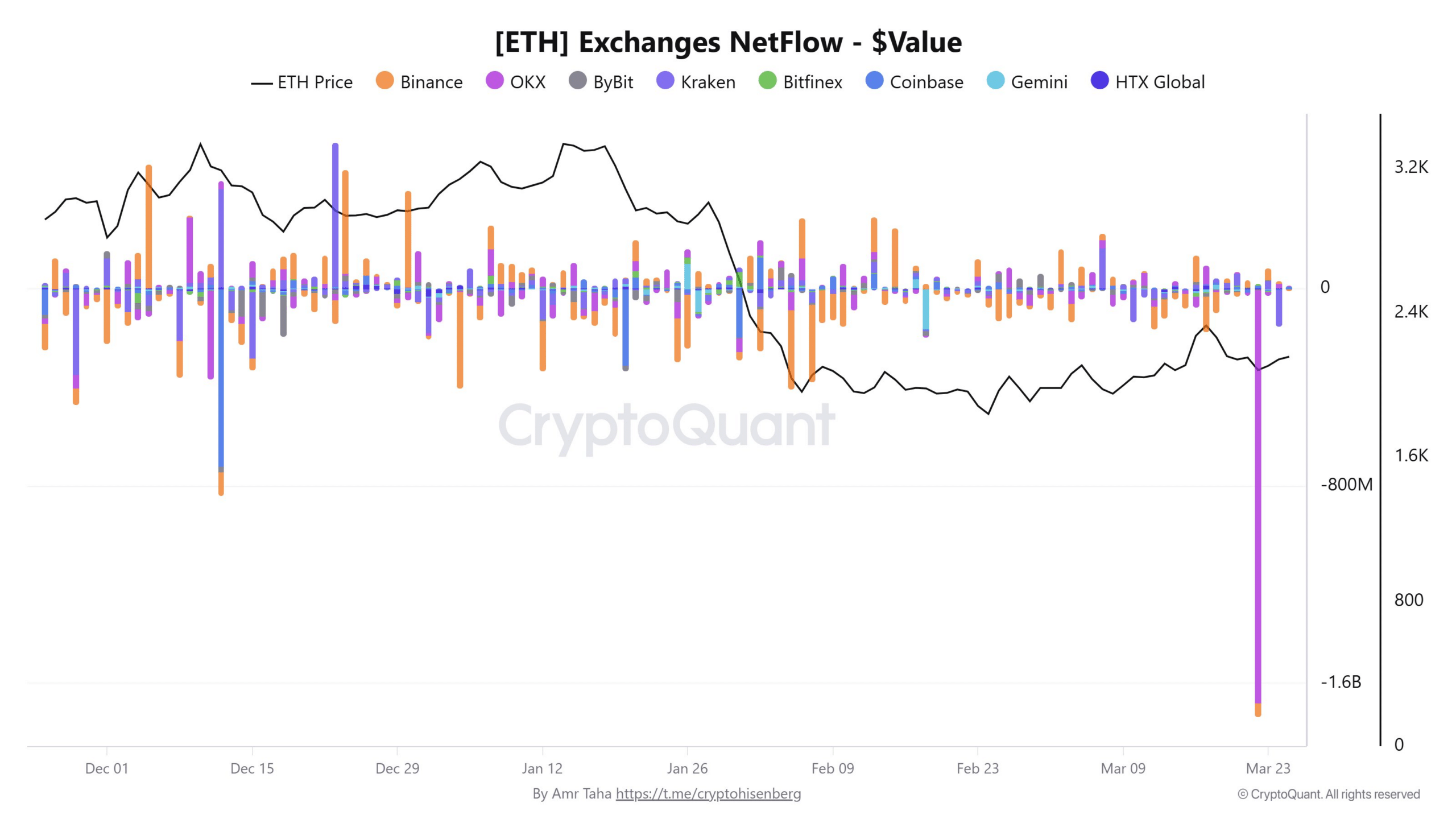
Source: CryptoQuant

Notably, ETH on exchanges has dropped to a 10-year low, the lowest amount since 2016, nearly the entirety of Ethereum’s lifetime. Outflows aren’t slowing either. Over the past few months, net withdrawals have been consistent, with a massive $1.67 billion removed from exchanges on the 22nd of March.

According to AMBCrypto, this is a textbook deleveraging setup.

Leveraged traders chasing short-term upside amplify volatility, while the shrinking exchange supply points to longer-term scarcity. The interplay forms a feedback loop: forced liquidations shake out overleveraged longs, clearing the market and setting the stage for a potential rebound.

In this context, once selling pressure eases and liquidity stabilizes, the reduced supply could give bulls room to push ETH higher, with $2.5k firmly on the table.


Final Summary

  • Mixed signals, a 5% pullback, and rising validator exits are reinforcing Ethereum’s technical weakness and market fear.
  • Exchange outflows hit a 10-year low, clearing overleveraged longs and setting the stage for bulls to push ETH toward $2.5k once selling pressure eases.


Related Questions

QWhat was the immediate impact of Ethereum's 5% single-day decline on March 26th?

AThe 5% decline marked Ethereum's worst daily close since the West Asian conflict began. Bulls failed to reclaim the $2.2k level, putting renewed pressure on the $2k support floor and reinforcing the bearish technical setup.

QWhat does the massive spike in Ethereum's validator exit queue indicate about market sentiment?

AThe validator exit queue jumping from 288 to 63k in less than a week signals that more validators are rushing to withdraw their staked ETH. This reflects growing caution and a potential loss of confidence in the network among participants.

QHow did the liquidation events contribute to Ethereum's market dynamics according to the article?

ADaily liquidations hit around $112 million with over 90% coming from long positions, marking the largest long squeeze in nearly ten days. These forced liquidations created a feedback loop where selling pressure fueled more selling, eroding market sentiment and pushing participants deeper into fear.

QWhat conflicting on-chain signal suggests potential for an Ethereum price recovery despite the bearish pressure?

AETH on exchanges has dropped to a 10-year low, the lowest amount since 2016, with consistent net withdrawals including a massive $1.67 billion removed from exchanges on March 22nd. This indicates long-term scarcity potential that could support prices once selling pressure eases.

QWhat is the article's final outlook for Ethereum's price potential once the selling pressure subsides?

AThe article suggests that once selling pressure eases and liquidity stabilizes, the reduced exchange supply from massive outflows could give bulls room to push ETH higher, with the $2.5k price level firmly on the table.

Related Reads

Huawei Cloud Rejects Token Price War, Zhou Yuefeng Seeks a New Winning Formula for AI Cloud

At the 2026 Huawei Cloud INSPIRE Creator Conference, CEO Zhou Yuefeng outlined Huawei Cloud's distinct strategy in the competitive AI cloud market. Instead of engaging in price wars based on token volume or Maas revenue—a common focus for rivals like Alibaba Cloud and ByteDance's Volcano Engine—Huawei Cloud is shifting the competition towards real-world productivity gains. Zhou highlighted three core differentiators: a fully domestic computing stack (Ascend, Kunpeng), a focus on government and enterprise clients rather than consumer internet, and a deep commitment to open-source ecosystems. To this end, Huawei Cloud launched a suite of new products under the "Agentic Infra" paradigm, including the AICS Lingqu computing cluster, AMS memory storage, and the ModelArts Next platform. These aim to solve enterprise challenges in deploying AI agents, such as latency, memory, scheduling, and security. The strategy further involves creating specialized industry zones ("AI Dream Factories") for sectors like healthcare and embodied intelligence. For example, a smart medical zone developed with Shanghai Ruijin Hospital aims to democratize expert-level diagnostic capabilities. In essence, Huawei Cloud is positioning itself not as a commodity token provider, but as the foundational infrastructure for industrial AI, leveraging its domestic supply chain and hybrid cloud solutions to serve sectors where productivity, not just scale, is the ultimate measure of value.

marsbit3m ago

Huawei Cloud Rejects Token Price War, Zhou Yuefeng Seeks a New Winning Formula for AI Cloud

marsbit3m ago

70% of the Public Opposes AI, Americans Hope the U.S. Loses the AI War

70% of Americans believe AI development is moving too fast, with growing public resistance evolving from online criticism to real-world protests and violence. This widespread anti-AI sentiment stems from fears of job losses, rising utility costs, environmental damage, threats to democracy, and financial instability. Key incidents illustrate the backlash: Google's former CEO Eric Schmidt was loudly booed at a graduation for promoting AI; AI company ads are vandalized; protests and even violent attacks target AI firms and data centers. Polls show deep public pessimism and strong local opposition to data center construction, often surpassing resistance to nuclear power plants. The core grievances are economic and practical: AI is seen as automating jobs, concentrating wealth, and increasing household electricity and water bills due to massive data center resource demands. Environmentalists also oppose AI's high energy use and carbon emissions. This opposition has turned AI into a major political issue in the US. While the Trump administration prioritizes AI innovation for global competition, bipartisan pushback is growing. Democrats and factions within the MAGA movement are forming temporary alliances to support stricter regulations and local bans on new data centers, pressuring the administration to choose between its tech industry backers and its voter base. The situation highlights a profound national divide over AI's future.

marsbit37m ago

70% of the Public Opposes AI, Americans Hope the U.S. Loses the AI War

marsbit37m ago

Agents Take Over Traffic Distribution Power: What Are Tencent, ByteDance, and Alibaba Competing For?

In the race to dominate the AI era's entry point, China's tech giants—Tencent, ByteDance, and Alibaba—are aggressively deploying AI Agents to control the future of traffic distribution. Alibaba is pursuing a dual-track "closed loop + openness" strategy. Its Qianwen app is evolving into a super-Agent integrated across its ecosystem (Taobao, Alipay, etc.) to handle complex tasks like travel planning. Concurrently, it is opening its platform to external brands (Luckin Coffee, KFC) and has launched a B2B Agent platform, "Wukong," targeting enterprise automation. Its other flagship, Quark, aims to be an "AI super search box" for information and tasks. ByteDance is executing an omnipresent "sprawl strategy." Its Doubao app boasts over 300 million monthly active users and is evolving into a default AI entry point for daily life, with plans for paid versions and e-commerce integration. Its core weapon is the Kouzi platform, a visual "AI assembly factory" for developers to build custom Agents. ByteDance is also pushing hardware integration, collaborating on AI phones and developing smart glasses to embed Doubao everywhere. Tencent is playing its long-held "ultimate card" by quietly embedding an AI Agent directly into WeChat. This Agent, accessible via a swipe, can understand user commands and automatically execute tasks by calling upon WeChat's millions of mini-programs (e.g., finding and ordering coffee). This leverages WeChat's unparalleled 1.4-billion-user ecosystem to position the app as an AI-powered "service operating system," a move that could dramatically reshape the competitive landscape. The core battleground is shifting from competing for "user screen time" to competing to be the "default execution layer" for user intent. The business model is evolving from an "attention economy" to an "intent economy," where the Agent that can most efficiently fulfill a user's need gains control over service access and token flow. This represents a fundamental change in how users connect with digital services, making the fight for the Agent入口 (entry point) a pivotal moment for redefining industry leadership in the AI age.

marsbit2h ago

Agents Take Over Traffic Distribution Power: What Are Tencent, ByteDance, and Alibaba Competing For?

marsbit2h ago

Trading

Spot
Futures

Hot Articles

Discussions

Welcome to the HTX Community. Here, you can stay informed about the latest platform developments and gain access to professional market insights. Users' opinions on the price of S (S) are presented below.

活动图片











