Ethereum is struggling to stabilize above the $3,000 threshold, a level that has become a psychological and technical battleground as bearish narratives gain traction across the market. After failing to hold its late-summer momentum, ETH is now down roughly 40% from its August peak, placing sustained pressure on investor confidence. Analysts are increasingly warning that the broader market may be transitioning into an early-stage bear phase, with Ethereum’s weak relative performance reinforcing those concerns.
Sentiment around ETH has deteriorated sharply in recent weeks. Price rebounds have been short-lived, volatility remains elevated, and trading activity suggests a market dominated by defensive positioning rather than accumulation. The inability to decisively reclaim higher levels has left Ethereum vulnerable to further downside if demand does not return near current prices.
Against this cautious backdrop, on-chain data is offering a contrasting signal. According to figures tracked by Arkham, institutional-focused miner Bitmine has continued to expand its Ethereum exposure. The firm recently acquired an additional 29,462 ETH, worth approximately $88.1 million, sourced from custodial and exchange-related wallets linked to BitGo and Kraken. The timing of the purchase, amid widespread pessimism, has drawn attention from market participants.
While price action remains fragile, the presence of large, deliberate buyers suggests that some investors are positioning beyond short-term volatility. Whether this activity marks early accumulation or simply isolated conviction remains an open question as Ethereum approaches a critical inflection point.
Large-Scale Accumulation Highlights Strategic Positioning In Ethereum
Bitmine’s Ethereum exposure has reached a new milestone, with the company now holding approximately 7.79 million ETH, valued at an estimated $11.2 billion at current market prices. This places Bitmine among the largest known Ethereum holders, a status that is drawing increasing attention as the market grapples with deteriorating sentiment and elevated volatility. The scale of the position alone makes recent transactions material, not just for tracking individual wallet activity, but for understanding broader capital behavior.
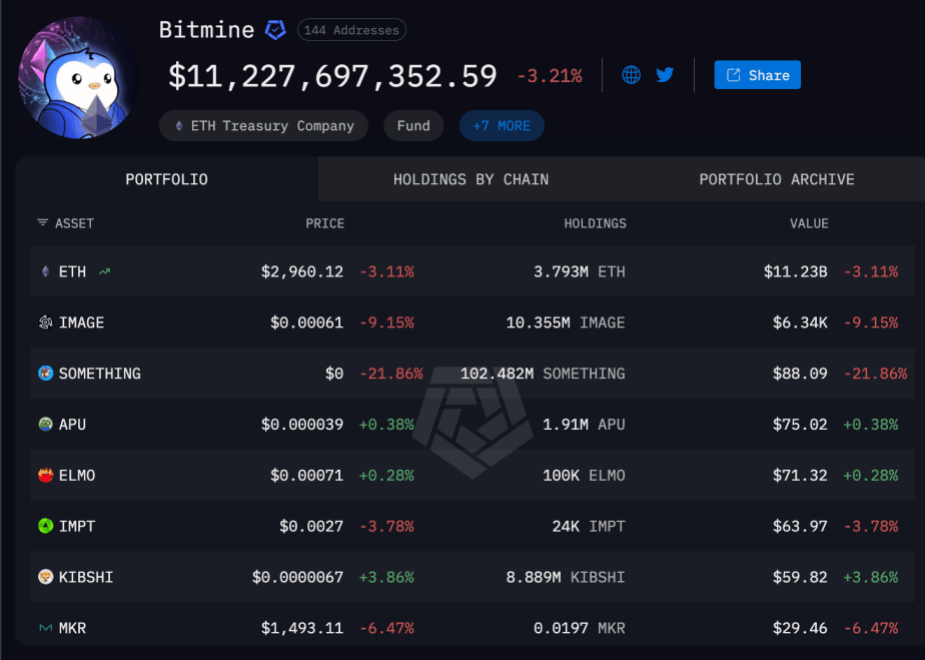
These purchases are notable because they are occurring during a period of sustained price weakness. Ethereum remains significantly below its recent highs, and many participants have adopted a risk-off stance. In that context, large, transparent inflows into long-term custody wallets suggest strategic allocation rather than short-term speculation. Transactions routed through custodians and major exchanges further reinforce the view that these moves are deliberate and structured, rather than opportunistic trades.
From a market perspective, activity of this magnitude can influence supply dynamics. When large holders accumulate and remove ETH from active circulation, available liquidity tightens, potentially reducing sell-side pressure over time. While this does not guarantee immediate price appreciation, it often alters the medium-term balance between buyers and sellers.
More broadly, Bitmine’s expanding position underscores how select institutional players continue to view Ethereum as a core asset despite unfavorable market conditions. As prices consolidate near critical levels, these flows provide important context for assessing whether current weakness reflects distribution or the early stages of long-term repositioning.