Ethereum Faces Whale Panic Fears as Coinbase Premium Turns Negative

TheNewsCryptoPublished on 2025-12-18Last updated on 2025-12-18

Abstract

Ethereum is on track for its fourth consecutive monthly decline in December, increasing pressure on large investors. The Coinbase Premium Index has turned negative, indicating significant selling pressure from U.S.-based institutional traders. Whale investors, holding between 1,000 to over 100,000 ETH, are nearing their breakeven threshold with minimal unrealized profits, having accumulated rather than sold during this cycle. While this suggests a potential bottom formation, the lack of retail participation and declining network activity pose risks. If the downtrend continues, whales may face actual losses, potentially triggering panic selling if key support around $3,000 fails to hold.

Ethereum appears headed toward a fourth consecutive monthly decline in December, creating pressure on large investors who accumulated throughout the year. The Coinbase Premium Index turned negative during December’s third week, signaling selling pressure from U.S.-based traders.

The indicator measures the percentage difference between ETH prices on Coinbase Pro’s USD pair versus Binance’s USDT pair. Negative readings indicate lower prices on Coinbase, reflecting institutional selling activity. After applying a 30-day exponential moving average filter, the index has remained negative for over one month.

Whale Investors Approach Breakeven Threshold

Data from the ETH Whale Unrealized Profit Ratio tracking addresses holding between 1,000 and over 100,000 ETH shows steady decline over four months. The ratio has approached zero, indicating large investors now hold average cost basis near current market prices with minimal unrealized profit.
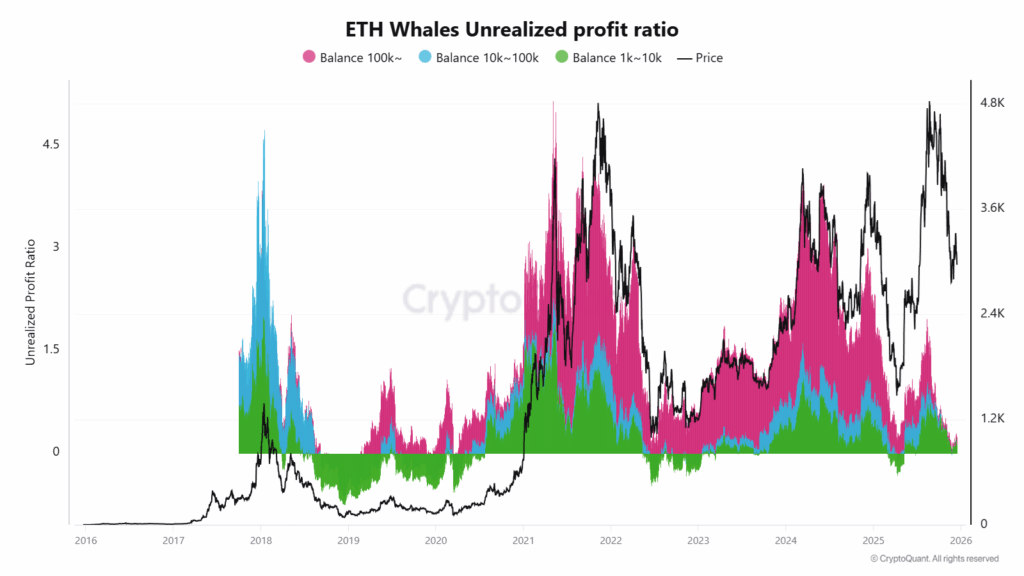
Ethereum Whale Unrealized Profit Ratio. Source: CryptoQuant

CryptoQuant analyst CW8900 stated that these holders did not take profits during this cycle and are increasing positions. This suggests the current price range offers an opportunity to acquire ETH at favorable levels. Continued accumulation at these prices could indicate a potential bottom formation zone.

However, bearish analysis raises questions about outcomes if the four-month downtrend continues. Whale investors would face actual losses in that scenario. Two factors suggest this possibility remains viable heading into year-end.

Active sending addresses for ETH reached the lowest level of 2025 in December. The metric displays a clear downward trend as network activity has cooled. Without retail buying pressure, ETH struggles to generate momentum needed for price breakouts even with institutional demand present.

CryptoOnchain analyst noted that lack of retail participation can limit short-term upside as retail flow typically drives momentum during early recovery phases. The realized price for ETH accumulation addresses serves as key support around $3,000.

These conditions place whale investors in a position requiring action. Selling to recover capital or limit losses could intensify downward pressure. Such movements could potentially trigger panic selling at institutional scale if support levels fail to hold through December close.


TagsETHEREUM

Related Questions

QWhat does a negative Coinbase Premium Index indicate for Ethereum?

AA negative Coinbase Premium Index indicates lower Ethereum prices on Coinbase Pro's USD pair compared to Binance's USDT pair, reflecting selling pressure from U.S.-based institutional traders.

QWhat is the significance of the ETH Whale Unrealized Profit Ratio approaching zero?

AThe ETH Whale Unrealized Profit Ratio approaching zero indicates that large investors (holding 1,000 to 100,000+ ETH) now hold an average cost basis near current market prices with minimal unrealized profit, meaning they are close to their breakeven threshold.

QAccording to the article, what is a key support level for Ethereum's price?

AThe realized price for ETH accumulation addresses serves as a key support level around $3,000.

QWhat potential risk do whale investors face if the four-month downtrend in Ethereum continues?

AIf the four-month downtrend continues, whale investors would face actual losses on their positions, which could lead them to sell to recover capital or limit losses, potentially intensifying downward pressure and triggering panic selling.

QWhat factor is identified as limiting Ethereum's upside momentum despite institutional demand?

AA lack of retail participation is limiting Ethereum's short-term upside momentum, as retail flow typically drives momentum during early recovery phases, and active sending addresses have reached their lowest level of 2025.

Related Reads

AI "Transfer Station" Earning Millions Monthly? Five Questions Uncover the Truth of Token Arbitrage

The article "AI 'Transfer Station' Earns Millions Monthly? Five Questions Uncover the Truth of Token Arbitrage" explores the emerging business of API token transfer stations, which profit from global AI service price disparities and access barriers. These intermediaries purchase low-cost tokens from overseas AI providers (e.g., OpenAI, Claude) through grey-market methods—such as exploiting enterprise credits, bulk accounts, or subscription benefits—and resell them to Chinese users at a markup. Key drivers include the high cost of using top AI models (e.g., Claude Code costs ~$5 per million tokens), the performance gap between domestic and foreign models, and mismatches between subscription and API pricing. However, the practice carries significant risks: upstream token sources may be unstable or illegal; user data passing through intermediaries can be harvested or injected with hidden prompts; and models might be downgraded without disclosure. The market is evolving, with some operators now exporting cheaper Chinese models (e.g., Qwen3.5 at ~$0.11 per million tokens) to overseas users, leveraging price gaps. Yet, sustainability is low due to compliance crackdowns, instability, and reputational risks. Users are advised to employ detection methods (e.g., prompt adherence tests) and avoid sensitive data usage. The authors caution that while transfer stations offer short-term arbitrage, they lack long-term reliability and security compared to official APIs.

marsbit6m ago

AI "Transfer Station" Earning Millions Monthly? Five Questions Uncover the Truth of Token Arbitrage

marsbit6m ago

The Cost of an 11.5% Annualized Return: Will MicroStrategy's STRC Face a Moment of Reckoning?

This article analyzes the potential risks associated with MicroStrategy's (MSTR) use of structured financial products like STRC to leverage its BTC exposure. While these tools have enabled impressive returns (e.g., 11.5% annualized) and fueled significant capital inflows ($13.5B outstanding), they also create substantial annual dividend obligations (~$400M). The author argues that this structure, while effective in a bull market, could become a liability if BTC price stagnates or declines. The core risk is a potential negative feedback loop: the growing dividend burden from continued STRC issuance may eventually outweigh the benefits of increased BTC holdings. To meet these obligations, MicroStrategy might need to use new issuance proceeds for dividends instead of buying more BTC, which could disappoint equity investors. If the market capitalization (mNAV) falls below the value of its BTC holdings, the company could be forced to sell BTC instead of issuing new shares, potentially triggering a panic. The author estimates a potential inflection point in 6 months, where annual dividend costs reach $3-4B. At that stage, CEO Michael Saylor might face a difficult choice: sell BTC to meet obligations or sacrifice the credibility of the preferred shares by halting dividends. The article concludes that this financial engineering, while powerful, could ultimately "backfire" on MicroStrategy if market conditions turn.

marsbit1h ago

The Cost of an 11.5% Annualized Return: Will MicroStrategy's STRC Face a Moment of Reckoning?

marsbit1h ago

Trading

Spot
Futures

Hot Articles

Discussions

Welcome to the HTX Community. Here, you can stay informed about the latest platform developments and gain access to professional market insights. Users' opinions on the price of ETH (ETH) are presented below.

活动图片