DOJ Files Reveal Epstein’s $3.2M Coinbase Stake in 2014, Fueling LiquidChain’s Booming Presale

bitcoinistPublished on 2026-02-03Last updated on 2026-02-03

Abstract

Newly unsealed DOJ documents reveal Jeffrey Epstein invested $3.2 million in Coinbase in 2014, half of which was sold for nearly $15 million in 2018. This highlights the significant returns from early crypto infrastructure investments. The article argues that while early exchanges solved the problem of buying crypto, the current challenge is fragmented liquidity across blockchains. It presents LiquidChain ($LIQUID) as a Layer 3 solution addressing this by unifying Bitcoin, Ethereum, and Solana ecosystems. The protocol enables cross-chain trades and offers developers a "Deploy-Once Architecture." The piece concludes that LiquidChain's presale is attracting attention as the next major infrastructure play, targeting the value of interoperability and simplified cross-chain usage.

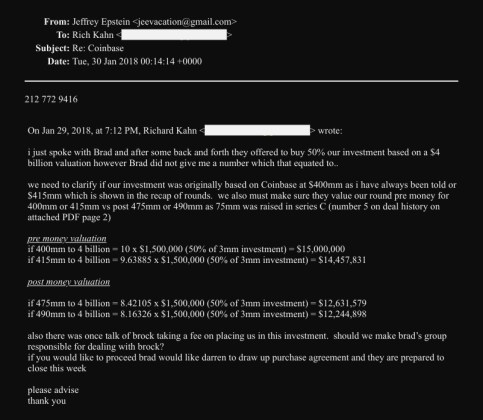
Newly unsealed Department of Justice documents have confirmed a bizarre footnote in crypto history: Jeffrey Epstein poured roughly $3.2 million into Coinbase back in 2014. At the time, Bitcoin was trading well below $1,000.

It wasn’t just a small punt, either. Records indicate that about half this stake was liquidated in 2018 for nearly $15 million, a windfall that underscores the staggering multiples generated by early infrastructure plays in the digital asset space.
Forget the name attached to the capital for a moment. What actually matters here, from a market structure perspective, is where the money went. In 2014, the biggest headache was simply buying Bitcoin; centralized exchanges (CEXs) like Coinbase solved that fiat on-ramp problem.

But today? The bottleneck has moved. It’s no longer about buying assets, but actually using them across a fragmented mess of blockchains. As the market digests these legacy gains, sophisticated traders are hunting for the next infrastructure fix: liquidity unification.

That search is funneling serious volume toward Layer 3 solutions, with LiquidChain ($LIQUID) emerging as a clear beneficiary.

Buy $LIQUID here.

Beyond Centralized Gatekeepers: LiquidChain Unifies Fragmented Ecosystems

The era defined by that 2014 investment was all about walled gardens, centralized entities holding custody to facilitate trade. While that worked for onboarding, it left us with a disjointed DeFi landscape where liquidity is trapped on isolated islands.

Bitcoin, Ethereum, and Solana currently operate as silos, forcing users to navigate risky bridges just to move capital. LiquidChain ($LIQUID) addresses this. The protocol (relatively new to the scene) isn’t trying to compete with these chains. Instead, it acts as the connective tissue between them.

LiquidChain operates as a Layer 3 (L3) Cross-Chain Liquidity Layer. It’s not just another bridge transferring tokens; it provides a single execution environment. This unlocks ‘atomic composability’, meaning you can execute a trade touching $BTC, $ETH, and $SOL liquidity simultaneously without ever leaving the interface.

For developers, the ‘Deploy-Once Architecture’ is the real hook. Instead of rewriting smart contracts for three different virtual machines (EVM, SVM, and Bitcoin script), teams deploy on LiquidChain once and instantly access users across every connected ecosystem.

The implications are massive. Just as Coinbase captured value by simplifying the purchase of Bitcoin, LiquidChain targets the value in simplifying the usage of Bitcoin in DeFi. By abstracting away the headache of cross-chain swaps, the protocol is chasing the institutional volume that currently sits on CEXs simply because on-chain UX is still too clunky.

Read the LiquidChain whitepaper.

Get your $LIQUID here.

Smart Money Rotates Into Layer 3 As LiquidChain Redefines Settlement

History suggests the highest ROI usually comes from solving the dominant infrastructure hurdle of the era.

In 2014, that was the exchange layer. In 2026? It’s interoperability. The buzz around LiquidChain ($LIQUID) comes down to its approach to verifiable settlement. Rather than trusting third parties, the protocol uses a Cross-Chain VM that cryptographically verifies transactions. It’s a necessary upgrade to reduce the counterparty risk that has plagued bridges for years.

The $LIQUID token fuels this entire ecosystem, handling liquidity staking and gas fees. The economic model looks aggressive: it’s designed to soak up value from the volatility of every chain it connects. If Bitcoin activity surges, LiquidChain benefits.
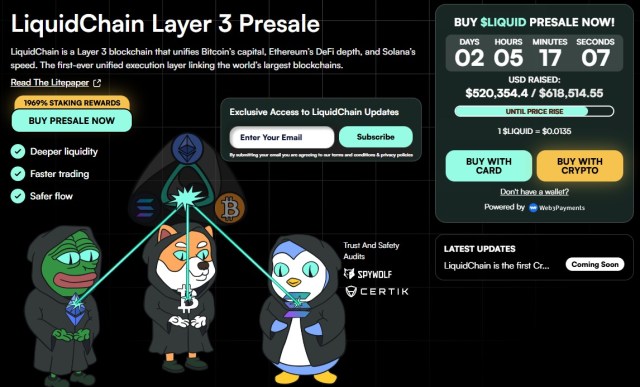
If Solana memecoins rally, LiquidChain captures fees from the cross-chain arbitrage. It offers “index-like” exposure to the broader market without forcing investors to pick a specific winning chain.

The contrast between legacy CEX investments and modern DeFi infrastructure is sharp. While those DOJ files are a stark reminder of the massive gains made by early gatekeepers, the current presale activity around LiquidChain suggests the next wave of capital is betting on a borderless, unified liquidity layer. Opportunities to back infrastructure protocols before mainnet launch don’t come around often.

Check out the LiquidChain presale.

Disclaimer: This article is for informational purposes only and does not constitute financial advice. Cryptocurrency investments, particularly in presale stages, carry high risks including volatility and potential loss of principal. Always conduct your own due diligence.


Related Questions

QAccording to the DOJ files, how much did Jeffrey Epstein invest in Coinbase in 2014 and what was the value of the partial liquidation in 2018?

AJeffrey Epstein invested roughly $3.2 million in Coinbase in 2014. Records indicate that about half of this stake was liquidated in 2018 for nearly $15 million.

QWhat is the primary market problem that LiquidChain ($LIQUID) aims to solve, according to the article?

ALiquidChain aims to solve the problem of fragmented liquidity across isolated blockchains (like Bitcoin, Ethereum, and Solana) by acting as a unified Layer 3 Cross-Chain Liquidity Layer, enabling atomic composability and simplifying cross-chain asset usage.

QWhat key feature does LiquidChain offer to developers to simplify building across multiple chains?

ALiquidChain offers developers a 'Deploy-Once Architecture,' which allows them to deploy their smart contracts on LiquidChain once and instantly gain access to users across every connected blockchain ecosystem, without needing to different virtual machines.

QHow does the $LIQUID token's economic model capture value from the broader cryptocurrency market?

AThe $LIQUID token is designed to capture value from the volatility and activity of every chain it connects. It benefits from fees generated by cross-chain transactions, such as when Bitcoin activity surges or Solana memecoins rally, providing 'index-like' exposure to the broader market.

QWhat does the article suggest is the current dominant infrastructure hurdle that represents the highest potential ROI, similar to the exchange layer in 2014?

AThe article suggests that the current dominant infrastructure hurdle, and thus the area with the highest potential ROI, is interoperability—solving the fragmentation and complexity of using assets across multiple, separate blockchains.

Related Reads

Google and Amazon Simultaneously Invest Heavily in a Competitor: The Most Absurd Business Logic of the AI Era Is Becoming Reality

In a span of four days, Amazon announced an additional $25 billion investment, and Google pledged up to $40 billion—both direct competitors pouring over $65 billion into the same AI startup, Anthropic. Rather than a typical venture capital move, this signals the latest escalation in the cloud wars. The core of the deal is not equity but compute pre-orders: Anthropic must spend the majority of these funds on AWS and Google Cloud services and chips, effectively locking in massive future compute consumption. This reflects a shift in cloud market dynamics—enterprises now choose cloud providers based on which hosts the best AI models, not just price or stability. With OpenAI deeply tied to Microsoft, Anthropic’s Claude has become the only viable strategic asset for Google and Amazon to remain competitive. Anthropic’s annualized revenue has surged to $30 billion, and it is expanding into verticals like biotech, positioning itself as a cross-industry AI infrastructure layer. However, this funding comes with constraints: Anthropic’s independence is challenged as it balances two rival investors, its safety-first narrative faces pressure from regulatory scrutiny, and its path to IPO introduces new financial pressures. Globally, this accelerates a "tri-polar" closed-loop structure in AI infrastructure, with Microsoft-OpenAI, Google-Anthropic, and Amazon-Anthropic forming exclusive model-cloud alliances. In contrast, China’s landscape differs—investments like Alibaba and Tencent backing open-source model firm DeepSeek reflect a more decoupled approach, though closed-source models from major cloud providers still dominate. The $65 billion bet is ultimately about securing a seat at the table in an AI-defined future—where missing the model layer means losing the cloud war.

marsbit3h ago

Google and Amazon Simultaneously Invest Heavily in a Competitor: The Most Absurd Business Logic of the AI Era Is Becoming Reality

marsbit3h ago

Computing Power Constrained, Why Did DeepSeek-V4 Open Source?

DeepSeek-V4 has been released as a preview open-source model, featuring 1 million tokens of context length as a baseline capability—previously a premium feature locked behind enterprise paywalls by major overseas AI firms. The official announcement, however, openly acknowledges computational constraints, particularly limited service throughput for the high-end DeepSeek-V4-Pro version due to restricted high-end computing power. Rather than competing on pure scale, DeepSeek adopts a pragmatic approach that balances algorithmic innovation with hardware realities in China’s AI ecosystem. The V4-Pro model uses a highly sparse architecture with 1.6T total parameters but only activates 49B during inference. It performs strongly in agentic coding, knowledge-intensive tasks, and STEM reasoning, competing closely with top-tier closed models like Gemini Pro 3.1 and Claude Opus 4.6 in certain scenarios. A key strategic product is the Flash edition, with 284B total parameters but only 13B activated—making it cost-effective and accessible for mid- and low-tier hardware, including domestic AI chips from Huawei (Ascend), Cambricon, and Hygon. This design supports broader adoption across developers and SMEs while stimulating China's domestic semiconductor ecosystem. Despite facing talent outflow and intense competition in user traffic—with rivals like Doubao and Qianwen leading in monthly active users—DeepSeek has maintained technical momentum. The release also comes amid reports of a new funding round targeting a valuation exceeding $10 billion, potentially setting a new record in China’s LLM sector. Ultimately, DeepSeek-V4 represents a shift toward open yet realistic infrastructure development in the constrained compute landscape of Chinese AI, emphasizing engineering efficiency and domestic hardware compatibility over pure model scale.

marsbit4h ago

Computing Power Constrained, Why Did DeepSeek-V4 Open Source?

marsbit4h ago

Trading

Spot
Futures

Hot Articles

Discussions

Welcome to the HTX Community. Here, you can stay informed about the latest platform developments and gain access to professional market insights. Users' opinions on the price of S (S) are presented below.

活动图片