Dogecoin has been sprinting this week! After a mild pace in late 2025, the memecoin is suddenly up and lively. So what flipped the switch this time?
Dogecoin wakes up!
Share
- Share
- Tweet
-
ambcryptoPublished on 2026-01-08Last updated on 2026-01-08
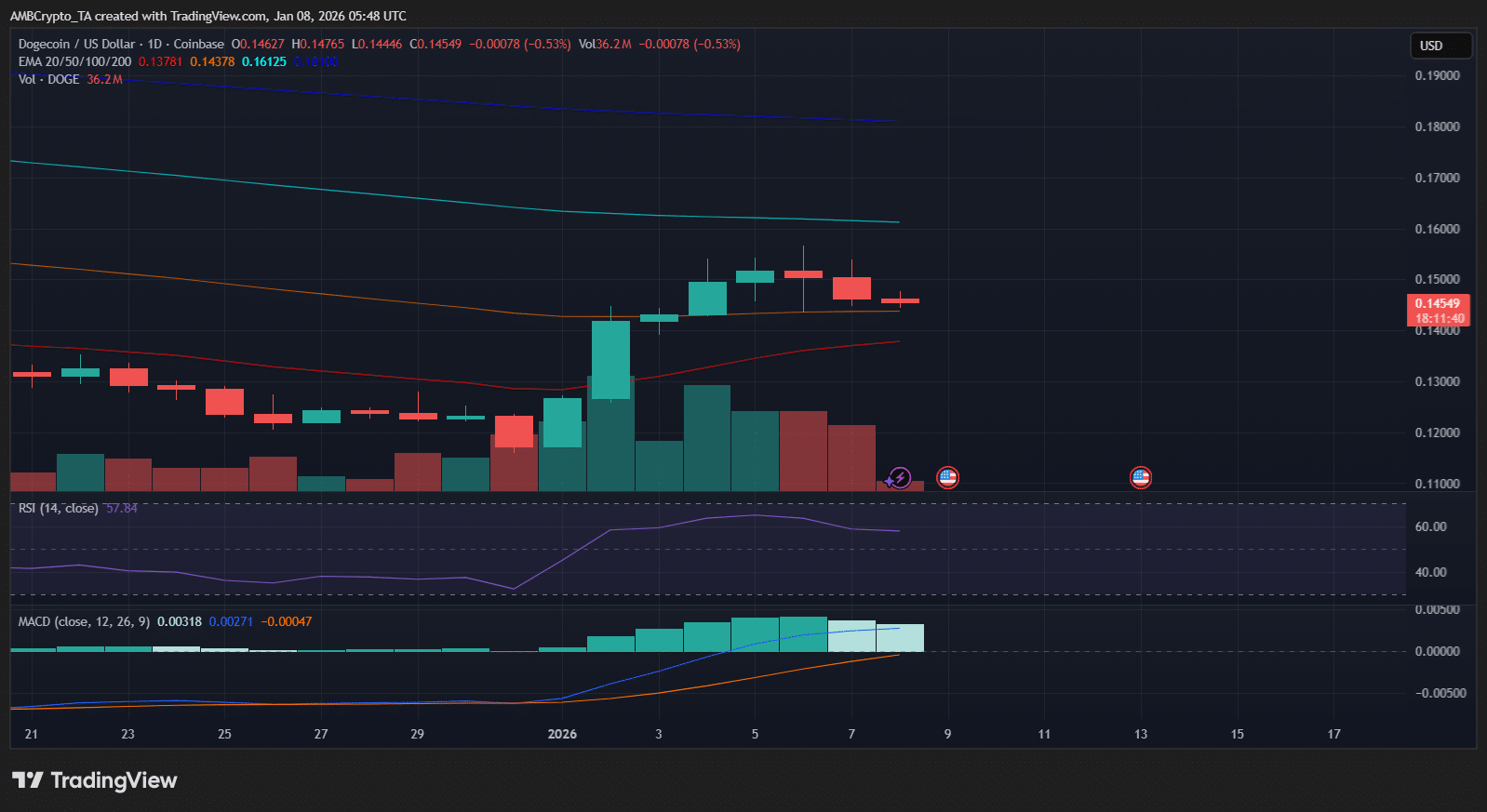
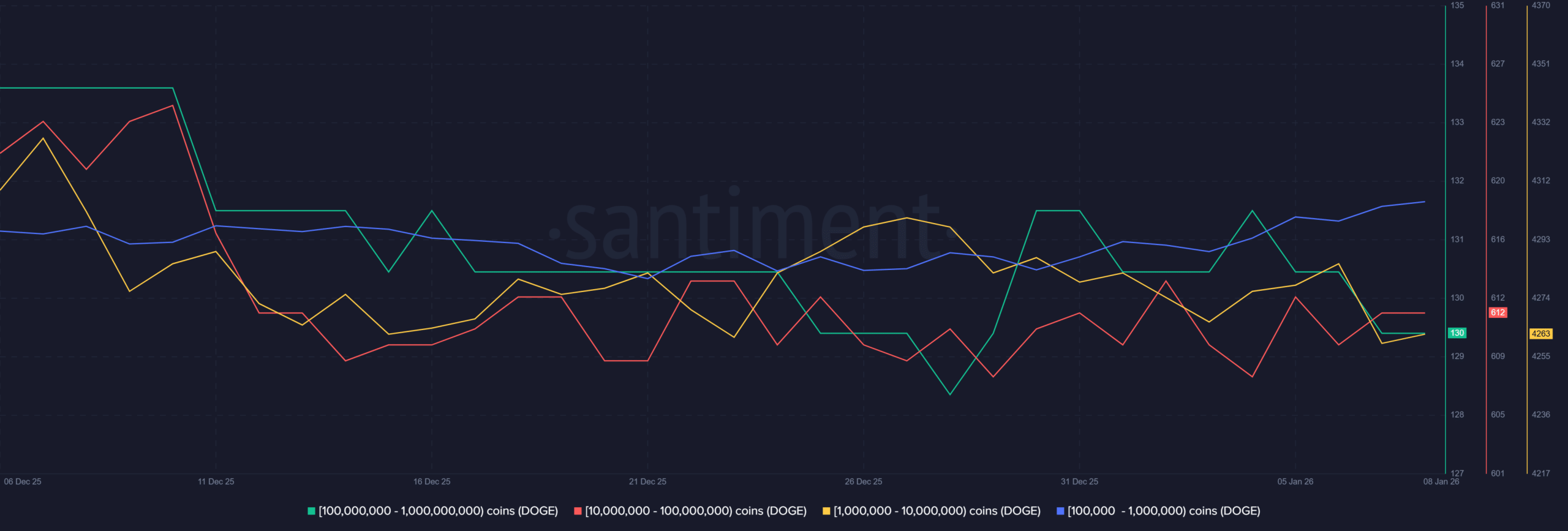
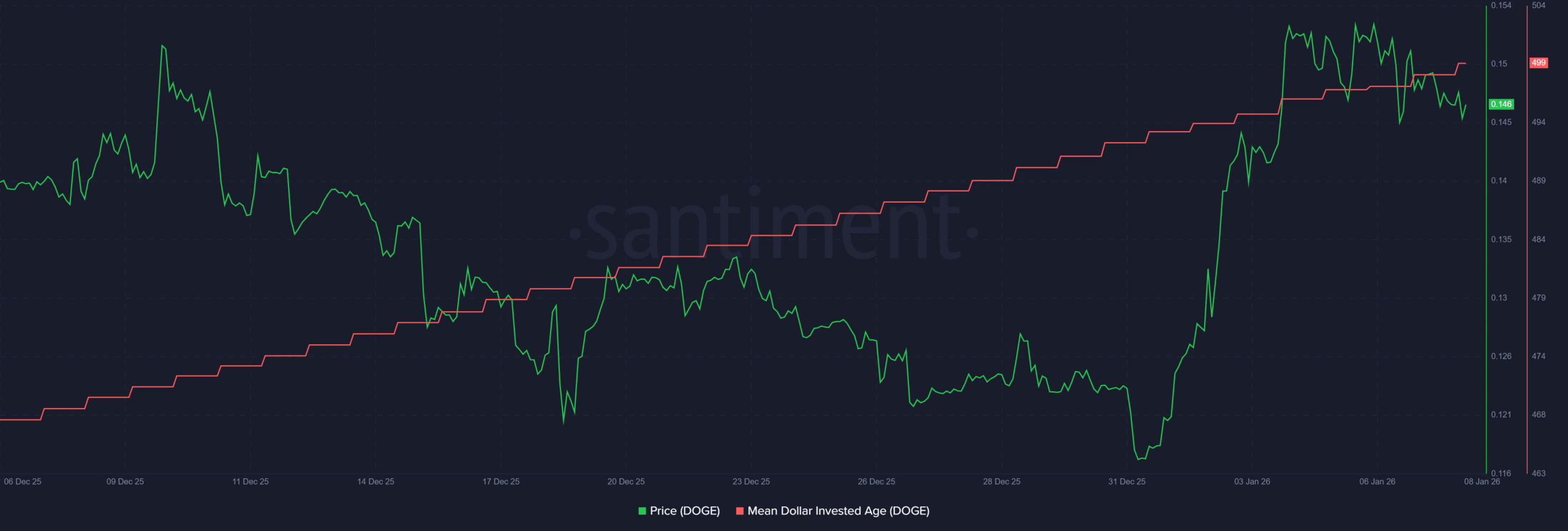
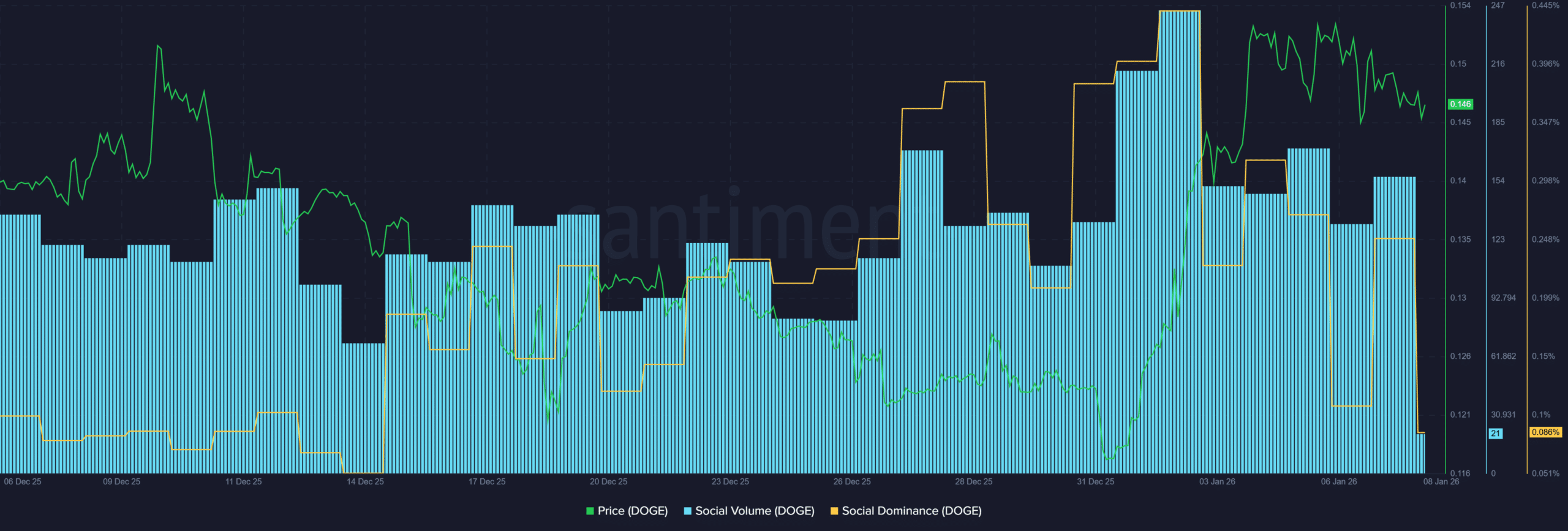
Dogecoin surged 23% this week, breaking out of its recent trading range and approaching the $0.15 level. The rally was supported by a significant increase in trading volume, indicating genuine buying interest rather than speculative air. Key technical indicators turned bullish: the RSI showed strength without immediate exhaustion, and the MACD flipped positive, confirming a short-term trend reversal. Notably, large holders (whales) did not sell into the rally. Wallets holding between 100 million and 1 billion DOGE remained stable, with no signs of major profit-taking. Meanwhile, the Mean Dollar Invested Age continued to rise, suggesting reduced selling pressure from older coins. This combination created a favorable environment for price appreciation. Social volume and mentions of Dogecoin increased significantly, driven by a broader memecoin revival that also boosted tokens like PEPE, POPCAT, and MOG. While social dominance hasn’t peaked yet, growing attention could provide further momentum. In summary, DOGE’s rally appears sustainable—supported by technical strength, quiet whales, low selling pressure, and increasing social buzz.
Dogecoin has been sprinting this week! After a mild pace in late 2025, the memecoin is suddenly up and lively. So what flipped the switch this time?
QWhat was the percentage increase in Dogecoin's price mentioned in the article?
ADogecoin's price jumped 23%.
QWhich technical indicators confirmed the bullish trend for Dogecoin according to the analysis?
AThe RSI indicated bullish interest with minimal exhaustion, and the MACD flipped positive, confirming the short-term trend change.
QWhy does the article suggest that whales' inactivity is significant for DOGE's price movement?
AWhales' inactivity means there was no heavy resistance or profit-taking from large holders, creating an environment for the price to move higher with reduced selling pressure.
QWhat on-chain metric showed that older coins were not being spent, indicating less selling pressure?
AThe Mean Dollar Invested Age continued to climb, indicating fewer older coins were being spent and thus reducing selling pressure.
QWhich other memecoins were mentioned as part of the sector revival that contributed to increased social volume and attention?
APepe (PEPE), Popcat (POPCAT), and Mog Coin (MOG) were mentioned as part of the memecoin revival driving social volume and sector interest.
Cat in a Dogs World (MEW) is a cat-inspired MEME token on Solana.
21.2k Total ViewsPublished 2024.07.05Updated 2024.07.05

Doge Matrix ($doge m): The New Breed of Community-Driven Cryptocurrency Introduction In the ever-evolving landscape of cryptocurrency, new projects constantly emerge, each aiming to capture the interest of investors and enthusiasts alike. One of the latest entrants to this domain is Doge Matrix, represented by the ticker symbol $doge m. This project has attracted attention thanks to its roots in the popular meme culture surrounding Dogecoin, establishing its place within the web3 space. This article aims to provide a comprehensive analysis of Doge Matrix, covering its overview, creator, investors, functionality, timeline, and notable aspects. What is Doge Matrix ($doge m)? Doge Matrix is a community-driven cryptocurrency project that seemingly builds upon the widespread appeal of Dogecoin, a digital currency known for its Shiba Inu mascot and its meme origins. While the overarching objectives of Doge Matrix are not extensively defined, it is characterized by a commitment to harnessing community involvement and support. Unlike traditional cryptocurrencies that often emphasize utility or intrinsic value through underlying technologies, Doge Matrix positions itself within a space that embraces the cultural phenomenon of cryptocurrencies, particularly appealing to those who resonate with the ethos of meme-based assets. Drawing on the strengths of the Dogecoin community, Doge Matrix operates as part of a broader ecosystem, inviting participation and engagement from users who share an interest in cryptocurrency and the digital landscape. Who is the Creator of Doge Matrix ($doge m)? The identity of the creator of Doge Matrix remains unknown. This lack of transparency is not an uncommon occurrence in the cryptocurrency space, where some projects are launched without revealing the identities of their founders. The absence of information regarding the founding team can raise questions among potential investors about the project’s accountability and direction. Who are the Investors of Doge Matrix ($doge m)? As it stands, there is no publicly available information detailing the investors or investment foundations that back Doge Matrix. The project appears to rely primarily on community support rather than institutional investment. This model aligns with the community-driven nature of the initiative, fostering an environment where the direction of the project is shaped by its participants rather than being dictated by a select few financial backers. How Does Doge Matrix ($doge m) Work? The specifics regarding the operational mechanisms of Doge Matrix are somewhat vague, reflecting a broader trend of projects in the meme coin space where innovative functionalities are not always clearly articulated. Nonetheless, Doge Matrix seems designed to tap into the existing cryptocurrency ecosystem by encouraging user participation while tapping into the familiar cultural references associated with Dogecoin. Its potentially unique characteristics derive from community interactions rather than technological advancements, emphasizing shared experiences and collaboration among token holders. While the exact innovations have not been explicitly outlined, the project appears to create a space where community members can engage, share ideas, and propel the project's potential forward. Timeline of Doge Matrix ($doge m) Reflecting on the project’s timeline reveals notable events that have defined its journey thus far: November 25, 2024: Doge Matrix reached its all-time high value, marking a significant milestone in its early history. January 1, 2025: Conversely, Doge Matrix hit its all-time low value, illustrating the volatility often associated with cryptocurrencies, especially in the early stages of a project's lifecycle. Ongoing: The project continues to be actively traded and supported by its community, although specific future milestones or objectives have yet to be disclosed. Key Points About Doge Matrix ($doge m) Community Focus At the heart of Doge Matrix is a commitment to community engagement. The project thrives on the premise of collaboration and shared objectives among its members, emphasizing the importance of collective effort. Unlike centralized projects that often have a defined leadership structure, Doge Matrix at present showcases a more fluid approach to governance, where every community member's voice matters. Volatility The cryptocurrency market is notorious for its volatility, and Doge Matrix is no exception. Its price history reflects significant fluctuations between high and low values, which is typical of many new cryptocurrencies but underscores the risks associated with investment in emerging tokens. Lack of Detailed Information One of the most striking features about Doge Matrix is the scarcity of detailed information regarding its technological underpinnings and operational mechanisms. This ambiguity necessitates that potential investors conduct thorough due diligence before engaging with the project. Conclusion In summary, Doge Matrix ($doge m) illustrates a new wave of cryptocurrency projects that lean heavily on community engagement and cultural relevance. While lacking in certain specifics—such as clear leadership, defined objectives, and detailed functionality—the project has managed to generate interest within the crypto community, leveraging the established appeal of meme culture. As with any investment in the cryptocurrency space, understanding the inherent risks and conducting comprehensive research is essential for potential participants. Doge Matrix stands as a reminder of the dynamic, sometimes unpredictable nature of the crypto industry, marked by constant evolution and enthusiasm for community-driven initiatives.
3.1k Total ViewsPublished 2025.02.03Updated 2025.02.03

Fifty undisclosed wallets have withdrawn $96M in PIPPIN from exchanges since October, signaling whale accumulation but also raising concerns over potential token manipulation.
37.9k Total ViewsPublished 2025.12.09Updated 2025.12.09