Delphi Labs Founder: Two Weeks Deep in China's AI, Shenzhen Hardware Shocks Me, Software Valuations Scare Me

marsbitPublished on 2026-03-26Last updated on 2026-03-26

Abstract

Delphi Labs co-founder José Maria Macedo spent two weeks in China meeting AI founders, VCs, and public company CEOs. His key takeaways: - **Hardware ecosystem in Shenzhen is impressive**, with systematic reverse-engineering of Western products and rapid iteration cycles. Companies like Bambu Lab are highly profitable and scaling fast. - **Software ecosystem is weaker than expected**. Chinese open-source models are strong, but closed-source models lag behind Western counterparts. GPU access remains constrained, and revenue gaps are significant (e.g., Anthropic’s $6B ARR vs. Chinese model companies at tens of millions). - **Founder profiles are highly accomplished** (top universities, Big Tech experience) but often lack rebellious, original vision. The education and VC systems favor execution over true innovation. - **Valuation bubbles exist** at both early and late stages. Some private AI companies are valued at 400x ARR, far exceeding Western multiples. Humanoid robotics is also overheating, with many pre-revenue companies targeting high-valuation IPOs. - **Information asymmetry favors Chinese founders**, who are highly informed about Western markets and tech trends. Many are building globally first, combining Chinese engineering with Western go-to-market strategies. Macedo believes the real alpha lies in finding non-traditional founders who break the "resume template" optimized by local VCs.

Author: José Maria Macedo, Delphi Labs Cofounder

Compiled by: Deep Tide TechFlow

Deep Tide Guide: The founder of Delphi Labs spent two weeks intensively visiting China's AI ecosystem, meeting a large number of founders, investors, and CEOs of listed companies.

His conclusion was unexpected: more optimistic about hardware than expected, more pessimistic about software than expected, and his views on Chinese founders overturned his previous perceptions.

The article also covers hot topics such as valuation bubbles, the humanoid robotics sector, and information asymmetry between China and the West.

Full text as follows:

I spent two weeks in China, meeting a large number of founders, VCs, and CEOs of listed companies within the AI ecosystem. Before going, I was bullish on this ecosystem, expecting to see world-class AI talent working at valuations far lower than in the West.

My perspective changed when I left—it became more specific: hardware is stronger than I imagined, software is weaker than I imagined, and some observations about Chinese founders also surprised me.

The Founder Problem

The exceptional founders I've invested in share a common trait: independent thinking, rebelliousness, extreme focus, and obsession. They don't follow the rules. They constantly ask "why" and refuse to accept second-hand wisdom. The decisions they make seem inexplicable to outsiders but feel obvious to them. They possess an intrinsic, unstoppable intensity, often manifested as a long-term obsession and excellence. As a VC who meets many smart people daily, this type of person stands out instantly in a crowd because their life trajectory has a distinct "sharpness."

Many founders I met in China were of another type, which surprised me.

They are extremely outstanding—top university degrees, resumes from ByteDance or DJI, Nature papers, multiple patents. In the West, these achievements are only for the top technical talents; in China, they are the entry ticket. They also work harder than almost anyone I've met. We had meetings at all hours, non-stop even on weekends, rushing between cities. One founder met with us on the day his wife gave birth.

But independent thinking, rebellious spirit, and a vision from 0 to 1—these were harder to find. The founders' backgrounds are highly similar, pitches are more conservative, and many ideas are upgrades of existing products (impressive V2) rather than truly original bets. Given the massive scale of technical talent China produces, I expected to encounter more people "showing up with ideas I've never heard of."

My interpretation: China's education system cultivates excellence but doesn't leave enough room for deviation. It produces top executors skilled at solving known problems, not the type who "show up with a problem nobody knew existed."

VCs Are Reinforcing This Model

More interestingly, local investors are exacerbating this trend.

The investment logic of most Chinese funds is based on one premise: invest in the best people coming out of ByteDance or DJI. They look at resumes, not edge; background, not conviction. The VCs' own profiles are similar—coming from big companies, consulting, or investment banking, much like European VCs a decade ago.

Ironically, historically, the Chinese founders who truly built great companies mostly never worked in big companies. Jack Ma was an English teacher who took the college entrance exam twice. Ren Zhengfei founded Huawei at 43, previously being in the military. Liu Qiangdong started by selling goods at a market stall. Wang Xing dropped out of his PhD to start a business. More recently, Liang Wenfeng, who created DeepSeek, never worked anywhere outside his own company. These people are outliers, those without "standard resumes"—precisely the ones the current investment system would miss.

Finding these people offers real alpha, but currently, few seem to be looking there.

Shenzhen and the Hardware Ecosystem

The most shocking thing I saw in China wasn't some startup's pitch.

It was Shenzhen's hardware underground workshops—engineers systematically obtaining high-end Western products, disassembling them part by part, and reverse-engineering everything in an extremely rigorous way. Walking out, I was genuinely unsure if most Western hardware founders understand what they're competing against. The network effects here aren't theoretical; they are physical, dense, and built up over decades.

The entrepreneurs we met confirmed this with data: over 70% of hardware investment comes from the Greater Bay Area, close to 100% from within China—this means iteration cycles are something Western hardware companies simply cannot match.

Most founders I met are using DJI's playbook: make consumer hardware in a niche—electric wheelchairs, lawn mowing robots, new-generation fitness equipment—grow revenue to 8 or 9 figures (USD), then leverage the customer base or underlying technology to move into adjacent categories. Some companies are already much larger than you think. The strongest company I saw on this trip was Bambu Lab, a 3D printing company most Westerners haven't heard of, reportedly with annual profits of $500 million, doubling every year.

Bearish on Chinese Software

I left more skeptical about Chinese software opportunities than when I arrived.

At the model level, China's open source is indeed strong, but closed-source models still have a noticeable gap compared to the best in the West, and the gap might be widening. The capital expenditure gap is huge. GPU access is still restricted. Western labs are increasingly cracking down on distillation. The revenue numbers say it all: Anthropic reportedly did $6 billion ARR in February alone. The best Chinese model companies have ARR in the tens of millions of dollars.

On the software startup side, the mainstream profile is PMs and researchers from ByteDance, making agentic or ambient consumer software for Western markets. The talent is indeed strong, but many of these products fall right within the feature set that big labs will natively release—one update could render them obsolete. Another thing that surprised me: China lacks large, fast-growing private software companies. In the West, besides model companies, there is a batch of startups already doing 9-figure or even 10-figure ARR with astonishing growth—Cursor, Loveable, ElevenLabs, Harvey, Glean. This tier of breakthrough private software companies basically doesn't exist in China—exceptions like HeyGen, Manus, GenSpark, who left after succeeding.

Valuation Bubble

Despite the weak software side, the bubble is real—both early and late stage.

Early on, the very top talent from ByteDance, DeepSeek, and Moonshot AI is indeed significantly cheaper than equivalent US talent, but median valuations have converged. Pre-product consumer startups valued at $100-200 million are common. Pre-seed rounds over $30 million are not unheard of.

The late-stage numbers are harder to justify. MiniMax is valued at around $40 billion on the public market, with ARR under $100 million—roughly 400x revenue. Zhipu is around $25 billion for $50 million revenue. For comparison: OpenAI's highest valuation round was roughly 66x ARR, Anthropic around 61x.
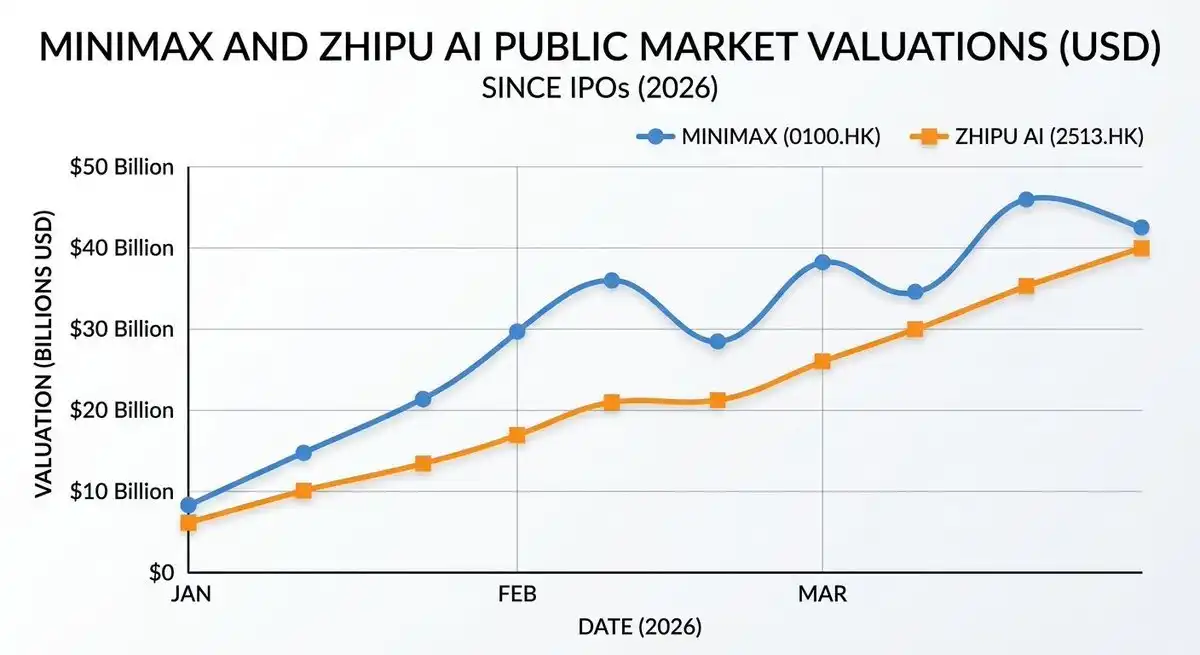
Private model companies like Moonshot AI use these public market comps to fundraise—jumping from $6 billion to $10 billion to $18 billion within months. Friends in crypto will be familiar with this playbook: investors compare private valuations to a public market price "pre-unlock." Furthermore, Zhipu and MiniMax can maintain these levels partly because they are currently the only way to get exposure to the "China AI narrative," which itself carries a premium. But as more companies list, this premium will dilute. Finally, IPO windows have a characteristic—they slam shut without warning. No one can guarantee you'll close this arbitrage before the comps move.

The humanoid robotics sector is in a similar situation. China has about 200 humanoid robotics companies, around 20 have raised over $100 million, several are valued in the billions—almost all with no revenue, most planning HK IPOs in 2026 or 2027. If this market is real, China's hardware advantage makes the long-term landscape relatively clear. But commercialization might be much slower than the current funding pace suggests, and I doubt the HK market can support the dozens of multi-billion dollar humanoid robotics companies currently queuing for IPO. I'm staying away for now.

Notable Information Asymmetry

One thing took me by surprise: almost every founder I met is targeting the global market first, then China. They use Claude Code, listen to Dwarkesh's podcasts, and know the San Francisco startup ecosystem inside out—often more than Western investors who haven't been keeping up.

Western hostility towards China is noticeably greater than Chinese hostility towards the West. Chinese founders see no contradiction in combining China's engineering execution and hardware depth with Western go-to-market and product thinking. When this combination comes together in the right founding team, it can birth some truly remarkable companies.

Finding these founders—those who don't fit the "standard resume template" optimized by the local VC system—is what we are doing now.

Special thanks to @woutergort for opening up his excellent Chinese network, @PonderingDurian for organizing the trip, and Claude for patiently editing my ramblings on the plane.


Related Questions

QWhat were the author's main observations about Chinese AI hardware and software ecosystems after his two-week visit?

AThe author became more bullish on Chinese hardware than expected, impressed by Shenzhen's hardware ecosystem and reverse engineering capabilities, but more pessimistic about Chinese software due to significant gaps in closed-source AI models compared to the West and lack of large, fast-growing private software companies.

QHow did the author describe the typical profile of Chinese founders he met, and what was missing?

AThe author found Chinese founders highly accomplished with elite educations and work experience at companies like ByteDance or DJI, but noted a lack of independent thinking, rebellious spirit, and original vision compared to Western founders who often pursue unconventional ideas.

QWhat role do Chinese VCs play in shaping the founder landscape according to the author?

AChinese VCs reinforce a pattern of investing in founders with impressive resumes from top companies like ByteDance or DJI, rather than seeking out unconventional thinkers with unique visions, potentially missing innovative outliers like many historically great Chinese entrepreneurs.

QWhat did the author identify as major valuation bubbles in China's AI sector?

AThe author highlighted massive valuation bubbles in both early and late-stage AI companies, with examples like MiniMax valued at ~$40B (400x ARR) and Zhipu at ~$25B (500x ARR), far exceeding Western multiples, and similar bubbles in humanoid robotics companies with high valuations despite no revenue.

QWhat surprising observation did the author make about information asymmetry between Chinese and Western ecosystems?

AThe author found that Chinese founders were highly knowledgeable about Western ecosystems (using Claude Code, following Silicon Valley trends), while Western counterparts showed greater hostility toward China, creating an asymmetry where Chinese founders better understand Western markets than Westerners understand Chinese capabilities.

Related Reads

Is the Sharp Decline Over? Let the Data Speak

**Has the Sharp Decline Ended? Let Data Speak** Bitcoin's recent significant drop has placed short sellers in a precarious position. Three concurrent pressures—sustained outflows from ETFs, miners offloading coins to exchanges, and short-term holders capitulating—pushed the price near $63k. The asset fell 13% this week and 21% this month, roughly halving from its all-time high. A critical data point is the extremely crowded short positioning, with a short-to-long ratio reaching 8:1, representing nearly $100 billion in short interest overhead. This creates conditions for a potential short squeeze if selling pressure merely pauses, similar to the event in November 2022 which triggered a 24% rally. The selling pressures are real: spot Bitcoin ETFs have seen a record $5.4 billion outflow over 20 days. Short-term holders moved 53k loss-held BTC to exchanges in a day, and miners sent 24k BTC to Binance, a six-month high. Capital is also rotating towards AI and tech stocks like SpaceX, with $400 billion invested in AI infrastructure recently. However, on-chain data shows accumulation by long-term holders, who added 200k BTC in a month, and institutions/miners have absorbed 1.24 million BTC since 2023. This indicates strong buying beneath the surface. Key levels to watch are the $67k-$70k zone (2021 high & 2024 breakout point). A swift recovery above it suggests a leverage washout; failure could test $60k-$55k. The direction also hinges on ETF flow reversal. Currently, the S&P 500 hits new highs driven by AI, while Bitcoin and DeFi (TVL down from $173b to $73.9b) lag. The most probable path is a grinding basing process between $60k-$58k with continued ETF outflows. A less likely but explosive scenario involves a sudden flow reversal, a surge above $70k triggering a short squeeze, and a rally back above $76k. The immediate trigger depends on when the relentless selling pauses. A final cautionary note questions Bitcoin's correlation: if the high-flying U.S. stock market corrects, will Bitcoin once again miss the rally but not the decline?

foresightnews_api2m ago

Is the Sharp Decline Over? Let the Data Speak

foresightnews_api2m ago

Single-Day Plunge of 30%, Arthur Hayes Suddenly Liquidates: Why Did ZEC Get Exploded by Security Issues?

On June 5th, Zcash founder Zooko Wilcox disclosed a critical soundness vulnerability in the project's latest Orchard privacy pool. This flaw, found in the elliptic curve multiplication constraints, could allow an attacker to create unlimited counterfeit ZEC within the shielded pool, with transactions appearing valid. The vulnerability was discovered in late May by security researcher Taylor Hornby, who utilized Anthropic's new Opus 4.8 AI model for a targeted audit. The Zcash ecosystem had already performed an emergency network upgrade to patch the issue. However, the detailed disclosure triggered severe market panic, causing ZEC's price to plummet over 30% in a single day. Notably, prominent investor Arthur Hayes announced he had sold his entire ZEC position following the news. The incident starkly challenges the "technological trust" narrative central to privacy coins. Despite years of top-tier cryptographic audits, the bug persisted until uncovered with advanced AI-assisted research. This highlights the growing gap between theoretical perfection and practical implementation in privacy technology. The event serves as a industry-wide warning: in an AI-driven security landscape, the assumption that "undiscovered equals safe" is obsolete. It underscores the urgent need for continuous, proactive security practices combining AI audits, formal verification, and rapid response mechanisms.

foresightnews_api1h ago

Single-Day Plunge of 30%, Arthur Hayes Suddenly Liquidates: Why Did ZEC Get Exploded by Security Issues?

foresightnews_api1h ago

Breaking the Curse of DeFi Cascading Liquidations, Vitalik Proposes a New Solution

**Vitalik Buterin Proposes New DeFi Design to Eliminate Forced Liquidations** Ethereum co-founder Vitalik Buterin has published a proposal for a new decentralized finance (DeFi) architecture aimed at removing the automatic liquidation mechanisms prevalent in current lending protocols. The core idea involves creating synthetic assets using options as building blocks, fundamentally avoiding the抵押借贷结构 that triggers forced sell-offs. The proposal responds to a recurring flaw in DeFi: during sharp market downturns, mass自动清算 of under-collateralized positions can exacerbate price declines, creating systemic selling pressure and market instability, as evidenced by recent crypto market volatility. Buterin's model would split an asset like 1 ETH into two option-like derivatives, P and N, pegged to a price index with a set strike price and expiration. At expiry, an oracle determines the settlement price to allocate the underlying ETH between P and N holders. This design eliminates the "cliff" of instant liquidation. Instead, a position's value would gradually drift from its target peg if not actively rebalanced by the user, transferring the rebalancing decision from the protocol to the user or automated tools. A key advantage is the reduced reliance on high-frequency, real-time oracle price feeds, which are vulnerable to manipulation and errors in current systems. The delayed settlement in the options model allows for more robust, fault-tolerant oracle designs. However, significant challenges remain for practical adoption. High transaction costs (slippage) from frequent rebalancing on automated market makers (AMMs) could erode user funds. The model may not be suitable for stablecoins requiring a strict 1:1 dollar peg, as it inherently allows for value drift. Success would depend on developing new liquidity provisioning models and deep markets for these synthetic assets. The proposal represents a fundamental rethinking of DeFi risk management, challenging the industry to explore alternatives to被动集中平仓 rather than merely optimizing existing liquidation processes. It remains a theoretical framework awaiting implementation and testing by development teams.

foresightnews_api1h ago

Breaking the Curse of DeFi Cascading Liquidations, Vitalik Proposes a New Solution

foresightnews_api1h ago

Bitcoin's Decline Marks the Transformation of Crypto

Title: The Decline of Bitcoin Marks the Transformation of Crypto While Bitcoin's price recently fell below $70,000, down approximately 45% from its peak, the broader crypto industry is not following it into decline. Instead, crypto is maturing and evolving beyond its dependence on Bitcoin's price movements. Two of Bitcoin's core functions are being usurped. First, AI has captured its role as the primary speculative asset. AI, with its tangible revenue, explosive demand, and massive capital inflows ($700-830 billion in 2024), is siphoning off the speculative "hot money" that once drove Bitcoin. It also contributes to a sustained high-interest-rate environment, further tightening liquidity for assets like Bitcoin. Second, dollar-pegged stablecoins like USDC and USDT have replaced Bitcoin as the crypto market's foundational currency and primary on/off-ramp. Most trading pairs and on-chain transactions are now settled in stablecoins, severing the historical link where all capital inflows had to pass through Bitcoin first. This decoupling allows projects to thrive based on their own fundamentals rather than Bitcoin's price. Examples include Hyperliquid, an on-chain derivatives exchange with annual revenues of $8-13 billion, and prediction market platform Polymarket, valued at $200 billion with $3.65 billion in annual fees. These projects are evaluated on traditional metrics like revenue and user growth. New opportunities are emerging, particularly around privacy. Privacy coins like Zcash (ZEC) are seeing surging demand, while infrastructure like NEAR enables private, cross-chain asset transfers without requiring users to hold a specific token—privacy becomes a universal service layer. In this new paradigm, stablecoins are the universal cash, various project tokens represent equity, and privacy-enabled cross-chain coordination layers (like NEAR) act as the critical infrastructure connecting a fragmented, multi-chain ecosystem. Bitcoin is now just one asset among many. The era where the entire crypto market moved in lockstep with Bitcoin is over. The industry's health should now be judged by project fundamentals—real revenue, active users, and tokenomics that capture value—and the development of the underlying infrastructure enabling a mature, dollar-denominated crypto economy.

foresightnews_api1h ago

Bitcoin's Decline Marks the Transformation of Crypto

foresightnews_api1h ago

Trading

Spot
Futures

Hot Articles

Discussions

Welcome to the HTX Community. Here, you can stay informed about the latest platform developments and gain access to professional market insights. Users' opinions on the price of S (S) are presented below.

活动图片