DDC Extends Its Bitcoin Accumulation Streak: The $LIQUID Presale Brings Smoother Cross-Chain Actions

bitcoinistPublished on 2026-02-05Last updated on 2026-02-05

Abstract

DDC continues its Bitcoin accumulation strategy, purchasing an additional 105 BTC, signaling a corporate shift toward treating Bitcoin as a treasury asset rather than speculative investment. This institutional buying reduces liquid supply, potentially causing a supply shock and price appreciation. However, it also creates liquidity fragmentation, making it difficult to use Bitcoin on high-performance chains like Ethereum or Solana. LiquidChain ($LIQUID), a Layer 3 protocol, aims to solve this by unifying liquidity from major blockchains into a single execution environment. Its architecture allows developers to build applications that access users and assets across chains simultaneously, enabling seamless cross-chain actions like using Bitcoin collateral on a Solana DEX. The project's presale has raised over $527K, with the $LIQUID token priced at $0.01355, attracting investors betting on infrastructure that abstracts away blockchain complexity for users.

DDC extends its Bitcoin accumulation streak. That move marks yet another chapter in the corporate race to secure hard assets on balance sheets.

It reinforces a shift we’ve been tracking for months: non-crypto native entities are no longer viewing digital gold as a speculative punt, but as a treasury imperative. Seen as DDC bought another $105 BTC. This aligns with the aggressive strategies seen from Strategy and Semler Scientific, basically, a vote of no confidence in cash reserves and a pivot toward scarce digital property.
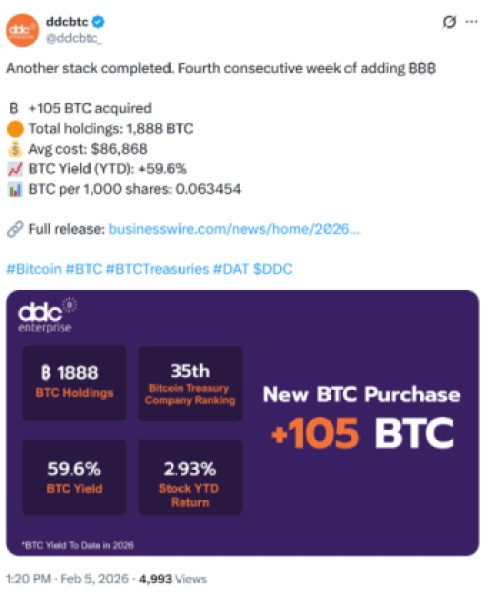
The specific dollar amount matters less than the signal: supply is vanishing. When corporate treasuries send Bitcoin to cold storage, they rip liquid supply from the market. This sets the stage for a ‘supply shock’ dynamic that historically triggers violent price appreciation. But there’s a catch.

This institutional hoarding creates a secondary problem, liquidity fragmentation. As capital gets trapped in the ‘store of value’ silo, utilizing that value on high-performance ecosystems like Solana or Ethereum becomes incredibly difficult (and risky) without centralized intermediaries.

That friction, between holding rigid assets and using agile DeFi, is the industry’s current bottleneck. While DDC and its peers lock down the asset layer, the market needs infrastructure to make that capital productive without selling it.

This narrative shift from simple accumulation to active utilization is driving interest toward interoperability solutions, specifically, LiquidChain ($LIQUID), a Layer 3 protocol built to solve this exact fragmentation headache.

LiquidChain L3 Architecture Unifies Fragmented Ecosystems For Seamless Execution

Let’s be honest: the current state of blockchain interoperability is a mess of inefficient bridges and risky ‘wrapped’ assets. When institutions or retail users want to move value from Bitcoin to Ethereum or Solana, they typically face high fees, anxiety-inducing wait times, and the security risk of custodial bridges.

LiquidChain flips this script by positioning itself as a Layer 3 (L3) infrastructure that fuses liquidity from these major chains into a single execution environment.

What makes LiquidChain different is its ‘deploy-once’ architecture. Developers can build applications on the LiquidChain L3 that instantly access users and assets on Bitcoin, Ethereum, and Solana.
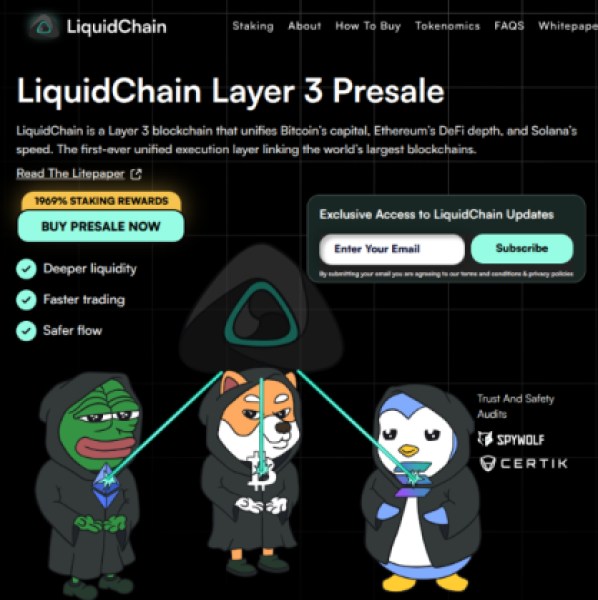
This eliminates the need to maintain three separate codebases. For a market increasingly dominated by multi-chain activity, that technical capability is critical. It allows for verifiable settlement and single-step execution; theoretically, a user could use Bitcoin collateral to execute a trade on a Solana-based DEX without ever manually bridging assets.

The implications for liquidity efficiency are profound. By acting as a Unified Liquidity Layer, LiquidChain reduces the slippage and capital inefficiency that plague fragmented markets. As corporate entities continue to accumulate Bitcoin, the demand for non-custodial ways to generate yield on those assets, or use them as transaction fuel across other networks, will likely drive adoption for this specific type of L3 infrastructure.

EXPLORE THE UNIFIED LIQUIDITY LAYER AT LIQUIDCHAIN

Early Adopters Target The $LIQUID Presale As Infrastructure Plays Heat Up

While headlines fixate on spot Bitcoin buys, smart money is increasingly rotating into the ‘pick and shovel’ plays, the infrastructure rails that will support the next cycle’s volume.

Infrastructure plays historically command high valuations because they service the entire ecosystem rather than a single niche. The LiquidChain presale has emerged as a focal point for investors looking to hedge against liquidity fragmentation.

LiquidChain ($LIQUID) has already raised $527K, signaling robust early interest despite the market’s recent consolidation. The token, $LIQUID, is currently priced at $0.01355. This entry point is garnering attention because it represents a valuation heavily discounted compared to established Layer 2 or cross-chain protocols.

That funding goes directly into the Cross-Chain VM (Virtual Machine), the engine powering the protocol’s interoperability features.

You could see the $0.01355 price point not just as a speculative entry, but as a bet on the ‘abstraction’ narrative, the idea that future users won’t care which chain they are on, as long as the liquidity is available.

By smoothing out the clunky user flows that currently hold DeFi back, LiquidChain positions itself to capture volume from both retail traders and institutional desks looking for smoother execution.

CHECK OUT THE OFFICIAL $LIQUID PRESALE

This article is for informational purposes only and does not constitute financial advice. Cryptocurrencies are volatile; conduct your own due diligence before investing.


Related Questions

QWhat is the main reason DDC's continued Bitcoin accumulation is significant according to the article?

AIt signals a shift where non-crypto native entities view Bitcoin not as a speculative asset but as a treasury imperative, reinforcing the trend of corporations securing hard assets and reducing liquid supply, which could lead to a supply shock.

QWhat specific problem does institutional Bitcoin hoarding create, as mentioned in the text?

AIt creates liquidity fragmentation, where capital gets trapped in the 'store of value' silo, making it difficult and risky to utilize that value on high-performance ecosystems like Solana or Ethereum without centralized intermediaries.

QHow does LiquidChain's Layer 3 architecture aim to solve blockchain interoperability issues?

ALiquidChain acts as a unified liquidity layer with a 'deploy-once' architecture, allowing developers to build applications that instantly access users and assets from Bitcoin, Ethereum, and Solana, enabling verifiable settlement and single-step execution without manual bridging.

QWhat is the current price of the $LIQUID token in its presale, and why is it attracting investor interest?

AThe $LIQUID token is priced at $0.01355 in the presale, attracting interest because it represents a heavily discounted valuation compared to established Layer 2 or cross-chain protocols, and it is seen as a bet on the 'abstraction' narrative for seamless multi-chain liquidity.

QWhat broader market trend is driving smart money towards infrastructure plays like LiquidChain?

ASmart money is rotating into 'pick and shovel' infrastructure plays that support ecosystem-wide volume, as these projects service the entire market rather than a single niche, with demand driven by the need for non-custodial yield generation and smoother cross-chain execution.

Related Reads

The Second Half of Macro Influencer Fu Peng's Career

Fu Peng, a prominent Chinese macroeconomist and former chief economist of Northeast Securities, has joined Hong Kong-based digital asset management firm Bitfire Group (formerly New Huo Group) as its chief economist. This move, announced in April 2026, triggered an 11% surge in Bitfire's stock price. Fu, known for his accessible macroeconomic commentary and large social media following, will focus on integrating digital assets into global asset allocation frameworks, particularly combining FICC (fixed income, currencies, and commodities) with cryptocurrencies for institutional clients. His career includes roles at Lehman Brothers and Solomon International, with significant influence gained through public communication. However, in late 2024, Fu faced temporary social media bans after a controversial private speech at HSBC on China's economic challenges, though he denied regulatory sanctions. He later left Northeast Securities citing health reasons. Bitfire, a licensed virtual asset manager serving high-net-worth clients, seeks to build trust and attract traditional capital through Fu’s expertise and credibility. The partnership represents a strategic shift for both: Fu enters the crypto sector after a traditional finance peak, while Bitfire aims to leverage his macro framework for institutional adoption. Outcomes remain uncertain regarding capital inflows and compatibility within corporate structure.

marsbit1h ago

The Second Half of Macro Influencer Fu Peng's Career

marsbit1h ago

Trading

Spot
Futures

Hot Articles

What is $BITCOIN

DIGITAL GOLD ($BITCOIN): A Comprehensive Analysis Introduction to DIGITAL GOLD ($BITCOIN) DIGITAL GOLD ($BITCOIN) is a blockchain-based project operating on the Solana network, which aims to combine the characteristics of traditional precious metals with the innovation of decentralized technologies. While it shares a name with Bitcoin, often referred to as “digital gold” due to its perception as a store of value, DIGITAL GOLD is a separate token designed to create a unique ecosystem within the Web3 landscape. Its goal is to position itself as a viable alternative digital asset, although specifics regarding its applications and functionalities are still developing. What is DIGITAL GOLD ($BITCOIN)? DIGITAL GOLD ($BITCOIN) is a cryptocurrency token explicitly designed for use on the Solana blockchain. In contrast to Bitcoin, which provides a widely recognized value storage role, this token appears to focus on broader applications and characteristics. Notable aspects include: Blockchain Infrastructure: The token is built on the Solana blockchain, known for its capacity to handle high-speed and low-cost transactions. Supply Dynamics: DIGITAL GOLD has a maximum supply capped at 100 quadrillion tokens (100P $BITCOIN), although details regarding its circulating supply are currently undisclosed. Utility: While precise functionalities are not explicitly outlined, there are indications that the token could be utilized for various applications, potentially involving decentralized applications (dApps) or asset tokenization strategies. Who is the Creator of DIGITAL GOLD ($BITCOIN)? At present, the identity of the creators and development team behind DIGITAL GOLD ($BITCOIN) remains unknown. This situation is typical among many innovative projects within the blockchain space, particularly those aligning with decentralized finance and meme coin phenomena. While such anonymity may foster a community-driven culture, it intensifies concerns about governance and accountability. Who are the Investors of DIGITAL GOLD ($BITCOIN)? The available information indicates that DIGITAL GOLD ($BITCOIN) does not have any known institutional backers or prominent venture capital investments. The project seems to operate on a peer-to-peer model focused on community support and adoption rather than traditional funding routes. Its activity and liquidity are primarily situated on decentralized exchanges (DEXs), such as PumpSwap, rather than established centralized trading platforms, further highlighting its grassroots approach. How DIGITAL GOLD ($BITCOIN) Works The operational mechanics of DIGITAL GOLD ($BITCOIN) can be elaborated on based on its blockchain design and network attributes: Consensus Mechanism: By leveraging Solana’s unique proof-of-history (PoH) combined with a proof-of-stake (PoS) model, the project ensures efficient transaction validation contributing to the network's high performance. Tokenomics: While specific deflationary mechanisms have not been extensively detailed, the vast maximum token supply implies that it may cater to microtransactions or niche use cases that are still to be defined. Interoperability: There exists the potential for integration with Solana’s broader ecosystem, including various decentralized finance (DeFi) platforms. However, the details regarding specific integrations remain unspecified. Timeline of Key Events Here is a timeline that highlights significant milestones concerning DIGITAL GOLD ($BITCOIN): 2023: The initial deployment of the token occurs on the Solana blockchain, marked by its contract address. 2024: DIGITAL GOLD gains visibility as it becomes available for trading on decentralized exchanges like PumpSwap, allowing users to trade it against SOL. 2025: The project witnesses sporadic trading activity and potential interest in community-led engagements, although no noteworthy partnerships or technical advancements have been documented as of yet. Critical Analysis Strengths Scalability: The underlying Solana infrastructure supports high transaction volumes, which could enhance the utility of $BITCOIN in various transaction scenarios. Accessibility: The potential low trading price per token could attract retail investors, facilitating wider participation due to fractional ownership opportunities. Risks Lack of Transparency: The absence of publicly known backers, developers, or an audit process may yield skepticism regarding the project's sustainability and trustworthiness. Market Volatility: The trading activity is heavily reliant on speculative behavior, which can result in significant price volatility and uncertainty for investors. Conclusion DIGITAL GOLD ($BITCOIN) emerges as an intriguing yet ambiguous project within the rapidly evolving Solana ecosystem. While it attempts to leverage the “digital gold” narrative, its departure from Bitcoin's established role as a store of value underscores the need for a clearer differentiation of its intended utility and governance structure. Future acceptance and adoption will likely depend on addressing the current opacity and defining its operational and economic strategies more explicitly. Note: This report encompasses synthesised information available as of October 2023, and developments may have transpired beyond the research period.

363 Total ViewsPublished 2025.05.13Updated 2025.05.13

What is $BITCOIN

Discussions

Welcome to the HTX Community. Here, you can stay informed about the latest platform developments and gain access to professional market insights. Users' opinions on the price of BTC (BTC) are presented below.

活动图片