CZ Eyes Binance US Expansion Following Withdrawal Of SEC’s Lawsuit – Report

bitcoinistPublished on 2026-02-24Last updated on 2026-02-24

Abstract

Binance.US is reportedly planning to expand its operations in the United States to offer "superior products" to American customers, following a more favorable regulatory environment under the Trump administration. Former Binance CEO Changpeng Zhao (CZ), who remains the majority shareholder of Binance.US, stated that the platform aims to enhance accessibility for U.S. consumers, though he clarified he is no longer involved in running the global exchange. CZ acknowledged challenges from the now-dropped 2023 SEC lawsuit, which impacted banking access and market share, but expressed optimism about pursuing deeper banking ties or a crypto national bank charter under the current regulatory climate. Binance.US reaffirmed its commitment to growing its platform through new products. The U.S. regulatory landscape was also discussed, with Binance CEO Richard Teng emphasizing the importance of regulatory clarity for crypto companies. Progress on crypto legislation, including stablecoin regulations, is ongoing, with potential White House approval expected soon.

Binance.US, the American affiliate of the global crypto exchange, is reportedly exploring expanding within the US to develop and offer “superior products” to the American market, following the Trump administration’s easing of enforcement actions and push for a clear regulatory framework.

Binance.US Eyes Local Growth

On Monday, Bloomberg reported that Binance founder and former CEO Changpeng Zhao shared Binance.US’s plan to expand its business in the US market to enhance accessibility to American customers.

In an interview at the Mar-a-Lago forum hosted by the Trump family’s World Liberty Financial (WLFI), he affirmed that the platform wants to “bring a superior product into the US,” adding, “We want to make the superior product offering much more accessible to the US consumer.”

Zhao, also known as CZ, clarified that his remarks concerned only the US affiliate, not the global exchange, noting that he doesn’t run Binance. He also asserted that his role as the exchange’s leader is “a chapter that’s closed.”

Notably, CZ stepped down as Binance’s CEO after pleading guilty to Anti-Money Laundering (AML) violations in 2023 while leading the crypto exchange. Despite this, he remained the majority shareholder of Binance.US. In October 2025, CZ was pardoned by US President Donald Trump.

In 2023, the global exchange also pleaded guilty to federal charges and agreed to pay over $4 billion to resolve the Department of Justice’s (DOJ) investigation.

Despite the potential expansion, Zhao acknowledged that the exchange faces obstacles following the now-dropped 2023 lawsuit by the US Securities and Exchange Commission (SEC), which led to a significant loss in banking access and market share.

The former CEO believes that under the more accommodating regulatory climate, options that used to be out of reach, such as deeper banking ties or pursuing a crypto national bank charter, now seem “totally possible.” Nonetheless, he stressed such a move would “depend on the right team and legal guidance.”

A Binance.US spokeswoman told Bloomberg that the company “remains committed to being the best platform for users to buy, trade, and earn digital assets in the US. We continue to actively build and grow our platform through new products and offerings, enhancing our ability to deliver an experience that meets the evolving needs of crypto investors.”

US Crypto Regulatory Landscape

During a January interview at the World Economic Forum in Davos, Binance CEO Richard Teng called America a very important market, adding that the global exchange is taking a “wait-and-see” approach to reentering the US.

Teng also discussed the state of US crypto regulations, affirming that “any regulation will be better than no regulation.” He argued that having regulatory clarity will allow crypto companies to navigate the market effectively.

His comments followed concerns about the passage of the crypto market structure bill, which has been stalled at the Senate Banking Committee for over a month. The legislation’s January markup was delayed after part of the crypto industry withdrew its support for the bill over stablecoin rewards.

The draft proposed that issuers offer rewards for specific actions, such as account openings and cashback, but also prohibited issuers from providing interest payments to passive token holders.

According to reports from the latest White House Crypto Council meeting to discuss the dispute, the debate was narrowed to whether crypto firms can offer rewards linked to specific activities, as “earning yield on idle balances (...) is effectively off the table.”

The White House also proposed anti-evasion language to give the SEC, the Commodity Futures Trading Commission (CFTC), and the Department of the Treasury authority to enforce a ban on paying yield on idle stablecoin balances.

Following the meeting, some attendees believe the legislation could meet the White House’s end-of-month deadline set last week and reach President Trump’s desk soon.
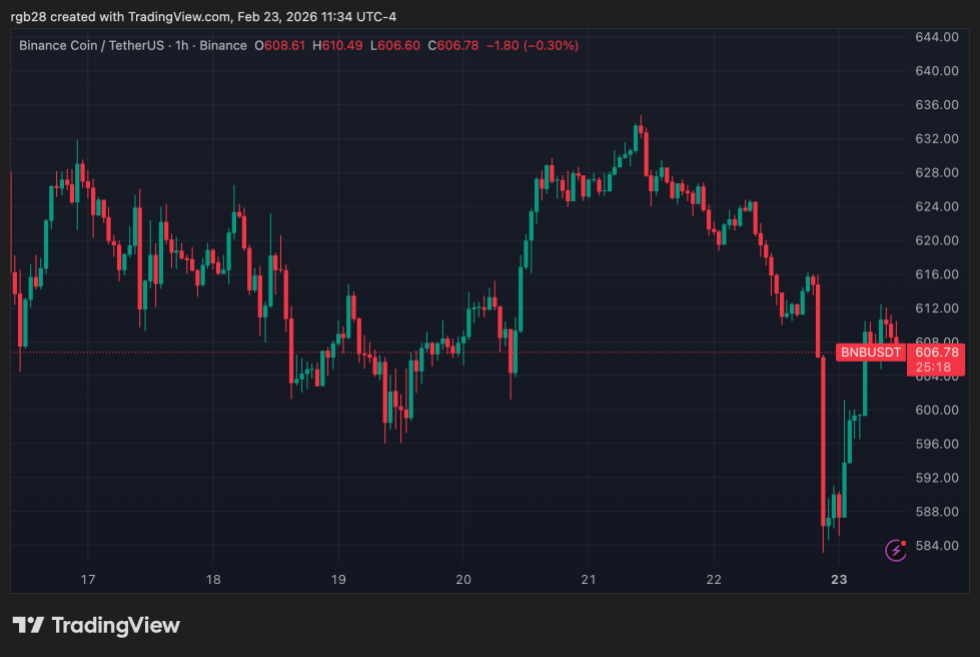
BNB trades at $606 in the one-week chart. Source: BNBUSDT on TradingView


Trending Cryptos

Related Questions

QWhat is Binance.US planning to do following the easing of enforcement actions by the Trump administration?

ABinance.US is exploring expanding within the US to develop and offer 'superior products' to the American market.

QWhy did Changpeng Zhao (CZ) step down as CEO of Binance?

ACZ stepped down as CEO after pleading guilty to Anti-Money Laundering (AML) violations in 2023 while leading the crypto exchange.

QWhat significant obstacle did Binance.US face due to the SEC's 2023 lawsuit?

AThe SEC's lawsuit led to a significant loss in banking access and market share for Binance.US.

QWhat is the current stance of Binance's global exchange regarding reentering the US market, as stated by CEO Richard Teng?

AThe global exchange is taking a 'wait-and-see' approach to reentering the US market.

QWhat was a key point of debate in the proposed crypto market structure bill discussed at the White House Crypto Council meeting?

AThe debate was narrowed to whether crypto firms can offer rewards linked to specific activities, as earning yield on idle balances is effectively off the table.

Related Reads

In Jinjiang, Fujian, a Storage Super Unicorn Lies Quiet

In Fujian's Jinjiang, a city known for sportswear, lies a quiet semiconductor giant: Fujian Jinhua Integrated Circuit Co. (JHICC). Once a promising domestic DRAM manufacturer alongside Yangtze Memory and ChangXin Memory Technologies (CXMT), its journey was derailed in 2018 when the U.S. placed it on an Entity List and filed criminal charges for alleged trade secret theft. This halted production for years. A turning point came in February 2024 when a U.S. federal court found JHICC not guilty. However, it had lost crucial time. While CXMT soared to become a top-valued A-share company in 2024, JHICC, with an estimated valuation of 80 billion RMB, was just restarting. Its current output is primarily customized DDR4 chips, not the advanced DDR5/HBM demanded for AI, but it still benefits from the broader memory chip upcycle. JHICC's story is tied to Chen Zhengkun, a veteran engineer who left Micron to lead the venture. Founded in 2016 with state-backed funding, JHICC partnered with Taiwan's UMC to develop DRAM technology. Rapid progress was cut short by the U.S. actions, which Micron initiated, partly due to its heavy reliance on the Chinese market. Post-sanctions, Chen's team worked to rebuild the production line with reduced reliance on U.S. technology. According to its records, JHICC achieved small-scale production and revenue growth under immense pressure. It now focuses on the stable "niche" DRAM market (e.g., TVs, routers) with a monthly capacity of ~40,000 wafers, aiming for 60,000 by 2026. It holds over 1,000 patents but remains on the Entity List. For Jinjiang, investing in JHICC was a bold industrial leap. The local government provided unwavering financial and logistical support during the crisis, helping the company survive. JHICC has become the anchor for a growing local semiconductor cluster. Though its scale lags behind domestic peers, JHICC's persistence symbolizes a hard-won foothold in a global market long dominated by Samsung, SK Hynix, and Micron. Having missed one boom, it seeks a place in the new AI-driven memory supercycle.

marsbit1h ago

In Jinjiang, Fujian, a Storage Super Unicorn Lies Quiet

marsbit1h ago

Trading

Spot

Hot Articles

Discussions

Welcome to the HTX Community. Here, you can stay informed about the latest platform developments and gain access to professional market insights. Users' opinions on the price of S (S) are presented below.

活动图片














