
Editor's Note: For the cryptocurrency industry, the market performance in the first month of 2026 is nothing short of an industry winter, which is particularly evident in the price performance of crypto concept stocks. Strategy, Bitmine, Sharplink, Forward, and other BTC and ETH treasury companies have all experienced significant pullbacks; in contrast, thanks to AI/HPC computing power demand and large orders, many mining concept stocks have shown bright price performance, but they are still some distance from last year's price highs. Considering the current market conditions, mining stocks may continue their upward trend, with Terawulf and Cipher Mining particularly favored by well-known investment bank analysts. Meanwhile, Jupiter Lend has listed company DFDV's liquid staking token dfdvSOL as collateral, which may indicate a further deepening of the integration between DeFi and TradFi liquidity.
The following is a summary of last week's currency and stock market information compiled by Odaily Planet Daily, all U.S. stock data are frommsx.com.
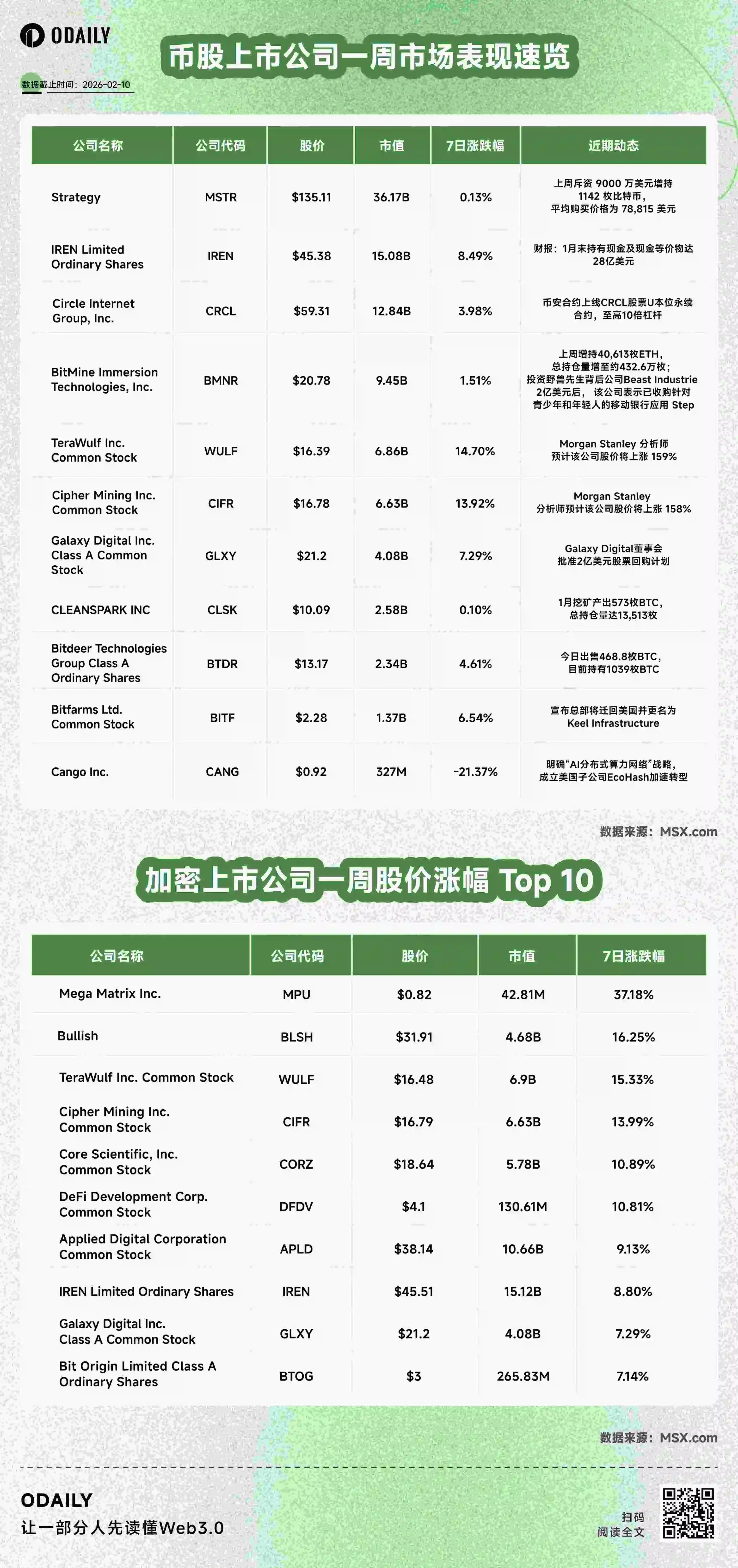
Crypto Concept Stocks Review: Mining Stocks Showed Strong Gains in January, But Still 15% Below Last Year's Highs
JPMorgan: Mining Stocks Significantly Outperformed BTC in January, Short-Term Prospects Supported but Valuation Gap Widens
JPMorgan stated in a report that Bitcoin miners performed strongly at the beginning of 2026, benefiting from reduced network competition and new enthusiasm for high-performance computing (HPC). The bank noted that the total market capitalization of the 14 U.S.-listed Bitcoin miners and data center operators it tracks reached $60 billion at the end of last month, a 23% increase month-on-month, far exceeding the S&P 500's 1% gain. This rise was partly fueled by news of Riot Platforms signing an HPC agreement with AMD, highlighting miners' efforts to diversify beyond Bitcoin. Facing record-low profit margins after the 2024 halving, Bitcoin miners are repositioning themselves as digital infrastructure providers, converting power-intensive mining sites into data centers usable for AI to seek more stable, long-term revenue.
The report pointed out that winter storms across the U.S. in January caused the average network hash rate to drop 6% month-on-month to 981 EH/s, and mining difficulty decreased 5% compared to December. The reduction in competition helped offset the weakness in Bitcoin prices. Analysts estimate that miners' daily block reward revenue in January was about $42,350 per EH/s, slightly higher than in December, while gross profit rose 24% to about $21,200 per EH/s. Among the 14 mining companies tracked by JPMorgan, 12 outperformed Bitcoin's 4% decline in January, with IREN up 42% and Cango down 18%. The group's total valuation is still about 15% below the October 2025 high.
Bloomberg: Selling Pressure Rises on Crypto Treasury Listed Companies, May Trigger Chain Reaction Risks in the Market
Crypto asset treasury listed companies (DATs), which drove the market rise last year, are now facing the problem of triggering chain reaction risks in the market due to increased selling pressure. Data shows that since Bitcoin fell nearly half from its October high of $126,000, the median stock price of the 150 largest DATs has fallen 62%, even more than Bitcoin's decline. Hayden Hughes, managing partner of Tokenize Capital, analyzed that DATs without operating revenue, relying solely on hoarding crypto assets, will be forced to sell their holdings to maintain operations, which may shake investors' confidence in their "long-term firm holding" narrative, thereby triggering broader market sentiment contagion.
Morgan Stanley Analyst: Two Mining Companies Expected to Rise Over 150% Within a Year
Morgan Stanley analyst Stephen Byrd stated that although the Bitcoin price has fallen 44% since October, Bitcoin miners have been reborn as AI data centers. Stephen Byrd initiated coverage of Terawulf and Cipher Mining on Monday, expecting the share prices of the two companies to rise 159% and 158%, respectively. Stephen Byrd pointed out that the core asset of mining companies is power access rights, and AI companies are willing to pay a premium for power access, and the economics of AI business are better than cryptocurrency mining. Currently, Terawulf has signed a 510-megawatt power agreement with Google, and Cipher Mining has reached similar cooperation with companies like Amazon. In addition, Stephen Byrd gave MARA Holdings an underweight rating, believing its AI strategy is not focused enough.
Weekly Updates on Currency and Stock Listed Companies
Representative BTC Treasury Listed Companies
Last week, global listed companies had a net purchase of BTC worth $92.83 million. Strategy invested $90 million to purchase 1,142 Bitcoins, a 19.5% increase in purchase amount compared to last week.
According to SoSoValue data, as of 8:30 AM Eastern Time on February 9, 2026, the total net purchase of Bitcoin by global listed companies (excluding mining companies) last week was $92.83 million, a decrease of 24.5% compared to the previous week.
Strategy (formerly MicroStrategy) announced on February 9 that it invested $90 million (a 19.5% increase compared to last week's purchase amount) to acquire 1,142 Bitcoins at a price of $78,815, bringing its total holdings to 714,644.
Japanese listed company Metaplanet did not purchase Bitcoin last week, marking the fourth consecutive week without a purchase.
Additionally, 5 other companies purchased Bitcoin last week. Japanese food brand DayDayCook announced on February 5 that it invested $9.12 million to purchase 105 Bitcoins at a price of $86,868, bringing its total holdings to 1,888; entrepreneurial education learning platform company Genius Group Limited announced on February 6 that it sold 96 Bitcoins at a price of $73,238, generating a total income of $7.03 million, reducing its total holdings to 84.15; Swedish health tech company H100 invested $3 million on February 6 to purchase 4.39 Bitcoins at a price of $66,620, bringing its total holdings to 1,051.05; UK Bitcoin company BHODL announced on February 6 that it spent $70,000 to purchase 1 Bitcoin at a price of $66,950, bringing its total holdings to 161.388; French Bitcoin reserve company Capital B announced on February 9 that it invested $370,000 to purchase 5 Bitcoins at a price of $73,893, bringing its total holdings to 2,828.
Canadian Bitcoin ecosystem company Metador Technologies announced the initiation of an ATM equity offering procedure, aiming to raise approximately $21.98 million to purchase Bitcoin. Metadoor Technologies plans to hold 1,000 Bitcoins by the end of 2026.
As of press time, the total Bitcoin holdings of the global listed companies (excluding mining companies) in the statistics amounted to 974,480, an increase of 0.035% compared to last week, with a current market value of approximately $67.36 billion, accounting for 4.9% of Bitcoin's circulating market capitalization.
Bitcoin treasury company ProCap repurchased approximately $135 million in convertible bonds
On February 9, Nasdaq-listed Bitcoin treasury company ProCap Financial disclosed that it repurchased convertible bonds worth approximately $135 million today. The company has repurchased about 2% of its outstanding common shares since December 2025. Additionally, the company disclosed that its current Bitcoin holdings are approximately 5,007, with a cash balance of $72 million and outstanding convertible bonds of approximately $100 million.
UK's largest Bitcoin treasury company listed on the London Stock Exchange main board last week
The UK's largest Bitcoin treasury company, Smarter Web Company, officially listed on the main market of the London Stock Exchange on February 3, with the stock code SWC. On its first day of listing, the stock price was reported at 43 pence, corresponding to a market capitalization of approximately £118 million. Public information shows that Smarter Web Company currently holds 2,674 Bitcoins, with an average purchase price of approximately $111,000, making it the largest Bitcoin treasury-type listed company in the UK by holding size.
Representative ETH Treasury Listed Companies
BitMine: Increased holdings by 40,613 ETH last week, total holdings increased to approximately 4.326 million
Ethereum treasury company BitMine Immersion Technologies disclosed that it increased its holdings by 40,613 ETH last week. The company's current crypto asset holdings include 4,325,738 ETH, 192 BTC, $19 million worth of Eightco Holdings equity, $200 million worth of Beast Industries shares, and $595 million in cash.
ETHZilla launches RWA token for aircraft engine cash flow
Nasdaq-listed company ETHZilla (ETHZ) announced that it will launch Eurus Aero Token I this week, splitting the monthly cash flow generated from leasing aircraft engines through tokenization to provide investors with on-chain yield exposure.
The token is issued by subsidiary ETHZilla Aerospace, with the underlying assets being two commercial aircraft engines leased to a "leading U.S. airline." Token holders will receive monthly cash flow distributions from basic rent and usage fees through ERC-20 tokens.
ETHZilla is supported by Peter Thiel's Founders Fund. The company was previously known for its Ethereum reserve strategy but has gradually shifted towards real-world asset (RWA) tokenization since last year. Previously, the company completed a tokenization trial involving 95 housing loans.
As the blockchain industry accelerates the onboarding of traditional assets, RWA is seen as one of the fastest-growing sectors. Ark Invest estimates that the tokenized asset size could reach $11 trillion by 2030, while the current market size is approximately $22 billion.
ETHZilla shifts to real estate tokenization, reaches $4.7 million housing loan agreement
Ethereum treasury company ETHZilla (ETHZ) is accelerating its asset tokenization layout, spending $4.7 million to acquire a portfolio of 95 manufactured housing and modular housing loans, and plans to tokenize these loans on the Ethereum Layer-2 network, issuing cash-flow type digital tokens to investors through the regulated trading platform Liquidity.io. The loan portfolio is secured by first-lien mortgages, with an expected annualized return of about 10%. ETHZilla Chairman and CEO McAndrew Rudisill stated that this transaction is a natural extension of the company's tokenization strategy, and manufactured housing loans have stable cash flow and strong collateral assets, making them very suitable for tokenization within a regulated, transparent framework.
Ethereum treasury company FG Nexus announces 1:5 reverse stock split
Nasdaq-listed Ethereum treasury company FG Nexus announced that it will implement a 1:5 reverse stock split, meaning every 5 shares of common stock will be automatically combined into 1 share. The company expects it to take effect officially at 9:30 AM Eastern Time on February 13, 2026. It will also adopt a new CUSIP number 30329Y403. After the split, its stock will continue to trade on Nasdaq under the code "FGNX". It is reported that based on the current outstanding shares of approximately 32.7762 million, the number of outstanding shares is expected to drop to approximately 6.5552 million after the split; the number of authorized common shares will decrease from 900 billion to 180 billion.
Bit Digital discloses holding 155,239.4 ETH as of the end of January, worth over $380 million
On February 6, Nasdaq-listed Ethereum treasury company Bit Digital released a holdings update report. As of January 31, 2026, the company held 155,239.4 ETH, worth approximately $380.2 million, with an average purchase price of $3045. Additionally, the company disclosed that as of the end of January, it had staked a total of 138,266 ETH, generating approximately 344 ETH in staking rewards.
Representative SOL Treasury Listed Companies
Forward Industries says it will adopt an offensive strategy and consolidate other SOL treasury companies if industry funding is under pressure
Solana treasury company Forward Industries (FWDI) Chief Information Officer Ryan Navi stated that there is mispricing in the current market, creating potential opportunities for the company. Ryan Navi pointed out that Forward Industries currently has no debt. If the industry faces funding constraints, the company will adopt an offensive strategy to promote the consolidation of other SOL treasury companies.
He disclosed that Forward Industries currently holds nearly 7 million SOL, with a holding size exceeding the sum of its top three competitors. Ryan Navi further stated that a leverage-free, debt-free balance sheet is considered its core advantage in the crypto treasury market. The company will continue to configure Solana as a long-term strategic infrastructure without using leverage or debt, rather than as a short-term speculative tool.
Solana treasury company Upexi to raise $7.4 million through placement
On February 6, Nasdaq-listed Solana treasury company Upexi announced that it had reached a final agreement with an institutional investor to sell and issue 6,337,000 shares of the company's common stock and warrants at a price of $1.17 per share to raise $7.4 million. The net proceeds from this offering will be used for working capital, general corporate purposes, and expanding its SOL token investment strategy. AGP/Alliance Global Partners acted as the sole placement agent for this offering of common stock and warrants.
Jupiter Lend lists DFDV's liquid staking token dfdvSOL as collateral
On February 5, Jupiter's lending platform Jupiter Lend announced that it has listed the liquid staking token dfdvSOL, issued by Solana treasury company DeFi Development (DFDV), as collateral, allowing users to directly borrow assets on-chain and release the liquidity of their staked SOL.