Crypto’s next altseason may have fewer winners: Wintermute

cointelegraphPublished on 2026-07-31Last updated on 2026-07-31

Abstract

The next altcoin season in crypto may yield fewer winners as institutional investors increasingly concentrate their trading in a narrower set of digital assets, according to a report from market maker Wintermute. Their data shows institutional clients generated a record 72% of spot OTC flow in H1 2026, up from 61% in H2 2025. This activity is focused on fewer tokens and fades faster after price surges compared to retail trading. The findings indicate capital is clustering in favored assets, weakening the "long tail" of the market. Broader industry data from CryptoQuant and Kaiko supports this trend, showing altcoin trading volume concentrating in top assets and a decline in the traditional rotation of Bitcoin profits into smaller coins. Analysts suggest future rallies will be more selective, with institutions focused on major tokens like Bitcoin and Ether.


Crypto’s next altcoin season may produce fewer winners as institutional investors concentrate their activity in a narrower group of digital assets, according to crypto market maker Wintermute.

In its over-the-counter (OTC) flow report for the first half of 2026, Wintermute said institutional counterparties generated 72% of spot flow across all tokens on its OTC desk, the highest share on record. That was up from 61% in the second half of 2025 and 59% in the first half of last year.

With institutional activity concentrated in fewer tokens and fading faster after price surges, the findings suggest future altcoin rallies could become narrower and more selective. Wintermute said liquidity was concentrating in the assets institutions favored while activity across the market’s “long tail” weakened.

Between the first half of 2024 and the first half of 2026, the number of unique tokens traded by Wintermute’s institutional counterparties grew by just 24%, compared with 76% among retail clients. The firm also found that institutional activity following a surge in a token’s price and volume faded after roughly one day. In contrast, retail activity typically remained elevated for about three days.
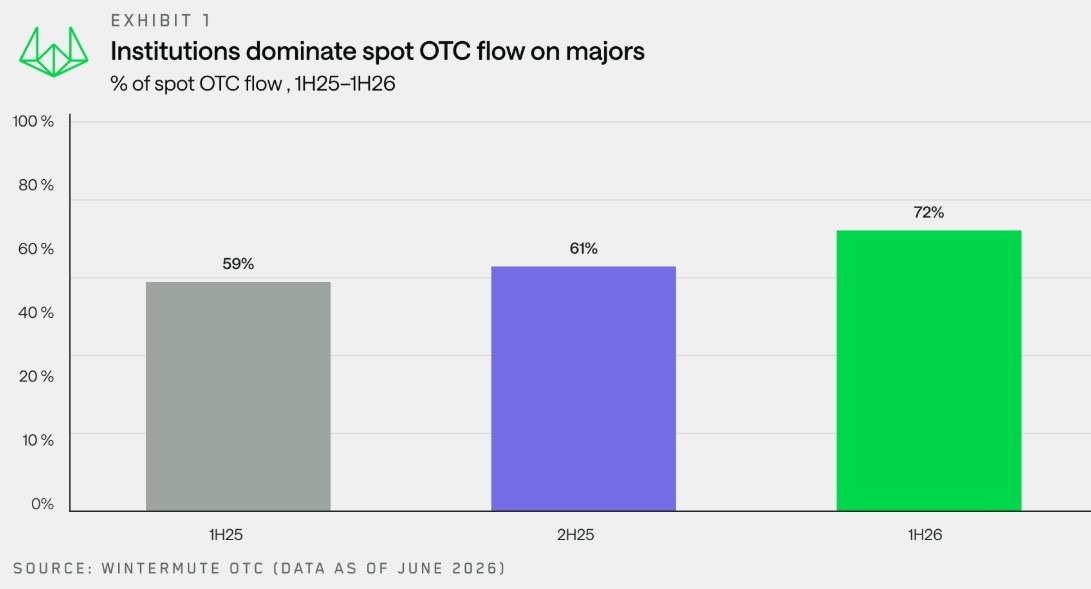
Percentage of institutional spot OTC flow. Source: Wintermute

Altcoin capital was already becoming more concentrated

Wintermute’s findings add proprietary OTC data to signs that capital has been clustering around a smaller group of altcoins across the wider market.

On June 20, CryptoQuant CEO Ki Young Ju said the traditional rotation of Bitcoin profits into smaller crypto assets had “basically disappeared.” CryptoQuant data showed trading volume in Bitcoin-denominated altcoin pairs near its weakest level since 2021.

Meanwhile, the 10 largest non-stablecoin altcoins accounted for about 80.5% of the non-Bitcoin, non-stablecoin market’s capitalization.

Related: Crypto altseason unlikely in 2026 as ‘blue-chip survivors’ to win out: Analyst

Kaiko identified a similar concentration in exchange trading. In July 2025, the data provider said that the 10 largest altcoins accounted for 63% of altcoin trading volume, up from about 50% several months earlier, as activity in smaller tokens weakened.

DWF Labs managing partner Andrei Grachev also argued that broad altcoin rallies were giving way to selective sector moves. On March 15, Grachev said too many tokens were competing for limited capital, while institutional investors remained focused on Bitcoin, Ether and tokenized real-world assets.

Magazine: The 100x obsession: Fundamentals grow in importance as crypto matures

Related Questions

QAccording to Wintermute's report, what percentage of spot flow on its OTC desk was generated by institutional counterparties in H1 2026?

AInstitutional counterparties generated 72% of spot flow across all tokens on Wintermute's OTC desk in the first half of 2026.

QHow does the duration of institutional activity following a token's price surge compare to retail activity, based on Wintermute's findings?

AInstitutional activity faded after roughly one day following a token's price and volume surge, whereas retail activity typically remained elevated for about three days.

QWhat evidence from CryptoQuant's CEO and Kaiko supports the idea of capital concentration in a narrower group of altcoins?

ACryptoQuant's CEO noted the traditional rotation of Bitcoin profits into smaller altcoins had 'basically disappeared,' with Bitcoin-denominated altcoin pair volume near its weakest since 2021. Kaiko reported that the 10 largest altcoins accounted for 63% of altcoin trading volume in July 2025, up from about 50% months earlier.

QWhat reason did DWF Labs' Andrei Grachev give for broad altcoin rallies giving way to selective sector moves?

AAndrei Grachev argued that too many tokens were competing for limited capital, while institutional investors remained focused on Bitcoin, Ether, and tokenized real-world assets.

QWhat is the main implication of Wintermute's findings for the next altcoin season, as suggested in the article?

AThe main implication is that the next altcoin season may produce fewer winners, with rallies becoming narrower and more selective, as institutional activity concentrates in fewer tokens and liquidity clusters in assets favored by institutions.

Related Reads

Stocks Fell Even More Violently Than Crypto, Where Did the Money Go?

From June to late July 2026, global stock markets, particularly technology and semiconductor stocks, experienced severe declines, with South Korea's KOSPI index facing historic circuit breakers and shedding 40% from its June peak. Key catalysts included SK Hynix's earnings miss despite record profits and competitive pressures from China's CXMT IPO. A global forced deleveraging event unfolded, devastating highly leveraged instruments like the 2x leveraged SK Hynix ETF, which lost over 80% of its value. Surprisingly, Bitcoin showed relative stability during this period, rising roughly 15% from its July low. The article clarifies this wasn't due to an inflow of equity flight capital but because Bitcoin had already undergone a significant correction in May and June, with U.S. spot Bitcoin ETFs seeing record outflows. True safe-haven flows went to gold, severing Bitcoin's short-term "digital gold" narrative. The sell-off is characterized not as an AI story collapse but a liquidity-driven清算 of crowded leveraged positions, potentially halfway through according to some analysts. For substantial capital to return to Bitcoin, the article cites necessary conditions: eased global liquidity pressure, a soft-landing Fed rate cut, and regulatory clarity from the stalled U.S. CLARITY Act. The conclusion is that Bitcoin is not a current safe haven but a pre-cleared asset. Its decoupling from tech stocks highlights its potential future role as a non-correlated asset for institutional portfolios, positioning it favorably for when global capital reallocates post-crisis.

marsbit1h ago

Stocks Fell Even More Violently Than Crypto, Where Did the Money Go?

marsbit1h ago

Trading

Spot
活动图片