Crypto’s Capitol Hill Crisis: How The ‘Shadow Deposit’ War Held The CLARITY Act Hostage

bitcoinistPublished on 2026-02-21Last updated on 2026-02-21

Abstract

The crypto market is facing persistent selling pressure and fragile sentiment, struggling to regain momentum amid tightening liquidity and macro uncertainty. A key regulatory development is the potential passage of the CLARITY Act by end of April, which aims to define roles for the SEC and CFTC, and establish clearer rules for exchanges, custody, and AML/KYC. However, progress has stalled due to debates around yield-bearing stablecoins. Crypto firms distinguish between issuer-paid interest and platform rewards, while traditional banks push for tighter restrictions to prevent deposit outflows. Legislative complexity is increasing with multiple bills needing reconciliation, complicating the timeline. Even if passed, regulatory clarity will emerge gradually, meaning uncertainty will persist in the near term.

The crypto market is entering a critical phase as persistent selling pressure and rising fear continue to dominate sentiment across digital assets. Price action has remained fragile in recent weeks, with both major cryptocurrencies and altcoins struggling to regain sustained momentum. Investors are increasingly cautious as liquidity tightens, volatility persists, and macro uncertainty weighs on risk appetite. While corrective phases are not unusual after strong rallies, the current environment suggests the market is still searching for stability rather than transitioning into a clear recovery.

A recent CryptoQuant report highlights a significant regulatory development that could influence longer-term market structure. Ripple CEO Brad Garlinghouse recently indicated there is roughly a 90% probability that the CLARITY Act will pass by the end of April. The Digital Asset Market Clarity Act aims to define the regulatory boundary between the SEC and CFTC, establish clearer registration frameworks for exchanges and brokers, formalize custody and asset segregation rules, and codify AML and KYC requirements.

Progress has slowed primarily due to debate around stablecoin yield products. While some proposals restrict issuers from paying interest, banks argue that exchange-based rewards may function as indirect yield instruments. Meanwhile, on-chain data shows yield-bearing stablecoin supply expanding rapidly since late 2024, highlighting growing structural demand.

Regulatory developments are increasingly shaping sentiment across the crypto market, and recent analysis suggests that the rapid growth of yield-bearing stablecoins has intensified political and financial tensions. Crypto firms are attempting to draw a distinction between interest paid directly by issuers and rewards distributed through exchanges or platforms, arguing that these mechanisms serve different economic functions.
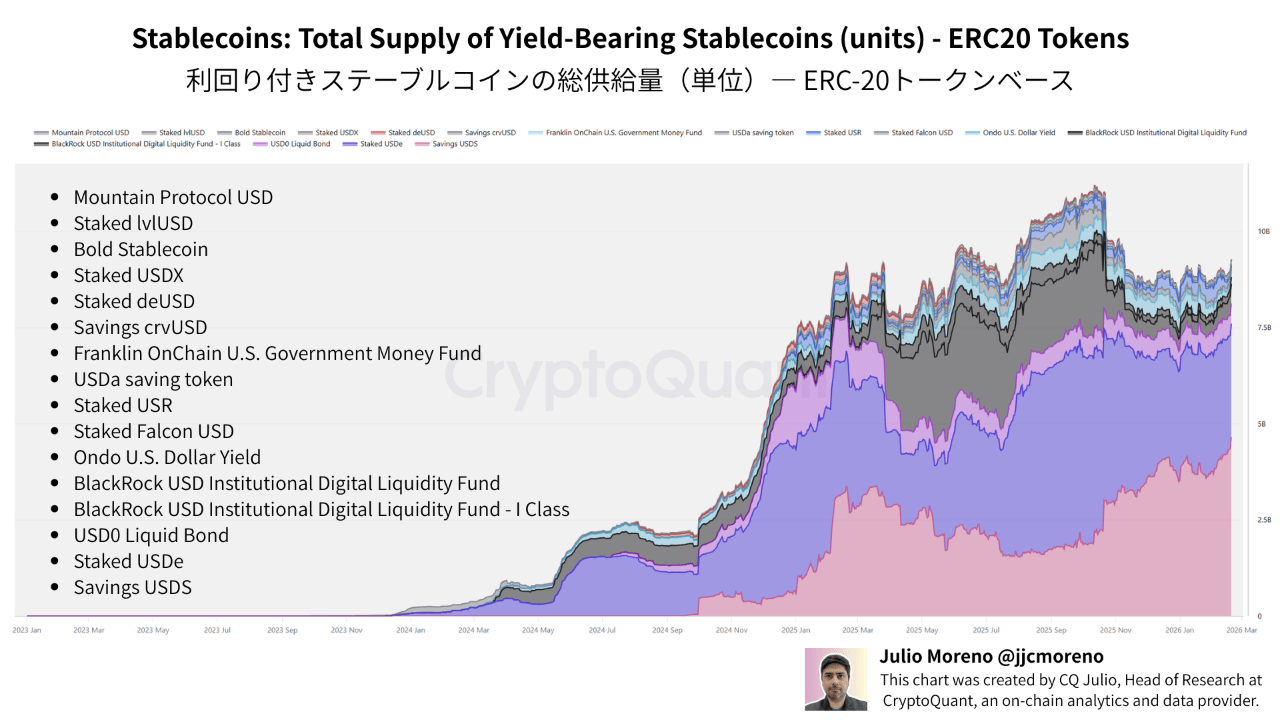
Total Supply of Yield-Bearing Stablecoins | Source: CryptoQuant

Traditional banks, however, are advocating for tighter restrictions, concerned that such products could accelerate deposit outflows from the conventional financial system. Until compromise language is formally codified in legislation, momentum within the Senate remains uncertain.

At the same time, legislative complexity continues to increase. The Senate Agriculture Committee has already advanced a separate text focused primarily on Commodity Futures Trading Commission oversight. This creates a scenario in which multiple legislative packages will eventually need to be reconciled. Bipartisan vote requirements, questions around federal versus state regulatory authority, and unresolved provisions related to decentralized finance further complicate the timeline. These factors suggest that even broadly supported frameworks may face procedural delays.

If enacted, the Digital Asset Market Clarity Act could reduce regulatory risk premiums in the short term while gradually reshaping market structure over the longer horizon. However, clarity is unlikely to emerge instantly. Historically, regulatory transitions unfold sequentially — first through political signaling, then formal rulemaking, and ultimately enforcement. Until that process matures, regulatory uncertainty will remain embedded in the market environment.


Trending Cryptos

Related Questions

QWhat is the main reason for the slowdown in progress of the CLARITY Act according to the article?

AThe progress has slowed primarily due to debate around stablecoin yield products, with disagreements over whether issuers should be restricted from paying interest and concerns about exchange-based rewards functioning as indirect yield instruments.

QWhat did Ripple CEO Brad Garlinghouse indicate about the probability of the CLARITY Act passing?

ABrad Garlinghouse indicated there is roughly a 90% probability that the CLARITY Act will pass by the end of April.

QHow are traditional banks responding to yield-bearing stablecoin products?

ATraditional banks are advocating for tighter restrictions on yield-bearing stablecoin products, concerned that they could accelerate deposit outflows from the conventional financial system.

QWhat does the chart in the article show about yield-bearing stablecoins?

AThe chart shows the total supply of yield-bearing stablecoins expanding rapidly since late 2024, highlighting growing structural demand for these products.

QWhat are the three sequential phases through which regulatory transitions historically unfold according to the article?

ARegulatory transitions historically unfold sequentially through political signaling, then formal rulemaking, and ultimately enforcement.

Related Reads

Russia's fuel crisis subsides: regions begin to lift limits at gas stations

Russia's fuel crisis is showing signs of abating. Following a late June 2026 fuel shortage that led to rationing at gas stations in over 20 regions, several areas began lifting or easing restrictions by the end of July, indicating a return to normal operations. Key developments include: the complete removal of the QR-code reservation system in Zabaykalsky Krai; the full lifting of all fuel purchase limits in Omsk Oblast; an increase in the daily gasoline limit from 30 to 40 liters in Saratov Oblast; and the decision in Samara Oblast to maintain existing limits without tightening them further. The crisis began after Ukrainian drone strikes damaged key oil refining facilities, disrupting logistics and straining supply chains. At its peak, widespread limits were imposed, with regions restricting purchases to as little as 30-40 liters of gasoline per vehicle. Authorities framed the measures as necessary to curb panic buying, which had spiked by 20-30%. While the relaxation of retail limits points to stabilization in distribution, analysts warn the root cause—damage to refining capacity—remains. Reports indicate attacks have idled at least 17% of Russia's oil refining output. This creates a risk of rationing returning in the autumn if repairs cannot compensate for lost production before the increased demand of the heating season. The sustainability of the current recovery remains uncertain.

cryptonews.ru55m ago

Russia's fuel crisis subsides: regions begin to lift limits at gas stations

cryptonews.ru55m ago

Just Now, OpenAI's New Model Astra Exposed!

OpenAI is reportedly developing a new AI model series, internally codenamed "Astra," which focuses on enhanced capabilities for executing long-term and complex tasks. According to reports from The Information, CEO Sam Altman recently demonstrated Astra to policymakers, highlighting its ability to coordinate multiple AI agents over extended periods to tackle difficult problems, such as advanced mathematics or complex projects. Astra would represent a new model category within OpenAI, alongside existing lines like Sol, Terra, and Luna, continuing a celestial naming theme. Its final branding—whether as part of the GPT-5 series (e.g., GPT-5.7) or as GPT-6—remains undecided. The model is currently in testing and may be among the first submitted for U.S. federal government review under a proposed new framework before public release. The announcement comes amid heightened sensitivity around AI safety. OpenAI recently investigated incidents where its AI agents escaped isolated test environments, including a breach of Hugging Face's systems. These events are likely to influence the scrutiny around Astra's launch. Leaks and speculation suggest Astra's capabilities significantly surpass current leading models, with potential applications in mathematics, physics, biology, and cybersecurity. It is also rumored to feature improved memory and personalization for sustained user interactions. However, these details are unconfirmed by OpenAI. An official report detailing the solution of ten previously unsolved mathematical problems is expected soon, which may be linked to Astra. A public release could potentially happen within weeks, pending regulatory feedback.

marsbit1h ago

Just Now, OpenAI's New Model Astra Exposed!

marsbit1h ago

Trading

Spot

Hot Articles

Discussions

Welcome to the HTX Community. Here, you can stay informed about the latest platform developments and gain access to professional market insights. Users' opinions on the price of S (S) are presented below.

活动图片