Crypto Surveillance Surge? South Korea’s Tax Office Rolls Out Aggressive New Profit‑Tracking

bitcoinistPublished on 2026-03-12Last updated on 2026-03-12

Abstract

South Korea's National Tax Service (NTS) is developing an AI-powered system to track cryptocurrency investment profits for taxation, set to launch in 2027. With a budget of $2 million, the "Comprehensive System for Virtual Asset Transaction Analysis" will aggregate data from exchanges and blockchain analytics to detect tax evasion. The move follows previous delays and recent crypto scandals, intensifying pressure for stricter oversight. Once operational, the system will monitor high-value transactions across borders, making tax avoidance riskier. This model may influence other high-tax jurisdictions, challenging crypto's status as an off-grid asset class.

South Korea has started laying the groundwork for a new tracking system designed to impose taxes on profits from cryptocurrency investments.

An AI Crypto Tracking System

According to The Korea Times, the National Tax Service (NTS) announced this Thursday that they are moving ahead with an AI-driven system to track crypto investment gains as they prepare to start taxing virtual asset profits from January 2027. The NTS said that the system “is expected to serve our goal of collecting individuals’ virtual asset transaction data starting in 2027”.

A $2 Million Project

In order to achieve this, the NTS issued a tender for what they call a “Comprehensive System for Virtual Asset Transaction Analysis”. There, they detailed that the project has a budget of around ₩3 billion ($2 million) and that the designing of the system will start in April. A pilot operation for the system should be ready to begin in November, after passing multiple tests runs, and be ready to fully launch between November and December.

The notice was uploaded to an online bidding system run by the Public Procurement Service, the agency in charge of sourcing goods and services for the government and affiliated bodies. A winning contractor is expected to be chosen and signed within this month.

A New Era Of Crypto Surveillance

With this new system, the NTS plans to aggregate data from domestic exchanges, blockchain analytics and existing tax databases, leveraging AI and machine learning to detect unusual patterns and potential tax evasion.

This recent update follows past January NTS’s unveiling of a new “control tower” unit created under the 2026 National Tax Administration Operation Plan to coordinate all virtual‐asset tax enforcement and monitoring of offshore flows.

According to Korean tax briefs, retail investors will face taxation on annual crypto gains above a set threshold (e.g., ₩2.5 million), while institutions are being given clearer but stricter rules on holding major coins, excluding stablecoins.

Korea’s Under Scrutiny Over Crypto

Even though the Korean government has repeatedly delayed full crypto‐gains taxation, it is now building one of the world’s more sophisticated virtual‐asset tax architectures, including real‐time monitoring and cross‐border cooperation.

The Korean government has recently been under fire because of embarrassing crypto scandals, like the loss of custody crypto assets and the accidental leak of wallet data by the NTS itself. It seems that the recurrence of these security breaches and mismanagement incidents have intensified political pressure to modernize systems, tighten oversight and demonstrate that crypto profits can be taxed as reliably as traditional assets.

What Traders Should Brace For

Once the system is live, Korean traders should assume high‐value transactions are traceable across exchanges and borders, making aggressive tax‐avoidance strategies, especially offshore routing, far riskier.

It is safe to assume that South Korea’s model could become a template for other high‐tax, high‐adoption jurisdictions, making it harder to treat crypto as an off‐grid asset class.
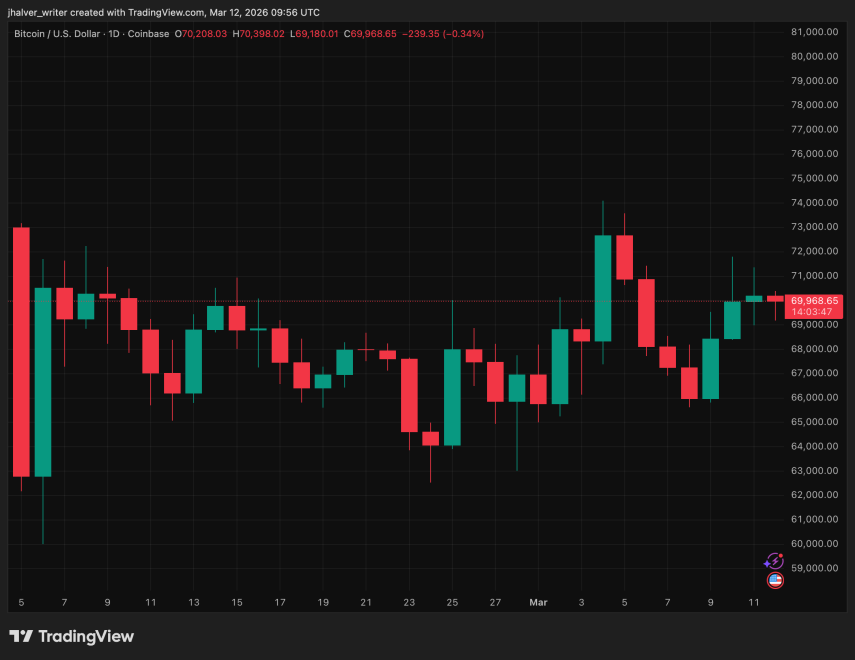
BTC’s price trends to the downside on the daily chart. Source: BTCUSD on Tradingview

Cover image from Perplexity, BTCUSD chart from Tradingview

Related Questions

QWhat is the primary purpose of the new AI-driven system being developed by South Korea's National Tax Service (NTS)?

AThe primary purpose of the AI-driven system is to track cryptocurrency investment gains and collect individuals' virtual asset transaction data to impose taxes on profits, starting from January 2027.

QWhat is the budget allocated for the 'Comprehensive System for Virtual Asset Transaction Analysis' project?

AThe project has a budget of approximately ₩3 billion, which is equivalent to about $2 million.

QHow does the NTS plan to use the new system to combat tax evasion?

AThe NTS plans to aggregate data from domestic exchanges, blockchain analytics, and existing tax databases, and leverage AI and machine learning to detect unusual patterns and potential tax evasion.

QWhat threshold must retail investors exceed to face taxation on their annual crypto gains according to Korean tax briefs?

ARetail investors will face taxation on annual crypto gains above a set threshold of ₩2.5 million.

QWhat recent events have intensified political pressure on the Korean government to modernize its tax systems for crypto?

ARecent embarrassing crypto scandals, such as the loss of custody crypto assets and the accidental leak of wallet data by the NTS itself, have intensified political pressure to modernize systems and tighten oversight.

Related Reads

$9.4 Billion: The Largest Robotics Funding This Year Has Emerged

Munich-based humanoid robotics company Neura has completed a $1.4 billion (approximately RMB 94.9 billion) Series C funding round, valuing the company at around $7 billion and positioning it among the global leaders in the sector. The investment round is notable not just for its size—reportedly the largest in robotics this year—but also for its strategic backers, which include tech giants like NVIDIA and Amazon, alongside established industrial players such as German engineering firms Bosch and Schaeffler. This mix of investors signals a significant shift in the industry's focus from technological demonstrations and general-purpose narratives toward practical, industrial deployment and commercialization. Neura's approach centers on developing humanoid robots for defined, high-value industrial tasks rather than pursuing a general-purpose model. Its early validation comes from a partnership with BMW, where its robots are being tested on actual production lines. The involvement of Bosch and Schaeffler, companies deeply embedded in global manufacturing, underscores a growing belief that humanoid robots are transitioning from labs to viable factory-floor solutions. The article highlights two converging trends driving investment: advancements in AI and large language models, which enhance robots' perception and decision-making in unstructured environments, and mounting pressure from labor shortages and rising costs in major manufacturing regions. The funding landscape is now bifurcating between companies like Figure AI, focusing on versatile general-purpose robots, and firms like Neura, targeting specific vertical industrial applications with clearer, shorter paths to ROI. While technical hurdles remain, the core challenges for widespread adoption are increasingly seen as engineering and commercial in nature: managing the high integration and customization costs for different factory environments and establishing robust, localized maintenance and service networks. The record investment in Neura, particularly from industrial capital, indicates the industry's growing confidence in moving from proving feasibility to solving the practical problems of scalability, reliability, and building sustainable business models around humanoid robots in real-world settings like automotive manufacturing and hazardous labor environments.

marsbit4h ago

$9.4 Billion: The Largest Robotics Funding This Year Has Emerged

marsbit4h ago

"119 to 176 Dollars": Behind SpaceX's Listing, MSX Once Again Successfully Executes the Pre-IPO Closed Loop

Following May's 300% gain on Cerebras, MSX delivered another outstanding performance during SpaceX's listing night. On June 12, SpaceX (SPCX) launched on Nasdaq, reaching a high of $176. This marked the successful culmination of MSX's Pre-IPO project launched in March, where users subscribed at $119, achieving gains of approximately 40-48%. This event validated MSX's complete Pre-IPO mechanism, a crucial advantage in a market where access to top-tier private company equity is typically limited to institutions. MSX's model provides a full cycle for users: subscription (at $119 for SpaceX), real-time on-chain portfolio tracking, optional early redemption, seamless conversion to tradable spot assets (SPCX.M) upon IPO, and final settlement in stablecoins. This end-to-end process distinguishes MSX from platforms that faced settlement issues during the SpaceX IPO, highlighting that the core challenge of Pre-IPO is not just access, but a clear exit and conversion path post-listing. This success with SpaceX is MSX's second major Pre-IPO verification, following the Cerebras listing in May, which yielded ~300% returns for early participants. These back-to-back achievements demonstrate MSX's capability to source, structure, and deliver real assets through a replicable on-chain model. The true barrier for Pre-IPO products lies not in providing an entry point, but in ensuring reliable fulfillment from subscription through to post-IPO liquidity. MSX's proven闭环 (closed-loop) process addresses this, offering Web3 users a structured way to access high-growth, pre-public companies in sectors like AI and frontier tech. MSX plans to continue expanding its Pre-IPO portfolio with this focus on authenticity, transparency, and post-listing execution.

Odaily星球日报16h ago

"119 to 176 Dollars": Behind SpaceX's Listing, MSX Once Again Successfully Executes the Pre-IPO Closed Loop

Odaily星球日报16h ago

Trading

Spot
Futures

Hot Articles

Discussions

Welcome to the HTX Community. Here, you can stay informed about the latest platform developments and gain access to professional market insights. Users' opinions on the price of S (S) are presented below.

活动图片















