Crypto Rules Are Changing—But Congress Still Decides The Endgame

bitcoinistPublished on 2026-03-20Last updated on 2026-03-20

Abstract

Republican senators met with a White House crypto adviser in a closed-door session, signaling progress on digital asset oversight legislation. A key sticking point—stablecoin yield—is nearly resolved, moving the Senate’s CLARITY Act forward. Simultaneously, SEC Chair Paul Atkins announced a major policy shift, stating that most cryptocurrencies are not securities. Only tokenized traditional securities remain under SEC jurisdiction. The SEC’s new interpretive guidance, described as a temporary bridge, aligns with a recent agreement with the CFTC, which is poised to take a larger regulatory role once Congress passes comprehensive legislation.

Republican senators huddled with a White House crypto adviser Thursday in a closed-door session that participants called “very productive” — a sign that Washington’s push to rewrite the rules of digital asset oversight may be gaining real momentum.

Stablecoin Sticking Point Nears Resolution

A spokesperson for Wyoming Sen. Cynthia Lummis confirmed the meeting with White House crypto adviser Patrick Witt, saying lawmakers are now “99% of the way there on stablecoin yield” — the thorny issue that has held up a broader market structure bill in the Senate Banking Committee for months.

Concerns over how stablecoin yield should be treated across the crypto and banking industries had effectively frozen progress. Based on reports from Lummis’ office, negotiations on the digital assets portion of the bill are also in good shape.

The bill, known as the CLARITY Act, cleared the House of Representatives back in July 2025. As of Thursday, it had not been scheduled for a markup hearing in the Senate Banking Committee. The Senate Agriculture Committee had already advanced its own version of the legislation in January.
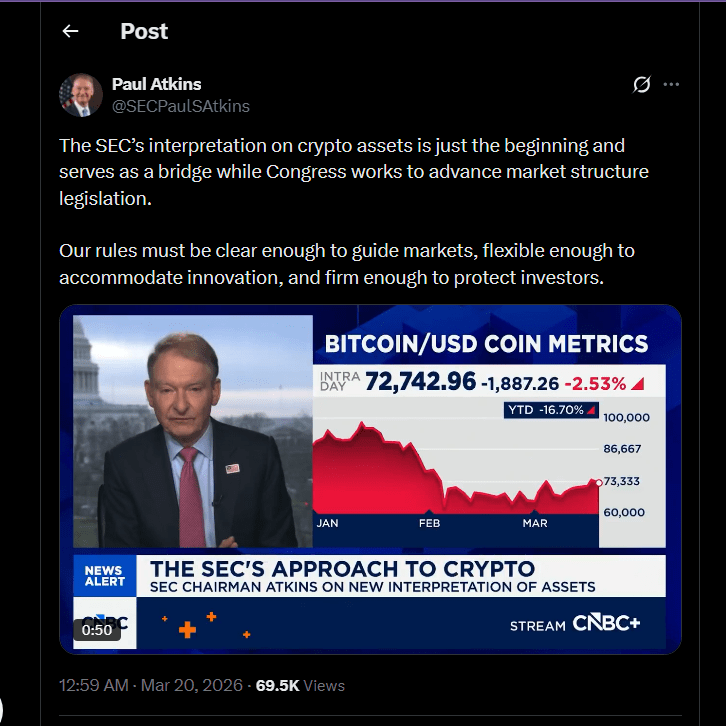
Source: Paul Atkins

SEC Draws A New Line On What Counts As A Security

The closed-door meeting came the same day SEC Chair Paul Atkins delivered prepared remarks at the Practising Law Institute in which he outlined a sharp departure from how his agency has handled crypto in the past.

Gone, he said, is the “regulation by enforcement” approach that defined the previous administration’s posture toward digital assets.

Earlier in the week, the agency published an interpretive notice laying out which crypto assets it considers securities and which it does not. The answer, under the new framework, is that most cryptocurrencies are not securities.

Total crypto market cap currently at $2.39 trillion. Chart: TradingView

Only one category remains under SEC oversight: traditional securities that have been converted into token form. Digital commodities, digital tools, non-fungible tokens, and stablecoins were all identified as falling outside the agency’s reach.

Atkins was direct about the limits of what the agency had done. The interpretation, he said, is a “beginning, not an end.”

A Bridge Until Congress Acts

The SEC’s move follows a memorandum of understanding signed last week between the agency and the Commodity Futures Trading Commission.

Under the expected market structure legislation, the CFTC would take on a larger role in regulating and overseeing digital assets — a shift the SEC appears willing to accept.

Atkins framed the interpretive notice as a necessary bridge while Congress works toward a permanent statutory framework. Administrative interpretations can be revised or reversed.

A law cannot be undone as easily. That distinction is why the Thursday meeting between senators and the White House carries weight beyond the usual Washington optics.

For an industry that spent years under threat of enforcement action, the week’s developments represent a visible change in direction from the country’s top securities regulator.

Featured image from Unsplash, chart from TradingView

Related Questions

QWhat was the main purpose of the closed-door meeting between Republican senators and the White House crypto adviser?

AThe meeting was held to discuss and advance the push to rewrite the rules of digital asset oversight, specifically making progress on the stablecoin yield issue that had been holding up broader market structure legislation.

QWhich specific sticking point in the Senate Banking Committee's crypto bill is reportedly close to being resolved?

AThe issue of 'stablecoin yield' is reportedly 99% resolved, according to a spokesperson for Senator Cynthia Lummis.

QHow did SEC Chair Paul Atkins describe the agency's new approach to crypto regulation, contrasting it with the past?

AAtkins stated that the 'regulation by enforcement' approach of the previous administration is gone, and the SEC has now published a new interpretive framework that clarifies which crypto assets are considered securities.

QAccording to the new SEC framework, which category of crypto assets remains under its oversight?

AOnly traditional securities that have been converted into token form remain under SEC oversight. Digital commodities, digital tools, NFTs, and stablecoins are considered outside the agency's reach.

QWhat role did SEC Chair Atkins say the agency's interpretive notice plays while Congress works on legislation?

AAtkins framed the interpretive notice as a 'necessary bridge' to provide guidance until Congress can establish a permanent statutory framework for digital asset regulation.

Related Reads

How to Do Research Well: Deliberately Practice the Real Skills That Matter

No one truly teaches you how to do research. You're often given a desk, a pre-selected problem, and vague instructions to "create something new." Consequently, many people reverse-engineer the job based on visible outputs—papers, posts, announcements—learning only how to *appear* like a researcher rather than how to *become* one. True research capability is built from stacking small, trainable skills, nearly all of which can be developed through deliberate practice. **Pick Your Own Problem:** Most researchers absorb problems from advisors or trends, lacking the underlying reasoning. Choosing a problem you genuinely care about, as John Schulman advises, leads to original work. Develop "taste" like a muscle: predict experiment outcomes, guess paper results from methods, and track which findings remain important over time. **Upgrade Your Inputs:** Relying on shared reading lists (arXiv hot lists, filtered group chats) leads to unoriginal conclusions. Undervalued old literature often holds crucial insights (e.g., MoE, LSTM, backpropagation). Richard Sutton's "The Bitter Lesson" or Claude Shannon's 1952 talk on creative thinking are more predictive than lengthy modern surveys. Breadth matters as much as depth: draw from neuroscience, mechanism design, hardware knowledge, and honest statistics. Read papers directly, especially appendices and limitations sections. **Write Everything Down:** As Paul Graham noted, writing exposes flaws in seemingly mature ideas. Writing is the cheapest defense against self-deception. Following Feynman's principle, Darwin programmatically wrote down facts contradicting his theory to combat memory bias. Maintain a detailed log of hypotheses, setups, predictions, results, and updated understandings. Reviewing past logs fosters essential humility.

marsbit1h ago

How to Do Research Well: Deliberately Practice the Real Skills That Matter

marsbit1h ago

Following US Ban on Fable 5, Zhipu AI's Stock Soars 47%

On June 15th, shares of Zhipu AI surged dramatically on the Hong Kong stock market, peaking at a 47.6% gain before closing 32.82% higher. This sharp increase was directly triggered by two recent industry events. On June 12th, Anthropic announced it was suspending global access to its latest flagship models, Claude Fable 5 and Claude Mythos 5, to comply with a U.S. government export control order. The next day, Zhipu AI announced it would open access to its latest open-source flagship model, GLM-5.2, under the permissive MIT license. The Anthropic incident highlighted a critical issue beyond raw model capability: the risk of sudden, unpredictable loss of access to advanced AI models, especially for developers and enterprises deeply integrated with them. This has shifted industry and market focus toward factors like stability, sustainable access, and controllability. Zhipu's move, promoting "frontier intelligence for all," positions its openly available model as a reliable and accessible alternative. The GLM-5.2 model emphasizes "Long Horizon Task" capabilities with a 1M context window, targeting complex, multi-step coding and engineering workflows where maintaining context is crucial. Analysts note this event exposes the risk of dependency on closed-source models subject to single jurisdictional controls, potentially accelerating a shift toward domestic base models and localized deployments. The market's reaction signals a new valuation dimension in AI: providers who can offer stable, long-term, and sustainably accessible AI capabilities are gaining strategic importance.

marsbit2h ago

Following US Ban on Fable 5, Zhipu AI's Stock Soars 47%

marsbit2h ago

Trading

Spot
Futures

Hot Articles

How to Buy HOUSE

Welcome to HTX.com! We've made purchasing Housecoin (HOUSE) simple and convenient. Follow our step-by-step guide to embark on your crypto journey.Step 1: Create Your HTX AccountUse your email or phone number to sign up for a free account on HTX. Experience a hassle-free registration journey and unlock all features.Get My AccountStep 2: Go to Buy Crypto and Choose Your Payment MethodCredit/Debit Card: Use your Visa or Mastercard to buy Housecoin (HOUSE) instantly.Balance: Use funds from your HTX account balance to trade seamlessly.Third Parties: We've added popular payment methods such as Google Pay and Apple Pay to enhance convenience.P2P: Trade directly with other users on HTX.Over-the-Counter (OTC): We offer tailor-made services and competitive exchange rates for traders.Step 3: Store Your Housecoin (HOUSE)After purchasing your Housecoin (HOUSE), store it in your HTX account. Alternatively, you can send it elsewhere via blockchain transfer or use it to trade other cryptocurrencies.Step 4: Trade Housecoin (HOUSE)Easily trade Housecoin (HOUSE) on HTX's spot market. Simply access your account, select your trading pair, execute your trades, and monitor in real-time. We offer a user-friendly experience for both beginners and seasoned traders.

4.7k Total ViewsPublished 2025.04.27Updated 2026.06.02

How to Buy HOUSE

Discussions

Welcome to the HTX Community. Here, you can stay informed about the latest platform developments and gain access to professional market insights. Users' opinions on the price of HOUSE (HOUSE) are presented below.

活动图片