Crypto Phishing Losses Crash By 83% In 2025 – Details

bitcoinistPublished on 2026-01-04Last updated on 2026-01-04

Abstract

Crypto phishing losses plummeted by 83% in 2025, falling from $494 million to $83.85 million, with victim count dropping 68% to 106,106. Despite the decline, Web3 security firm Scam Sniffer warns this does not indicate reduced threat levels, as losses correlated with market activity—peaking in Q3 during high user engagement. A new threat emerged with EIP-7702 exploits, enabling bundled malicious transactions via account abstraction. Permit/Permit2 signatures remained the leading attack method, responsible for 38% of large-case losses. Major incidents included a $1.46 billion breach by the Lazarus group. While reported losses fell, attackers may be shifting to harder-to-track methods like private key theft or targeted social engineering.

Phishing losses fell drastically in 2025 by over 83% compared to the previous year. However, the underlying data show that reduced figures do not translate to a decline in security threats.

Crypto Phishing Losses Down From $494M To $84M In 2025

A phishing attack occurs when an unsuspecting user is tricked into giving up sensitive information or signing off on malicious transactions. In the crypto space, signature phishing attacks are a major security concern and are facilitated using wallet drainers.

According to Web3 security outfit Scam Sniffer, total phishing losses in 2025 were valued at $83.85 million across 106,106 victims, representing respective drops of 83% and 68% from 2024. There were also 11 large cases of theft over $1 million compared to 30 in 2024. Meanwhile, the single largest theft was a $6.5 million loss via a permit signature attack in September, which was 8x lower than that of 2024.
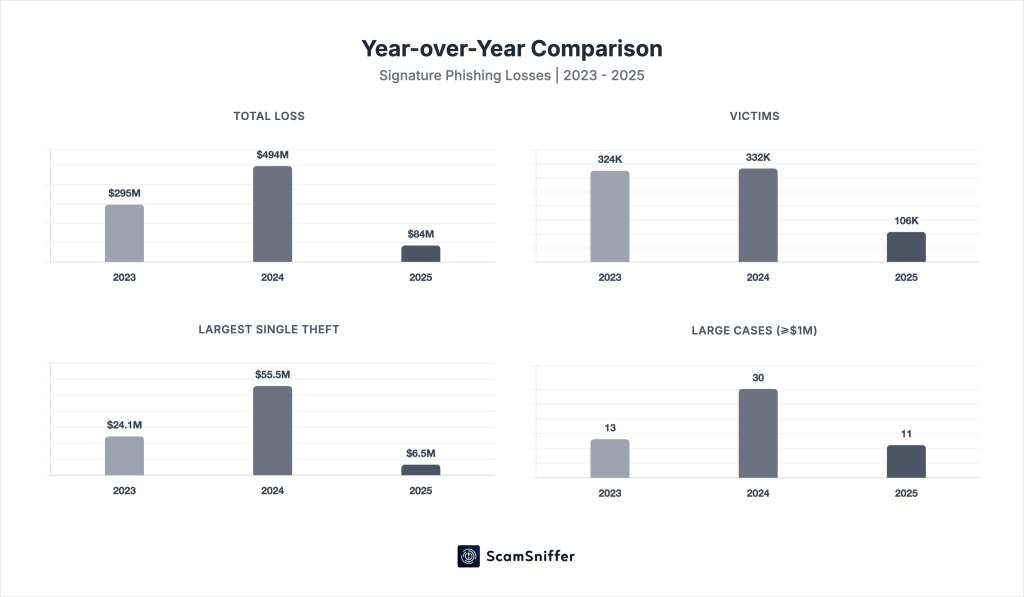
Source: Scam Sniffer

While the latest figures represent a significant decline from the previous year, Scam Sniffer analysts state there is no direct translation to decreased market threat as losses moved in parallel with the market cycle. Therefore, losses increased or decreased in relation to the global crypto user activity.

Notably, monthly losses varied from $2.04 million in December to $12.17 million in August. However, Q3, which was the busiest market period, accounted for the largest portion (29% i.e $31 million) of the yearly losses. However, figures dropped to $13 million in Q4, as user activity cooled off.

Related Reading: Aave Founder Responds To Governance Tension With Strategic Plan – Details

EIP-7702 Emerges As Latest Phishing Signature Type

According to Scam Sniffer’s report, EIP-7702 exploitation emerged as a new threat in the signature-based wallet-drainer ecosystem. Leveraging account abstraction introduced in the Pectra upgrade in May 2025, attackers can bundle multiple malicious operations into a single signature.

Notably, the largest EIP-7702 losses, with two incidents culminating in $2.54 million, were recorded in August. Meanwhile, Permit/ Permit2 signature types lead the space, accounting for $8.72 million in losses across three major incidents, I.e. 38% of all large-case losses.

Beyond signature phishing types, Scam Sniffer also highlighted other phishing attack types that threaten the crypto space. The Bybit incident in February stands out, after the Lazarus group breached a Safe (Wallet) developer machine and launched a program that imitated the multi-sig interface, resulting in losses of $1.46 billion.

In conclusion, while reported signature phishing losses have declined, the threat landscape remains active. Moreover, the fall in trackable losses may suggest attackers are employing harder-to-track vectors such as private key breaches or targeted social engineering.

Total crypto market cap valued at $3.08 trillion on the daily chart | Source: TOTAL chart on Tradingview.com

Related Questions

QWhat was the percentage decrease in crypto phishing losses from 2024 to 2025 according to Scam Sniffer?

AThere was an 83% decrease in crypto phishing losses from 2024 to 2025.

QWhat new type of phishing signature emerged as a threat in 2025, and which Ethereum upgrade did it leverage?

AEIP-7702 exploitation emerged as a new threat, leveraging the account abstraction introduced in the Pectra upgrade in May 2025.

QDespite the drop in losses, why do analysts caution that this does not mean the market threat has declined?

AAnalysts state that losses moved in parallel with the market cycle, meaning they increased or decreased in relation to global crypto user activity, not because the underlying security improved.

QWhich quarter of 2025 accounted for the largest portion of the yearly phishing losses, and how much was it?

AQ3 of 2025 accounted for the largest portion of the yearly losses at 29%, which was $31 million.

QWhat was the single largest theft via a permit signature attack in 2025, and how did it compare to 2024?

AThe single largest theft was a $6.5 million loss via a permit signature attack in September, which was 8 times lower than the largest theft in 2024.

Related Reads

Coldcard Hardware Wallet Hacked: 594 Bitcoin Withdrawn in 25 Minutes

The Coldcard hardware wallet has been compromised, with hackers stealing approximately 594.5 Bitcoin (~$40 million) from 500 addresses in just 25 minutes. The root cause was a critical software bug, undetected for five years, which disabled the device's secure chip for generating true random numbers. This led to the creation of private keys based on predictable data like the processor's serial number, drastically reducing cryptographic security. The attackers exploited this offline by brute-forcing possible seed phrases, finding active addresses on the public ledger, and signing transactions. Initially, Coinkite (Coldcard's maker) claimed only older models were at risk but later admitted all devices running the compromised firmware were vulnerable. CEO Rodolphe Novak (NVK) apologized but ruled out financial compensation for affected users. To secure funds, owners must urgently update their firmware to specific safe versions, generate a completely new seed phrase on the updated device, and transfer all assets to new addresses created with that new seed. While a BIP-39 passphrase can help, it does not replace this migration process. Other Coinkite products like TAPSIGNER were not affected. This incident underscores that even specialized hardware requires rigorous, independent code audits, especially for cryptographic functions. It parallels past failures, like a 2006 OpenSSL bug in Debian, and raises questions about whether automated code analysis can ever fully replace human scrutiny in critical security areas.

cryptonews.ru1h ago

Coldcard Hardware Wallet Hacked: 594 Bitcoin Withdrawn in 25 Minutes

cryptonews.ru1h ago

Trading

Spot
活动图片