Author: Deep Tide TechFlow
Yesterday's Market Dynamics
The Federal Reserve cut the benchmark interest rate by 25 basis points to 3.50%-3.75% early this morning, in line with market expectations
According to Jinshi Data, the Federal Reserve cut the benchmark interest rate by 25 basis points to 3.50%-3.75%, marking the third consecutive meeting with a rate cut, in line with market expectations. The cumulative rate cut for the year has reached 75 basis points.
Key points from the Fed statement and Powell's press conference:
FOMC Statement:
-
Statement Summary: Cut rates by 25 basis points to 3.50%-3.75%, the third consecutive meeting with a rate cut. Milan supported a 50 basis point cut, while Goolsbee and Schmid supported maintaining rates unchanged.
-
Interest Rate Outlook: Will consider the extent and timing of further interest rate adjustments. The median dot plot is entirely consistent with September's, projecting one rate cut each in the next two years.
-
Inflation Outlook: Inflation has risen since the beginning of the year and remains relatively high, consistent with previous statements. Lowered next year's inflation expectations in the SEP.
-
Economic Outlook: Economic activity has been expanding at a moderate pace, and uncertainty about the outlook remains high, consistent with previous statements. Upwardly revised GDP growth forecasts for the next three years across the board.
-
Labor Market: Removed the description of the unemployment rate as "low," believing that downside risks to employment have increased in recent months. The unemployment rate forecast for next year remains unchanged at 4.4%.
-
Reserve Purchases: Will begin purchasing Treasury bills on December 12th, buying $40 billion in Treasury bills over the next 30 days. Removed operational limits on standing overnight repo operations.
Powell's Press Conference:
-
Interest Rate Outlook: Can wait and observe how the economy develops. Currently at the upper end of the neutral range. No one currently has rate hikes as their baseline expectation. Long-term rates may rise due to expectations of faster economic growth.
-
Inflation Outlook: Inflation risks are tilted to the upside. Peak inflation could be zero point something percent higher or lower than current levels. Current inflation overshoot is primarily driven by tariffs. If tariffs are removed, the inflation rate would be at the low end of the 2% range. The impact of tariffs is likely a one-time event.
-
Economic Outlook: Does not believe the economy is overheating. The baseline outlook for next year is solid growth; can wait and observe developments.
-
Employment Outlook: There are downside risks in the labor market. Job growth in recent months was overstated by 60,000 positions. The unemployment rate could rise by up to 0.1%-0.2%.
-
Purchase Situation: Purchasing short-term Treasury bills is solely for reserve management purposes. The scale of purchases may remain high in the coming months before gradually decreasing.
-
Latest Expectations: As of the time of writing, futures markets expect the Fed to cut rates by a cumulative 55 basis points next year, a slight increase from pre-meeting expectations. The probability of a 25 basis point cut in January next year is 24.4%.
-
Market Reaction: From the release of the Fed statement through Powell's speech, gold and silver initially rose, then fell, before rising again, with silver hitting a new all-time high. U.S. Treasury yields fell by about 4 basis points. The U.S. dollar generally weakened, while non-USD currency pairs strengthened. U.S. stocks trended upward, with the Dow Jones rising over 1%. Trump criticized Powell after the meeting, saying the rate cut could have been larger.
U.S. Senate Banking Committee may delay consideration of the "Crypto Market Structure Bill" until 2026
Crypto journalist Eleanor Terrett posted on platform X that U.S. senators from both parties held another meeting today regarding the "Crypto Market Structure Bill." After the meeting, Senator Mark Warner revealed that it would be "very difficult" to consider the bill next week given its current state, a view shared by other senators. It now appears likely that the U.S. Senate Banking Committee will have to wait until the new year to consider the bill.
Bank of America approved to provide crypto trading intermediary services for clients
According to Dlnews, the U.S. Office of the Comptroller of the Currency (OCC) announced on Tuesday that Bank of America can act as an intermediary for cryptocurrency transactions, buying and selling digital assets on behalf of clients. This "riskless principal trading" model is the same way banks currently handle securities transactions for clients; the bank acts only as an intermediary and does not hold crypto assets in its own inventory.
Brevis partners with Aster to bring ZK security and privacy to on-chain transactions
According to an official announcement, ZK verifiable computing platform Brevis has now partnered with Aster. As a multi-chain DEX, Aster supports yield-generating collateral and hidden order functionality. This collaboration aims to address the three long-standing challenges faced by DEXs, achieving a true balance between speed, security, and privacy.
Brevis can migrate complex on-chain computations off-chain and generate efficient ZK proofs, enabling on-chain verification at a cost far lower than native on-chain execution. Through this partnership, the two will explore how to leverage these capabilities to achieve centralized exchange-level execution speed, cryptographically-secure verification, and protect user position data privacy without compromising overall market transparency.
Bitwise CEO: The four-year cycle is dead; it's actually been a bear market since February this year, a major rally is coming in 2026
Bitwise CEO Hunter Horsley expressed his views on social media, stating that the four-year cycle pattern for cryptocurrency has ended, and the market has changed and matured.
Hunter Horsley said that looking back at 2025, it will be clear that the market has actually been in a bear market since February, only masked by sustained buying from crypto treasury companies. He believes all factors are setting the stage for a massive rally in 2026.
Silk Road-linked wallets transfer $3.14 million in BTC to unknown address after a decade of dormancy
According to The Block, hundreds of cryptocurrency wallets linked to the dark web market Silk Road were reactivated on Tuesday after lying dormant for over a decade, transferring $3.14 million worth of BTC to an unknown address.
Data from Arkham Intelligence showed that approximately 312 wallets associated with the defunct dark web market Silk Road collectively moved BTC to the address "bc1q...ga54". The reason for the reactivation of these wallets is currently unclear. As of now, Silk Road-linked wallets still hold approximately $41.3 million in BTC. In January of this year, Coinbase director Conor Grogan stated on platform X that he had identified wallets linked to Silk Road founder Ross Ulbricht containing approximately $47 million worth of BTC.
Earlier this year, U.S. President Trump signed an executive order granting clemency to Ulbricht, who is currently serving a prison sentence.
Yi He: Will airdrop BNB to users who suffered losses due to WeChat hack
Binance co-founder Yi He's WeChat account was recently hacked, leading some users who trusted the information in her朋友圈 (Moments) to purchase a certain meme coin and suffer losses. Yi He has announced that she will personally provide a certain amount of BNB to compensate users who traded the meme coin on Binance's non-custodial wallet and Alpha platform during the account hack period and incurred losses. The airdrop will be completed within 24 hours.
Strategy responds to MSCI excluding DAT from index: Formally requests MSCI withdraw the proposal
Strategy has submitted a response to MSCI's consultation regarding Digital Asset Treasury companies. Index standards should remain neutral, consistent, and reflect global market trends. Therefore, they have formally requested MSCI withdraw the proposal, as it is arbitrary, discriminatory, unworkable, contrary to U.S. policy, and would stifle innovation. Digital Asset Treasury companies (DATs) are operating businesses, not investment funds.
HashKey Holdings IPO enters final stage, public offering nearly 149 times oversubscribed
HashKey Holdings (Stock Code: 03887), the parent company of Hong Kong licensed virtual asset exchange HashKey Exchange, which is soon to list on the Hong Kong Stock Exchange, continues to see active market subscription. It is reported that the international offering portion of the company has been oversubscribed, attracting long-term capital participation from international and Chinese institutions.
Meanwhile, its public offering portion has received a enthusiastic response. According to the latest data from several brokerages as of the time of writing, the total subscription funds lent through brokerage channels have climbed to approximately HK$24.898 billion. Based on the public offering fundraising amount of HK$167 million, it has initially recorded an oversubscription of about 148.91 times, indicating high investor participation.
HashKey Holdings' IPO subscription will close on December 12th.
Crypto AI platform Surf completes $15 million funding round led by Pantera Capital
According to Fortune, AI platform Surf announced the completion of a $15 million funding round led by Pantera Capital, with participation from Coinbase Ventures and Digital Currency Group.
Surf was founded by Ryan Li to address the "hallucination" issues mainstream AI platforms like ChatGPT have with cryptocurrency information. The platform launched in July this year on an invitation-only basis and opened to the public in September. It currently has over 300,000 users and has generated over 1 million search results.
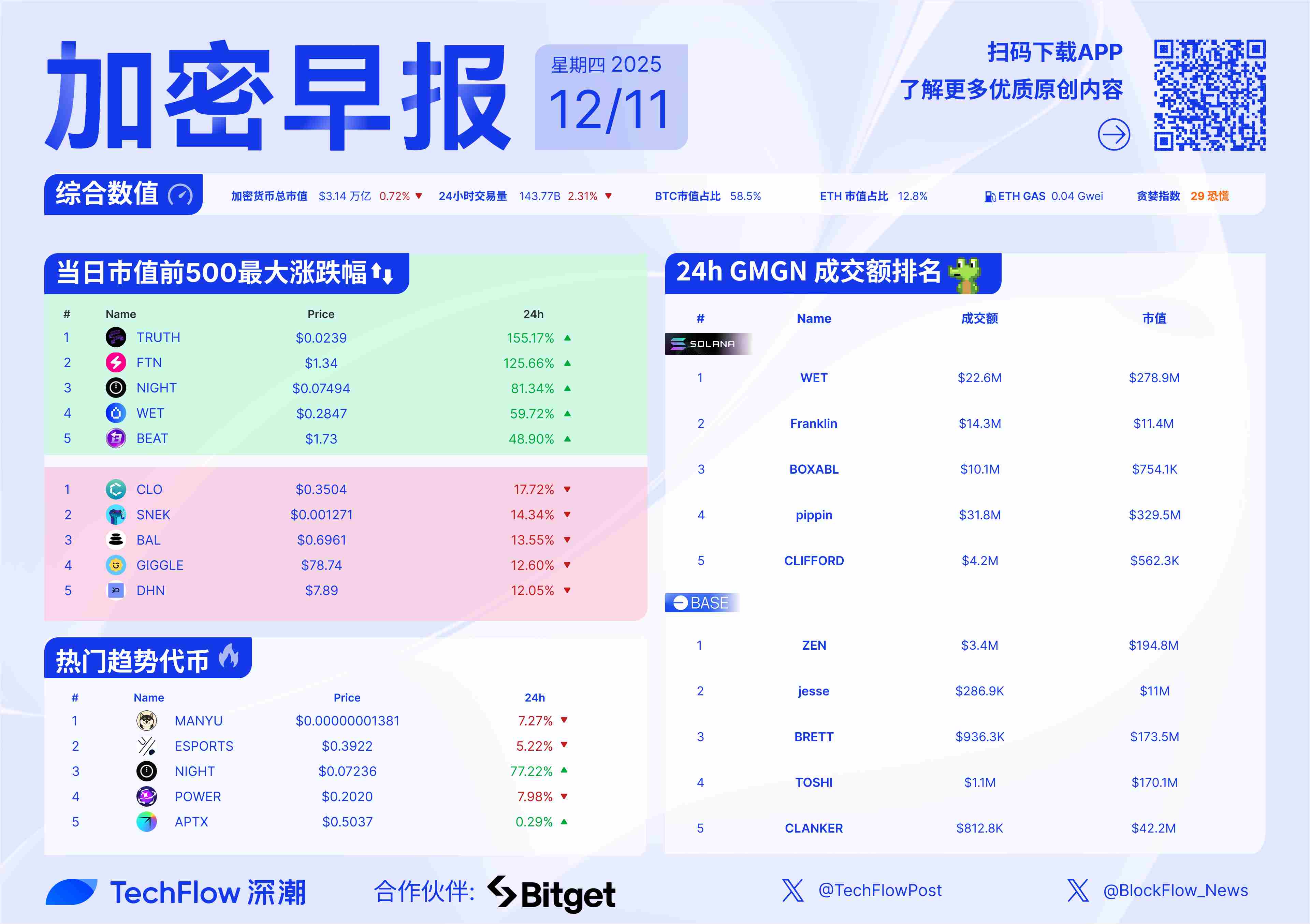
Market Dynamics
Recommended Reading
On the Eve of Do Kwon's Sentencing, $1.8 Billion is Betting on His Prison Term
This article describes the intense speculative gambling around LUNA tokens on the eve of Do Kwon's sentencing. Although LUNA's fundamentals have gone to zero, the market is leveraging the uncertainty surrounding Do Kwon's sentence to drive wild price fluctuations. The sentencing hearing on December 11th became a key market focus, expected to significantly impact LUNA token trading.
Crypto Analysts in Conversation: Bitcoin Bottom Taking Shape, Smart Money Starts Scooping Up in Anticipation of 2026 Market
This article delves into the current state and future trends of the Bitcoin and crypto markets, covering the formation of market bottoms, liquidity drivers, institutional capital deployment, and the potential of prediction markets, among other aspects. Through expert dialogue, it analyzes the impact of the macroeconomic environment on Bitcoin and altcoin markets and explores the shifting attitudes of sovereign wealth funds and financial institutions towards cryptocurrency.
30-Year Wall Street Veteran: Lessons from Horse Racing, Poker, and Investment Legends That Taught Me About Bitcoin
Through personal experience, this article explores how analytical methods used for horse racing odds can be applied to Bitcoin investment and other decisions. It emphasizes the importance of probabilistic thinking, independent evaluation, and position sizing, using Bitcoin as an example to analyze its potential value and risks as an investment.
The Person Who Made $69 Million from NFTs Four Years Ago is Still Making Money
This article tells the story of how, despite the NFT market no longer being glorious, artist Beeple and his team remain active in the NFT space. Beeple launched a series of NFT "Regular Animas" robotic dogs at Art Basel, which feature unique artistic expression and technological innovation and sold for high prices. Furthermore, the article mentions that Beeple never slowed down his creative pace due to success; he continues to drive NFT art development through his team and studio.
Regulatory Crossroads: The US, Europe, and the Future of Crypto Assets
This article analyzes the current state of the global cryptocurrency market and its regulatory trends, focusing on the different approaches to cryptocurrency regulation in regions like the US, Europe, and Switzerland. It points out that the US is actively promoting cryptocurrency normalization to attract capital and leveraging its fiscal advantages to push industry development; while the EU, due to overly cumbersome regulation, risks stifling innovation and becoming an obstacle to crypto industry growth; Switzerland, with its flexible and friendly regulatory environment, serves as a model for the crypto industry.