Crypto Markets Stay Calm As US Supreme Court Rules Against Trump’s Tariffs — Here’s Why

bitcoinistPublished on 2026-02-22Last updated on 2026-02-22

Abstract

The crypto market remains in a bearish trend, with a 12% drop in February and a 44.5% decline since October 2025. Despite the US Supreme Court ruling against Trump’s tariffs as illegal under IEEPA, the crypto space showed little reaction. Analysts note that any potential impact depends on liquidity shifts, which hinge on the implementation of the court’s decision. Refunds estimated between $40 billion and $170 billion could improve corporate liquidity and risk appetite but may also raise fiscal concerns. Bitcoin, being highly sensitive to liquidity changes, did not experience immediate price movement. Investors are advised to monitor ETF flows, stablecoin movements, and exchange activity. The total crypto market cap stands at $2.33 trillion.

The crypto landscape remains in a widespread bear market following months of consistent market sell-off driven by geopolitical tensions, macro settings, and a shift in structure. In February alone, the total market cap has dropped by 12%, extending the total decline from October 2025 to around 44.5%.

Interestingly, another geopolitical event has occurred in which the US Supreme Court has struck down the legality of trade tariffs imposed by President Donald Trump under IEEPA. In a QuickTake post on CryptoQuant, XWIN Research Japan highlights the potential implications of this development for the crypto market.

Tariff Impact On Crypto Assets Hinges On Implementation

On February 20, the US Supreme Court declared that the majority of the new tariffs imposed by Trump over the last year are illegal. The nation’s apex court clarified that the International Emergency Economic Powers Act (IEEPA) does not authorize the President to impose tariffs; these taxes are being revoked, potentially those under Sections 232 and 301.

According to XWIN Research Japan, the crypto market has barely reacted to this development. This is an important observation as digital assets experienced significant losses in reaction to these tariff announcements during 2025, most notably on October 10. However, the analysts explain that any impact on crypto prices relies on liquidity, which further hinges on the legal processes and political implementation of the Supreme Court’s decision.

Notably, total tariff refunds from the US government are estimated between $40 billion and $170 billion. If the refunds proceed as instructed, liquidity will move from the US Treasury Account to the private business. This scenario is expected to improve companies’ cash flow and encourage investment and risk allocation.

However, it’s worth noting that a decline in government revenue could raise fiscal concerns, resulting in increased bond issuance. Eventually, there is heightened pressure on long-term bonds as investors push for higher yields.

Bitcoin Remains Liquidity Sensitive

XWIN Research Japan notes that the Supreme Court’s decision does not immediately create a “cash-hit-market” scenario. Hence, the lack of corresponding price action.
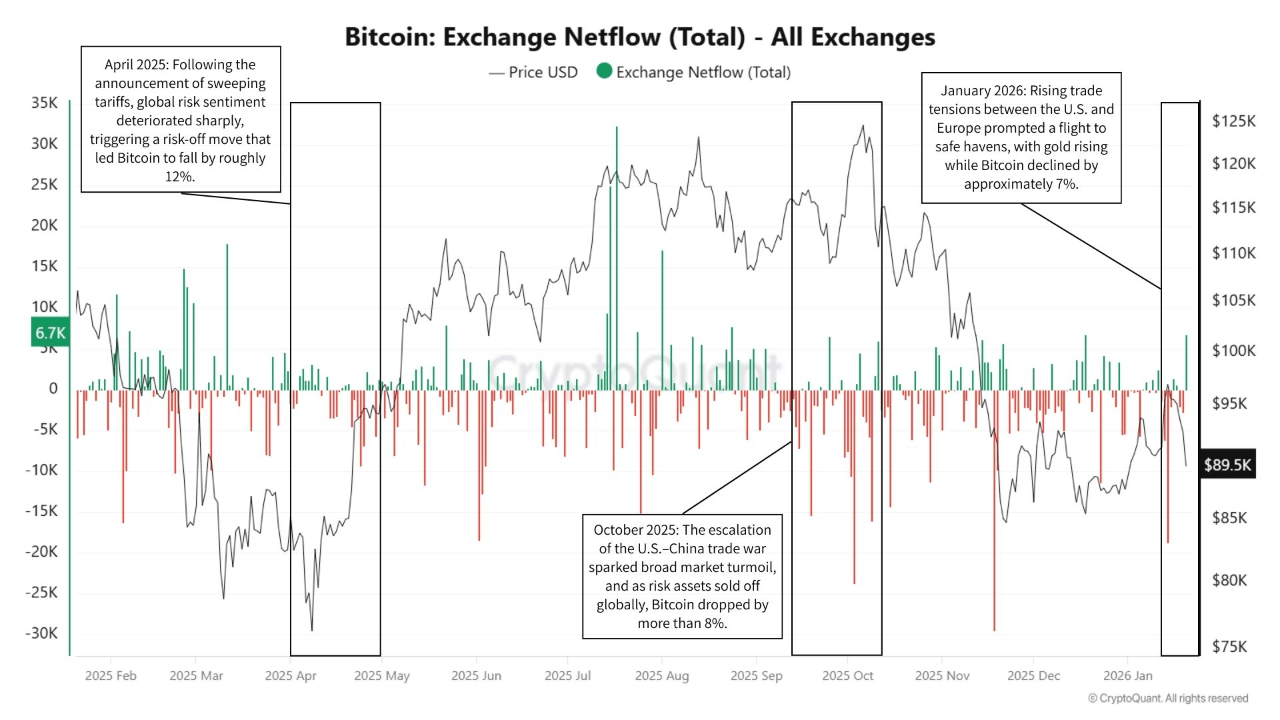
Source: CryptoQuant

Data from the Bitcoin Exchange Netflow chart shows macroeconomic shocks have coincided with a surge in exchange inflows and a fall in price, reinforcing Bitcoin’s status as a liquidity-sensitive asset rather than a stable investment. Therefore, investors are advised to monitor indicators of this liquidity, including ETF flows. Stablecoin exchange inflows, Bitcoin exchange inflows, and the US dollar. At press time, the total crypto market is valued at $2.33 trillion, with total trading volume estimated at $103.2 billion.

Total crypto market cap valued at $2.33 trillion on the daily chart | Source: TOTAL chart on Tradingview.com

Related Questions

QWhat was the US Supreme Court's ruling regarding President Trump's tariffs, and under which act were they imposed?

AThe US Supreme Court ruled that the majority of the tariffs imposed by President Trump over the last year are illegal. The court clarified that these tariffs, imposed under the International Emergency Economic Powers Act (IEEPA), were not authorized by that act.

QWhy has the crypto market shown little reaction to the Supreme Court's decision on tariffs, according to XWIN Research Japan?

AThe crypto market has barely reacted because any impact on crypto prices relies on liquidity, which further depends on the legal processes and political implementation of the Supreme Court's decision. The ruling does not immediately create a 'cash-hit-market' scenario.

QWhat is the estimated range of total tariff refunds from the US government, and what is the potential effect of these refunds?

AThe total tariff refunds are estimated to be between $40 billion and $170 billion. If the refunds proceed, liquidity will move from the US Treasury Account to private businesses, which is expected to improve companies' cash flow and encourage investment and risk allocation.

QHow is Bitcoin characterized in the article in terms of its reaction to macroeconomic events?

ABitcoin is characterized as a liquidity-sensitive asset rather than a stable investment. Data shows that macroeconomic shocks have coincided with a surge in Bitcoin exchange inflows and a fall in its price.

QWhat indicators are investors advised to monitor to gauge liquidity, as mentioned in the article?

AInvestors are advised to monitor indicators of liquidity, including ETF flows, stablecoin exchange inflows, Bitcoin exchange inflows, and the US dollar.

Related Reads

BIP-110 Controversy Intensifies: Bitcoin May Face Its Most Divisive Hard Fork Battle in Years

Bitcoin is approaching a critical block height of 961,632, which could activate the controversial BIP-110 proposal. This proposal aims to restrict the amount of non-financial data, such as inscriptions and other large data payloads, within Bitcoin transactions. Supporters, including some node operators and Bitcoin purists, argue that BIP-110 is necessary to preserve Bitcoin's core function as a monetary settlement layer by reducing network congestion and node operational burdens caused by non-essential data. They frame it as a correction to keep the network true to its original purpose. However, critics, including prominent figures like Blockstream's Adam Back and developer Jameson Lopp, warn that the proposal's implementation mechanism is dangerously flawed. They highlight that its low 55% miner signaling threshold, coupled with a contentious enforcement mechanism allowing nodes to unilaterally reject non-compliant blocks, significantly increases the risk of a chain split. Opponents argue this sets a dangerous precedent for transaction censorship, undermines Bitcoin's protocol neutrality, and creates excessive uncertainty for developers and businesses, especially since the rule is proposed as a temporary one-year measure. Market analysts, such as those from Bitfinex, suggest a full-scale network split is unlikely due to a lack of broad economic consensus. Major mining pools remain neutral, and adoption of the new rules is minimal. They view the situation more as a governance stress test. The primary risk is operational disruption: if a minority chain persists, major exchanges and custodians may need to temporarily suspend Bitcoin deposits and withdrawals to manage security and liquidity, potentially unsettling newer institutional investors. While BIP-110 is not expected to succeed in overtaking the main chain, its approach has ignited a significant debate about Bitcoin's governance, core values, and resilience.

Foresight News18m ago

BIP-110 Controversy Intensifies: Bitcoin May Face Its Most Divisive Hard Fork Battle in Years

Foresight News18m ago

Crypto Market Makers Are Collectively Seeking Change as Money Becomes Harder to Earn

**Summary: Crypto Market Makers Adapt as Margins Shrink** Leading crypto market maker GSR exemplifies a broader industry shift, moving beyond traditional market-making to become a full-service "Web3 investment bank." Its recent strategic acquisitions—including an SEC-registered broker-dealer, rebranded as GSR Securities—and purchases of token advisory firms aim to create an integrated platform covering token design, fundraising, listing, liquidity provision, and asset management. This includes launching an ETF and investing in tokenization platforms like Libeara, backed by a strategic investment from Standard Chartered's SC Ventures. This transformation is not unique to GSR. Other major players like Keyrock, B2C2, Wintermute, and DWF Labs are also expanding geographically, pursuing regulatory licenses (especially under frameworks like MiCA in the EU), and diversifying into over-the-counter (OTC) trading, asset management, and real-world asset tokenization. The driving force behind this collective pivot is a rapidly changing market. Profits from traditional altcoin market-making are declining due to fewer viable projects, reduced client budgets, increased competition, and smarter, more demanding clients. Simultaneously, regulatory pressures are mounting, making compliance a baseline cost. Extreme market events further expose teams lacking robust risk controls. Consequently, the crypto market-making business model is evolving from one reliant on information asymmetry and volatility to a more institutionalized, regulated, and service-diverse industry. Survival now depends on building systemic capabilities beyond mere liquidity provision.

marsbit1h ago

Crypto Market Makers Are Collectively Seeking Change as Money Becomes Harder to Earn

marsbit1h ago

Trading

Spot
Futures

Hot Articles

Discussions

Welcome to the HTX Community. Here, you can stay informed about the latest platform developments and gain access to professional market insights. Users' opinions on the price of S (S) are presented below.

活动图片















