Crypto Markets Stay Calm As US Supreme Court Rules Against Trump’s Tariffs — Here’s Why

bitcoinistPublished on 2026-02-22Last updated on 2026-02-22

Abstract

The crypto market remains in a bearish trend, with a 12% drop in February and a 44.5% decline since October 2025. Despite the US Supreme Court ruling against Trump’s tariffs as illegal under IEEPA, the crypto space showed little reaction. Analysts note that any potential impact depends on liquidity shifts, which hinge on the implementation of the court’s decision. Refunds estimated between $40 billion and $170 billion could improve corporate liquidity and risk appetite but may also raise fiscal concerns. Bitcoin, being highly sensitive to liquidity changes, did not experience immediate price movement. Investors are advised to monitor ETF flows, stablecoin movements, and exchange activity. The total crypto market cap stands at $2.33 trillion.

The crypto landscape remains in a widespread bear market following months of consistent market sell-off driven by geopolitical tensions, macro settings, and a shift in structure. In February alone, the total market cap has dropped by 12%, extending the total decline from October 2025 to around 44.5%.

Interestingly, another geopolitical event has occurred in which the US Supreme Court has struck down the legality of trade tariffs imposed by President Donald Trump under IEEPA. In a QuickTake post on CryptoQuant, XWIN Research Japan highlights the potential implications of this development for the crypto market.

Tariff Impact On Crypto Assets Hinges On Implementation

On February 20, the US Supreme Court declared that the majority of the new tariffs imposed by Trump over the last year are illegal. The nation’s apex court clarified that the International Emergency Economic Powers Act (IEEPA) does not authorize the President to impose tariffs; these taxes are being revoked, potentially those under Sections 232 and 301.

According to XWIN Research Japan, the crypto market has barely reacted to this development. This is an important observation as digital assets experienced significant losses in reaction to these tariff announcements during 2025, most notably on October 10. However, the analysts explain that any impact on crypto prices relies on liquidity, which further hinges on the legal processes and political implementation of the Supreme Court’s decision.

Notably, total tariff refunds from the US government are estimated between $40 billion and $170 billion. If the refunds proceed as instructed, liquidity will move from the US Treasury Account to the private business. This scenario is expected to improve companies’ cash flow and encourage investment and risk allocation.

However, it’s worth noting that a decline in government revenue could raise fiscal concerns, resulting in increased bond issuance. Eventually, there is heightened pressure on long-term bonds as investors push for higher yields.

Bitcoin Remains Liquidity Sensitive

XWIN Research Japan notes that the Supreme Court’s decision does not immediately create a “cash-hit-market” scenario. Hence, the lack of corresponding price action.
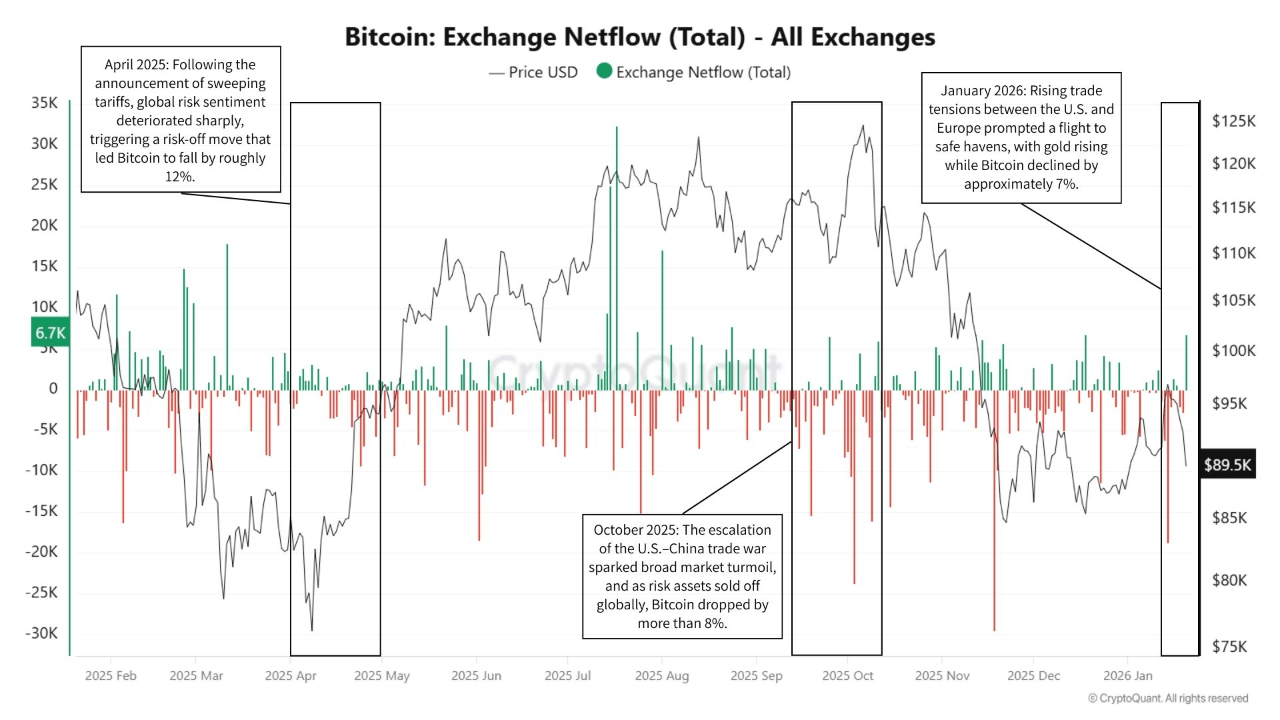
Source: CryptoQuant

Data from the Bitcoin Exchange Netflow chart shows macroeconomic shocks have coincided with a surge in exchange inflows and a fall in price, reinforcing Bitcoin’s status as a liquidity-sensitive asset rather than a stable investment. Therefore, investors are advised to monitor indicators of this liquidity, including ETF flows. Stablecoin exchange inflows, Bitcoin exchange inflows, and the US dollar. At press time, the total crypto market is valued at $2.33 trillion, with total trading volume estimated at $103.2 billion.

Total crypto market cap valued at $2.33 trillion on the daily chart | Source: TOTAL chart on Tradingview.com

Related Questions

QWhat was the US Supreme Court's ruling regarding President Trump's tariffs, and under which act were they imposed?

AThe US Supreme Court ruled that the majority of the tariffs imposed by President Trump over the last year are illegal. The court clarified that these tariffs, imposed under the International Emergency Economic Powers Act (IEEPA), were not authorized by that act.

QWhy has the crypto market shown little reaction to the Supreme Court's decision on tariffs, according to XWIN Research Japan?

AThe crypto market has barely reacted because any impact on crypto prices relies on liquidity, which further depends on the legal processes and political implementation of the Supreme Court's decision. The ruling does not immediately create a 'cash-hit-market' scenario.

QWhat is the estimated range of total tariff refunds from the US government, and what is the potential effect of these refunds?

AThe total tariff refunds are estimated to be between $40 billion and $170 billion. If the refunds proceed, liquidity will move from the US Treasury Account to private businesses, which is expected to improve companies' cash flow and encourage investment and risk allocation.

QHow is Bitcoin characterized in the article in terms of its reaction to macroeconomic events?

ABitcoin is characterized as a liquidity-sensitive asset rather than a stable investment. Data shows that macroeconomic shocks have coincided with a surge in Bitcoin exchange inflows and a fall in its price.

QWhat indicators are investors advised to monitor to gauge liquidity, as mentioned in the article?

AInvestors are advised to monitor indicators of liquidity, including ETF flows, stablecoin exchange inflows, Bitcoin exchange inflows, and the US dollar.

Related Reads

Goldman Sachs Bows Down, Bitcoin Finally Breaks Through the Gates of Wall Street

Wall Street giants, including Goldman Sachs, Morgan Stanley, Charles Schwab, and the New York Stock Exchange, have reversed their long-standing opposition to Bitcoin and are now actively embracing it. After years of dismissing Bitcoin as a scam, a bubble, or a tool for illicit activities, these institutions are launching Bitcoin ETFs, enabling spot trading, and building dedicated crypto infrastructure. Goldman Sachs, which once called Bitcoin a "fraud tool," is now offering Bitcoin ETFs. Morgan Stanley, which internally banned the term "cryptocurrency," has launched its largest-ever ETF backed by Bitcoin. Charles Schwab has opened spot crypto trading for its retail clients, integrating Bitcoin alongside traditional assets. The NYSE is building robust infrastructure to support digital assets, signaling a long-term commitment. This dramatic shift is driven not by a change in ideology but by economic necessity. As Bitcoin repeatedly survived market crashes and grew into a multi-trillion-dollar asset class, ignoring it became too costly. Wall Street’s business model relies on capturing fees, and Bitcoin’s rise represented a massive wealth transfer occurring outside their ecosystem. The fear of missing out (FOMO) and client demand forced these institutions to capitulate. The article frames this as a historic surrender to Bitcoin’s mathematical inevitability. Unlike the trust-based traditional financial system, Bitcoin operates on decentralized, transparent, and unchangeable rules. Its scarcity and resilience make it a hedge against fiat currency devaluation and systemic risk. The narrative has flipped: not holding Bitcoin is now seen as the greater risk. The author concludes that Bitcoin has not been co-opted by Wall Street; instead, it has co-opted Wall Street, marking a fundamental shift in the global financial architecture.

marsbit50m ago

Goldman Sachs Bows Down, Bitcoin Finally Breaks Through the Gates of Wall Street

marsbit50m ago

Trading

Spot
Futures

Hot Articles

Discussions

Welcome to the HTX Community. Here, you can stay informed about the latest platform developments and gain access to professional market insights. Users' opinions on the price of S (S) are presented below.

活动图片