Crypto Market Structure Bill Paused: Senate Banking Cancels Markup

bitcoinistPublished on 2026-01-15Last updated on 2026-01-15

Abstract

The Senate Banking Committee has postponed the markup of a crypto market structure bill following opposition from Coinbase CEO Brian Armstrong, who argued the current draft is "materially worse than the status quo" and would effectively ban tokenized equities, restrict DeFi, and stifle innovation. Committee Chairman Tim Scott described the delay as a tactical pause to continue bipartisan negotiations, emphasizing the goal of establishing clear rules to protect consumers and national security. The move has split the crypto industry, with firms like a16z, Circle, and Ripple expressing support for the legislative effort, while others, including Bitwise Asset Management, sided with Coinbase's stance that "no bill is better than a bad bill." Despite the setback, key figures like Galaxy Digital's Mike Novogratz remain optimistic about a eventual compromise, noting ongoing good-faith discussions among lawmakers. The total crypto market cap was $3.22 trillion at the time of reporting.

The Senate Banking Committee has pulled the scheduled Thursday markup of its crypto asset market structure bill after a late-stage flare-up with Coinbase, freezing what had looked like a tightening path toward action. The pause lands at a sensitive moment for Washington’s crypto negotiations: industry heavyweights are publicly splitting over the Senate draft even as lawmakers insist bipartisan talks are still alive.

Senate Banking Committee Chairman Tim Scott (R-S.C.) said Wednesday the committee will postpone the markup “as bipartisan negotiations continue,” framing the delay as tactical rather than terminal. “I’ve spoken with leaders across the crypto industry, the financial sector, and my Democratic and Republican colleagues, and everyone remains at the table working in good faith,” Scott wrote on X. “As we take a brief pause before moving to a markup, this market structure bill reflects months of serious bipartisan negotiations and real input from innovators, investors, and law enforcement.”

Scott positioned the bill as a foundational framework rather than a narrow industry carveout. “The goal is to deliver clear rules of the road that protect consumers, strengthen our national security, and ensure the future of finance is built in the United States,” he added.

Coinbase Breaks Ranks Late

The immediate catalyst was Coinbase CEO Brian Armstrong, who said the exchange “can’t support the bill as written” after reviewing “the Senate Banking draft text over the last 48hrs.”

Armstrong argued the draft contains multiple provisions he says would be “materially worse than the current status quo,” contending that it amounts to “a defacto ban on tokenized equities,” includes “DeFi prohibitions” that expand government access to financial records and erode privacy, and would “stifl[e] innovation” by weakening the CFTC relative to the SEC.

He also pointed to “draft amendments” he said “would kill rewards on stablecoins,” warning the changes could allow banks to “ban their competition.” Armstrong’s bottom line was blunt: “We’d rather have no bill than a bad bill.” Still, he struck a conciliatory note about process and odds of a compromise, adding he was “quite optimistic” that continued work could produce “the right outcome.”

That posture split the difference between hard opposition to the text and support for continued negotiations,an important distinction as the markup process is typically where senators offer and vote amendments.

Crypto Industry Split

Coinbase’s stance quickly triggered a counter-response from other major crypto firms and advocacy groups backing the Senate Banking GOP’s push. Support was voiced by a16z, Circle, Kraken, The Digital Chamber, Ripple, and Coin Center, coalescing into a public front aimed at keeping momentum intact despite the delay.

Ripple CEO Brad Garlinghouse cast the bill as overdue but directionally positive. “While long-overdue, this move by @SenatorTimScott and @BankingGOP on market structure is a massive step forward in providing workable frameworks for crypto, while continuing to protect consumers,” he wrote. He said Ripple would remain engaged, adding: “We are at the table and will continue to move forward with fair debate. I remain optimistic that issues can be resolved through the mark-up process.”

Meanwhile, Tim Draper said Armstrong’s opposition is justified, arguing the Senate compromise “is worse than no bill at all” and suggesting that “the banks have been meddling.”

Ryan Rasmussen, Head of Research at Bitwise Asset Management , called the current CLARITY Act draft broadly harmful, listing tokenization, stablecoins, DeFi, privacy, builders, users, investors, and innovation, and concluded that the industry would “rather have no bill than a bad bill.”

White House Crypto Czar David Sacks urged the industry to treat the delay as a narrow window to align rather than an opening to splinter. “Passage of market structure legislation remains as close as it’s ever been,” Sacks wrote. “The crypto industry should use this pause to resolve any remaining differences. Now is the time to set the rules of the road and secure the future of this industry.”

Galaxy Digitall’s CEO Mike Novogratz struck a more optimistic tone, saying: “While the crypto bill might be delayed to keep working on it, I am very confident that a bill will get done soon. I have spoken to over 10 senators on both sides of the aisle in the past 24 hrs and I believe they all are working in good faith to get something done. Always gets tense at the end.”

At press time, the total crypto market cap stood at $3.22 trillion.
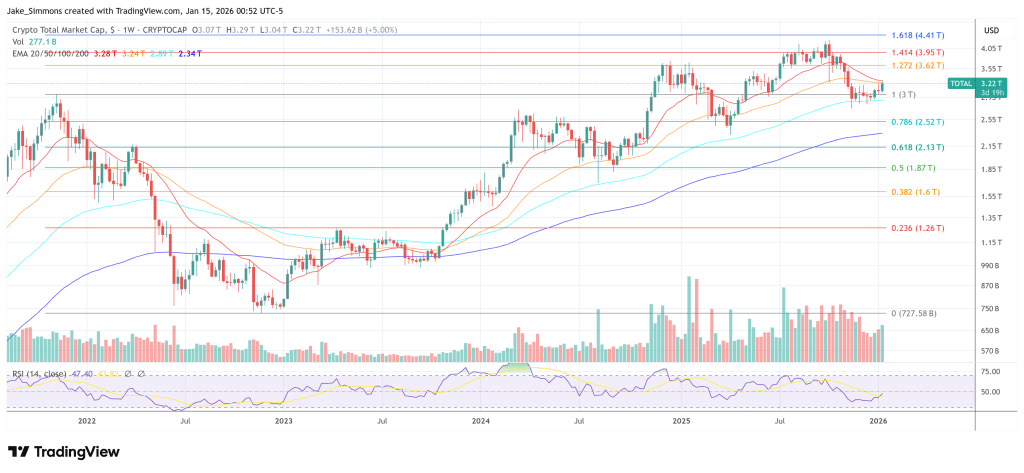
Total crypto market cap needs to overcome the 20-and 50-week EMAs, 1-week chart | Source: TOTAL on TradingView.com

Related Questions

QWhy did the Senate Banking Committee postpone the markup of the crypto market structure bill?

AThe Senate Banking Committee postponed the markup to allow more time for bipartisan negotiations to continue, as stated by Chairman Tim Scott, who framed the delay as tactical rather than terminal.

QWhat were Coinbase CEO Brian Armstrong's main objections to the draft bill?

ABrian Armstrong argued the draft bill contained provisions that would be 'materially worse than the current status quo,' including a de facto ban on tokenized equities, DeFi prohibitions that expand government access to financial records, and measures that would stifle innovation by weakening the CFTC relative to the SEC.

QWhich major crypto firms and advocacy groups publicly supported the Senate Banking GOP's push for the bill?

ASupport for the bill was voiced by a16z, Circle, Kraken, The Digital Chamber, Ripple, and Coin Center.

QWhat was the overall sentiment of Ripple CEO Brad Garlinghouse regarding the bill?

ABrad Garlinghouse viewed the bill as a long-overdue but massive step forward, calling it a positive framework for crypto that protects consumers, and he remained optimistic that issues could be resolved through the mark-up process.

QHow did White House Crypto Czar David Sacks advise the crypto industry to respond to the delay?

ADavid Sacks urged the industry to use the pause as a narrow window to resolve remaining differences and align, rather than splinter, emphasizing that this is the time to set the rules of the road and secure the industry's future.

Related Reads

STRC Major De-pegging's First Financial Report, How Will Strategy Repair Its Capital Flywheel?

Bitcoin treasury company Strategy released its Q2 2026 earnings report on July 31. Despite a 6.9% year-over-year revenue increase to $122 million, the company recorded a net loss of $8.22 billion, largely due to $8.32 billion in unrealized losses from Bitcoin price fluctuations. As of quarter-end, Strategy holds 843,775 BTC with an average cost of $75,000 per coin, and Bitcoin per share increased. The report highlights a critical shift in Strategy's capital model following the de-pegging of its key financing tool, STRC (Strategic Coin), which fell below its $100 target. Management's top priority is restoring STRC to its target value, aiming for a recovery by September 8. They rule out discounted STRC issuances and plan to maintain its dividend yield at 12%, instead focusing on bolstering its $3.75 billion cash reserve. Strategy has moved from a one-way "buy-and-hold" Bitcoin strategy to active capital management. This new approach, part of its "Digital Credit Capital Framework," involves flexibly managing its balance sheet across four elements: BTC, USD cash, common stock (MSTR), and digital credit securities like STRC. This allows for BTC monetization (having sold $218.4 million in BTC so far), strategic repurchases of discounted securities, and debt optimization, as seen with a $1.5 billion convertible bond buyback. The company's future hinges on two key tests: successfully re-pegging STRC to restore market confidence in its digital credit system, and a long-term recovery in Bitcoin's price to ultimately support its growth thesis.

marsbit44m ago

STRC Major De-pegging's First Financial Report, How Will Strategy Repair Its Capital Flywheel?

marsbit44m ago

STRC's First Financial Report Post-Depegging, How is Strategy Restoring the Capital Flywheel?

On July 31, 2026, Bitcoin treasury company Strategy released its Q2 financial report. Despite a 6.9% year-over-year increase in revenue to $122 million, the company recorded a substantial net loss of $8.22 billion, primarily due to $8.32 billion in unrealized losses from Bitcoin holdings. While Strategy's core Bitcoin strategy remains intact—its holdings grew 11% to 843,775 BTC—the company is undergoing a fundamental shift in its capital model. Following the de-pegging of its key financing tool, the STRCoin (STRC), from its $100 target in May, Strategy has pivoted from a one-directional "raise funds, buy Bitcoin" cycle to a more dynamic, multi-asset capital management approach. A key part of this new framework is the "Monetization Program," through which Strategy has sold approximately $218.4 million worth of BTC to bolster liquidity. The company's top priority is repairing STRC's peg, committing not to issue discounted shares until it returns to its target range. It has initiated a $1 billion buyback program for discounted digital credit securities, having repurchased $28.9 million face value of STRC so far. Management aims to restore the peg around September 8, 2026. Strategy now actively manages a matrix of assets: Bitcoin (for accumulation or strategic sales), USD cash reserves (now at $3.75 billion), common stock (MSTR), and digital credit securities like STRC. This allows for tactical moves like repurchasing discounted debt or equity to capture value. The future success of Strategy's "capital flywheel" hinges on two factors: the short-term ability to successfully re-peg STRC to restore market confidence in its digital credit system, and the long-term price trajectory of Bitcoin, upon which its entire investment thesis ultimately depends.

Odaily星球日报50m ago

STRC's First Financial Report Post-Depegging, How is Strategy Restoring the Capital Flywheel?

Odaily星球日报50m ago

With Two Consecutive Quarters of Losses, Coinbase Must Rely on Paths Beyond Trading

Coinbase posted its second consecutive quarterly net loss of $359 million on $1.22 billion in revenue for Q2, highlighting its vulnerability to crypto market cycles where weaker prices and lower volatility reduce user trading. However, the report also reveals a strategic shift in its business model. Despite a 25% quarter-over-quarter decline in global spot trading volume, Coinbase increased its market share to a company-record 10.3%. This suggests its position as a compliant U.S. on-ramp is strengthening even in a cooler market. A key development is the diversification of revenue streams. Transaction revenue fell to $599 million, nearly equaling subscription and services revenue of $555 million. Stablecoin services, generating $292 million, are becoming a crucial revenue "floor." This income, derived from interest on the $20 billion average USDC balance held on its platform, is less tied to daily trading activity. Furthermore, while spot trading volume dropped significantly, derivatives volume held steady at $1.03 trillion. Coinbase is pushing to integrate spot, stablecoin, and derivatives liquidity to create a more interconnected and sticky ecosystem for users. The GAAP net loss includes non-cash expenses like stock-based compensation and crypto asset valuation changes. Its adjusted EBITDA remained positive at $208 million for the 14th straight quarter, indicating core operations can cover ongoing costs. The company is also reducing expenses to manage the downturn. The central question moving forward is whether Coinbase's growing market share, stablecoin revenues, and expanding product integration can sufficiently offset the inherent cyclicality of its core trading business during future market contractions.

marsbit1h ago

With Two Consecutive Quarters of Losses, Coinbase Must Rely on Paths Beyond Trading

marsbit1h ago

Trading

Spot
活动图片