Crypto Market First Major Outflow In 5 Weeks – Here’s How Bitcoin And Ethereum Performed

bitcoinistPublished on 2026-03-31Last updated on 2026-03-31

Abstract

After five consecutive weeks of inflows, the cryptocurrency market experienced its first major capital outflow, with over $414 million withdrawn last week. This shift in investor sentiment was largely driven by rising rate expectations and geopolitical tensions involving Iran. The United States led the selling activity with $445 million in outflows, while regions like Germany and Canada saw inflows. Ethereum bore the brunt of the sell-off, recording approximately $222 million in outflows. In contrast, Bitcoin maintained a net inflow of over $964 million year-to-date despite the negative weekly performance. Analysts suggest this single week of outflows may not indicate a full trend reversal, but it has reduced market momentum. If macro conditions stabilize, inflows could resume in the coming weeks.

Despite waning price performance from Bitcoin and Ethereum, the broader cryptocurrency market still recorded notable inflows for weeks. However, all of these changed as investors’ sentiment shifted, and the crypto market ended up seeing massive capital outflows once again.

Bitcoin And Ethereum Are In Major Crypto Outflow

After several weeks of steady inflows, the cryptocurrency market has finally recorded a day of outflows as investors pull funds. Such a development is typically seen as a potential shift in investors’ sentiment across the highly volatile market.

As outlined in Milk Road’s report, this marks the first significant capital outflow in 5 weeks, raising questions about the market’s direction. Funds that had continuously invested in digital assets, especially well-known cryptocurrencies like Bitcoin and Ethereum, are now starting to turn around.

A single week of outflows doesn’t always indicate a larger trend, but it frequently indicates that investors are becoming more cautious. However, this could shift investors’ focus toward the sustainability of crypto’s recent momentum.

Milk Road highlighted that over $414 million left the sector last week, putting an end to a stream that had bulls feeling more excited about the market. Underneath the surface, the United States led the selling activity with $445 million in outflows. Meanwhile, other regions such as Germany and Canada moved in the opposite direction to the US, buying the dip while American investors were heading for the exit.
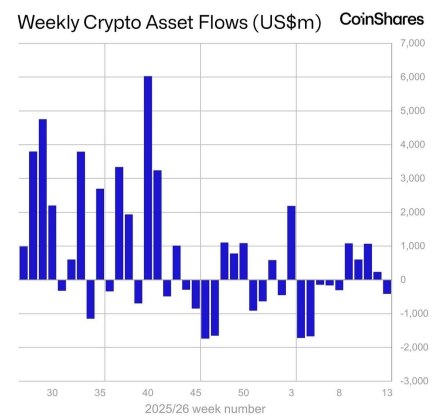
Source: Chart from Milk Road on X

In this bloodbath, Ethereum led the selling activity, recording approximately $222 million in outflows. According to Milk Road, this figure represents more than half of the total weekly rain emerging from a single asset.

Bitcoin, on the other hand, is telling a different story compared to Ethereum. Even though the week was rough, Bitcoin still managed to attract over $964 million in net inflows year-to-date (YTD). However, investors panicked as the asset reacted strongly negatively to economic and macro events.

Taking a look at the market, this cautious investor sentiment can be traced back to two major catalysts, which include rising rate expectations and Iran war fears. When both negative events meet, it often leads to institutions pulling away from risk assets like Bitcoin and Ethereum very fast.

What Bulls And Bears Are Calling For

As the event intensified, the crypto market was the first thing to get trimmed, prompting bears to call this the beginning of a trend reversal. For bulls, they will point to the BTC YTD figure and declare that one bad week does not mean anything significant. Milk Road noted that both ideas make a point.

One week of outflows does not mean the multi-week trend will not continue, but it does reduce momentum and make sellers more alert. In the meantime, the next test is whether the next two weeks produce more of the same or whether this was just institutions getting spooked by speculative headlines that carry no real significance.

If Iran tensions ease and rates stay put, the inflow streak will probably resume and continue in the following weeks. Sustained inflows will likely recover momentum for digital assets, with Bitcoin and Ethereum transitioning into the upward direction again.

BTC trading at $67,394 on the 1D chart | Source: BTCUSDT on Tradingview.com

Related Questions

QWhat was the overall trend in the cryptocurrency market after five weeks of inflows, and what was the total outflow amount?

AThe cryptocurrency market recorded its first major outflow in 5 weeks, with a total of over $414 million leaving the sector.

QWhich two major cryptocurrencies were highlighted in the report, and how did their outflow performances differ?

AEthereum led the selling activity with approximately $222 million in outflows, while Bitcoin still maintained a net inflow of over $964 million year-to-date (YTD).

QAccording to the report, which country was the selling activity led by, and how did other regions like Germany and Canada react?

AThe United States led the selling activity with $445 million in outflows, while other regions such as Germany and Canada moved in the opposite direction by buying the dip.

QWhat were the two major catalysts identified as causing the shift to cautious investor sentiment?

AThe two major catalysts were rising rate expectations and fears of war with Iran, which led institutions to pull away from risk assets like Bitcoin and Ethereum.

QWhat do bulls and bears respectively argue about this single week of outflows, according to Milk Road?

ABears call it the beginning of a trend reversal, while bulls point to Bitcoin's strong YTD inflows and argue that one bad week is not significant.

Related Reads

iQiyi Is Too Impatient

The article "iQiyi Is Too Impatient" discusses the controversy surrounding the Chinese streaming platform IQiyi's recent announcement of an "AI Actor Library" during its 2026 World Conference. IQiyi claimed over 100 actors, including well-known names like Zhang Ruoyun and Yu Hewei, had joined the initiative. CEO Gong Yu suggested AI could enable actors to "star in 14 dramas a year instead of 4" and that "live-action filming might become a world cultural heritage." The announcement quickly sparked backlash. Multiple actors named in the list issued urgent statements denying they had signed any AI-related authorization agreements. This forced IQiyi to clarify that inclusion in the library only indicated a willingness to *consider* AI projects, with separate negotiations required for any specific role. The incident, which trended on social media with hashtags like "IQiyi is crazy," is presented as a sign of the company's growing desperation. Facing intense competition from short-video platforms like Douyin and Kuaishou, as well as Bilibili and Xiaohongshu, IQiyi's financial performance has weakened, with revenues declining for two consecutive years. The author argues that IQiyi is "too impatient" to tell a compelling AI story to reassure the market, especially as it pursues a listing on the Hong Kong stock exchange. The piece concludes by outlining three key "AI questions" IQiyi must answer: defining its role as a tool provider versus a content creator, balancing the "coldness" of AI with the human element audiences desire, and properly managing the interests of platforms, actors, and viewers. The core dilemma is that while AI can reduce costs and increase efficiency, it risks creating homogenized, formulaic content and devaluing human performers.

marsbit9m ago

iQiyi Is Too Impatient

marsbit9m ago

Trading

Spot
Futures

Hot Articles

What is $BITCOIN

DIGITAL GOLD ($BITCOIN): A Comprehensive Analysis Introduction to DIGITAL GOLD ($BITCOIN) DIGITAL GOLD ($BITCOIN) is a blockchain-based project operating on the Solana network, which aims to combine the characteristics of traditional precious metals with the innovation of decentralized technologies. While it shares a name with Bitcoin, often referred to as “digital gold” due to its perception as a store of value, DIGITAL GOLD is a separate token designed to create a unique ecosystem within the Web3 landscape. Its goal is to position itself as a viable alternative digital asset, although specifics regarding its applications and functionalities are still developing. What is DIGITAL GOLD ($BITCOIN)? DIGITAL GOLD ($BITCOIN) is a cryptocurrency token explicitly designed for use on the Solana blockchain. In contrast to Bitcoin, which provides a widely recognized value storage role, this token appears to focus on broader applications and characteristics. Notable aspects include: Blockchain Infrastructure: The token is built on the Solana blockchain, known for its capacity to handle high-speed and low-cost transactions. Supply Dynamics: DIGITAL GOLD has a maximum supply capped at 100 quadrillion tokens (100P $BITCOIN), although details regarding its circulating supply are currently undisclosed. Utility: While precise functionalities are not explicitly outlined, there are indications that the token could be utilized for various applications, potentially involving decentralized applications (dApps) or asset tokenization strategies. Who is the Creator of DIGITAL GOLD ($BITCOIN)? At present, the identity of the creators and development team behind DIGITAL GOLD ($BITCOIN) remains unknown. This situation is typical among many innovative projects within the blockchain space, particularly those aligning with decentralized finance and meme coin phenomena. While such anonymity may foster a community-driven culture, it intensifies concerns about governance and accountability. Who are the Investors of DIGITAL GOLD ($BITCOIN)? The available information indicates that DIGITAL GOLD ($BITCOIN) does not have any known institutional backers or prominent venture capital investments. The project seems to operate on a peer-to-peer model focused on community support and adoption rather than traditional funding routes. Its activity and liquidity are primarily situated on decentralized exchanges (DEXs), such as PumpSwap, rather than established centralized trading platforms, further highlighting its grassroots approach. How DIGITAL GOLD ($BITCOIN) Works The operational mechanics of DIGITAL GOLD ($BITCOIN) can be elaborated on based on its blockchain design and network attributes: Consensus Mechanism: By leveraging Solana’s unique proof-of-history (PoH) combined with a proof-of-stake (PoS) model, the project ensures efficient transaction validation contributing to the network's high performance. Tokenomics: While specific deflationary mechanisms have not been extensively detailed, the vast maximum token supply implies that it may cater to microtransactions or niche use cases that are still to be defined. Interoperability: There exists the potential for integration with Solana’s broader ecosystem, including various decentralized finance (DeFi) platforms. However, the details regarding specific integrations remain unspecified. Timeline of Key Events Here is a timeline that highlights significant milestones concerning DIGITAL GOLD ($BITCOIN): 2023: The initial deployment of the token occurs on the Solana blockchain, marked by its contract address. 2024: DIGITAL GOLD gains visibility as it becomes available for trading on decentralized exchanges like PumpSwap, allowing users to trade it against SOL. 2025: The project witnesses sporadic trading activity and potential interest in community-led engagements, although no noteworthy partnerships or technical advancements have been documented as of yet. Critical Analysis Strengths Scalability: The underlying Solana infrastructure supports high transaction volumes, which could enhance the utility of $BITCOIN in various transaction scenarios. Accessibility: The potential low trading price per token could attract retail investors, facilitating wider participation due to fractional ownership opportunities. Risks Lack of Transparency: The absence of publicly known backers, developers, or an audit process may yield skepticism regarding the project's sustainability and trustworthiness. Market Volatility: The trading activity is heavily reliant on speculative behavior, which can result in significant price volatility and uncertainty for investors. Conclusion DIGITAL GOLD ($BITCOIN) emerges as an intriguing yet ambiguous project within the rapidly evolving Solana ecosystem. While it attempts to leverage the “digital gold” narrative, its departure from Bitcoin's established role as a store of value underscores the need for a clearer differentiation of its intended utility and governance structure. Future acceptance and adoption will likely depend on addressing the current opacity and defining its operational and economic strategies more explicitly. Note: This report encompasses synthesised information available as of October 2023, and developments may have transpired beyond the research period.

363 Total ViewsPublished 2025.05.13Updated 2025.05.13

What is $BITCOIN

Discussions

Welcome to the HTX Community. Here, you can stay informed about the latest platform developments and gain access to professional market insights. Users' opinions on the price of BTC (BTC) are presented below.

活动图片