Crypto Libra Scandal: New Evidence Exposes Payments From Lobbyist To President Milei

bitcoinistPublished on 2026-03-19Last updated on 2026-03-19

Abstract

New forensic evidence and leaked court documents reveal that Mauricio Novelli, a lobbyist for the cryptocurrency Libra (LIBRA), made thousands of dollars in payments to Argentine President Javier Milei and his inner circle since 2021. The payments, initially around $2,000 monthly during Milei's time as a congressman, increased to $4,000 routed through his sister after he became president. Prosecutors found that Novelli financed these transactions by selling cryptocurrencies like USDT for cash. Additional documents suggest a coordinated effort to leverage Milei’s influence to promote Libra, including a proposed $5 million package for his endorsement. Milei’s public promotion of the token in February 2025 led to a 1,300% price surge followed by a crash, causing significant investor losses and triggering legal and congressional investigations. Opposition lawmakers are now accusing Milei of being a "necessary participant" in a premeditated crypto scam, though the presidency maintains he acted in "good faith."

New forensic reports and leaked court documents show years of dollar payments from crypto Libra (LIBRA) lobbyist Mauricio Novelli to Javier Milei and his inner circle, well before the memecoin collapsed.

Dollar Payments For A Crypto Scandal

Thirteen months after Argentina and the entire crypto world was shaken by the accusations of insider trading against the President of Argentina, Javier Milei, new uncovered evidence shows references to thousands of dollars Novelli had paid the libertarian since 2021, back when he was a congressman, for teaching classes and promoting Novelli’s investment consulting firm, Argentinian outlet La Nación reported yesterday.
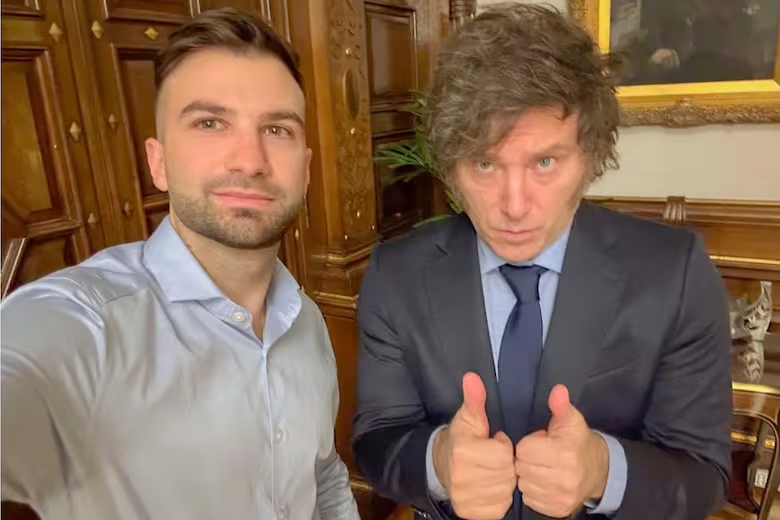
A selfie of Novelli and Milei, taken in 2024. Source: La Nación.

Messages and audios recovered by prosecutors reveal that Novelli financed the payouts with crypto, mainly selling USDT and other assets for cash and then delivering physical dollars labeled as the “usual” amount for Milei and associated influencers: monthly payments of around $2,000 during Milei’s time as deputy, later rising to $4,000 routed to his sister and chief of staff, Karina Milei, once he became president in 2023.

A Long List Of New LIBRA Case Findings

The new evidence comes from the forensic analysis of Novelli’s phone and it adds to the long list of revelations regarding the case that have been exposed since last week. On March 14, local outlet El Destape reported the finding of a document that show coordinated calls and messages between Milei, Karina Milei, strategist Santiago Caputo and Libra promoters in the minutes before and after Milei posted the Libra smart contract on X in February 2025. A seized “5 million memo” from Novelli’s notes app describes a potential USD 5 million package (tokens or cash) for Milei’s social‐media promotion and political backing of Libra, framing him as a central “asset” in the project, though no signed contract has surfaced.

A memo outlining a public statement intended to quell the scandal also surfaced. Written in Spanish and dated February 16, 2025, the statement was likely a narrative designed for Milei to share on his social media or to use later in the interview he was scheduled to have the following day with Jonatan Viale, Argentinian outlet Clarín claims.

Additional documents reveal multiple agreements between Novelli and U.S. entrepreneur Hayden Mark Davis, detailing a strategy to leverage Milei’s image and online reach to legitimize Libra.

When Crypto Turmoil Turns Into High Political Stakes

In February 2025, Milei promoted the $LIBRA token on X as a project to fund Argentinian entrepreneurs, triggering a 1,300% spike and then a violent crash that left late buyers nursing heavy losses of as much as $100 million. The episode sparked criminal complaints, a congressional inquiry and allegations that the president used his office to pump a high‐risk crypto asset.
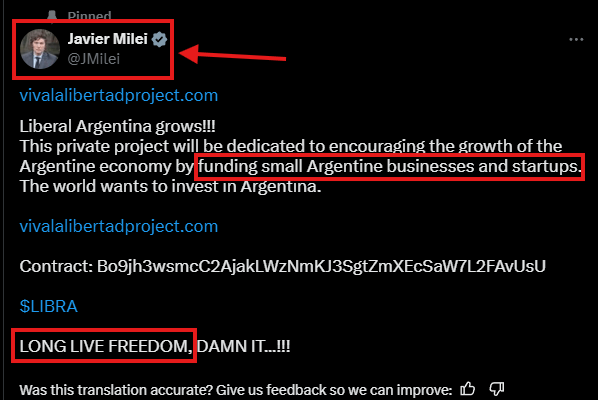
Milei’s original X’s post promoting the cryptocurrency. Source: The Kobeissi Letter.

Opposition deputies in Argentina’s lower house have called a new press conference and are moving to reactivate the special Libra commission in Congress after the latest leaks, now accusing Milei of being a “necessary participant” in a premeditated crypto scam. Representative Maximiliano Ferraro (CC), chairman of the Investigative Committee, stated:

We want to be very clear. Nothing will save them. This evidence confirms the president’s political responsibility and his deliberate involvement. We believe they will have to answer to the courts and this Congress.

The presidency maintains its line that Milei only shared Libra “in good faith” and was not fully informed about the project’s details, while officials dismiss media leaks as biased parts of a flawed case file. The Libra affair hits just as Argentina tries to present itself as a crypto hub, with policymakers debating how far to go in formalizing digital‐asset rules and bank participation.

For traders, the lesson is clear: politically branded tokens like Libra carry extreme risk, while more established crypto and stablecoin rails are likely to remain the preferred instruments for hedging local macro volatility.
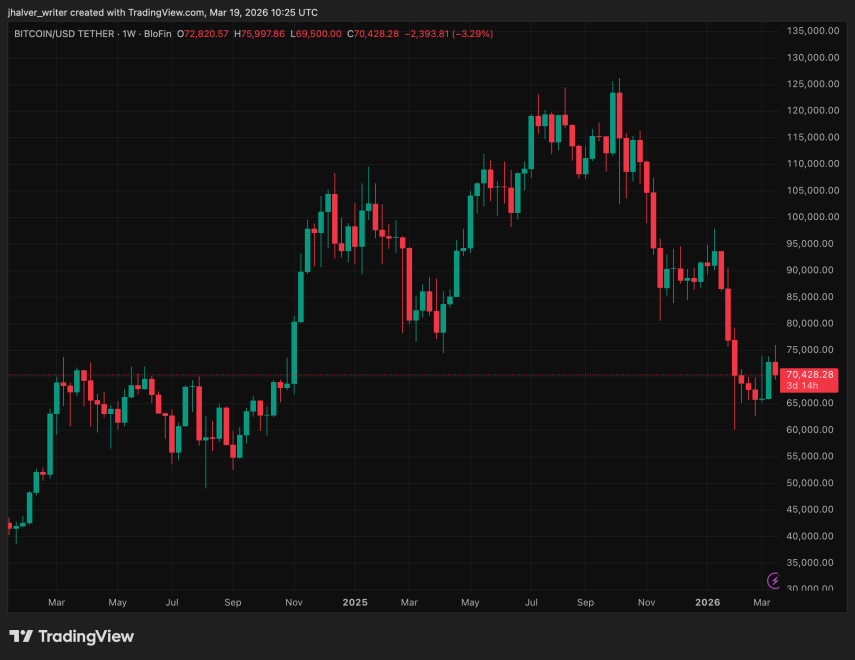
At the moment of writing, BTC’s trades for $70k on the daily chart. Source: BTCUSDT on Tradingview

Cover image from Perplexity, BTCUSD chart from Tradingview

Related Questions

QWhat new evidence has been uncovered regarding payments from Mauricio Novelli to Javier Milei?

ANew forensic reports and leaked court documents show years of dollar payments from crypto Libra lobbyist Mauricio Novelli to Javier Milei and his inner circle, dating back to 2021. These payments were for teaching classes and promoting Novelli's investment consulting firm.

QHow were the payments from Novelli to Milei's circle financed and delivered?

AProsecutors found that Mauricio Novelli financed the payouts by selling USDT and other crypto assets for cash. He then delivered physical dollars, which were labeled as the 'usual' amount. Monthly payments were around $2,000 during Milei's time as a deputy and later rose to $4,000, routed to his sister Karina Milei once he became president.

QWhat was the content of the '5 million memo' found in Novelli's notes?

AThe seized '5 million memo' from Novelli's notes app described a potential USD 5 million package, which could be in tokens or cash, for Milei's social-media promotion and political backing of Libra. It framed Milei as a central 'asset' in the project, though no signed contract has been found.

QWhat were the consequences of President Milei promoting the $LIBRA token on social media?

AWhen President Milei promoted the $LIBRA token on X in February 2025, it triggered a 1,300% price spike followed by a violent crash. This resulted in late buyers suffering heavy losses of as much as $100 million, sparking criminal complaints, a congressional inquiry, and allegations that the president used his office to pump a high-risk crypto asset.

QHow has the Argentine presidency responded to the allegations in the Libra scandal?

AThe presidency maintains that Milei only shared information about Libra 'in good faith' and was not fully informed about the project's details. Officials have dismissed the media leaks as biased parts of a flawed case file.

Related Reads

Agents Take Over Traffic Distribution Power: What Are Tencent, ByteDance, and Alibaba Competing For?

In the race to dominate the AI era's entry point, China's tech giants—Tencent, ByteDance, and Alibaba—are aggressively deploying AI Agents to control the future of traffic distribution. Alibaba is pursuing a dual-track "closed loop + openness" strategy. Its Qianwen app is evolving into a super-Agent integrated across its ecosystem (Taobao, Alipay, etc.) to handle complex tasks like travel planning. Concurrently, it is opening its platform to external brands (Luckin Coffee, KFC) and has launched a B2B Agent platform, "Wukong," targeting enterprise automation. Its other flagship, Quark, aims to be an "AI super search box" for information and tasks. ByteDance is executing an omnipresent "sprawl strategy." Its Doubao app boasts over 300 million monthly active users and is evolving into a default AI entry point for daily life, with plans for paid versions and e-commerce integration. Its core weapon is the Kouzi platform, a visual "AI assembly factory" for developers to build custom Agents. ByteDance is also pushing hardware integration, collaborating on AI phones and developing smart glasses to embed Doubao everywhere. Tencent is playing its long-held "ultimate card" by quietly embedding an AI Agent directly into WeChat. This Agent, accessible via a swipe, can understand user commands and automatically execute tasks by calling upon WeChat's millions of mini-programs (e.g., finding and ordering coffee). This leverages WeChat's unparalleled 1.4-billion-user ecosystem to position the app as an AI-powered "service operating system," a move that could dramatically reshape the competitive landscape. The core battleground is shifting from competing for "user screen time" to competing to be the "default execution layer" for user intent. The business model is evolving from an "attention economy" to an "intent economy," where the Agent that can most efficiently fulfill a user's need gains control over service access and token flow. This represents a fundamental change in how users connect with digital services, making the fight for the Agent入口 (entry point) a pivotal moment for redefining industry leadership in the AI age.

marsbit55m ago

Agents Take Over Traffic Distribution Power: What Are Tencent, ByteDance, and Alibaba Competing For?

marsbit55m ago

From Banning Doubao to Embracing Honor: Why Did WeChat Suddenly 'Change Its Face'?

The article explores the sudden shift in WeChat's strategy towards AI assistants from mobile phone manufacturers, transitioning from strict opposition to active collaboration. For over a year, WeChat fiercely resisted attempts by phone AI assistants (like ByteDance's Doubao in late 2025) to control its features via GUI automation ("simulated clicking"), citing security and data control concerns. This stance created a significant barrier for system-level AI integration. Now, Tencent has initiated A2A (Agent-to-Agent) partnerships with major phone brands like Honor, Xiaomi, OPPO, and vivo. This model allows a phone's system AI (e.g., Honor's YOYO) to parse a user's voice command and send a structured request directly to WeChat's own internal AI agent via secure APIs. WeChat then executes the action (e.g., sending a message) and returns the result. The article attributes Tencent's "change of face" to strategic pressure. While leading in social app usage, Tencent trails rivals like ByteDance and Alibaba in standalone AI app popularity. WeChat, with its vast mini-program ecosystem, is Tencent's key asset for an AI comeback. The upcoming WeChat AI agent aims to handle tasks like booking and payments within the app. However, phone system assistants remain the primary AI entry point for most users. The A2A collaboration allows Tencent to extend WeChat's AI reach to this crucial system layer while maintaining control over its core functions and data. For phone manufacturers, embracing A2A is a pragmatic move. The GUI route proved unviable due to WeChat's blocks. A2A offers a compliant path to integrate a vital service, enhancing their AI assistants' usefulness. It allows them to focus on developing their own AI ecosystems for other services while cooperating on WeChat access. The collaboration is framed as a mutual, strategic necessity: Tencent gains a distribution channel, and manufacturers gain a key functionality. The partnership relies on a "dual authorization" mechanism for security, requiring both user and app consent for each action. While questions about long-term data privacy practices remain, experts note A2A is more secure and compliant than GUI automation. Ultimately, this cooperation is seen as a tentative, calculated truce. Tencent's long-term goal is to make WeChat an AI-powered "service OS." Phone manufacturers aim to make their system AI the central user interface. Their paths may converge or clash in the future, but for now, the A2A deal represents the opening chapter in the battle for the AI-era user入口, driven by necessity and strategic calculus on both sides.

marsbit2h ago

From Banning Doubao to Embracing Honor: Why Did WeChat Suddenly 'Change Its Face'?

marsbit2h ago

Trading

Spot
Futures
活动图片





