Crypto Alert: 2 Victims Lose Over $60M In Address Poisoning Scam

bitcoinistPublished on 2026-02-09Last updated on 2026-02-09

Abstract

Cryptocurrency users are facing significant losses due to address poisoning scams, where attackers send tiny "dust" transactions from lookalike addresses. When users copy what appears to be a familiar address, they instead send funds to a fraudulent account. In January, one victim lost $12.25 million, following a $50 million loss in December. Additionally, signature phishing is rising sharply, with $6.27 million stolen from 4,741 victims in January—a 207% increase from the previous month. These scams trick users into approving malicious smart contracts. Analysts report approximately 270 million poisoning attempts across Ethereum and Binance Smart Chain, targeting 17 million addresses. Over 6,633 confirmed theft cases have resulted in more than $83.8 million in losses. The Fusaka upgrade on Ethereum, which reduced transaction fees, has made it cheaper for scammers to execute these attacks. Stablecoins like DAI are often used to move illicit funds due to a lack of cooperation with freezing mechanisms.

A simple slip of the fingers has turned into huge losses for some crypto users. One wallet lost over $12 million in January after copying the wrong address, and similar high-value mistakes were seen in December.

Reports say attackers are using tiny deposits and subtle address tweaks to trick people into sending funds to accounts they do not control.

How Copying Mistakes Turn Costly

Address lookalikes are the trick. Attackers send tiny “dust” transfers from addresses that mimic ones in a user’s history so that when someone copies an address they get the wrong string.

According to Scam Sniffer, that single mistake cost one user $12.2 million in January and followed a $50 million hit in December.

The tactic relies on people trusting what appears familiar; it works because most wallets show only the first and last few characters, and the middle can be swapped for a malicious match.

Signature Phishing Is Growing Too

Signature scams lure users into approving dangerous contract calls or broad token approvals. Reports say $6.27 million was stolen from 4,741 victims in January, a 207% rise from December.

Two wallets took the lion’s share — accounting for 65% of those signature phishing losses. Attackers increasingly mix both tricks: small deposits to get attention, followed by social engineering that convinces someone to sign a transaction.

Scale And Automation

This is not limited to a few isolated scams. Based on reports from several trackers, roughly 270 million poisoning attempts have been recorded across Ethereum and Binance Smart Chain, targeting around 17 million addresses.

Total crypto market cap at $2.35 trillion on the daily chart: TradingView

Confirmed cases leading to actual theft number about 6,633, but the confirmed loss figure already tops $83.8 million. One campaign alone created 82,030 lookalike wallets, and in September 2025 there were about 32,290 suspicious poisoning events hitting 6,516 unique victims.

The numbers show a picture of automated scripts and high-volume tactics designed to find and exploit simple human errors.
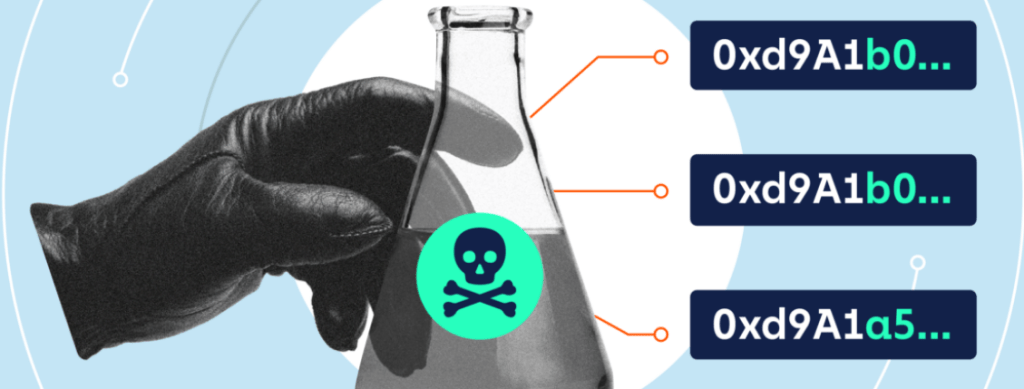
Image: Chainalysis

Why Ethereum Has Seen More Dust Activity

Analysts link part of the recent surge to the Fusaka upgrade, which lowered the cost of sending tiny transactions. Coin Metrics analyzed over 227 million stablecoin balance updates on Ethereum from November 2025 through January 2026 and found that 38% of those updates were under a single penny.

Stablecoin-related dust now makes up an estimated 11% of Ethereum transactions and touches 26% of active addresses on an average day. Lower fees make these spray-and-pray tactics cheap and efficient.

Where Stolen Funds End Up

Blockchain intelligence teams have tracked flows and noticed patterns. Whitestream reports that DAI has become a favored place to park illicit proceeds because its protocol governance does not cooperate with authorities to freeze wallets.

Web3 Antivirus has cataloged a range of large poisonings, with tracked losses spanning from $4 million to $126 million in some incidents. Once funds move through these paths they are often hard to recover.

Featured image from Arek Socha/Pixabay, chart from TradingView

Related Questions

QWhat is an address poisoning scam in the context of cryptocurrency?

AAn address poisoning scam is a tactic where attackers send tiny 'dust' transfers from addresses that mimic ones in a user's transaction history. This tricks the user into copying the wrong, malicious address when they intend to send funds, resulting in the loss of their cryptocurrency.

QHow much did a single user lose in January due to copying the wrong address, and what was the larger loss reported in December?

AIn January, a single user lost $12.2 million by copying the wrong address. This followed a larger loss of $50 million from a similar mistake in December.

QBesides address poisoning, what other type of attack saw a significant increase in January, and by what percentage did it grow?

ASignature phishing attacks also saw a significant increase. $6.27 million was stolen from 4,741 victims in January, representing a 207% rise from December.

QWhat technical upgrade on the Ethereum network is linked to the recent surge in dusting activity for these scams?

AThe Fusaka upgrade on the Ethereum network is linked to the surge in dusting activity because it lowered the cost of sending tiny transactions, making these spray-and-pray tactics cheap and efficient for attackers.

QAccording to the article, which stablecoin has become a favored place for attackers to park illicit proceeds and why?

ADAI has become a favored place for attackers to park illicit proceeds because its protocol governance does not cooperate with authorities to freeze wallets, making it harder to recover stolen funds.

Related Reads

Cook's Curtain Call and Ternus Takes the Helm: The Disruption and Reboot of Apple's 4 Trillion Dollar Empire

Tim Cook has officially announced he will step down as CEO of Apple in September, transitioning to executive chairman after a 15-year tenure during which he grew the company’s market value from around $350 billion to nearly $4 trillion. He will be succeeded by John Ternus, a 50-year-old hardware engineering veteran who has been groomed for the role through increasing public visibility and internal responsibility. Ternus’s appointment signals a strategic shift toward hardware and engineering leadership, with Johny Srouji—head of Apple Silicon—taking on an expanded role as Chief Hardware Officer. This consolidation aims to strengthen Apple’s core technological capabilities. However, Cook’s departure highlights a significant unresolved issue: Apple’s delayed and fragmented approach to artificial intelligence. Despite early efforts, such as hiring John Giannandrea from Google in 2018, Apple’s AI initiatives—particularly around Siri—have struggled with internal restructuring and reliance on external partnerships, including with Google. The transition comes at a critical moment as Apple faces paradigm shifts with the rise of artificial general intelligence (ASI). The company’s closed ecosystem of hardware, software, and services—once a major advantage—now presents challenges in adapting to an AI-centric world where intelligence may matter more than the device itself. Ternus must quickly articulate a clear AI strategy, possibly starting at WWDC, to reassure markets and redefine Apple’s role in a new technological era. His task is not only to maintain Apple’s operational excellence but also to reinvigorate its capacity to innovate and lead in the age of AI.

marsbit1h ago

Cook's Curtain Call and Ternus Takes the Helm: The Disruption and Reboot of Apple's 4 Trillion Dollar Empire

marsbit1h ago

Trading

Spot
Futures
活动图片