Could A Stablecoin Fund Gaza Relief? Trump’s Board Of Peace Is Considering It

bitcoinistPublished on 2026-02-24Last updated on 2026-02-24

Abstract

President Donald Trump's advisory group, the Board of Peace, is exploring a plan to issue a US dollar-backed stablecoin to address severe cash shortages and broken banking services in Gaza. The proposal, still in an exploratory phase, aims to facilitate aid distribution and basic trade by allowing people and aid groups to use a digital token for essential purchases like food, medicine, and fuel. Membership on the board reportedly requires a $1 billion contribution, raising concerns over influence. Supporters argue a stablecoin could reduce transaction friction and enable faster aid delivery with fewer intermediaries. However, critics warn of risks including political isolation, patchy internet access, potential manipulation, and unresolved questions about reserve management, auditing, and legal enforcement. No issuing authority has been chosen, and the plan remains preliminary.

US President Donald Trump’s advisory group is looking at a plan to issue a US dollar-backed stablecoin to help people in Gaza who face severe cash shortages and broken banking services.

The plan is being talked about by the Board of Peace and a handful of outside advisers. Based on reports by the Financial Times, the pitch aims to let aid and basic trade carry on even when ATMs and regular banks are offline.

$1 Billion Membership

Membership in the board requires a $1 billion contribution, according to reports, a condition that has fueled debate over influence and oversight. Trump announced the assembly of the board in January.
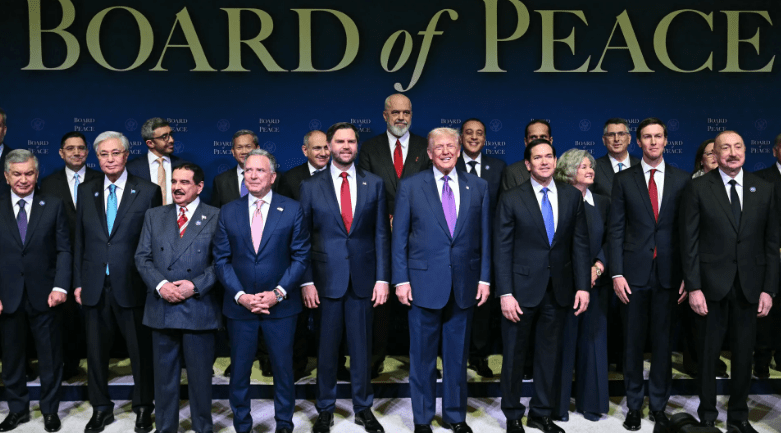
The inaugural Board of Peace meeting in D.C. Image credit: Saul Loeb/AFP via Getty

The effort has technical backers. One name tied to early planning is Liran Tancman, who has been linked to discussions with the territory’s technocratic team, the National Committee For The Administration Of Gaza.

They have talked about a currency token that would be pegged to the dollar, with reserves and systems that would allow people and aid groups to buy food, medicine, and fuel without needing functioning local banks.

Stablecoin Support For Transactions

Supporters say a token could cut some friction. When cash runs low and banks are down, people cannot get what they need. A simple digital token held on phones could move value quickly between traders and charities.

It might also let international donors send help with fewer middlemen. There are questions about how to store the reserves, who would audit them, and what legal system would enforce payments. None of those issues has been solved.

BTCUSD trading at $63,123 on the 24-hour chart: TradingView

Concerns About Control And Isolation

Critics warn of political and practical risks. Some worry that a special token for the strip could deepen separation from nearby markets and make coordination with the West Bank harder.

Others point to patchy internet access and the risk that a digital system could be shut down or manipulated during fighting. There is also debate over which institutions would hold the funds and who would be allowed to issue or burn tokens if things go wrong.
Image: iQoncept/Shutterstock

How It Would Work In Practice

Reports say the plan is still preliminary and that no issuing authority has been chosen. Proposals vary. One model uses a trusted third party outside the region to hold dollar reserves and run the ledger. Another relies on local partners to manage day-to-day distribution.

In both cases, safeguards have been suggested: independent audits, multi-party control of reserves, and strict rules for spending on essential goods only. These are ideas on paper more than firm plans.

Featured image from Crypto Valley Journal, chart from TradingView

Related Questions

QWhat is the proposed solution to help people in Gaza facing cash shortages and broken banking services?

AThe proposed solution is to issue a US dollar-backed stablecoin to facilitate aid and basic trade.

QWhat is the name of the advisory group considering this stablecoin plan for Gaza?

AThe advisory group is called the Board of Peace.

QWhat is the financial requirement for membership on the Board of Peace?

AMembership requires a $1 billion contribution.

QWhat are some of the main concerns critics have raised about the stablecoin plan?

ACritics warn it could deepen Gaza's separation from nearby markets, be difficult to coordinate with the West Bank, and is vulnerable to internet outages or manipulation during conflict.

QWhat is one of the key technical challenges mentioned for implementing the stablecoin?

AKey challenges include determining how to store the dollar reserves, who would audit them, and what legal system would enforce payments.

Related Reads

La Liga Team Bets $1 Million Against Themselves Before Match: Does Using Prediction Markets for Insurance Comply with Sports Regulations?

A Spanish La Liga club, reportedly Osasuna, purchased insurance against relegation and was linked to a transaction of over $1 million on the prediction market platform Kalshi, betting against its own victory in a crucial season-ending match. While Osasuna confirmed buying €1.2 million insurance for a potential €6 million payout in case of relegation through broker Howden, it did not confirm involvement with Kalshi. The reported trade involved intermediaries like Game Point Capital and Greenlight Commodities, with quant firm Susquehanna as the counterparty. This incident highlights the blurring line between financial hedging and gambling in prediction markets. Such markets allow trading on future event outcomes, like sports results. In the US, Kalshi operates as a regulated event contract market under the CFTC. However, Spanish authorities recently initiated penalties against Kalshi and Polymarket, considering their activities unlicensed gambling. The case raises core questions about prediction markets: who can trade, how insider information is handled, and whether participants can influence outcomes, especially in sports where results are human-driven. While leagues like La Liga and Serie A have partnered with Polymarket in North America, the regulatory clash and potential for conflicts of interest, as seen in this club's alleged transaction, present significant challenges as prediction markets evolve toward institutional risk management.

Foresight News31m ago

La Liga Team Bets $1 Million Against Themselves Before Match: Does Using Prediction Markets for Insurance Comply with Sports Regulations?

Foresight News31m ago

From Shouting 150 Dollars to Liquidating HYPE in Just Three Days, How Much Credibility Does Arthur Hayes Have Left?

How much of Arthur Hayes's market credibility remains? Recently, the "godfather of crypto perpetual swaps" and BitMEX co-founder has faced public criticism, including accusations from on-chain investigator ZachXBT about creating exit liquidity for his followers. Starting last week, Hayes executed multiple sudden sell-offs. He had repeatedly publicly predicted the HYPE token would reach $150. After a $100,000 bet defending Hyperliquid on June 1st, he announced just three days later that he had completely sold his HYPE and NEAR holdings, successfully exiting near the peak. He also sold ZEC and WLD. His sale of WLD appeared to be a classic "pump and dump" maneuver. On June 3rd, he publicly set a $10 target for WLD, causing its price to surge over 35%. By June 6th, he announced he had sold his WLD, citing "anomalous" SpaceX pre-IPO price action, which triggered a sharp price drop. On June 9th, Hayes published a lengthy article explaining his actions, citing factors like rising energy costs and a potential AI bubble burst. Consequently, his family office, Maelstrom, now holds positions in US energy producers and only core crypto assets BTC and ETH, having sold AI-related stocks and non-core cryptocurrencies. This pattern is not new. In 2025, he similarly touted HYPE before selling it at what turned out to be a cycle peak, only to repurchase it at the next cycle's low. Similar scenarios played out with tokens like ETHFI and ENA. Long-term observers have developed a strategy: ignore Hayes's public statements but closely monitor his on-chain actions—be cautious following his buys, but decisively follow his sells. If he continues these tactics, especially as seen with the WLD case, his market credibility risks being permanently damaged. As Hayes himself admitted in his latest article, "I remain an unapologetic gambler."

marsbit49m ago

From Shouting 150 Dollars to Liquidating HYPE in Just Three Days, How Much Credibility Does Arthur Hayes Have Left?

marsbit49m ago

Fundraising is Like a Strange Dance: The 'Absurd Drama' of Silicon Valley Founders' Capital Raises

The article details a series of absurd and revealing anecdotes shared by Silicon Valley founders about their venture capital fundraising experiences, sparked by Greg Isenberg's story of pitching to a sleeping a16z partner. Founders describe surreal pitch meetings: one faced a barefoot, peanut-eating investor who offered triple the requested amount after 30 seconds; another performed a pitch in a VC's parked car; a founder discovered his audience understood no English beyond "yes." These stories highlight the often irrational and performative nature of fundraising. Beyond the absurdity, darker power imbalances are exposed. Stories include investors suggesting founders fire co-founders for their equity, blatant market misjudgments, disrespectful behavior from LPs, and discriminatory remarks. A debate also emerges around "Sequoia's" practice of splitting a round into two valuations. However, the thread isn't solely critical. Positive counter-narratives celebrate supportive VCs who offered crucial advice during crises, respected founders' timelines, and showed simple gestures of respect—like a partner personally fetching coffee before a major pitch. Ultimately, the collective sharing acts as a pressure release, illustrating that fundraising is a complex dance of power, trust, and sometimes sheer theater. It underscores that beyond capital, mutual respect and integrity remain the most enduring foundations of the founder-investor relationship.

marsbit1h ago

Fundraising is Like a Strange Dance: The 'Absurd Drama' of Silicon Valley Founders' Capital Raises

marsbit1h ago

Trading

Spot
Futures

Hot Articles

Discussions

Welcome to the HTX Community. Here, you can stay informed about the latest platform developments and gain access to professional market insights. Users' opinions on the price of S (S) are presented below.

活动图片















