‘Clarity once and for all’ – White House reviews SEC’s new crypto framework

ambcryptoPublished on 2026-03-24Last updated on 2026-03-24

Abstract

The U.S. SEC is shifting its approach to crypto regulation by moving away from enforcement actions toward creating clear rules. On March 20, it submitted two proposals to the White House, one aimed at classifying digital assets to determine which should be considered securities. If approved, many cryptocurrencies may no longer be classified as securities, reducing regulatory confusion. An "innovation exemption" may ease compliance for crypto firms, encouraging innovation in the U.S. The CFTC chair emphasized the need for clarity. The SEC-CFTC collaboration suggests most digital assets should not be automatically treated as securities. Despite recent market gains, investor sentiment remains fearful. The new framework seeks to balance oversight and growth while awaiting potential congressional legislation.

The U.S. Securities and Exchange Commission (SEC) is starting to change how it handles crypto regulation. Instead of relying mainly on lawsuits and enforcement actions, it is now working toward creating clear and structured rules.

On the 20th of March, the SEC quietly sent two important proposals to the White House. One focuses on making hedge funds and private equity firms more transparent.

Meanwhile, the second proposal was a more significant one for crypto. The latter aims to create a clear system to classify digital assets.

White House reviews crypto interpretation

If approved, many cryptocurrencies may no longer be classified as securities, reducing confusion and giving the industry clearer rules to follow. Instead of relying on lawsuits, the SEC is shifting toward setting clear guidelines, as reported by Bloomberg.

The proposed “innovation exemption” highlights this change. Rather than strict enforcement, the SEC is offering a more supportive environment where crypto firms can operate with fewer restrictions. This means new companies may not need to immediately meet complex registration requirements, making it easier for them to build and grow in the U.S.

Remarking on the same, Michael S. Selig, Chair of the Commodity Futures Trading Commission (CFTC), said,

Chairman Atkins and I now have developed a new interpretation that will provide clarity once and for all as to what’s a security and what’s not

Citing the reason behind this shift, Selig explains that earlier, the SEC, under Chair Gary Gensler, companies were often left guessing what was allowed and what wasn’t. This confusion pushed many crypto businesses to move outside the U.S.

In fact, because of this unclear environment, many developers became hesitant and stopped taking risks. Now, the new SEC proposals are trying to fix that by bringing more clarity and encouraging innovation to return to the U.S.

Private fund space also gets a breather

A similar shift is happening in the private fund space. The SEC has delayed some reporting rules (Form PF) until the 1st of October and is rethinking the strict data requirements introduced under Gary Gensler.

This revives an important debate. Following the Archegos collapse, regulators pushed for greater transparency to mitigate risk. Now, however, the SEC is shifting focus toward easing compliance burdens for firms, aiming to strike a balance between market safety and regulatory simplicity.

Notably, this change comes at a time when there is a significant disconnect between price movements and investor sentiment.

Market scenes are full of question marks

In the last 24 hours, the total crypto market value has gone up by about 3.26% at press time. But even with this rise, investor confidence is still very low.

The Crypto Fear & Greed Index is stuck in the “Extreme Fear” zone, showing that people are still uncertain and cautious.
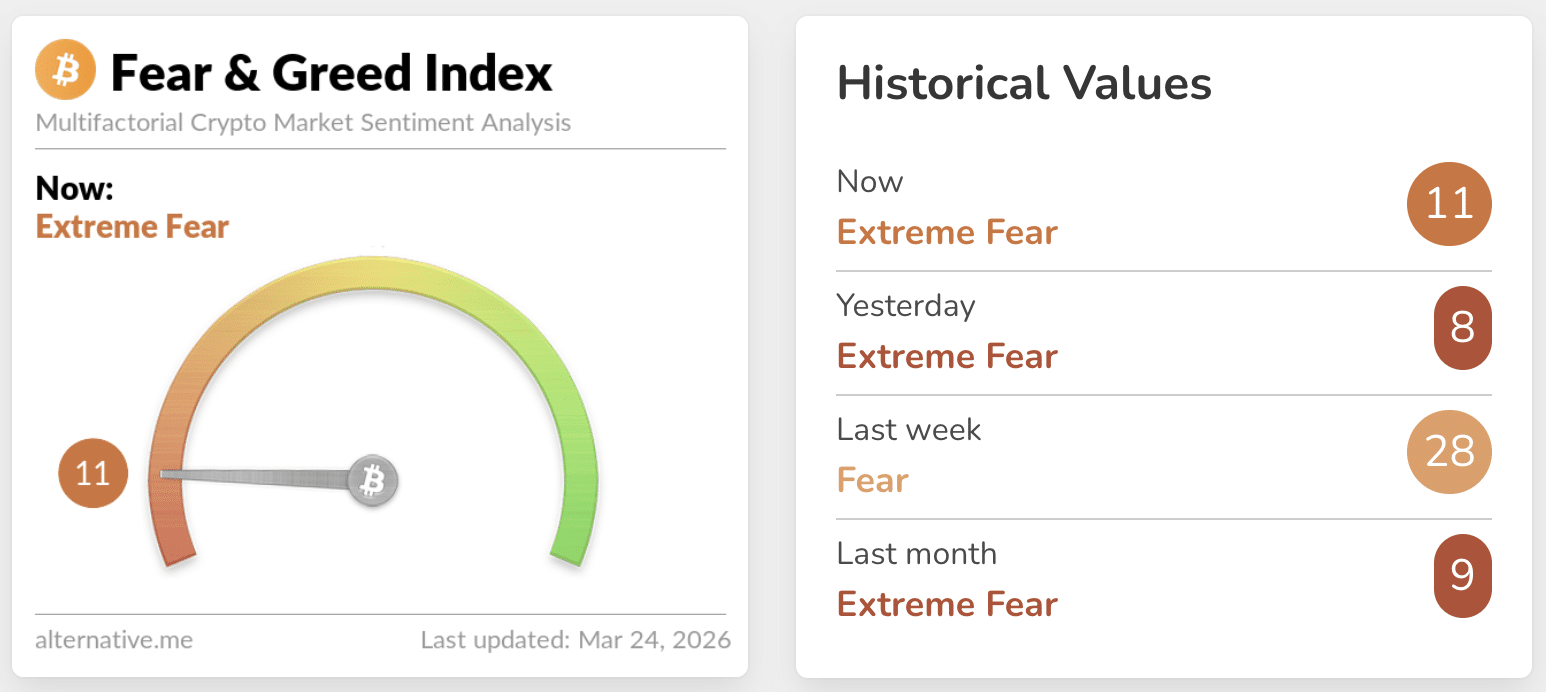
Source: Alternative

However, with all these developments, the SEC is trying to build a bridge between its old approach and future laws like the CLARITY Act, which aim to provide clearer legal clarity.

Needless to say, the SEC is also working closely with the CFTC. In a recent interpretation on the 17th of March, they suggested that most digital assets should not be treated as securities automatically. This helps reduce risk and uncertainty for crypto companies in the U.S.

It’s still unclear whether these new rules will be temporary until Congress passes full legislation or if they will become a long-term framework. But one thing is clear: under Chairman Paul Atkins, the SEC is trying to end the confusion.


Final Summary

  • Collaboration between the SEC and CFTC is a key step toward unified oversight, reducing regulatory overlap and uncertainty.
  • Clear classification of digital assets could finally remove the grey zone that has stalled crypto innovation.


Trending Cryptos

Related Questions

QWhat is the main shift in the SEC's approach to crypto regulation as described in the article?

AThe SEC is shifting from relying mainly on lawsuits and enforcement actions to creating clear and structured rules for the crypto industry.

QWhat is the purpose of the proposed 'innovation exemption' mentioned in the article?

AThe 'innovation exemption' aims to create a more supportive environment where crypto firms can operate with fewer restrictions, allowing new companies to build and grow without immediately meeting complex registration requirements.

QAccording to the article, what problem did the previous regulatory environment cause for crypto businesses?

AThe previous unclear regulatory environment, under Chair Gary Gensler, caused confusion that pushed many crypto businesses to move outside the U.S. and made developers hesitant to take risks.

QWhat does the current 'Crypto Fear & Greed Index' indicate about investor sentiment, despite recent market gains?

ADespite a recent rise in the total crypto market value, the Crypto Fear & Greed Index is stuck in the 'Extreme Fear' zone, indicating that investor confidence is still very low and people remain uncertain and cautious.

QHow are the SEC and CFTC collaborating to provide clarity, according to the recent interpretation on March 17th?

AIn their recent interpretation, the SEC and CFTC suggested that most digital assets should not be automatically treated as securities, which helps reduce risk and uncertainty for crypto companies in the U.S.

Related Reads

Is Ethereum Truly a "World Computer"?

Title: Is Ethereum Really a "World Computer"? Ethereum, envisioned as a "world computer" by its founder Vitalik Buterin, aims to be a decentralized platform for global applications. However, a recent analysis by Four Pillars raises questions about whether it is more accurately a "Western computer," based on the geographical distribution of its validators. Currently, the United States dominates with 38.19% of all validators, followed by Germany at 13.04%. Combined, these two countries account for over half of the network. In contrast, Asian representation is minimal, with Singapore holding only 3.15%. The concentration is partly due to affordable cloud hosting services like Hetzner and OVH in Europe and North America, as well as the prevalence of residential validators in the U.S., where individuals run nodes via home internet connections. When examining professionally operated validators, the distribution becomes more balanced. The U.S. share drops to 25.81%, while Asian countries like Singapore (7.28%), Hong Kong (6.44%), Japan (6.38%), and South Korea (4.59%) collectively approach the U.S. level. This shift reflects strategic deployments by institutions to meet regulatory requirements and reduce latency for local users. However, regions like South America, the Middle East, and Africa remain underrepresented. Ethereum's peer-to-peer network mechanisms, such as gossipsub, disadvantage areas with low node density, creating a feedback loop where delayed message propagation reduces validator performance and rewards. This imbalance challenges Ethereum's promises of censorship resistance and global accessibility. Despite these issues, opportunities exist for growth in underrepresented regions. As demand for localized staking infrastructure rises, early entrants in areas like the Middle East could establish dominant positions by offering compliant, low-latency solutions. The evolving validator landscape highlights both the structural challenges and the potential for Ethereum to move closer to its "world computer" ideal.

Foresight News2h ago

Is Ethereum Truly a "World Computer"?

Foresight News2h ago

Trading

Spot

Hot Articles

How to Buy HOUSE

Welcome to HTX.com! We've made purchasing Housecoin (HOUSE) simple and convenient. Follow our step-by-step guide to embark on your crypto journey.Step 1: Create Your HTX AccountUse your email or phone number to sign up for a free account on HTX. Experience a hassle-free registration journey and unlock all features.Get My AccountStep 2: Go to Buy Crypto and Choose Your Payment MethodCredit/Debit Card: Use your Visa or Mastercard to buy Housecoin (HOUSE) instantly.Balance: Use funds from your HTX account balance to trade seamlessly.Third Parties: We've added popular payment methods such as Google Pay and Apple Pay to enhance convenience.P2P: Trade directly with other users on HTX.Over-the-Counter (OTC): We offer tailor-made services and competitive exchange rates for traders.Step 3: Store Your Housecoin (HOUSE)After purchasing your Housecoin (HOUSE), store it in your HTX account. Alternatively, you can send it elsewhere via blockchain transfer or use it to trade other cryptocurrencies.Step 4: Trade Housecoin (HOUSE)Easily trade Housecoin (HOUSE) on HTX's spot market. Simply access your account, select your trading pair, execute your trades, and monitor in real-time. We offer a user-friendly experience for both beginners and seasoned traders.

5.0k Total ViewsPublished 2025.04.27Updated 2026.06.02

How to Buy HOUSE

Discussions

Welcome to the HTX Community. Here, you can stay informed about the latest platform developments and gain access to professional market insights. Users' opinions on the price of HOUSE (HOUSE) are presented below.

活动图片