China Mobile Launches Token-Included Phone Plan

marsbitPublished on 2026-05-19Last updated on 2026-05-19

Abstract

China's three major telecom operators—China Telecom, China Mobile, and China Unicom—have simultaneously launched nationwide "Token packages" for consumers. Starting from as low as 9.9 RMB per month for 10 million tokens, these plans allow direct payment via phone bills, positioning AI usage tokens as a new type of basic telecom commodity akin to traditional data or call packages. Each operator has adopted slightly different strategies: China Telecom offers tiered personal and enterprise plans bundled with bandwidth and security services; China Mobile integrates tokens with cloud computing packages and partners with Tencent; while China Unicom provides free trial tokens and team plans. Despite minor price variations, their core approach is unified: selling computational tokens directly to their massive combined user base of over 1.7 billion subscribers. The significance lies not in groundbreaking pricing but in the unparalleled distribution channel. By embedding token sales into existing billing systems, operators are demystifying AI access, transforming tokens from a niche developer resource into a mainstream utility. This collective move by state-backed carriers signals a strategic industry shift from "traffic management" to "computing power management," potentially reshaping the AI API market landscape and making token purchases as simple as topping up phone credit.

Breaking News! China Telecom, China Mobile, and China Unicom All Enter the Fray

From May 16th to 17th, the three major telecom operators successively launched nationwide Token plans within two days.

Starting as low as 9.9 yuan/month for 10 million Tokens.

Direct payment via phone bill is supported.

AI has evolved from a tech circle concern into a line item on your phone bill.

What does this mean—Tokens are becoming the new generation of "data packages."
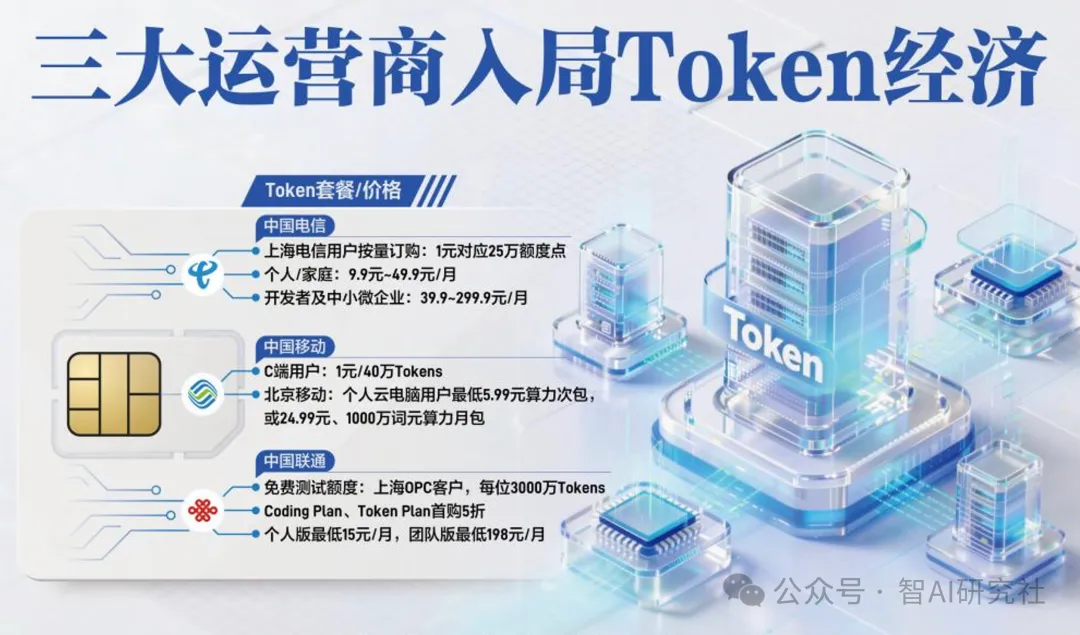
Different Selling Methods, Strikingly Similar Direction

First, look at China Telecom's offering.

Individual plan: Minimum 9.9 yuan/month, includes 10 million Tokens.

Higher tiers include 29.9 yuan and 49.9 yuan, corresponding to 40 million and 80 million Tokens respectively.

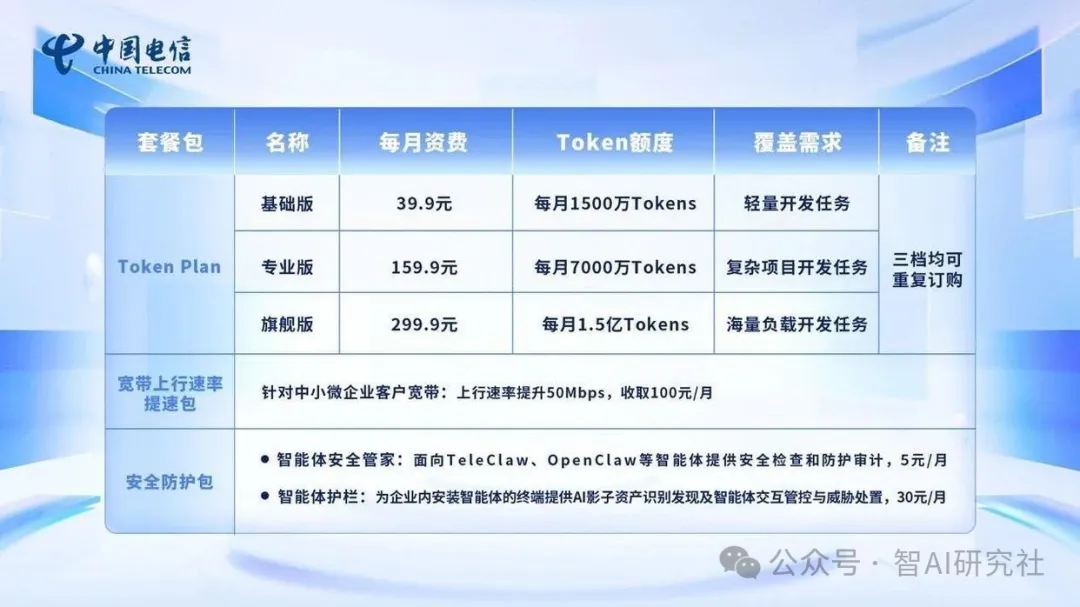
For developers and enterprises: Basic version at 39.9 yuan for 15 million Tokens, Professional version at 159.9 yuan, and Flagship version at 299.9 yuan.

China Telecom's selling point is a bundled package of "Tokens + Connectivity + Security," offering broadband uplink speed boost and security protection along with Tokens.
Next, China Mobile.

Shanghai Mobile, in collaboration with Tencent, launched an AI-native workbench, with 1 yuan buying 400k Tokens. Beijing Mobile was even earlier—minimum 5.99 yuan for a computing resource sub-package, and 24.99 yuan for 10 million Tokens.

The most notable move is that China Mobile integrated Tokens into its cloud computer service.

Users without a cloud computer can directly purchase a bundled cloud computer plan with built-in OpenClaw, ready to use upon startup.

China Unicom's approach is also different.

Shanghai Unicom is giving them away—OPC customers can receive a 30 million Token testing quota for free.

Personal version: 15 yuan/month for 6 million Tokens. Team version: 198 yuan/month, also including a one-month free trial of AI cloud desktop.

The prices of the three operators are similar, with each having its own strategic focus.

But the core logic is exactly the same—selling Tokens like phone credit packages.
What's More Worth Noting Than the 9.9 Yuan Price

The 9.9 yuan Token plan itself is not cheaper than offerings from major tech giants.

Some market commentators note that compared to API pricing from major model providers, the operators do not have a clear price advantage.

But the key point here is not the price; it's the distribution channel.

Major tech companies sell Tokens to developers and power users—there's a ceiling there.

Telecom operators sell Tokens to everyone who has a mobile phone.

China Mobile has nearly 1 billion subscribers, China Telecom has nearly 400 million, and China Unicom also has over 300 million.

This user pool is on a completely different scale.

And most importantly, this represents the collective entry of state-owned enterprises.
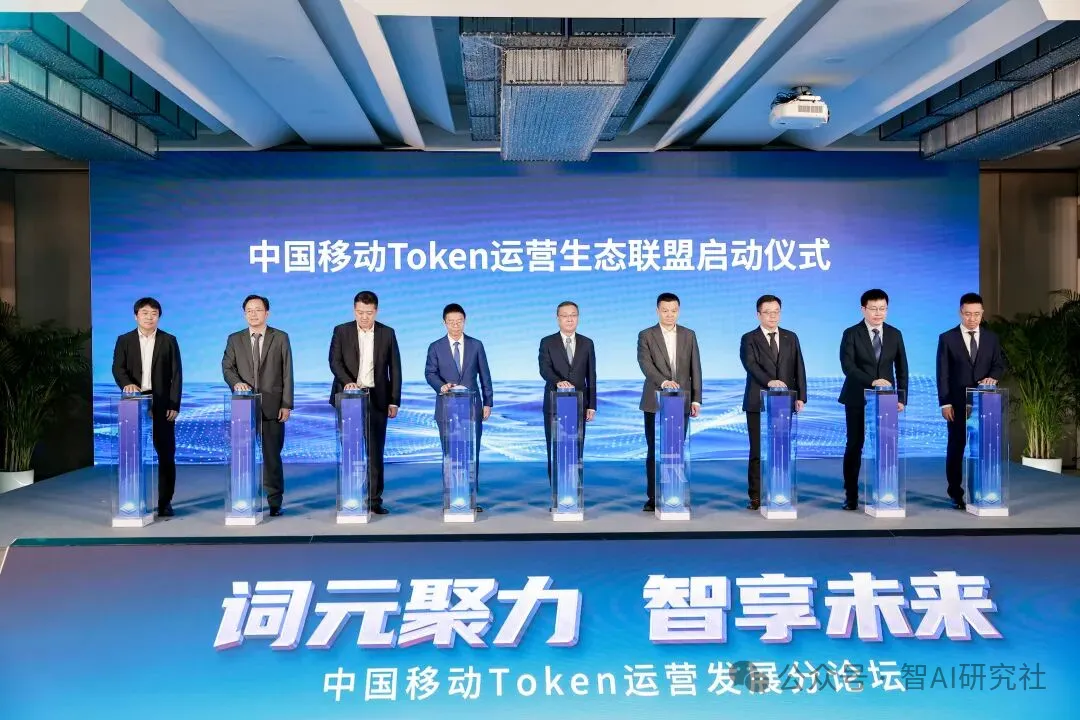
The shift in the telecom industry from traffic management to computing power management is not the decision of a single company.

It is a synchronous pivot by the three major operators.

The data from the National Data Administration is also on the table—the daily Token consumption volume in China surged from 100 billion in early 2024 to over 140 trillion by March 2026.

An increase of over a thousand times in two years.

Tokens are no longer a niche unit in the AI circle; they are becoming a basic telecom commodity alongside data and call credit.

Some telecommunications industry experts judge that if all three operators follow through,

the distribution market for large model APIs might partially shift from cloud providers to the operator system.

In the future, you won't need to understand what an API or a model is to buy Tokens.

You could just go to a service center and say, "Top up 100 yuan worth of Tokens for me," and another line would appear on your phone bill.


Related Questions

QWhat is the core new product that China's three major telecom operators (China Telecom, China Mobile, and China Unicom) have recently launched?

AThey have collectively launched national "Token packages" or "Token plans." These are data-like packages where users pay a monthly fee to receive a certain amount of AI model processing tokens.

QWhat is the lowest monthly price point mentioned for these Token packages, and how many tokens does it offer?

AThe lowest monthly price mentioned is 9.9 yuan per month, which offers 10 million tokens. The article cites this as China Telecom's entry-level personal plan.

QWhy is the launch of these Token packages by telecom operators considered significant beyond just pricing?

AThe significance lies in the channel and scale. Unlike AI companies selling primarily to developers, operators can sell Token packages to their entire mobile user base—totaling hundreds of millions of customers—making AI consumption as easy and common as paying a phone bill.

QHow is China Mobile specifically integrating its Token offering?

AChina Mobile is integrating Tokens into its cloud computer service. For users without a cloud computer, they can purchase a fused package that includes a cloud computer pre-installed with 'OpenClaw' AI tools, ready to use upon startup.

QWhat broader industry shift does the article suggest this move by the telecom operators represents?

AIt represents a strategic shift for the telecom industry from 'traffic operation' (focusing on data/bandwidth) to 'computing power operation' (focusing on AI processing tokens and services). This is a coordinated move by the state-backed operators, signaling Tokens are becoming a fundamental telecom commodity.

Related Reads

Anthropic Cries Wolf: Is the AGI Threat Real, or Just an IPO Story?

Anthropic has published an article titled "When AI builds itself," discussing the emerging concept of "recursive self-improvement," where AI begins to actively participate in designing, training, testing, and optimizing its own subsequent versions. The company presents internal data showing that by May 2026, over 80% of code merged into its codebase was written by Claude, its AI model. Claude's capabilities have expanded to handling complex, open-ended engineering tasks, achieving a 76% success rate in such areas, and even contributing to research processes, such as optimizing code performance and conducting AI safety experiments. Anthropic outlines an evolution from human-driven development to AI-assisted workflows, culminating in the current stage where AI agents can autonomously write, run, and delegate code. The company cautions that the path toward a "closed loop," where AI continuously improves itself, is becoming visible. It calls for coordinated global mechanisms to potentially slow or pause frontier AI development to allow safety research and societal structures to catch up. However, the timing of this warning coincides with Anthropic's preparations for an IPO, framing the narrative not just as a safety concern but also as a demonstration of Claude's advanced capabilities and its integral role in accelerating Anthropic's own R&D—creating a potential "flywheel" effect for competitive advantage. This contrasts with OpenAI's recent, more policy-oriented discussion of the same risks, highlighting the competitive dynamics in the AI industry as companies position themselves in both the technological and regulatory landscape.

marsbit21m ago

Anthropic Cries Wolf: Is the AGI Threat Real, or Just an IPO Story?

marsbit21m ago

BIT Research: ETF Purchases Have Slowed, Strategy (MicroStrategy) Has Slowed, What Else Can Drive Bitcoin's Rise?

Market Refocus on Inflation and Rate Expectations Weighs on Bitcoin Currently, the market is in a phase of macro-repricing dominated by inflation and interest rate expectations. Bitcoin, which previously benefited from easy liquidity and low inflation, is seeing its core bullish drivers weaken. These drivers were market expectations for interest rate cuts and strong inflows from Bitcoin ETFs and institutions like MicroStrategy (referred to as "Strategy" in the text). The logic has shifted. Recent high inflation data (e.g., CPI hitting 3.8% in a May 2026 report) has caused the market to sharply reduce its rate cut expectations for 2025 and even price in potential hikes. This is a key constraint for Bitcoin, as it lacks cash flows and is highly sensitive to rate expectations. Concurrently, institutional capital flows have slowed significantly. Following the hot CPI data, Bitcoin ETFs saw accelerated outflows, with around $4.3 billion leaving over a period. MicroStrategy's ability to keep adding substantial Bitcoin to its balance sheet is also diminishing. Together, ETF and MicroStrategy holdings total roughly $110 billion, but their momentum as growth engines is cooling. In summary, Bitcoin's current pressure stems not from its own fundamentals but from a changing macro environment. As long as inflation stays elevated, Bitcoin is likely to remain in a consolidating phase. However, historically, inflation eventually peaks. Once it recedes and rate cut expectations rebuild, institutional capital could return, potentially fueling a new and more robust recovery phase for Bitcoin.

marsbit29m ago

BIT Research: ETF Purchases Have Slowed, Strategy (MicroStrategy) Has Slowed, What Else Can Drive Bitcoin's Rise?

marsbit29m ago

Earning 1000 Trillion in Half a Year, 'Pocketing' 20 Million per Capita: This Round of Wealth Creation in the Korean Stock Market is Unprecedented in Scale

The South Korean stock market is experiencing an unprecedented wealth surge in 2026, with household equity and fund asset values soaring by over 1,000 trillion KRW (~$730bn) year-to-date. This translates to an average per capita wealth increase of roughly 20 million KRW, fueled by a historic 109% rally in the KOSPI index. The boom is driven by three converging forces: an AI-driven semiconductor supercycle boosting giants like Samsung and SK Hynix; the government's "Value-Up" market reforms addressing long-standing corporate governance issues; and aggressive real estate regulations that have locked capital within financial markets, preventing profits from flowing back into property. This has triggered a wealth effect, boosting high-end consumption significantly. However, the gains are highly concentrated. The two semiconductor behemoths account for over half the index's value, but retail investors own relatively low stakes in them, systematically missing the biggest rallies. Wealth and consumption benefits are skewed towards luxury goods and imported cars, bypassing mainstream retail. Further risks stem from excessive leverage, with high trading volume in leveraged ETFs, and a market sentiment heavily reliant on the AI sector's fortunes and speculative rumors. While this cycle marks a potential shift from real estate to equities as a primary wealth generator for Koreans, its sustainability, amid structural imbalances and leverage, remains a critical test.

marsbit34m ago

Earning 1000 Trillion in Half a Year, 'Pocketing' 20 Million per Capita: This Round of Wealth Creation in the Korean Stock Market is Unprecedented in Scale

marsbit34m ago

Trading

Spot
Futures
活动图片