ChatGPT Loses Half Its Market: From Monopoly to Shared Market in Three and a Half Years

marsbitPublished on 2026-06-18Last updated on 2026-06-18

Abstract

In a landmark shift three and a half years after its debut, ChatGPT's global market share in the AI assistant market has fallen below 50% for the first time, dropping to 46.4% as of May 2026. This signals the end of its initial dominance, with the market now diversifying among competitors like Gemini (27.7%) and Claude (10.3%). The report from Sensor Tower indicates the AI assistant landscape has matured from a phase of awe and experimentation into one of product comparison, ecosystem integration, and monetization. Users are increasingly pragmatic, readily switching between assistants based on specific use cases, brand trust, and value propositions. The industry is moving past the "free lunch" era, with users demonstrating a willingness to pay for premium features, driving significant in-app expenditure. Major players are adopting varied monetization strategies: Claude boasts a high subscription conversion rate, while ChatGPT is increasingly testing ads and shopping integrations to complement its subscription revenue. However, this growth comes with immense costs, as exemplified by OpenAI's soaring cash burn for model training and infrastructure. While ChatGPT remains the largest single player, its declining share symbolizes a broader normalization of AI. The technology is no longer a novelty but an integral, scrutinized part of daily digital life, judged on practical utility, price, and seamless integration. The battle has shifted from proving AI's potential to competing i...

It has been three and a half years since ChatGPT made its debut. At that time, many people realized for the first time that a dialog box could become the next-generation internet gateway. Today, it has long been the fastest application in human history to reach 1 billion monthly active users. Yet, at the same time, it has reached a symbolic turning point:

ChatGPT's global market share has fallen below 50% for the first time.

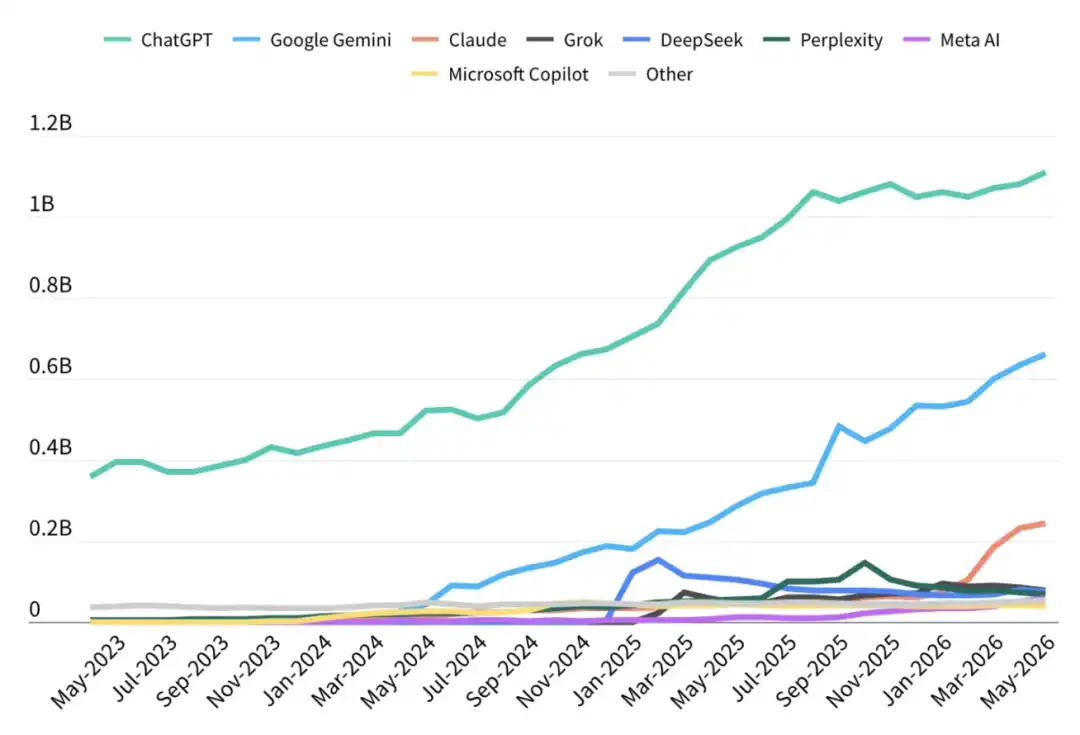
According to data analytics firm Sensor Tower's "State of AI 2026 Report," as of the end of May this year, ChatGPT's share of the global AI assistant market dropped to 46.4%. Before January this year, that figure was still above 50%. ChatGPT remains the world's largest AI assistant. But leading no longer equals monopolizing.

The AI assistant boom ignited by OpenAI has moved from awe, trial, and admiration into the stages of product comparison, ecosystem integration, paid conversion, and commercial realization.

Loyalty Is a False Proposition, Users Are All 'Heartbreakers'

In 2023, having a ChatGPT account still carried a certain identity of being an AI pioneer.

By 2026, AI assistants have increasingly become internet infrastructure, much like search, email, and office suites. The most noteworthy change in the Sensor Tower report is not just that ChatGPT still ranks first.

More importantly, users are becoming more willing to migrate. As long as another assistant is more convenient in a specific scenario, users will immediately allocate time to another product.

The main competitors pulling ChatGPT's share below 50% are Gemini and Claude.

As of the end of May, Gemini's global share reached 27.7%, and Claude reached 10.3%. Products like Grok, Perplexity, DeepSeek, and Meta AI each still hold less than 5%, but they are also constantly squeezing the remaining market.
Gemini's growth is easy to understand. It's backed by Google's complete ecosystem. Search, Gmail, Docs, Calendar, and Android are all natural entry points. When AI is embedded into tools users rely on daily, many average users have no need to specifically open another webpage to summon ChatGPT.

Especially after the release of Gemini 3.0, Google also achieved its first truly significant victory, officially securing a seat at the AI table and entering the mainstream user's view.

Claude's path is more like a victory for a productivity tool.

It lacks a distribution system like Google's, but has built a strong reputation in scenarios like writing, coding, long-text processing, and complex task collaboration. Sensor Tower states that Claude is approaching ChatGPT's user retention levels. For power users, AI assistants have shed their toy-like attributes and are genuinely beginning to impact work efficiency.
A more subtle change is that when users evaluate AI products, they no longer look solely at model capability. As AI assistants gradually take on more personalized interaction characteristics, users are also starting to discuss work, emotions, judgments, and decisions with them. Brand trust, value orientation, and institutional relationships can all become part of the user's choice.

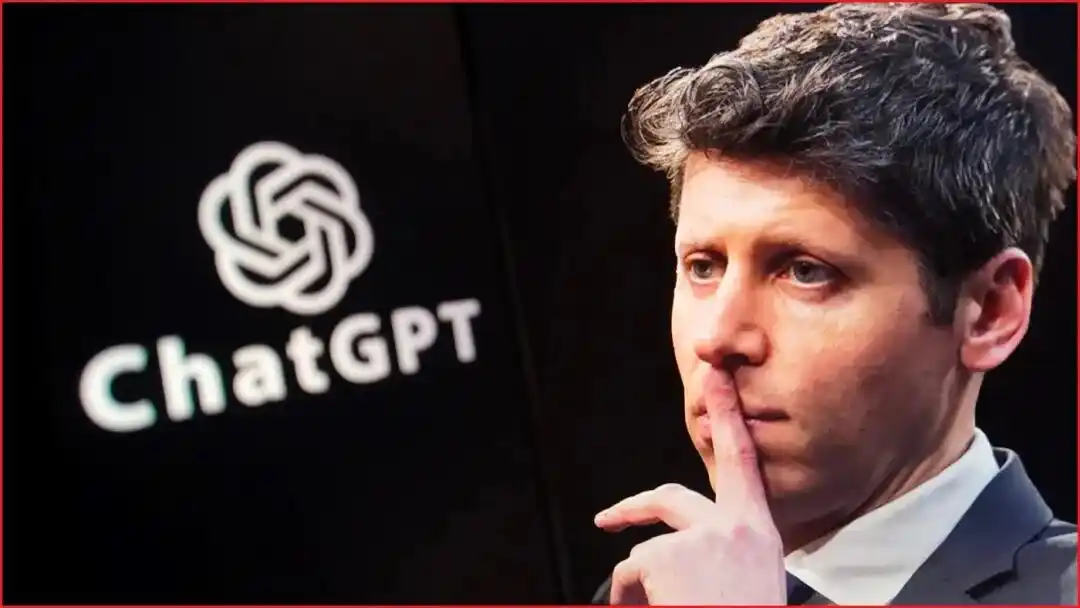
A hint of public controversy can trigger a massive wave of uninstalls. OpenAI CEO Sam Altman has likely gained a deep understanding of this over the past year.

AI companies once believed that as long as the model was stronger, users would stay. The reality in 2026 is far more complex. Capability, ecosystem, price, use case, and brand trust are now collectively determining whether an assistant will be used consistently.

The Free Lunch Is Over, AI Apps Start Talking Money

Beyond market share, another set of data from the Sensor Tower report better illustrates the stage change in the industry: AI applications are still growing, but the growth logic has changed.

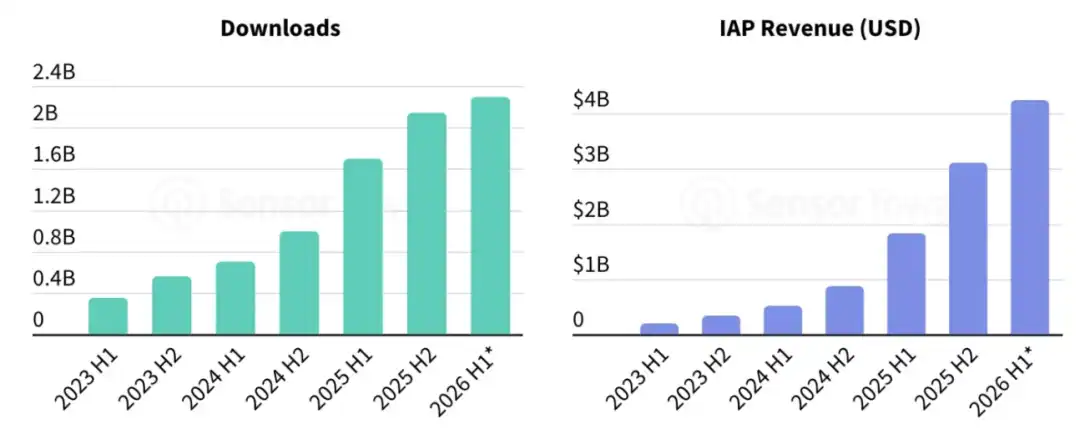
Sensor Tower estimates that in the first half of 2026, global AI app downloads will approach 2.3 billion, with in-app spending exceeding $4.2 billion. In comparison, AI app in-app spending was $1.83 billion in the first half of 2025.

Users are still downloading AI apps and are also willing to pay for AI.

However, the growth rates for both downloads and spending have slowed. Meanwhile, the industry has moved from a period of rapid expansion into a more realistic phase of competition.

Vendors can no longer just talk about user growth; they must also prove they can turn traffic into revenue. Regional differences are also emerging. Asia remains the market with the highest AI app downloads, but in Q1 2026, downloads declined for the first time by 3.3%, mainly affected by markets like India.
In contrast, North America and Europe are stronger in terms of in-app consumption. For AI companies, what truly determines the business model is often the ability to pay; install base only solves part of the problem. The trend in the US market is more pronounced. Users are starting to use AI assistants for productivity tasks and are more willing to pay for premium features.

Claude performs notably well here. Sensor Tower states that Anthropic has 13% of its users subscribing to a paid plan, a conversion rate ranking among the highest in the industry. This 13% subscription conversion rate explains why Claude can continue to expand its presence amidst competition from giants.

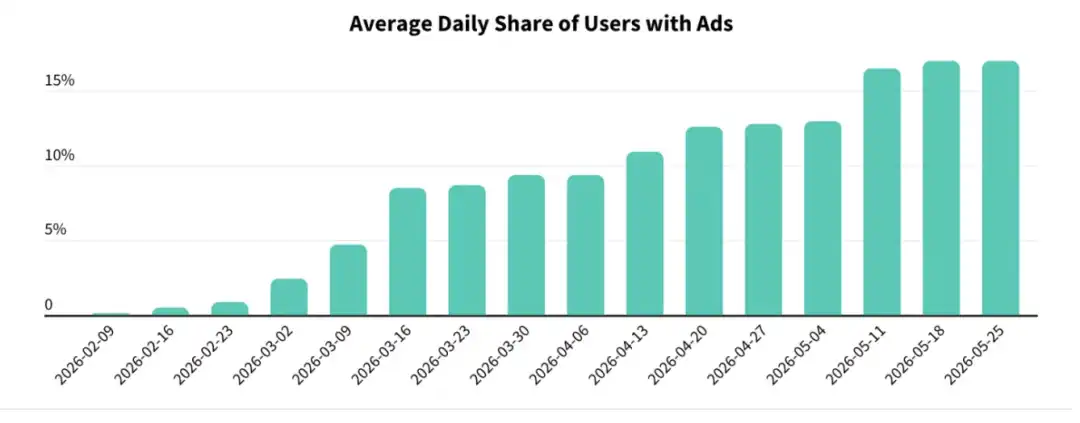
As long as AI can help users save time, complete code, organize documents, and handle complex tasks, monthly subscription fees ranging from twenty to even two hundred dollars are actually within an acceptable range. ChatGPT's commercialization path is more diverse and also more controversial. Sensor Tower states that OpenAI began testing ads in ChatGPT starting in February this year, gradually expanding the scale of ad displays and the proportion of users covered.

By May, an average of 17% of users were seeing ads daily. Software and shopping are currently the largest advertiser categories, followed by media & entertainment, and food & beverage.
From subscriptions to ads, ChatGPT is moving towards a more typical internet business model. Early users were familiar with a clean dialog box, an entry point imbued with the imagination of Artificial General Intelligence (AGI).

Unfortunately, even the smartest AI on this planet ultimately cannot escape the fate of becoming a shopping guide.

For OpenAI, ads and shopping have become necessary experiments to advance. Now, this entry point is also starting to carry ads, shopping guides, recommendations, and transaction conversions.

Model inference, training, and computing power expenses are extremely costly; relying solely on subscription revenue can hardly cover long-term investments. Advertising and shopping are becoming the next pieces of the puzzle for ChatGPT's commercialization.

As AI begins to penetrate core scenarios like shopping, office work, and search, the imagination of AI becoming a unified super-gateway is also encountering increasingly realistic platform boundaries. Sensor Tower estimates that in the first half of 2026, global AI app usage time will grow from 17.2 billion hours in the same period last year to approximately 36 billion hours.

Among them, the top three AI assistants account for 89% of the total usage time of AI assistant apps.

New players still have opportunities, but these opportunities exist more in fragmented scenarios, such as AI companions, AI content generation, and vertical industry tools. The main battlefield for general assistants is already mostly occupied by ChatGPT, Gemini, and Claude.

Stepping Down from the Altar, AI Goes Mainstream

ChatGPT's share decline occurs at a somewhat paradoxical time: OpenAI's revenue is still growing rapidly, its user base is still expanding, and its capital reserves far exceed those of most startups. According to a report by The Information, based on documents OpenAI disclosed to shareholders, OpenAI consumed $3.7 billion in cash in the first quarter, more than half of its $5.7 billion revenue.

Both cash burn and revenue tripled compared to the same period last year.

This is also a common challenge facing the current AI industry. Users and revenue continue to grow, yet massive capital investment is required to sustain model training, inference services, and infrastructure construction.
Furthermore, OpenAI expects cash burn could reach $25 billion in 2026, further rising to $57 billion in 2027. Even though OpenAI has confidentially submitted its IPO filing documents, the listing time may still be adjusted based on market conditions.

In other words, as one of the world's strongest AI brands, OpenAI still needs to answer a question: when models become increasingly expensive, competition grows fiercer, and users become more prone to migrate, how high can ChatGPT's business model's profit margin ultimately be.

Nevertheless, even as ChatGPT's share falls below 50%, it remains the world's largest AI assistant and is still the name most frequently mentioned when discussing AI. But this milestone is symbolic. The AI assistant market has moved beyond the era defined by a single product. In the past, ChatGPT was responsible for convincing the public that AI could change the internet.

Now, Gemini, Claude, Grok, DeepSeek, and various vertical AI assistants are collectively dividing up user time, usage scenarios, and commercial revenue.
User demands are also subtly changing.

By now, you likely no longer find satisfaction in just having AI write a poem or tell a silly joke. Instead, you start demanding it write code with fewer errors, process documents more accurately, collaborate in office work more conveniently, and offer more reasonable subscription prices, etc.

When a technology no longer elicits repeated amazement but instead begins to be criticized, compared, and replaced, it has truly started to enter mainstream life.

ChatGPT has lost half of its market dominance, but AI has truly begun to win over the world.

It's just that in this new world, there are no eternal kings, only us, forever ready to migrate for better tools.


Trending Cryptos

Related Questions

QAccording to the article, what is the current global market share of ChatGPT and what has caused its decline?

AAccording to the article, as of May, ChatGPT's global market share has dropped to 46.4%. The decline is attributed to increased competition from other AI assistants like Gemini (27.7%) and Claude (10.3%). Users are now more willing to migrate to other products if they offer a better fit for specific scenarios, and factors like ecosystem integration, productivity features, brand trust, and price are becoming key decision points.

QWhat does the article suggest about user loyalty in the AI assistant market?

AThe article suggests that user loyalty is a 'false proposition' and that users are fickle ('渣男'). Users are willing to switch between AI assistants based on which product performs better in specific use cases, such as writing, coding, or integration with existing tools like Google's ecosystem.

QHow is the business model for AI applications evolving, according to the Sensor Tower report cited in the article?

AThe business model is shifting from focusing solely on user growth to monetization. The 'free lunch' is ending. Methods include subscription fees (e.g., Claude's 13% paid user conversion rate) and advertising (e.g., ChatGPT testing ads shown to 17% of daily users by May). The report notes that while downloads are still growing, the pace has slowed, and the ability to convert traffic into revenue is now critical.

QWhat financial challenge does OpenAI face despite its growth, as mentioned in the article?

ADespite rapid revenue growth, OpenAI faces the significant financial challenge of massive cash burn to sustain model training, inference services, and infrastructure. The article states that in Q1, OpenAI burned $3.7 billion in cash, over half of its $5.7 billion revenue. It is projected that cash burn could reach $25 billion in 2026 and $57 billion in 2027, raising questions about the long-term profitability of its business model.

QWhat does the symbolic decline of ChatGPT's market share below 50% represent for the AI industry?

AThe symbolic decline represents the end of a single product defining the AI assistant market. The industry has moved past the initial phase of awe and experimentation into a stage of practical comparison, ecosystem competition, and commercial diversification. While ChatGPT popularized AI, the market is now being shared by multiple players like Gemini, Claude, and others, indicating that AI technology is maturing and becoming integrated into everyday life.

Related Reads

NVIDIA CPU Advances, China's RISC-V Responds: Semiconductor Deep Dive - Part Four

NVIDIA is set to launch its new Vera AI data center CPU in China as early as August, with high pricing. While this move offers a new option, it highlights China's continued dependence on foreign-controlled Arm architecture. In response, the Chinese semiconductor industry is increasingly turning to RISC-V as a strategic alternative for achieving high-performance computing autonomy. The article explores the concept of the "impossible triangle" in CPU development—balancing prosperity, control, and autonomy—and posits that RISC-V's open-source, modular nature offers a unique path to achieving all three. While RISC-V is already dominant in embedded systems, the focus is now shifting to data centers and AI workloads. China has become a global hotspot for RISC-V development, driven by AI-driven compute demand, supply chain concerns from export controls, cost benefits of open-source, and strong policy support. Multiple Chinese companies have reportedly crossed the key performance threshold of 15 SPECint per GHz, a benchmark for entering the high-performance CPU club. Progress extends beyond single-core benchmarks. Companies are developing complete computing subsystems, including commercial-grade coherent network-on-chip (NoC) technology and server processors with up to 40 cores that strictly adhere to the RVA23 standard to ensure software compatibility. Real-world applications are emerging in areas like video transcoding and edge AI. However, significant challenges remain. The RISC-V ecosystem faces fragmentation, immature toolchains and verification processes, and gaps in single-core performance and energy efficiency compared to mature x86 and Arm architectures. The formidable software moat, epitomized by NVIDIA's CUDA, is a long-term hurdle. In conclusion, while RISC-V cannot immediately replace offerings like NVIDIA's Vera, it represents a viable long-term path for China to develop a self-sufficient, high-performance CPU ecosystem. The journey is acknowledged to be long and arduous, requiring sustained effort to overcome technical and ecosystem challenges.

marsbit2h ago

NVIDIA CPU Advances, China's RISC-V Responds: Semiconductor Deep Dive - Part Four

marsbit2h ago

My Coding Betting Dashboard is Profiting, but Polymarket is Truly Not a Good Place for 'Arbitrage'

The author built a custom monitoring dashboard for Polymarket, a prediction market platform, and tested it with $1,600, achieving over 30% returns. However, the core argument is that Polymarket is not a good venue for traditional arbitrage. The dashboard has two main sections: a "Portfolio Dashboard" for tracking active positions with key metrics like total capital, P&L, and a risk-control module using a tier system (T1, T2, T3), and an "Opportunity Watchlist" for monitoring markets. The article details a critical structural trap in binary markets: a bet with a high perceived probability of success still carries a 100% loss risk if wrong. The author's T1/T2/T3 system is designed to manage this by limiting position sizes based on conviction and time horizon, emphasizing that high confidence should not equal high concentration. A key insight is the danger of "pseudo-diversification"—betting on different markets driven by the same underlying variable. The author concludes that Polymarket offers few true low-risk, arbitrage opportunities. It is instead a high-risk environment where wins can create a false sense of mastery, leading to large losses. The platform is better viewed as a training ground for honing judgment through disciplined, framework-driven betting rather than a reliable income source. The tools help transform intuition into structured, rule-based decisions to mitigate the risk of catastrophic errors.

marsbit5h ago

My Coding Betting Dashboard is Profiting, but Polymarket is Truly Not a Good Place for 'Arbitrage'

marsbit5h ago

WeChat AI Card Hands-On Guide: Has the AI Shopping Era Arrived?

**"WeChat AI Card" Practical Test Guide: Has the Era of AI Shopping Arrived?** WeChat has officially launched the "AI Exclusive Card," a feature integrated into its Workbuddy AI assistant. This card is designed to handle payments for AI-initiated purchases. Our hands-on test reveals it's not yet a tool for fully autonomous AI shopping, but rather a controlled payment layer for AI agents. The AI Card functions as an isolated sub-wallet within WeChat Pay. Users must bind the card and transfer funds into it from their main wallet. Crucially, every transaction requires explicit user confirmation via smartphone scan; AI cannot spend autonomously. Currently accessible through the Workbuddy agent, the card targets specific digital consumption scenarios: purchasing paid content (reports, data), calling paid APIs/tools, and subscribing to services. Its design prioritizes security and control by separating funds and mandating approval for each payment. We tested a real-world scenario: ordering bubble tea via Workbuddy using a "Meituan Life Assistant" skill. The process encountered multiple hurdles: high "skill" usage costs (exceeding daily free credits), and most importantly, while a payment was successfully initiated, the AI purchased an incorrect product (a mismatched group-buy coupon instead of the desired drink). This highlights the current limitation: the **AI Card only solves the payment step**. The broader challenge lies in the **AI agent's execution chain**—accurately understanding intent, navigating third-party platforms, selecting the right product, and ensuring proper fulfillment. The payment succeeded, but the purchase failed to meet the user's need. In conclusion, the WeChat AI Exclusive Card is a cautious, early-step experiment in AI commerce. It provides a secure, user-controlled payment method for agent interactions but is not yet capable of reliable, end-to-end complex purchases. For now, it's best used for low-value, low-risk digital services with careful user verification at each step. The vision of AI handling complete shopping tasks remains a work in progress.

marsbit8h ago

WeChat AI Card Hands-On Guide: Has the AI Shopping Era Arrived?

marsbit8h ago

Trading

Spot
Futures

Hot Articles

What is DOGE M

Doge Matrix ($doge m): The New Breed of Community-Driven Cryptocurrency Introduction In the ever-evolving landscape of cryptocurrency, new projects constantly emerge, each aiming to capture the interest of investors and enthusiasts alike. One of the latest entrants to this domain is Doge Matrix, represented by the ticker symbol $doge m. This project has attracted attention thanks to its roots in the popular meme culture surrounding Dogecoin, establishing its place within the web3 space. This article aims to provide a comprehensive analysis of Doge Matrix, covering its overview, creator, investors, functionality, timeline, and notable aspects. What is Doge Matrix ($doge m)? Doge Matrix is a community-driven cryptocurrency project that seemingly builds upon the widespread appeal of Dogecoin, a digital currency known for its Shiba Inu mascot and its meme origins. While the overarching objectives of Doge Matrix are not extensively defined, it is characterized by a commitment to harnessing community involvement and support. Unlike traditional cryptocurrencies that often emphasize utility or intrinsic value through underlying technologies, Doge Matrix positions itself within a space that embraces the cultural phenomenon of cryptocurrencies, particularly appealing to those who resonate with the ethos of meme-based assets. Drawing on the strengths of the Dogecoin community, Doge Matrix operates as part of a broader ecosystem, inviting participation and engagement from users who share an interest in cryptocurrency and the digital landscape. Who is the Creator of Doge Matrix ($doge m)? The identity of the creator of Doge Matrix remains unknown. This lack of transparency is not an uncommon occurrence in the cryptocurrency space, where some projects are launched without revealing the identities of their founders. The absence of information regarding the founding team can raise questions among potential investors about the project’s accountability and direction. Who are the Investors of Doge Matrix ($doge m)? As it stands, there is no publicly available information detailing the investors or investment foundations that back Doge Matrix. The project appears to rely primarily on community support rather than institutional investment. This model aligns with the community-driven nature of the initiative, fostering an environment where the direction of the project is shaped by its participants rather than being dictated by a select few financial backers. How Does Doge Matrix ($doge m) Work? The specifics regarding the operational mechanisms of Doge Matrix are somewhat vague, reflecting a broader trend of projects in the meme coin space where innovative functionalities are not always clearly articulated. Nonetheless, Doge Matrix seems designed to tap into the existing cryptocurrency ecosystem by encouraging user participation while tapping into the familiar cultural references associated with Dogecoin. Its potentially unique characteristics derive from community interactions rather than technological advancements, emphasizing shared experiences and collaboration among token holders. While the exact innovations have not been explicitly outlined, the project appears to create a space where community members can engage, share ideas, and propel the project's potential forward. Timeline of Doge Matrix ($doge m) Reflecting on the project’s timeline reveals notable events that have defined its journey thus far: November 25, 2024: Doge Matrix reached its all-time high value, marking a significant milestone in its early history. January 1, 2025: Conversely, Doge Matrix hit its all-time low value, illustrating the volatility often associated with cryptocurrencies, especially in the early stages of a project's lifecycle. Ongoing: The project continues to be actively traded and supported by its community, although specific future milestones or objectives have yet to be disclosed. Key Points About Doge Matrix ($doge m) Community Focus At the heart of Doge Matrix is a commitment to community engagement. The project thrives on the premise of collaboration and shared objectives among its members, emphasizing the importance of collective effort. Unlike centralized projects that often have a defined leadership structure, Doge Matrix at present showcases a more fluid approach to governance, where every community member's voice matters. Volatility The cryptocurrency market is notorious for its volatility, and Doge Matrix is no exception. Its price history reflects significant fluctuations between high and low values, which is typical of many new cryptocurrencies but underscores the risks associated with investment in emerging tokens. Lack of Detailed Information One of the most striking features about Doge Matrix is the scarcity of detailed information regarding its technological underpinnings and operational mechanisms. This ambiguity necessitates that potential investors conduct thorough due diligence before engaging with the project. Conclusion In summary, Doge Matrix ($doge m) illustrates a new wave of cryptocurrency projects that lean heavily on community engagement and cultural relevance. While lacking in certain specifics—such as clear leadership, defined objectives, and detailed functionality—the project has managed to generate interest within the crypto community, leveraging the established appeal of meme culture. As with any investment in the cryptocurrency space, understanding the inherent risks and conducting comprehensive research is essential for potential participants. Doge Matrix stands as a reminder of the dynamic, sometimes unpredictable nature of the crypto industry, marked by constant evolution and enthusiasm for community-driven initiatives.

3.8k Total ViewsPublished 2025.02.03Updated 2025.02.03

What is DOGE M

What is $M

Understanding Mantis ($M): A New Era in Cross-Chain Interoperability In the continually evolving landscape of Web3 and cryptocurrency, new projects strive to offer innovative solutions aimed at enhancing the user experience and expanding functional possibilities within the decentralized financial ecosystem. One such project garnering attention is Mantis ($M), a pioneering protocol founded on the principles of cross-chain interoperability and intent-based settlements. This article delves into the essential aspects of Mantis, including its core functionality, creators, investment backing, innovative features, and critical milestones. What is Mantis ($M)? Mantis is described as a multi-domain intent settlement protocol that simplifies cross-chain interactions, enabling users to execute complex financial transactions across various blockchain platforms seamlessly. The protocol operates through three primary layers: Intent Expression: Users can articulate their transaction goals using natural language facilitated by the DISE LLM, an advanced AI language model. For instance, a user might express a desire to swap Ethereum (ETH) for Solana (SOL) with a specific slippage tolerance of 1%. Execution: This layer employs a network of solvers that compete to fulfill user intents. Transactions are executed using mechanisms such as Coincidence of Wants (CoWs) and Order Flow Auctions (OFAs), which ensure that user demands are met optimally. Settlement: Leveraging the Inter-Blockchain Communication (IBC) protocol, Mantis enables atomic cross-chain transactions, allowing users to operate across various supported chains, including Ethereum, Solana, and Cosmos. Mantis is engineered to introduce native yield generation for idle assets, employing cryptographic proofs to maintain the integrity of transactions throughout the entire process. Creators & Development Team Mantis was conceived by the Composable Foundation, a research-driven organization notable for its emphasis on blockchain interoperability solutions. This foundation collaborates with esteemed academic institutions, including Harvard University and the University of Lisbon, contributing to extensive research and development efforts that inform Mantis's architecture and functionality. The Composable Foundation’s commitment to fostering innovation in the blockchain space positions Mantis as a robust solution for the growing demand for interoperability among multiple blockchain networks. Investors & Backing While specific details about individual investors have not been publicly disclosed, Mantis enjoys substantial backing from various entities, including: Ecosystem grants from IBC-enabled chains, which support the protocol's growth and integration within decentralized finance ecosystems. Strategic partnerships with infrastructure providers that enhance Mantis's network capabilities and deployment strategies. Funding through the Composable Foundation's treasury, ensuring sustained financial support for ongoing development and operational costs. These collaborative efforts reflect a consensus among stakeholders about the importance of enhancing cross-chain functionality and the potential utility of Mantis's infrastructural innovations. Key Innovations Mantis sets itself apart through several pioneering innovations that enhance its functionality and utility: Chain-Agnostic Intents: Users can initiate transactions from any supported chain while settling on another. This flexibility empowers users, driving increased interaction among different platforms. AI-Powered Interface: The integration of DISE LLM allows users to conduct complex DeFi operations using natural language, thereby simplifying interactions and making blockchain technology accessible to a broader audience. Cross-Domain MEV Capture: Mantis creates an internal market for maximal extractable value (MEV) through competitions among solvers. This innovative approach allows for greater efficiency and value extraction in complex transactions. Modular Settlement Layer: The protocol supports various verification methods, including zero-knowledge proofs and optimistic rollups, providing a versatile framework that can adapt to emerging blockchain technologies. Historical Timeline Mantis's development is marked by several critical milestones that chart its trajectory and growth: | Year | Milestone | |————|————————————————————————-| | 2022 | Initial concept development within the Composable Foundation's research division. | | Q3 2024 | Launch of the testnet with bridging capabilities between Solana and Ethereum. | | Q1 2025 | Anticipated Token Generation Event (TGE) alongside the mainnet launch. | | Q2 2025 | Expected integration of DISE LLM and expansion of cross-chain capabilities. | | 2025 H2 | Planned support for over 15 chains through further IBC upgrades. | This timeline outlines Mantis's evolution, from conceptual discussions to active implementation and future growth phases. Ecosystem Growth Strategy Mantis's strategy for ecosystem growth includes several initiatives designed to encourage user participation and developer engagement: Credits System: Users can earn protocol credits by providing liquidity and engaging in referral programs. These credits are redeemable for incentives in the future, fostering a robust user community. Modular Software Development Kit (SDK): This toolkit empowers developers to create applications based on intent-driven models utilizing Mantis's infrastructure, thus promoting innovation within its ecosystem. Governance Model: As the protocol matures, $M token holders will have a voice in protocol governance, allowing them to vote on proposed upgrades and changes, thereby enhancing community engagement and decentralization. Mantis represents a significant advancement in the realm of cross-chain architecture. By seamlessly integrating advanced AI algorithms with a robust settlement framework, Mantis seeks to tackle the problems of fragmentation within multi-chain ecosystems. Its innovative approach prioritizes improved user experiences while adhering to the foundational principles of decentralization and security, setting a new standard for the future interoperability of blockchain technologies. As Mantis continues its journey of growth and implementation, it promises to be a project to watch closely in the competitive landscape of Web3 and decentralized finance. With its focus on crossing boundaries and elevating user engagement, Mantis is poised to be an integral part of the future developments in the cryptocurrency space.

253 Total ViewsPublished 2025.03.18Updated 2025.03.18

What is $M

How to Buy M

Welcome to HTX.com! We've made purchasing MemeCore (M) simple and convenient. Follow our step-by-step guide to embark on your crypto journey.Step 1: Create Your HTX AccountUse your email or phone number to sign up for a free account on HTX. Experience a hassle-free registration journey and unlock all features.Get My AccountStep 2: Go to Buy Crypto and Choose Your Payment MethodCredit/Debit Card: Use your Visa or Mastercard to buy MemeCore (M) instantly.Balance: Use funds from your HTX account balance to trade seamlessly.Third Parties: We've added popular payment methods such as Google Pay and Apple Pay to enhance convenience.P2P: Trade directly with other users on HTX.Over-the-Counter (OTC): We offer tailor-made services and competitive exchange rates for traders.Step 3: Store Your MemeCore (M)After purchasing your MemeCore (M), store it in your HTX account. Alternatively, you can send it elsewhere via blockchain transfer or use it to trade other cryptocurrencies.Step 4: Trade MemeCore (M)Easily trade MemeCore (M) on HTX's spot market. Simply access your account, select your trading pair, execute your trades, and monitor in real-time. We offer a user-friendly experience for both beginners and seasoned traders.

7.3k Total ViewsPublished 2025.07.02Updated 2026.06.02

How to Buy M

Discussions

Welcome to the HTX Community. Here, you can stay informed about the latest platform developments and gain access to professional market insights. Users' opinions on the price of M (M) are presented below.

活动图片













