Chainlink’s price looks weak, but there’s more to the story – 2 reasons why

ambcryptoPublished on 2026-03-31Last updated on 2026-03-31

Abstract

Chainlink (LINK) has shown signs of recovery with a 3.47% price increase, trading at $8.76 after a four-day decline. On-chain data reveals a significant drop in exchange reserves, suggesting accumulation and investor confidence in a potential rebound. Derivatives data supports this shift, with a high long/short ratio of 1.06 indicating bullish sentiment. Additionally, U.S. Spot LINK ETFs continue to see steady inflows, reinforcing positive market outlook. Technically, LINK is trading within an ascending channel pattern, and if it holds above the $8.19 support level, it could potentially surge by 14.50% to $10.08. However, the weak Average Directional Index (ADX) suggests limited trend strength and cautious market momentum.

Chainlink [LINK] has shown a mild recovery after four consecutive days of decline. According to CoinMarketCap, as of the 30th of March, the asset gained over 3.47% in the past 24 hours and was trading at $8.76.

The improving on-chain data, along with derivatives data, is currently reinforcing optimism around LINK and suggests that the asset’s ongoing upside move could continue in the coming days.

On-chain and derivatives data signal a shift in sentiment

The data from the analytics tool CryptoQuant shows that investor interest in the asset has improved notably despite the recent decline.

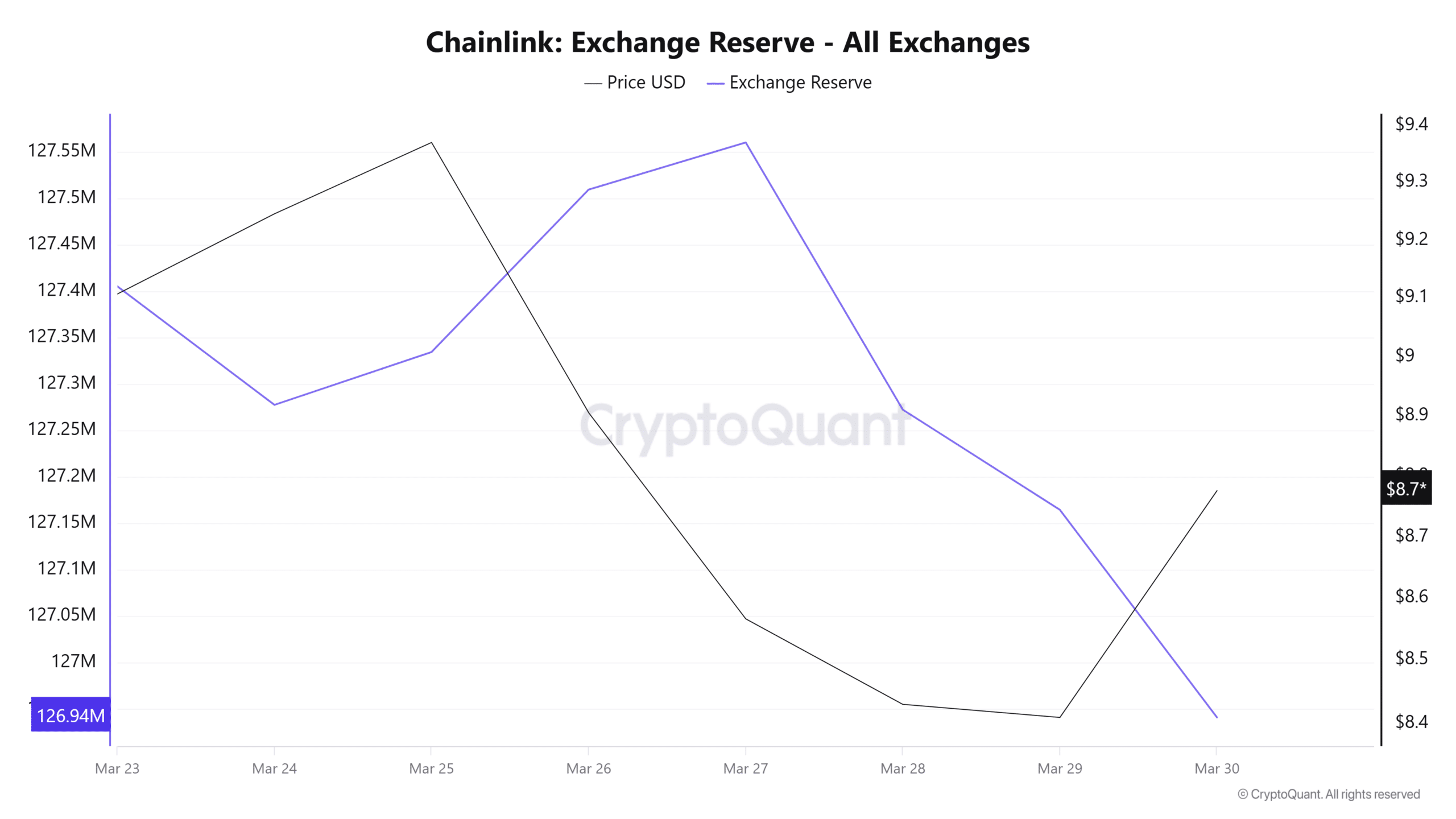
According to Chainlink’s exchange reserve across all exchanges, a massive drop of 331K LINK has been recorded over the past 48 hours.
Source: CryptoQuant

A declining exchange reserve typically suggests accumulation. When this occurs at a price level that has historically shown signs of reversal, it indicates that investors are not only expecting a potential rebound but may also be taking advantage of the dip.

On the derivatives side, it appears that intraday traders are following the market trend.

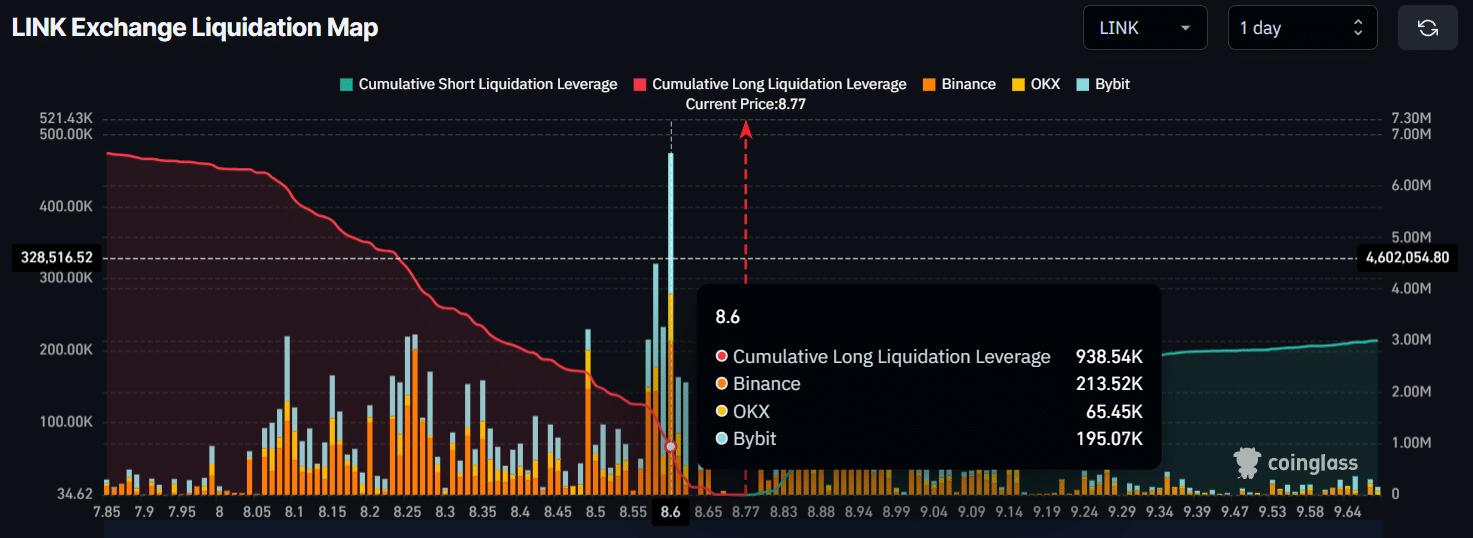
Data from CoinGlass’s LINK exchange liquidation map shows that, amid this recovery, traders are showing interest around $8.60 on the lower end and $8.83 on the upper end.
Source: CoinGlass

These are not just key levels; traders at these zones are highly overleveraged, having built $938.54K worth of long positions and $268K worth of short positions. This indicates a shift in market sentiment amid the ongoing recovery.

Meanwhile, LINK’s Long/Short Ratio has reached 1.06, its highest level in a month. A ratio above 1 reflects bullish sentiment among traders, as a larger number of participants are betting on the price to move upward.

In fact, LINK’s ongoing optimism is further supported by U.S. Spot LINK ETFs. Data from SoSoValue shows that these ETFs continue to record steady inflows despite ongoing market uncertainty.
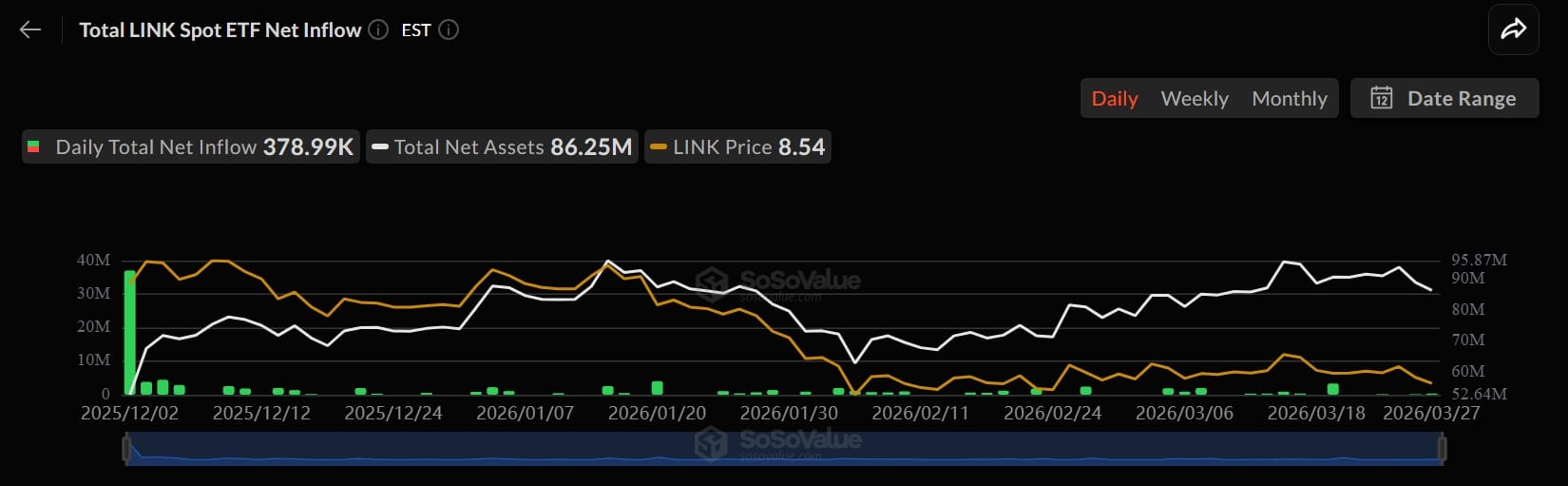
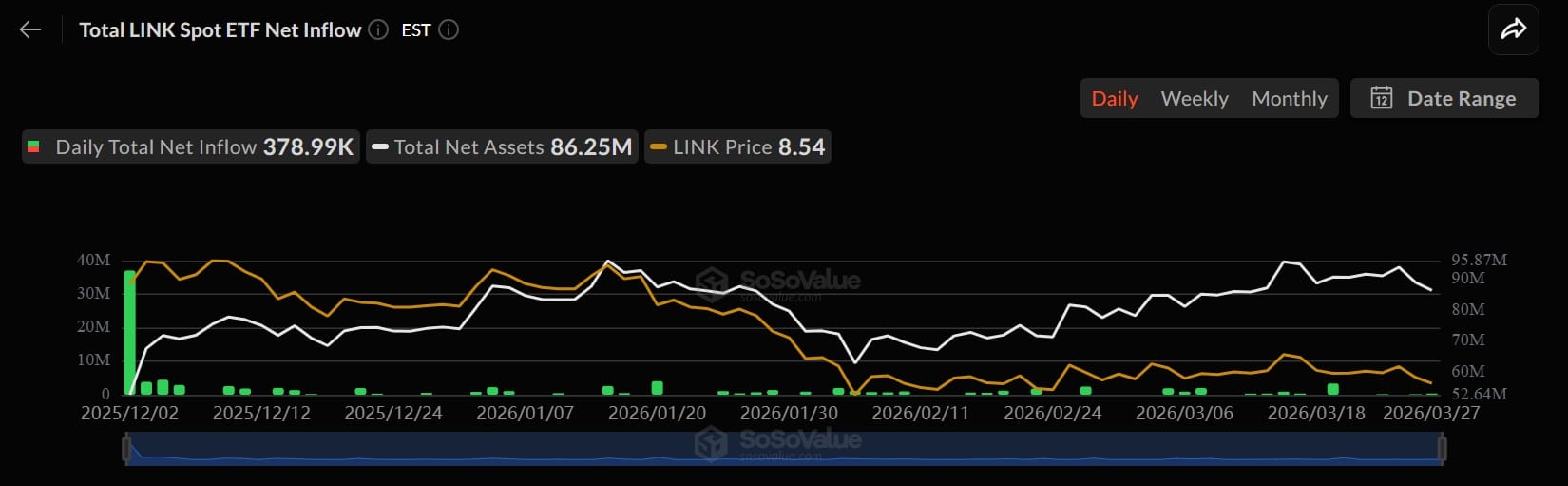
Source: SoSoValue

This not only strengthens LINK’s outlook but also indicates steady and growing demand for the asset in the traditional market.

LINK eyes a potential 14.50% jump

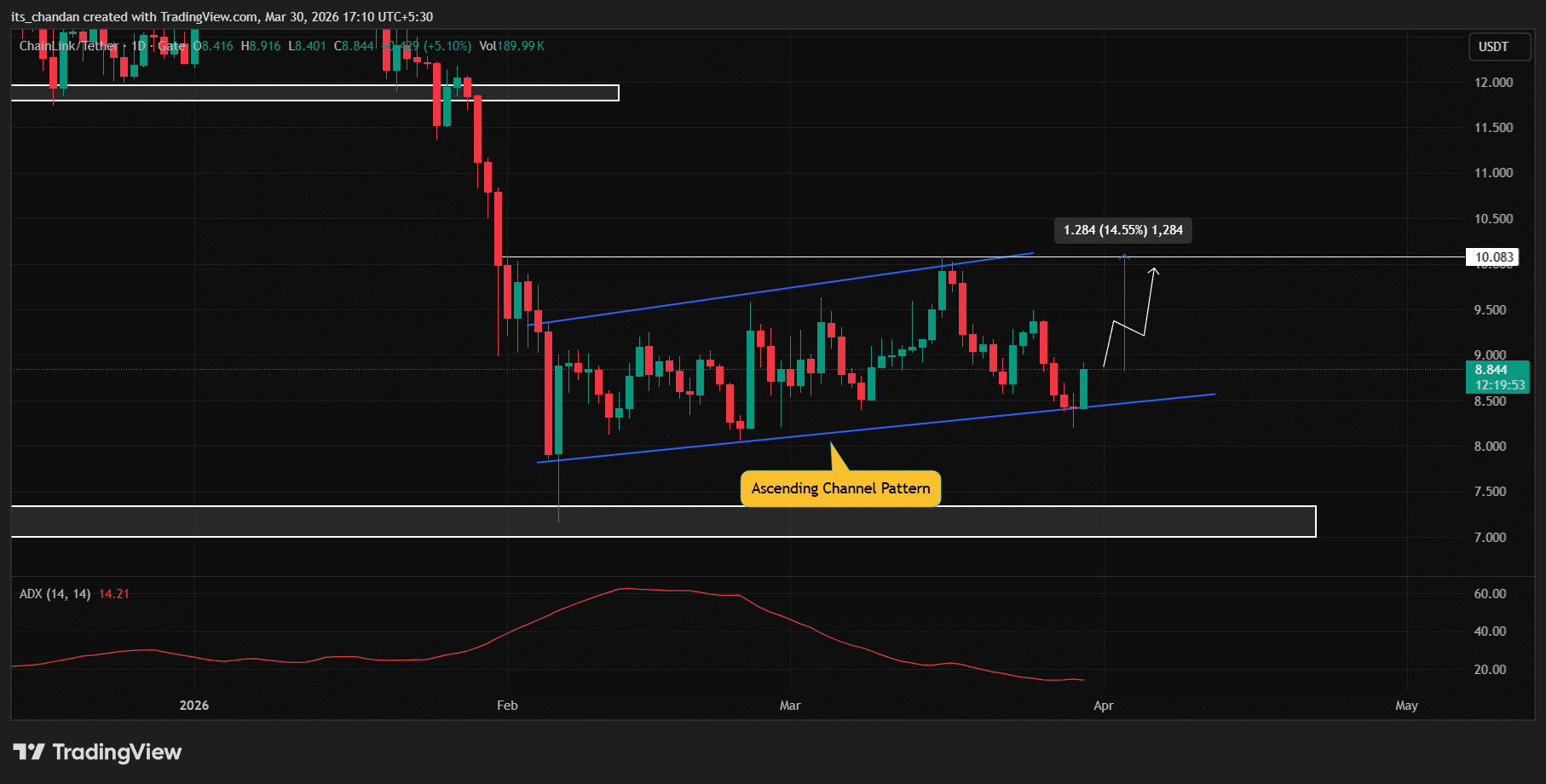
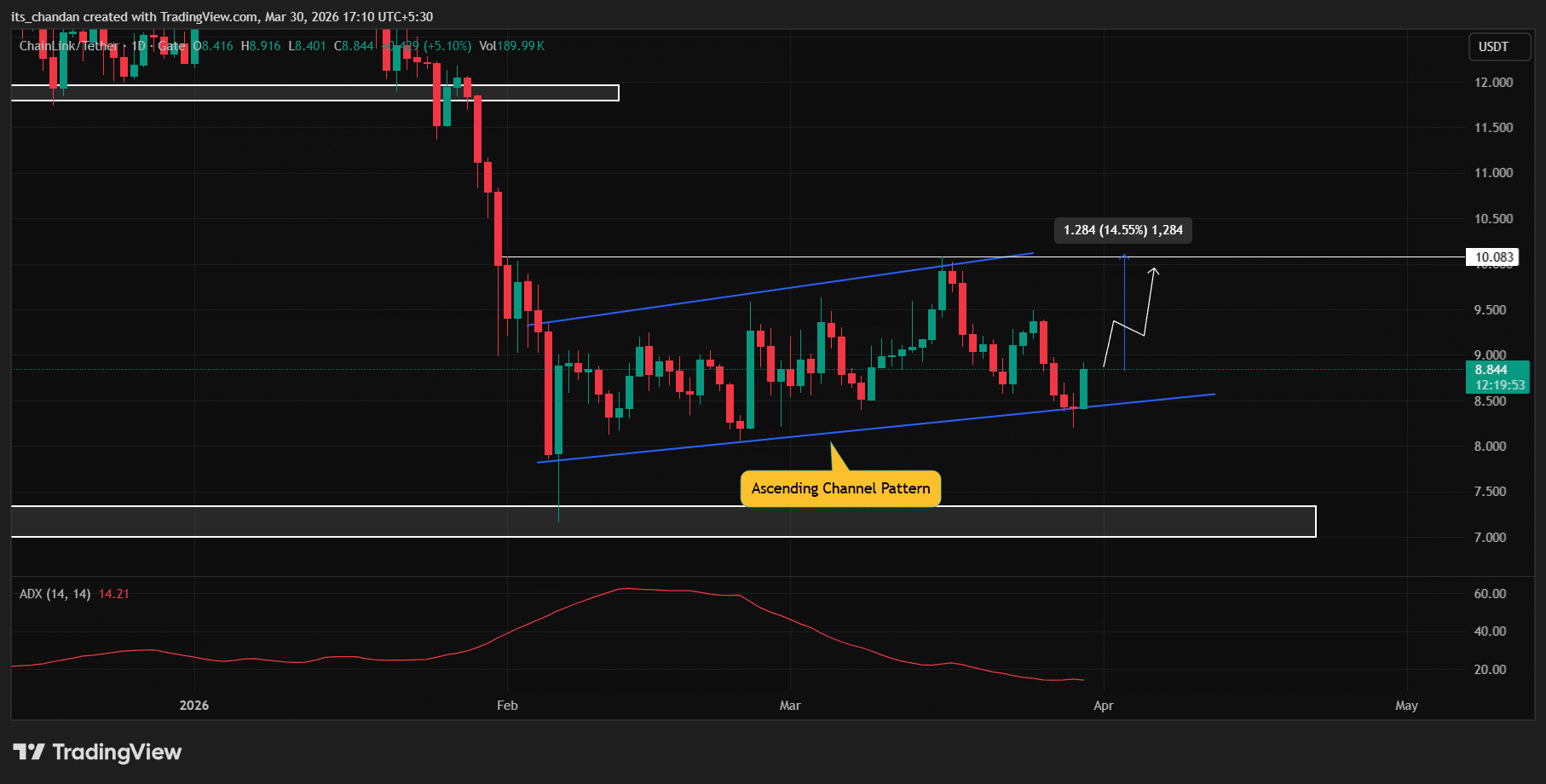
On the daily chart, LINK appeared poised for a significant price uptick. The price action showed that LINK has been moving within an ascending channel pattern between its upper and lower boundaries since the 6th of February.

Since then, whenever the price has touched the lower boundary, it has recorded a strong rebound, something that LINK appears to be doing again.
Source: TradingView

Based on this historical pattern, if LINK remains above the lower boundary at the $8.19 level, it has strong potential to register a price increase of over 14.50% and could reach the $10.08 level in the coming days.

However, the Average Directional Index (ADX), an indicator that measures trend strength, has dropped to 14.43, well below the key threshold of 25, indicating weak trend momentum and a lack of strong directional bias in the market.


Final Summary

  • Chainlink has jumped 3.47%, increasing the chances of a price rebound as it is currently trading near the lower boundary of an ascending channel pattern.
  • Improving on-chain data, along with derivatives data, suggests that LINK could continue its upward momentum in the coming days.


Trending Cryptos

Related Questions

QWhat are the two main reasons why Chainlink's price might continue to rise despite looking weak?

AThe two main reasons are: 1) Improving on-chain data, specifically a massive drop in exchange reserves indicating accumulation, and 2) Bullish derivatives data, including a high Long/Short Ratio and significant leveraged long positions at key price levels.

QWhat does a declining exchange reserve for an asset like LINK typically indicate?

AA declining exchange reserve typically indicates accumulation, suggesting that investors are moving their assets off exchanges, expecting a potential price rebound, and are likely buying the dip.

QAccording to the technical analysis, what is the potential price target for LINK if it holds above the $8.19 level?

AIf LINK remains above the $8.19 level (the lower boundary of its ascending channel), it has the potential to register a price increase of over 14.50%, reaching the $10.08 level.

QWhat does Chainlink's Long/Short Ratio of 1.06 signify for market sentiment?

AA Long/Short Ratio above 1 reflects bullish sentiment among traders, indicating that a larger number of participants are betting on the price to move upward. A ratio of 1.06 is its highest level in a month.

QWhat external factor, beyond on-chain and derivatives data, is also supporting optimism for LINK?

AU.S. Spot LINK ETFs are supporting optimism, as data shows they continue to record steady inflows despite market uncertainty, indicating steady and growing demand for the asset in the traditional market.

Related Reads

IPO Imminent, OpenAI Faces Major Personnel Upheaval

OpenAI, preparing for a potential IPO, is experiencing significant leadership turmoil. In mid-August 2026, longtime "GPU geek" Scott Gray quietly left, and within three days, Chief Operating Officer Brad Lightcap (8-year veteran) and Chief Revenue Officer Denise Dresser (8-month tenure) departed. This follows a broader exodus of at least 10 senior executives in 2026, including heads of product, safety, and ethics. Analysts view this as a strategic "surgery" to transform from a research lab into a sales-driven enterprise company before going public. Revenue now tilts toward enterprise clients, surpassing consumer income sooner than expected, with annualized revenue reaching $40 billion. The new CRO, Dali Rajic, is a veteran enterprise sales leader. Concurrently, OpenAI has disbanded independent safety teams like "Preparedness," which assessed catastrophic risks, integrating their functions into core research. Critics warn this removes dedicated "brakes" on AI development. The leadership vacuum raises questions about who is the clear second-in-command after former apps CEO Fidji Simo moved to an advisory role. Co-founder Greg Brockman appears to be consolidating power. As OpenAI races against rival Anthropic ($47B annualized revenue), it faces the dual challenge of commercial execution while managing the departure of foundational technical talent and ensuring responsible AI development remains a priority.

marsbit52m ago

IPO Imminent, OpenAI Faces Major Personnel Upheaval

marsbit52m ago

AI Can 'Have Moods Too'! New Research from USTC: Confusion and Anxiety Make AI Work Better

The article discusses research from the University of Science and Technology of China and Oxford, revealing that allowing AI to recognize and act upon simulated "internal emotions" can significantly improve its performance. The study demonstrates a coherent pairing between specific emotional states in AI agents and their subsequent skill choices. For instance, an agent feeling curious and desirous will search for products, while one feeling confused and tense will rephrase queries. This mirrors human decision-making influenced by emotions. Statistical validation showed a 76.5% semantic consistency in these pairings. Crucially, the research challenges the traditional view of AI errors as flaws to be eliminated. It found that "bad" emotions like confusion, tension, or frustration serve as useful metacognitive signals, indicating a mismatch between the current strategy and the environment. By responding to these signals, AI can proactively adjust before a failure occurs. This is particularly effective in complex tasks prone to failure. For example, in tasks like "heating an item" and "picking up two items," success rates surged from 9.6% to 56.9% and 4.4% to 31.3%, respectively, when using the emotion-driven skill selection method (EMOTION2SKILL). The AI's "nervous" state about a closed microwave, for instance, prompted it to check and open it first, preventing failure. The article also mentions related work from Tianjin University, which embeds emotional prediction into world models (Large Emotional World Model, LEWM), significantly improving prediction accuracy in human-centric environments. Removing emotional data was found to degrade performance even in unrelated logical reasoning tasks. These studies build on earlier findings, like those from Anthropic, that identifiable emotional representations exist within large language models (LLMs). The focus is shifting from philosophical debate about AI emotion to practically harnessing these internal states as functional signals to enhance AI robustness and capability.

marsbit1h ago

AI Can 'Have Moods Too'! New Research from USTC: Confusion and Anxiety Make AI Work Better

marsbit1h ago

Trading

Spot

Hot Articles

Discussions

Welcome to the HTX Community. Here, you can stay informed about the latest platform developments and gain access to professional market insights. Users' opinions on the price of S (S) are presented below.

活动图片