Indepth Research

Provide in-depth research reports and independent analysis, leveraging data, technology, and economic insights to deliver a comprehensive examination of the blockchain ecosystem, project potential, and market trends.


Trading Everything, Never Closing: RWA Perpetual Contracts — The Final Piece of DeFi Devouring Wall Street (Part 2)

This article explores the emergence and implications of Real World Asset (RWA) Perpetual Contracts (Perps) in DeFi, focusing on their potential to bridge traditional and decentralized finance. It analyzes key projects, contrasting two primary architectural models: the order book-based system, exemplified by Hyperliquid's HIP-3 ecosystem (e.g., Trade.xyz), and the oracle-priced liquidity pool model used by protocols like Ostium. The former prioritizes 24/7 market-driven pricing with oracles for risk management, while the latter favors accuracy and safety by pausing trading during market closures. A significant portion is dedicated to the regulatory landscape, particularly in the US. The analysis highlights the legal barrier of the "Shad-Johnson agreement," which subjects equity-based derivatives to dual SEC and CFTC jurisdiction, effectively blocking compliant retail single-stock perps. This creates a window of opportunity for offshore markets operating under Regulation S exemptions. The article proposes a symbiotic "CFD Broker + RWA Perps Dex" model for growth, where DeFi protocols act as back-end clearing engines for traditional brokers handling front-end compliance and user acquisition. Finally, it examines the external variable of traditional exchanges like NYSE planning their own 24/7 trading platforms. While this could erode DeFi's current monopoly on continuous trading and provide better underlying price feeds, it also forces DeFi to compete on different strengths like higher leverage, permissionless access, and superior capital efficiency. The conclusion posits that RWA Perps represent a fundamental restructuring of global leverage markets, evolving into a high-speed execution layer atop regulated traditional finance.

marsbit03/12 03:41

Trading Everything, Never Closing: RWA Perpetual Contracts — The Final Piece of DeFi Devouring Wall Street (Part 2)

marsbit03/12 03:41

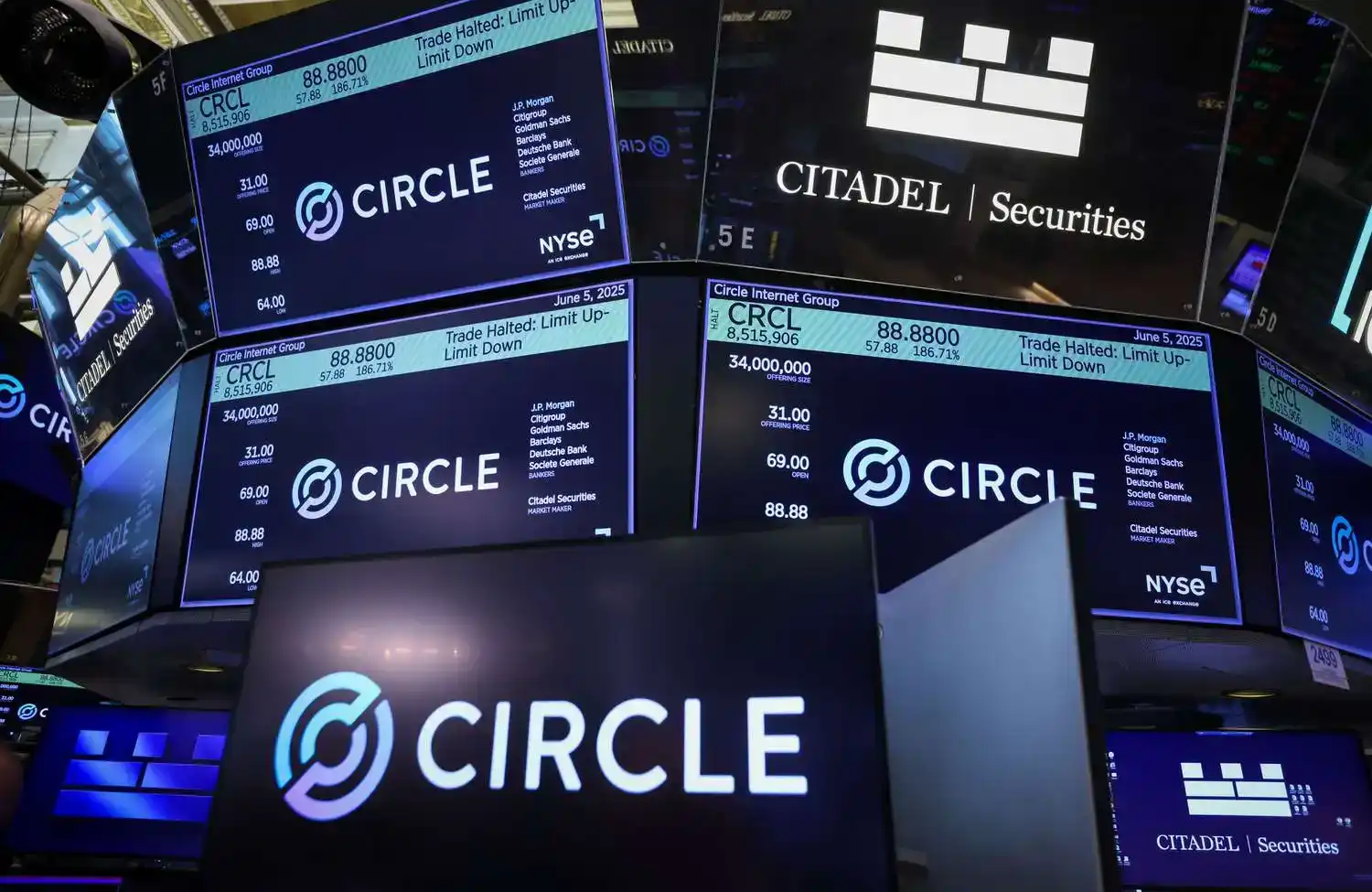
Circle Doubles in a Month: What Is the Market Betting On?

Circle's stock (CRCL) has experienced significant volatility, doubling in February 2025 after a sharp post-IPO decline. This surge occurred while Bitcoin fell 40%, indicating a decoupling from the broader crypto market. The key driver is a fundamental shift in how the market values Circle and its USDC stablecoin. Previously viewed as a cyclical crypto play, USDC's growth accelerated during the bear market, with its circulating supply rising 72% to a record $753 billion. This growth is increasingly driven by traditional finance and global payments, not speculative crypto trading. Major partnerships with Visa, Mastercard, JPMorgan, and Intuit are embedding USDC into mainstream payment infrastructure. The passage of the GENIUS Act in July 2025 provided a federal regulatory framework, creating a moat for compliant issuers like Circle and helping USDC gain market share against USDT. USDC also surpassed Tether in on-chain transaction volume. A major future growth narrative centers on AI Agent payments. Circle and others are developing infrastructure for machine-to-machine transactions, offering 24/7 settlement at a fraction of the cost of traditional systems. While current non-interest revenue from these new use cases remains under 5% of total revenue, the potential market is vast, with predictions of a multi-trillion-dollar stablecoin and AI Agent economy by 2030. Circle's $23 billion valuation largely bets on this future narrative becoming reality.

marsbit03/12 01:09

Circle Doubles in a Month: What Is the Market Betting On?

marsbit03/12 01:09

Why We No Longer Love Crypto

The article "Why We No Longer Passionate About Crypto" explores the growing sense of disillusionment among crypto veterans. Many who once found excitement in the space now feel stuck, particularly those not working on stablecoins, financial infrastructure, or DeFi. The author notes that the previous era—where developer-focused products thrived on vibes rather than revenue—ended about 18 months ago. The crypto market for non-financial applications is now seen as limited, with an estimated annual addressable market of only $200–300 million, leading many builders to feel they have few viable paths forward. The rise of AI has intensified this frustration, as it offers faster innovation and more tangible product development compared to crypto’s current constraints. The author outlines several unappealing options for those exploring crypto-AI intersections: tokenizing traditional AI products without real utility, building decentralized AI infrastructure (which lacks immediate feedback), or competing with giants in AI-focused stablecoin infrastructure. Despite this pessimism, the author concludes with a note of optimism: Crypto’s unique value lies in its ability to serve as "capital superconductor" for growth. The convergence of AI-driven product innovation and crypto’s programmable capital mechanisms could fuel a new generation of "agent-based companies," creating a renewed sense of purpose for those who remain.

比推03/11 20:29

Why We No Longer Love Crypto

比推03/11 20:29

Nanobot User Security Practice Guide: Guarding the Last Line of Defense for AI Permissions

A comprehensive security guide for Nanobot users emphasizes the critical importance of safeguarding AI agents with system-level permissions (shell execution, file access, network requests, etc.) against threats like prompt injection, supply chain poisoning, and unauthorized operations. It advocates a balanced, multi-layered defense strategy involving three key roles: - **End Users**: The final decision-makers responsible for managing API keys (secure storage, avoiding code repository exposure), enforcing channel access controls (using allowFrom whitelists), avoiding root privileges, minimizing email channel usage due to vulnerabilities, and deploying via Docker for isolation. - **AI Agent**: Enhanced with built-in "Self-Wakeup" security skills to autonomously audit intent, intercept malicious commands (e.g., `rm -rf`, shell injection), prevent sensitive data exfiltration (e.g., config files), and validate MCP skills. - **Deterministic Scripts**: Automatically perform static code analysis, hash-based tamper checks, security baseline verification, and nightly backups to ensure integrity and enable recovery. The guide underscores that no single layer is foolproof, but together they balance usability and security. It includes a disclaimer noting that these are best-effort measures and not a substitute for professional audits, with users bearing ultimate responsibility for risk management.

marsbit03/11 10:16

Nanobot User Security Practice Guide: Guarding the Last Line of Defense for AI Permissions

marsbit03/11 10:16

Ondo, xStocks, Hyperliquid 'Three Kingdoms': Who is Building the 'Foundation' of Future Finance?

This article analyzes three distinct approaches to on-chain tokenization of traditional assets like stocks and ETFs: Ondo Finance, xStocks (by Backed Finance, now Kraken-owned), and Hyperliquid's HIP-3. Ondo Finance employs an institutional-grade, indirect tokenization model. An offshore SPV holds the underlying stocks, issuing on-chain structured notes that represent economic exposure but not legal ownership. It features atomic settlement, instant minting/redemption, and requires KYC for accredited non-US investors. xStocks targets the retail market with a multi-chain, composable model. Similar to Ondo, it uses a 1:1 backed debt instrument structure (tracking certificates) issued by a Jersey-based SPV. It emphasizes self-custody, ease of access with no specific KYC for trading, and integrates a novel "xChange" engine to bridge TradFi liquidity into DeFi. Hyperliquid's HIP-3 offers a fundamentally different, permissionless model for creating perpetual futures markets on any asset. It requires no underlying custody of assets. Instead, it provides synthetic price exposure through oracle-fed perpetual contracts, allowing high leverage and 24/7 trading. It functions as a decentralized infrastructure layer for market creators. The piece concludes that these protocols are not in direct competition but serve different purposes: Ondo and xStocks offer economic ownership and redemption, while Hyperliquid provides leveraged synthetic trading. The common thread is expanding access and composability for on-chain users.

marsbit03/11 10:03

Ondo, xStocks, Hyperliquid 'Three Kingdoms': Who is Building the 'Foundation' of Future Finance?

marsbit03/11 10:03

活动图片