Cardano Payments Roll Out Across 137 SPAR Stores In Switzerland

bitcoinistPublished on 2026-03-06Last updated on 2026-03-06

Abstract

The Cardano blockchain has been integrated into the Swiss financial platform DFX.swiss, enabling its native token ADA to be used for retail payments. As a result, customers can now pay with ADA at 137 SPAR stores across Switzerland through the Open Crypto Pay standard. This integration allows direct payments from native wallets and reduces transaction fees by about two-thirds compared to traditional payment methods. Additionally, DFX.swiss provides a bridge to traditional banking, allowing users to exchange ADA for fiat currencies. Despite this development, ADA’s underperformed recently, declining over 6% in a week as large investors reduced their holdings.

The Cardano blockchain has now been integrated into the DFX.swiss platform, bringing its native token ADA to retail store payments.

Cardano Can Now Be Used To Pay At Certain SPAR Stores In Switzerland

As announced by the Cardano Foundation on its website, the Cardano blockchain has seen integration into DFX.swiss, a digital asset financial services platform based in Switzerland.

With the integration, ADA is now a part of Open Crypto Pay, a payments standard developed by DFX.swiss. “Through the integration of Cardano, customers can now pay with the cryptocurrency ADA in 137 SPAR stores across Switzerland,” explained the announcement. Open Crypto Pay also allows users to use their ADA from their native wallets directly at checkout.

SPAR is a Netherlands-based multinational franchise that provides licensing to independently owned and operated food retail stores. In Switzerland, there are over 350 stores using the branding, but currently, only 137 support payments with DFX.swiss.

According to the Cardano Foundation, Open Crypto Pay can help reduce transactions fees by around two-thirds compared to traditional card and payment providers. “This delivers not only technological innovation, but also clear economic value for retailers,” noted the not-for-profit organization dedicated to the cryptocurrency.

DFX.swiss also provides a direct bridge into the traditional banking infrastructure, enabling users to buy or exchange ADA directly into fiat currencies. Cyrill Thommen, DFX.swiss CEO, said:

With Open Crypto Pay, we demonstrate that Cardano is not only technologically advanced, but also delivers real value in daily payments – for both consumers and merchants.

ADA is now also integrated with the urble app, a savings platform created by Swiss FinTech Brick Towers. DFX.swiss announced a partnership with urble back in January. Ralph Hofacker, Co-CEO of Brick Towers, noted:

The combination of regulated infrastructure and user-centric applications makes it possible to implement saving and payments based on Cardano in a simple way.

ADA Has Declined While Other Digital Assets Have Rallied

Bitcoin and Ethereum have witnessed bullish price action during the past week, but Cardano has shown a different trajectory as the coin has gone down by more than 6% inside the window, reaching the $0.27 level.

Below is a chart that shows how the asset’s trajectory has looked over the past month.

The price of the coin seems to have overall moved sideways in this period | Source: ADAUSDT on TradingView

ADA’s lackluster price action has come as large investors have participated in distribution. Over the past week, whales on the network have shed 230 million tokens (worth more than $63 million right now) from their holdings, as highlighted by analyst Ali Martinez in an X post.
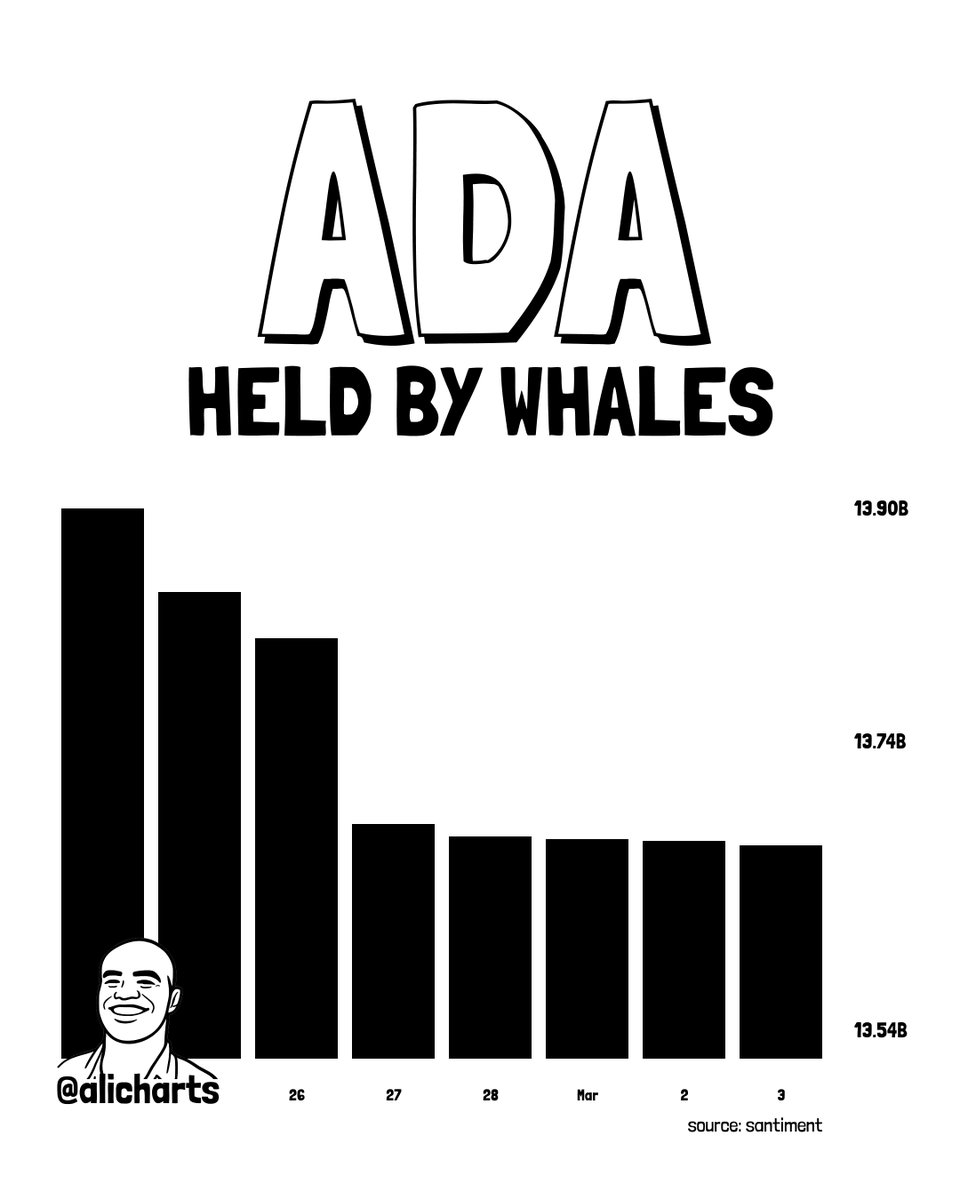
The recent trend in the holdings of the ADA whales | Source: @alicharts on X


Related Questions

QWhat is the significance of Cardano's integration into the DFX.swiss platform?

AThe integration allows the Cardano blockchain's native token, ADA, to be used for retail payments through the Open Crypto Pay standard, enabling customers to pay with ADA in 137 SPAR stores across Switzerland directly from their native wallets.

QHow many SPAR stores in Switzerland currently support payments with ADA through DFX.swiss?

ACurrently, 137 SPAR stores in Switzerland support payments with ADA through the DFX.swiss platform.

QAccording to the Cardano Foundation, what is a key economic benefit of using Open Crypto Pay for retailers?

AOpen Crypto Pay can help reduce transaction fees by around two-thirds compared to traditional card and payment providers, delivering clear economic value for retailers.

QWhat recent partnership did DFX.swiss announce to further integrate ADA into the financial ecosystem?

ADFX.swiss announced a partnership with the urble app, a savings platform created by Swiss FinTech Brick Towers, which now integrates ADA, allowing for simplified saving and payments based on Cardano.

QHow has the price of ADA performed recently compared to other major cryptocurrencies like Bitcoin and Ethereum?

AWhile Bitcoin and Ethereum have witnessed bullish price action, ADA has declined by more than 6% in the past week, reaching the $0.27 level, as large investors (whales) distributed 230 million tokens from their holdings.

Related Reads

Investors Are Now Hunting for AI Projects on Bilibili and Xiaohongshu

Investors Turn to Bilibili and Xiaohongshu to Source AI Projects The AI hardware boom is in full swing in 2025, with a surge in smart wearables like AI glasses, rings, toys, and companion robots. This frenzy has investors scrambling, not just sifting through business plans, but actively hunting for promising "under-the-radar" projects on youth and tech-enthusiast content platforms like Bilibili and Xiaohongshu. The logic is straightforward: for consumer-facing AI hardware, genuine user demand and potential pitfalls are often revealed earlier in public discussions, comments, and critiques on these communities than in formal pitches. As one industry insider notes, these products must ultimately be tested and understood by real people. This shift highlights a crucial challenge in the sector: user education. The success of AI hardware depends on moving beyond mere efficiency gains to fulfilling higher-order needs like "unleashing personal creativity." Products must convince users they are natural, unobtrusive additions to daily life. Early hype, as seen with devices like the Rabbit R1, often fades if the product fails to clearly solve real-world problems, leading to high return rates and market rejection. The market is now entering a shakeout phase. 2026 is seen as a year of commercial validation. Some projects have already stalled or been canceled due to market resistance, lack of differentiation, or financial woes. However, the long-term opportunity remains vast, with forecasts predicting a multi-trillion dollar global AI hardware market by 2030. The competition is intensifying. With giants like OpenAI and Meta preparing their own hardware, and Chinese companies launching diverse AI-powered products, the battle for user attention, product excellence, and market understanding is just beginning. The core principle endures: in the AI era, it remains a user-sovereign market.

marsbit11m ago

Investors Are Now Hunting for AI Projects on Bilibili and Xiaohongshu

marsbit11m ago

"Agents' Last Exam", Claude Fable 5 Actually Loses to GPT 5.5

Surprisingly, in the newly released "Agents' Last Exam" (ALE) benchmark from UC Berkeley, GPT-5.5 has outperformed the recently launched and highly-regarded Claude Fable 5. ALE tests AI agents on their ability to perform real-world tasks across 55 professional domains—such as 3D modeling in Siemens NX, creating game scenes in Unreal Engine, and visual effects work in Adobe After Effects—by granting them full GUI and command-line access. In the core task completion rate ranking, GPT-5.5 configurations secured the top two spots (24.0% and 23.0%), while Claude Fable 5 with Claude Code came in third (22.0%). Notably, the highest pass rate was only 24%, and the most difficult "Last-Exam" tier saw most top models, including GPT-5.5 and Fable 5, scoring zero. The benchmark also revealed significant cost and efficiency gaps: Fable 5 spent over four times more money than GPT-5.5's most expensive configuration for a slightly lower score, and was much slower. ALE differs from previous knowledge-based benchmarks by evaluating practical "ability to do" rather than static knowledge retrieval. Its tasks are derived from real expert projects, automatically scored, and designed to prevent cheating through a rotating pool of private challenges. The results suggest that high performance on traditional benchmarks does not necessarily translate to proficiency in complex, open-ended real-world work. The study also notes that agents often fail by prematurely declaring tasks complete without proper verification, and that no single model excels uniformly across all diverse domains.

marsbit17m ago

"Agents' Last Exam", Claude Fable 5 Actually Loses to GPT 5.5

marsbit17m ago

Trading

Spot
Futures

Hot Articles

Discussions

Welcome to the HTX Community. Here, you can stay informed about the latest platform developments and gain access to professional market insights. Users' opinions on the price of ADA (ADA) are presented below.

活动图片