Cardano Founder To Leave X Permanently, Details Next Steps

bitcoinistPublished on 2025-12-29Last updated on 2025-12-29

Abstract

Cardano founder Charles Hoskinson has announced he will permanently leave X (formerly Twitter) by the end of December, with a "digital twin" set to take over his account in January. He plans to shift his communication to platforms like Discord for weekly AMAs, YouTube for livestreams, and long-form writing on his personal blog. Hoskinson cited X's tendency to "reward outrage" as a key reason for leaving, emphasizing that his focus will remain on building meaningful projects like Cardano's development, Africa initiatives, and Midnight. He also hinted at past conflicts on the platform, thanking supportive followers while dismissing critics. Further details about the digital twin will be explained in his first YouTube stream of the new year. At the time of writing, ADA was trading at $0.3779.

Cardano founder Charles Hoskinson says he will stop using X at the end of December, with a “digital twin” set to take over his account in January, an unusual handoff that reshapes how one of crypto’s most visible founders communicates with the Cardano community. “Five more days on X,” Hoskinson wrote in a Dec. 27 post. “Come January, a digital twin takes over this account—I’ll explain what that means on the first YouTube stream of the new year.”

Here’s Why The Cardano Founder Will Leave X

Hoskinson pointed followers to where he intends to be active next. “Where to find me: Midnight Discord for weekly AMAs, YouTube for livestreams, and the long-form writing I’ve owed myself for a decade,” he wrote, tying the shift to Midnight and to a renewed emphasis on longer-form communication.

The motivation, he said, is incentive design. “Why leave? X rewards outrage,” Hoskinson wrote, adding that “the work that matters—Africa, Basho, Midnight 1.0, Cardano governance—rewards building.” He framed it as a conclusion drawn from a full decade on the platform: “Ten years taught me which game is worth playing.”

The farewell also carried a sharper edge that nodded to the disputes he has been drawn into on X. “To everyone who made this decade worthwhile: thank you. To the rest: I won’t miss you,” he wrote. Hoskinson has been a prolific and often combative presence on the platform, frequently engaging critics directly and weighing in on Cardano’s technical direction, governance arguments, and broader industry controversies.

Hoskinson’s writing pivot is already underway. On Dec. 25, he published a long post titled “What the Horizon Kept” on his personal Blogger site, opening with a vignette in which “The old fisherman said, ‘The ocean’s too quiet,’” before moving into a surreal narrative about instruments failing, maps not matching reality, and an island appearing where none was marked. The site’s profile bio describes him, bluntly, as a “Guy who writes stuff that makes people angry.”

He also continued posting in a more typically terse mode in recent days. In one message, Hoskinson wrote: “Before Crypto and After Crypto. Friends don’t let friends do crypto.”

Hoskinson has not provided details about the “digital twin” beyond promising an explanation in his first YouTube livestream of the year. For Cardano and Midnight followers, the near-term question is how that handoff works in practice, and whether the conversation he has historically driven on X consolidates on Discord, YouTube, and whatever long-form writing comes next.

At press time, ADA traded at $0.3779.
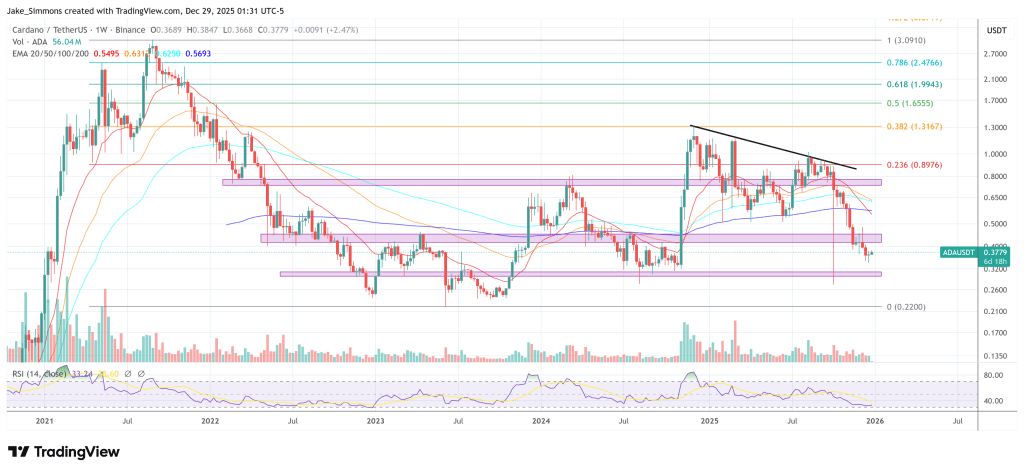
ADA falls below key support, 1-week chart | Source: ADAUSDT on TradingView.com

Related Questions

QWhy is Cardano founder Charles Hoskinson leaving X (formerly Twitter)?

ACharles Hoskinson is leaving X because he believes the platform rewards outrage, while the work that matters, such as the development of Africa, Basho, Midnight 1.0, and Cardano governance, rewards building. He concluded from his ten years on the platform that building is the game worth playing.

QWhat is the 'digital twin' that Charles Hoskinson mentioned?

AHoskinson has not provided specific details about the 'digital twin' yet. He has only promised to explain what it means during his first YouTube livestream of the new year in January.

QWhere does Charles Hoskinson plan to be active after leaving X?

AAfter leaving X, Hoskinson plans to be active on the Midnight Discord for weekly AMAs, on YouTube for livestreams, and he will focus on long-form writing that he has wanted to do for a decade.

QWhat was the tone of Hoskinson's farewell message on X?

AHis farewell message had a sharp edge. He thanked those who made his decade on the platform worthwhile but also stated, 'To the rest: I won’t miss you,' nodding to the many disputes he has been involved in on the platform.

QWhat is the trading price of ADA (Cardano's token) mentioned at the end of the article?

AAt the time the article was written, ADA was trading at $0.3779.

Related Reads

Where Is the AI Infrastructure Industry Chain Stuck?

The AI infrastructure (AI Infra) industry chain is facing unprecedented systemic bottlenecks, despite the rapid emergence of applications like DeepSeek and Seedance 2.0. The surge in global computing demand has exposed critical constraints across multiple layers of the supply chain—from core manufacturing equipment and data center cabling to specialty materials and cleanroom facilities. Key challenges include four major "walls": - **Memory Wall**: High-bandwidth memory (HBM) and DRAM face structural shortages as AI inference demand outpaces training, with new capacity not expected until 2027. - **Bandwidth Wall**: Data transfer speeds lag behind computing power, causing multi-level bottlenecks in-chip, between chips, and across data centers. - **Compute Wall**: Advanced chip manufacturing, reliant on EUV lithography and monopolized by ASML, remains the fundamental constraint, with supply chain fragility affecting production. - **Power Wall**: While energy demand from data centers is rising, power supply is a solvable near-term challenge through diversified energy infrastructure. Expansion is further hindered by shortages in testing equipment, IC substrates (critical for GPUs and seeing price hikes over 30%), specialty materials like low-CTE glass fiber, and high-end cleanroom facilities. Connection technologies are evolving, with copper cables resurging for short-range links due to cost and latency advantages, while optical solutions dominate long-range scenarios. Innovations like hollow-core fiber and advanced PCB technologies (e.g., glass substrates, mSAP) are emerging to meet bandwidth needs. In summary, AI Infra bottlenecks are multidimensional, spanning compute, memory, bandwidth, power, and supply chain logistics. Advanced chip manufacturing remains the core constraint, while substrate, material, and equipment shortages present immediate challenges. The industry is moving toward hybrid copper-optical solutions and accelerated domestic supply chain development.

marsbit15m ago

Where Is the AI Infrastructure Industry Chain Stuck?

marsbit15m ago

Autonomy or Compatibility: The Choice Facing China's AI Ecosystem Behind the Delay of DeepSeek V4

DeepSeek V4's repeated delay in early 2026 has sparked global discussions on "de-CUDA-ization" in AI. The highly anticipated trillion-parameter open-source model is undergoing deep adaptation to Huawei’s Ascend chips using the CANN framework, representing China’s first systematic attempt to run a core AI model outside the CUDA ecosystem. This shift, however, comes with significant engineering challenges. While the model uses a MoE architecture to reduce computational load, it places extreme demands on memory bandwidth, chip interconnects, and system scheduling—areas where NVIDIA’s mature CUDA ecosystem currently excels. Migrating to Ascend introduces complexities in hardware topology, communication latency, and software optimization due to CANN’s relative immaturity compared to CUDA. The move highlights a broader strategic dilemma: short-term compatibility with CUDA offers practical benefits and faster adoption, as seen in CANN’s efforts to emulate CUDA interfaces. Yet, long-term over-reliance on compatibility risks inheriting CUDA’s limitations and stifling native innovation. If global AI shifts away from transformer-based architectures, strict compatibility could lead to technological obsolescence. Despite these challenges, DeepSeek V4’s eventual release could demonstrate the viability of a full domestic AI stack and accelerate CANN’s ecosystem growth. However, true technological independence will require building an original software-hardware paradigm beyond compatibility—a critical task for China’s AI ambitions in the next 3-5 years.

marsbit33m ago

Autonomy or Compatibility: The Choice Facing China's AI Ecosystem Behind the Delay of DeepSeek V4

marsbit33m ago

How Blockchain Fills the Identity, Payment, and Trust Gaps for AI Agents?

AI Agents are rapidly evolving into autonomous economic participants, but they face critical gaps in identity, payment, and trust infrastructure. They currently lack standardized ways to prove who they are, what they are authorized to do, and how they should be compensated across different environments. Blockchain technology is emerging as a solution to these challenges by providing a neutral coordination layer. Public ledgers offer auditable credentials, wallets enable portable identities, and stablecoins serve as a programmable settlement layer. A key bottleneck is the absence of a universal identity standard for non-human entities—akin to "Know Your Agent" (KYA)—which would allow Agents to operate with verifiable, cryptographically signed credentials. Without this, Agents remain fragmented and face barriers to interoperability. Additionally, as AI systems take on governance roles, there is a risk that centralized control over models could undermine decentralized governance in practice. Cryptographic guarantees on training data, prompts, and behavior logs are essential to ensure Agents act in users' interests. Stablecoins and crypto-native payment rails are becoming the default for Agent-to-Agent commerce, enabling seamless, low-cost transactions for AI-native services. These systems support permissionless, programmable payments without traditional merchant onboarding. Finally, as AI scales, human oversight becomes impractical. Trust must be built into system architecture through verifiable provenance, on-chain attestations, and decentralized identity systems. The future of Agent economies depends on cryptographically enforced accountability, allowing users to delegate tasks with clearly defined constraints and transparent operation logs.

marsbit1h ago

How Blockchain Fills the Identity, Payment, and Trust Gaps for AI Agents?

marsbit1h ago

Trading

Spot
Futures

Hot Articles

Discussions

Welcome to the HTX Community. Here, you can stay informed about the latest platform developments and gain access to professional market insights. Users' opinions on the price of ADA (ADA) are presented below.

活动图片