Cardano Founder Calls For Simpler, Safer Crypto Across All Chains

bitcoinistPublished on 2026-05-08Last updated on 2026-05-08

Abstract

Cardano founder Charles Hoskinson argued at Consensus 2026 that the crypto industry must overcome its complex and intimidating user experience to achieve mainstream adoption. He highlighted the burdens of managing seed phrases, navigating exchanges, and understanding DeFi risks as major barriers. Hoskinson's solution involves simplifying self-custody, identity, privacy, and multi-chain access without reverting to centralized control. He praised efforts like Ethereum's account abstraction but warned that abstraction must be paired with privacy to avoid recreating Web2's surveillance model. Hoskinson introduced Midnight Passport as a framework designed to offer secure, mobile-native management across multiple blockchains. He also discussed the future role of AI agents in handling transactions, emphasizing that privacy will be critical as these agents require deep personal context to operate effectively.

Cardano founder Charles Hoskinson used a Wednesday keynote at Consensus 2026 in Miami to argue that crypto’s next phase will not be won by another isolated chain, token or wallet. The Cardano founder said the industry must make self-custody, identity, privacy and multi-chain access simple enough for mainstream users without handing control back to centralized intermediaries.

Hoskinson framed the problem bluntly: crypto still asks users to manage seed phrases, navigate exchanges, wait for withdrawals, choose between networks, avoid fake apps and understand DeFi risk before they can do anything useful. That, he said, remains the core barrier to bringing “the next few billion people” into the industry.

“The number one problem that people say again and again and again when they think about cryptocurrencies, whether you’re an experienced user and you’ve been in the industry a long time or you’re a completely new person, you’ve heard about the industry is, I’m gonna fuck it up. The safety side,” Hoskinson said. “That is the user experience in 2026. That make any sense to you? Is this like a product you wanna use?”

Cardano Founder Targets Crypto’s UX Problem

His answer was not to abandon crypto’s original principles, but to make them usable. Hoskinson contrasted crypto’s current experience with Web2 products such as Google Wallet, which he said has around 1.5 billion users and trains consumers to expect one-click setup, recovery and seamless mobile access. Crypto, in his view, cannot keep insisting it is “different” if the product experience remains too punishing for ordinary users.

A central theme of the keynote was abstraction. Hoskinson credited Ethereum with advancing account abstraction and chain abstraction standards, arguing that these efforts became necessary as fragmented layer-2 environments created a poor user experience. He also pointed to Near Protocol as an example of embedding those ideas at the protocol level, citing $71 million in transaction fees in a year and billions of dollars traded through Near intents.

But Hoskinson warned that abstraction carries a tradeoff. When users delegate complexity to third parties, those parties often gain visibility into assets, transactions, preferences, identity and business data. For crypto to scale without repeating the surveillance model of Web2, he argued, abstraction must be paired with privacy.

“When you abstract things, you delegate to people. You trust people. You give them something to do that on your behalf somewhere else,” he said. “You don’t worry about the doing, but when they do the doing, they know you. They know what you’re buying. They know where you’re at.”

That argument led into Hoskinson’s pitch for Midnight Passport, a framework he described as combining mobile-native key management, recovery, self-sovereign identity, selective disclosure, wallet credentials, name services and multi-chain signatures. The idea, according to Hoskinson, is to let users scan a QR code, rely on trusted execution hardware already built into phones, encrypt off-chain data client-side and create wallets across networks such as Bitcoin, Ethereum, Solana and XRP.

“I don’t care what networks you want to use. I don’t care what assets you want to have,” Hoskinson said. “I want you to have control of those assets. I want you to custody those assets. I want you to be in control of your identity and your data.”

The keynote also expanded into AI agents, which Hoskinson described as an incoming force that could reshape internet commerce and crypto usage. He argued that agents may eventually handle most searches, transactions and online activity, while humans interact with a smaller “human internet.” For crypto, that raises a practical question: if users cannot safely evaluate DeFi protocols, counterparties or risks themselves, AI systems may become the layer that performs diligence and execution.

Hoskinson said this makes privacy even more important, because effective agents require deep personal context. Midnight Passport, he said, is being developed not only for people but also for agents, allowing rules to be set around identity, data access and execution.

At press time, Cardano traded at $0.2689.
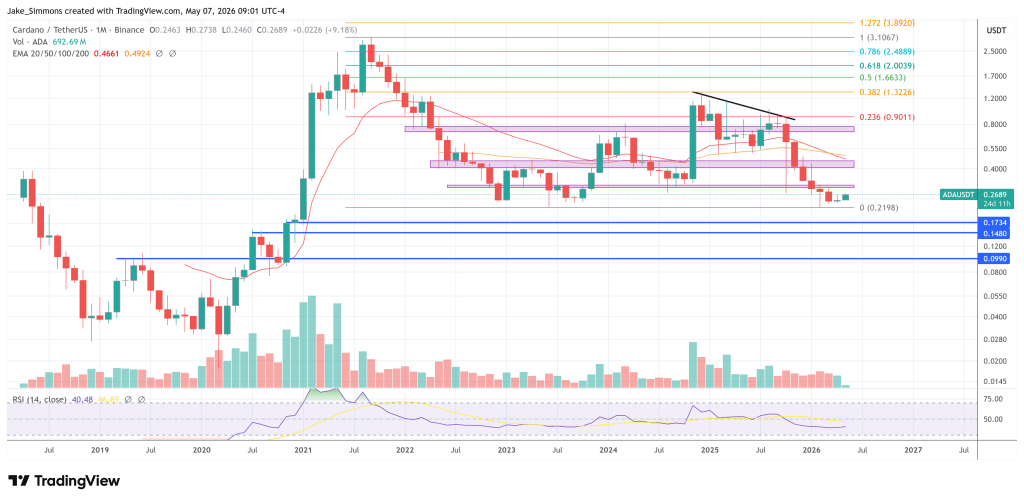
Cardano remains below key resistance, 1-monthly chart | Source: ADAUSDT on TradingView.com

Related Questions

QWhat is the main barrier to bringing mainstream users into crypto, according to Charles Hoskinson?

AAccording to Hoskinson, the main barrier is the poor user experience, which asks users to manage seed phrases, navigate exchanges, wait for withdrawals, choose between networks, avoid fake apps, and understand DeFi risks before they can do anything useful.

QWhat does Hoskinson identify as a necessary tradeoff that comes with simplifying crypto through abstraction?

AHoskinson identifies that the tradeoff with abstraction is often a loss of privacy. When users delegate complexity to third parties, those parties gain visibility into their assets, transactions, preferences, identity, and business data.

QWhat is the proposed solution, Midnight Passport, designed to combine?

AMidnight Passport is designed to combine mobile-native key management, recovery, self-sovereign identity, selective disclosure, wallet credentials, name services, and multi-chain signatures to simplify user experience across different blockchains.

QAccording to the keynote, why will privacy become even more critical with the rise of AI agents?

APrivacy will become more critical because effective AI agents require deep personal context to operate. Therefore, systems are needed to set rules around identity, data access, and execution for these agents, protecting user data.

QHow did Hoskinson contrast the current crypto user experience with that of successful Web2 products?

AHe contrasted it with products like Google Wallet, which trains consumers to expect one-click setup, recovery, and seamless mobile access. He argued crypto cannot insist it is 'different' if its product experience remains too punishing compared to these seamless mainstream options.

Related Reads

Gnosis DAO Faces Massive Treasury Redemption Proposal, "Treasury Raiders" Return

A group of activist investors, often labeled as "treasury raiders," have submitted proposal GIP-150 to Gnosis DAO, calling for a one-time, voluntary, and proportional treasury redemption. The proposal would allow participating GNO holders to claim a share of the over $220 million in DAO reserves. Proponents argue this addresses the persistent and widening discount of GNO's market price relative to the treasury's net asset value. Despite recent DAO funding to Gnosis Ltd., the discount has increased. The current vote, closing May 12th, shows 65% opposition among early votes. The redemption would value each eligible token around $170, a ~30% premium to the current $131 market price. GNO held by Gnosis Ltd. is excluded. DeFi community reactions are mixed. Some commentators acknowledge the "risk-free value" (RFV) arbitrage logic but criticize the proposal as a short-term cash grab lacking legitimacy, as Gnosis never promised treasury backing for the token price. Others oppose it due to Gnosis's contributions to ecosystem infrastructure (Safe, CoW Swap, etc.). Founder Sebastian Bürgel lamented the targeting of respected builders. Aragon's team, previously targeted in similar RFV campaigns, called for better mechanisms to align incentives. This follows a pattern of 2023 RFV-style actions against projects like Rook and Aragon. Recently, Beefy Finance implemented a buyback to preempt such pressure. The proposal's author, Wismerhill, expressed past admiration for Gnosis but now sees this vote as a test of whether holders prioritize short-term arbitrage or long-term ecosystem value.

marsbit32m ago

Gnosis DAO Faces Massive Treasury Redemption Proposal, "Treasury Raiders" Return

marsbit32m ago

TON Enters the Telegram Era: The On-Chain Experiment of Super Apps is Unfolding

The TON token recently surged nearly 120% in 4 days, approaching $3. This rally is primarily driven by Telegram founder Pavel Durov's announcement that Telegram will become the core driver of the TON network, replacing the TON Foundation and serving as its largest validator. This move signals a fundamental shift: Telegram is no longer just supporting TON from a distance but is formally taking over its governance and operations. This changes TON's valuation narrative from being a crypto project with Telegram's user base to becoming the foundational blockchain infrastructure for Telegram's future commercial ecosystem—transitioning from a crypto narrative to an internet-platform-level story. TON's recent technical upgrades focus on 10x faster speeds, 6x lower fees, and near-instant confirmations. These optimizations target Telegram's internal high-frequency, micro-transaction scenarios like tipping, bot services, and Mini App purchases. The goal is to enable seamless, near-zero-cost transactions for its nearly 1 billion users, making blockchain usage almost invisible—akin to platforms like WeChat Pay. TON's path is unique: it already has a massive user base and is building the blockchain system to serve it, aiming to onboard users into Web3 without them realizing it. The vision is to integrate wallet, payment, bot, and Mini App functionalities into a closed loop within Telegram, positioning TON as the value-exchange infrastructure for a super-app. In essence, this surge reflects a market reassessment: TON is emerging as the first blockchain ecosystem with a genuine super-app gateway. Its true competitors may not be other Layer 1 blockchains but global internet payment systems. With Telegram now fully committed, the experiment of on-chaining a super-app is underway.

marsbit1h ago

TON Enters the Telegram Era: The On-Chain Experiment of Super Apps is Unfolding

marsbit1h ago

Trading

Spot
Futures

Hot Articles

Discussions

Welcome to the HTX Community. Here, you can stay informed about the latest platform developments and gain access to professional market insights. Users' opinions on the price of ADA (ADA) are presented below.

活动图片