Cardano Founder Calls For Crypto ‘Reset’ Heading Into 2026

bitcoinistОпубліковано о 2025-12-16Востаннє оновлено о 2025-12-16

Анотація

Charles Hoskinson, founder of Cardano, has declared the need for a crypto industry "reset" heading into 2026, calling 2025 a deeply disappointing year. In a year-end address, he criticized the market for losing its retail investors, becoming overly political, and reverting to speculative "pump and dump" narratives. Hoskinson pinpointed key failures: institutional capital remained locked in Bitcoin and failed to benefit altcoins, regulatory hopes were dashed by political memes and cash-grab tokens like TRUMP coin, and trust with retail was never rebuilt after the 2022 crash. His solution is a return to "first principles," emphasizing that no government or large investor is coming to save the industry. He advocates for building systems that provide real utility and help people, tying crypto's future to solutions for a potential AI-driven "dystopian hellscape." While admitting to past prediction errors, Hoskinson expressed belief in a 2026 recovery, pointing to projects like Midnight as examples of a new, retail-focused approach.

Cardano founder Charles Hoskinson wants crypto to stop acting like it’s permanently stuck in 2021 brain.

In a Dec. 15 livestream titled “Some End of Year Thoughts,” the IOG CEO delivered a blunt year-end diagnosis of a market that, in his telling, lost its retail engine, let politics turn into a sideshow, and drifted back into the easiest (and laziest) narrative in the business: find the next 10x, then dump it on someone else.

“This has been a really [expletive] up year for our industry as a whole,” Hoskinson said from Colorado, describing 2025 as “a donkey of a year” — “an old donkey with a gas problem.”

Cardano’s Hoskinson Warns Of Retail Exodus

His first big complaint was structural, not emotional. The Cardano founder argued that institutional capital did arrive, but much of it got “locked into the Bitcoin layer,” and didn’t rotate into altcoins the way prior cycles did. “So we lost our trickle down effect that we enjoyed in 2021 and in 2017,” he said, framing it as a market-mechanics issue as much as a sentiment one.

Then he pivoted to politics. Hoskinson described a messy set of expectations heading into 2025 — hopes of a more constructive US regulatory posture, then disappointment as crypto became entangled in headline-grabbing memes and what he characterized as erratic signaling. He pointed to the launch of TRUMP coin at the inauguration (as he recounted it), followed by MELANIA, calling them “cash grab situations” that left the broader industry wearing the reputational fallout while still chasing regulatory relief.

The deeper problem, though, was retail. The Cardano founder argued the industry never rebuilt trust after the 2022 wipeout, and that 2025 didn’t offer a compelling reason for everyday participants to come back beyond speculative churn. “Retail showed up in 2021... and then they got screwed again and again and again,” he said. “And now you want them to come back so you can do it again. Will they? No.”

That sets up his core pitch for 2026: a reset framed as a return to “first principles,” with less reliance on governments, celebrity catalysts, or “the cavalry.” His language wasn’t subtle. “No government is coming to save us. No large company is coming to save us. No large investor is coming to save us,” he said. “We are on the island.”

He also tied that reset to a broader, darker worldview — AI, robotics, and a society he worries will drift into a “dystopian hellscape” without credible systems for agency, ownership, and verification. Whether you buy that framing or not, it’s clearly the rhetorical engine he wants crypto to run on: less number-go-up, more “what are we actually building, and who does it help?”

Hoskinson didn’t completely let his own camp off the hook, either. He acknowledged missed predictions — including his past expectation that bitcoin would reach $250,000 in 2025 — and the ongoing criticism he gets for timelines.

“I honestly believed [Bitcoin] would be back in December of 2024. Because I believed that Trump would be good for crypto. I was wrong. I believed it and I was wrong. I’ll admit that. But I do believe in 2026 there’s a path for it to get there. And I do believe we as an industry will pivot and return to retail and rebuild those relationships and get it done. It’ll be a difficult road, but I see a path to make that happen. Leios will ship. We know how to do it. We wrote all the code down. We got it done,” Hoskinson said.

Towards the end, he tried to anchor the “reset” in concrete ecosystem moments, pointing to Midnight’s launch mechanics as an example of retail-first distribution and highlighting heavy trading activity around the token. “The bullshit’s over,” he said. “We’re back to work... in 2026 it’s a return to first principles.”

At press time, Cardano traded at $0.3843.
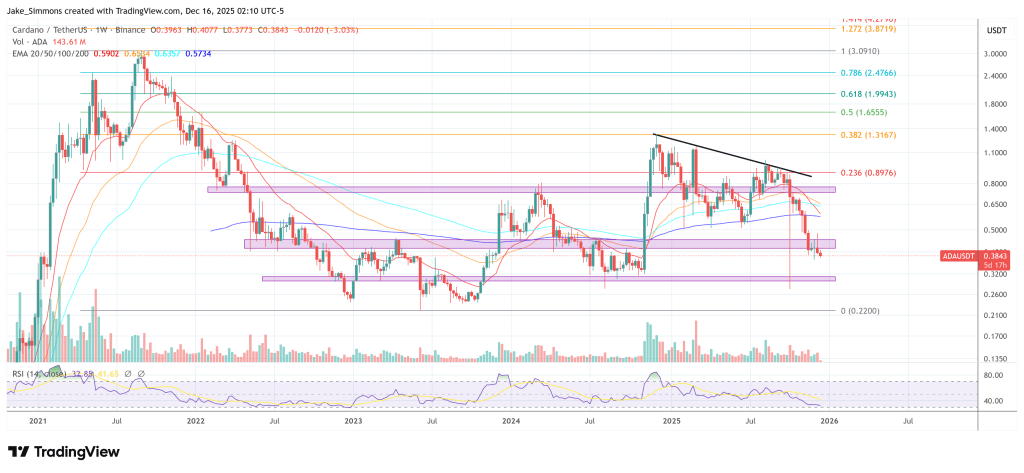
Cardano falls below key support, 1-week chart | Source: ADAUSDT on TradingView.com

Пов'язані матеріали

Anthropic's IPO Launch: Commercial Miracle or Valuation Bubble?

Anthropic has confidentially filed for an IPO, led by Morgan Stanley and Goldman Sachs, potentially going public by October. Following its latest $650 billion funding round, its pre-IPO valuation stands at $965 billion, with projections reaching up to $2 trillion at listing, which would make it the highest-valued private company ever. The article, written by Fu Sheng, addresses skepticism that this represents an AI bubble akin to the 2000 dot-com crash. It argues the current situation differs fundamentally. Unlike the internet bubble era, which relied on speculative narratives with little revenue, Anthropic's valuation is backed by unprecedented, measurable financial performance. Key data points include: * **Revenue Growth:** ARR skyrocketed from $10 billion in early 2025 to $470 billion by May 2026, targeting $100 billion by year-end—a growth curve unmatched in business history. * **Profitability:** It achieved operating profitability in Q2 2026 with an estimated $5.6 billion profit. * **Efficiency:** With ~3,000 employees and ~$470 billion ARR, its revenue per employee exceeds $10 million. Products like Claude Code, launched less than a year ago, already generate $25 billion in annualized revenue. * **Enterprise Adoption:** It boasts a strong enterprise client base, with 8 of the Fortune 10 and over 1,000 large firms spending over $1 million annually on Claude. The valuation is framed using a traditional SaaS model (e.g., a 10x Price-to-Sales multiple on $100 billion revenue). The author contends the core question for analysts has shifted from "How big could this be?" to "How much is it earning and will earn next quarter?" The discussion extends beyond Anthropic to a broader paradigm shift: the transition from a "carbon-based" to a "silicon-based" economy. Companies are increasingly prioritizing investment in compute and AI capabilities over human resources, as these directly scale productivity and competitive advantage. Anthropic's IPO is thus positioned not just as a corporate milestone, but as a price anchor for this new economic era.

链捕手1 год тому

Anthropic's IPO Launch: Commercial Miracle or Valuation Bubble?

链捕手1 год тому

Near Returns to the AI Stage: Transformation into a Public Chain Due to 'Payroll Difficulties,' Agent and Privacy Emerge as New Growth Narratives

NEAR Returns to AI Origins: From Payroll Struggles to Blockchain, Now Focusing on AI Agents and Privacy NEAR Protocol's journey began not with grand blockchain ambitions, but from a practical hurdle: its AI startup founders, including Transformer paper co-author Illia Polosukhin, couldn't efficiently pay international developers in 2017. This led them to pivot and build a high-performance, scalable blockchain. After years navigating various crypto narratives like sharding and cross-chain interoperability, NEAR is now leveraging its AI roots to re-enter the AI arena. A key driver is its "NEAR Intents" layer, which abstracts complex cross-chain transactions. Users simply state their goal (e.g., swap BTC for ETH), and a solver network finds the optimal route. This system has processed over $20B in cross-chain volume, generating significant fee revenue. A major growth area is private transactions via "Confidential Intents/Swaps," which hide trade details until settlement to protect against MEV and front-running. Remarkably, private swaps recently accounted for over 40% of NEAR's transaction volume, highlighting strong demand but also potential regulatory scrutiny. With its AI-founder pedigree, NEAR is positioning itself at the intersection of blockchain, AI agents, and privacy, aiming to become infrastructure for the emerging agent economy while navigating the challenges of its rapid adoption.

marsbit4 год тому

Near Returns to the AI Stage: Transformation into a Public Chain Due to 'Payroll Difficulties,' Agent and Privacy Emerge as New Growth Narratives

marsbit4 год тому

From Ethereum to AI's 'CROPS': What Exactly is This Set of 'Slow Variables' That Vitalik Repeatedly Emphasizes?

In recent discussions, Vitalik Buterin has frequently emphasized the concept of "CROPS," a framework defining core values for Ethereum's development. CROPS stands for Censorship Resistance, Capture Resistance, Open Source, Privacy, and Security. Initially outlined in the Ethereum Foundation's "EF Mandate," it represents a commitment to user sovereignty, ensuring that the network resists external control, remains open, protects privacy, and prioritizes security. The relevance of CROPS extends beyond Ethereum's foundational principles, becoming crucial in the context of AI integration. As AI agents begin handling wallet operations and automated transactions, the risk increases that users may cede control over their digital assets, privacy, and intentions to centralized AI service providers. A "CROPS AI" would therefore emphasize local execution where possible, privacy-preserving remote model calls (e.g., using zero-knowledge proofs), and transparent, verifiable processes to maintain user agency. Vitalik highlights a significant convergence between "CROPS Ethereum access layer" and "CROPS AI." Both address the same fundamental challenge: how users can access powerful services—be it blockchain data via RPCs or AI models—without exposing sensitive information or relinquishing ultimate control. This intersection points toward a future digital entry point that is more private, secure, and user-controlled. Ultimately, CROPS is not merely an abstract ideal but a practical guidepost. It steers development—from protocol resilience and wallet design to AI agent safety—towards a future where users retain self-sovereignty even as digital systems grow more complex and powerful. In an era of accelerating AI adoption, these "slow variables" of censorship resistance, openness, privacy, and security may define Ethereum's enduring value.

marsbit4 год тому

From Ethereum to AI's 'CROPS': What Exactly is This Set of 'Slow Variables' That Vitalik Repeatedly Emphasizes?

marsbit4 год тому

Торгівля

Спот
Ф'ючерси

Популярні статті

Як купити ADA

Ласкаво просимо до HTX.com! Ми зробили покупку Cardano (ADA) простою та зручною. Дотримуйтесь нашої покрокової інструкції, щоб розпочати свою криптовалютну подорож.Крок 1: Створіть обліковий запис на HTXВикористовуйте свою електронну пошту або номер телефону, щоб зареєструвати обліковий запис на HTX безплатно. Пройдіть безпроблемну реєстрацію й отримайте доступ до всіх функцій.ЗареєструватисьКрок 2: Перейдіть до розділу Купити крипту і виберіть спосіб оплатиКредитна/дебетова картка: використовуйте вашу картку Visa або Mastercard, щоб миттєво купити Cardano (ADA).Баланс: використовуйте кошти з балансу вашого рахунку HTX для безперешкодної торгівлі.Треті особи: ми додали популярні способи оплати, такі як Google Pay та Apple Pay, щоб підвищити зручність.P2P: Торгуйте безпосередньо з іншими користувачами на HTX.Позабіржова торгівля (OTC): ми пропонуємо індивідуальні послуги та конкурентні обмінні курси для трейдерів.Крок 3: Зберігайте свої Cardano (ADA)Після придбання Cardano (ADA) збережіть його у своєму обліковому записі на HTX. Крім того, ви можете відправити його в інше місце за допомогою блокчейн-переказу або використовувати його для торгівлі іншими криптовалютами.Крок 4: Торгівля Cardano (ADA)Легко торгуйте Cardano (ADA) на спотовому ринку HTX. Просто увійдіть до свого облікового запису, виберіть торгову пару, укладайте угоди та спостерігайте за ними в режимі реального часу. Ми пропонуємо зручний досвід як для початківців, так і для досвідчених трейдерів.

974 переглядів усьогоОпубліковано 2024.12.10Оновлено 2026.06.02

Як купити ADA

Обговорення

Ласкаво просимо до спільноти HTX. Тут ви можете бути в курсі останніх подій розвитку платформи та отримати доступ до професійної ринкової інформації. Нижче представлені думки користувачів щодо ціни ADA (ADA).

活动图片