Cardano Breaks Governance Deadlock With New Constitutional Committee

bitcoinistPublicado a 2025-12-18Actualizado a 2025-12-18

Resumen

Cardano has resolved a governance deadlock by ratifying a new Constitutional Committee (CC) member through an on-chain vote. The CC, essential for evaluating constitutionality and approving upgrades, budgets, and parameter changes, had been left without a quorum after a mid-term departure. This stalled key governance actions, including treasury withdrawals, budget approvals, and protocol upgrades. The newly elected member, Cardano Curia, was selected off-chain and ratified with over 80% support from delegate representatives (DReps) and sufficient stake pool operator (SPO) backing. The restoration reactivates the CC, allowing Cardano's governance processes to resume normal operation and preventing further delays in network upgrades.

Cardano has moved to resolve a governance bottleneck by ratifying an on-chain vote to restore its Constitutional Committee (CC) to functional capacity, a procedural step that matters because the CC is required to evaluate constitutionality and ratify many categories of governance actions, including upgrades, budgets, and parameter changes.

Intersect, which coordinates parts of Cardano’s governance process, said on X: “On the 7th day of GA... We hit the Epoch’s end. DReps at 80%. Stake pools supporting- It looks like we have a new CC. Ratified. Thank you to everyone who reviewed, voted, and wrote rationales,Santa has been notified.”

Why The Cardano Governance Was Stuck

Cardano’s governance model is tripartite: delegate representatives (DReps), stake pool operators (SPOs), and the Constitutional Committee. The CC plays a gatekeeping role: it judges whether on-chain actions are constitutional and ratifies decisions needed for the network to adapt.

That mechanism stalled after an unexpected mid-term departure left the CC below its minimum operational size. The Cardano Atlantic Council retired mid-term in epoch 597, opening a seat and reducing the committee below quorum. The consequence was that the Cardano CC could not ratify key actions, even as the chain continued to operate normally at the protocol level.

The vote asked DReps and SPOs to ratify a newly elected CC member and restore the committee to full capacity. The candidate, Cardano Curia, was selected off-chain through a DRep vote using the Ekklesia tool, with on-chain ratification required to formalize the result.

The governance materials described the restoration as bringing the CC back to seven members and activating a clarified alternate-member process to handle future vacancies with less disruption. Approval thresholds were set at 67% from DReps and 51% support from SPOs. Intersect’s update indicates those thresholds were met as the epoch ended.

Why This Was Treated As Urgent

The vote was framed as more than housekeeping because an undersized CC effectively blocks major governance flows. Without quorum: Treasury withdrawals couldn’t proceed, the Critical Integrations Budget could not pass, hard forks could not be ratified, delaying network upgrades and several categories of governance actions were blocked, leaving only a limited subset able to move forward.

There was also a timing element: delays risk actions expiring, which would force a repeat of the voting process and extend the governance backlog. With the restoration ratified, Cardano’s governance process can resume normal throughput — reopening the path for upgrades, budget approvals, and protocol changes that depend on a functioning Constitutional Committee.

At press time, Cardano traded at $0.38.
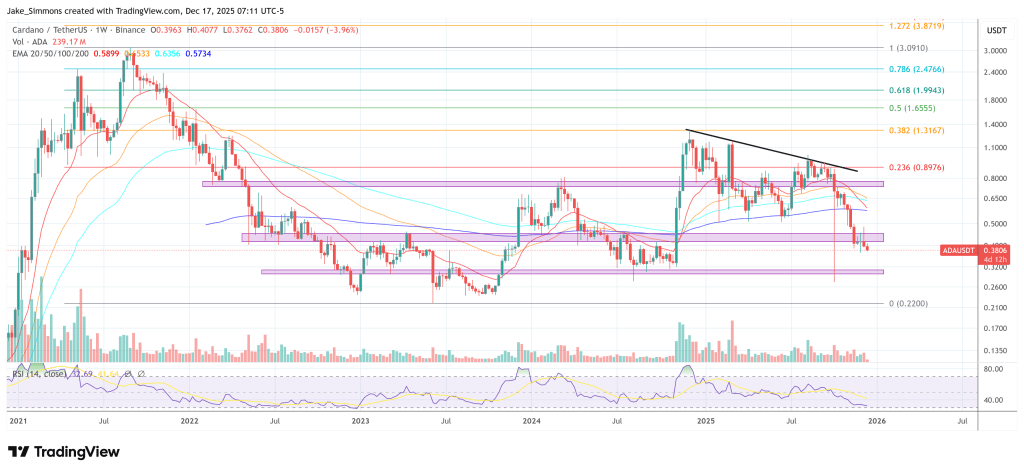
ADA falls below key support, 1-week chart | Source: ADAUSDT on TradingView.com

Lecturas Relacionadas

When AI Traffic Surpasses Humans, How Do You Prove You're Human?

As AI-generated web traffic now surpasses human activity, the internet's foundational business models—built on human attention, browsing, and advertising—face severe disruption. AI agents crawl websites at immense scale without generating ad revenue, while AI summaries divert traffic from original content sites. In response, over 2.5 million sites are blocking AI crawlers, and protections like Cloudflare's "honeypot" traps have emerged, though advanced AI can bypass these. The collapse of traditional CAPTCHAs, which assumed machines were weaker than humans, has led to a shift toward behavioral biometrics for human verification. Companies like IBM and BioCatch now analyze unique human patterns—cursor movements, typing rhythms, keystroke dynamics, and even cognitive delays like the Stroop effect—to distinguish real users from bots. These biometric signatures are difficult to fake or alter, offering a new layer of security but raising significant privacy concerns. Two competing visions for a reliable human verification system are emerging. One, exemplified by Sam Altman’s World (formerly Worldcoin), uses centralized iris scanning to generate unique credentials, though it faces bans and criticism over unauthorized data collection. The other employs cryptographic zero-knowledge proofs, allowing users to prove they are human without revealing identity or biometric data, as advocated by Vitalik Buterin. However, decentralized approaches risk exploitation through identity renting in economically unequal regions. The central dilemma is between a scalable but privacy-invasive centralized system that permanently controls users' biometric data, and a privacy-preserving cryptographic system vulnerable to real-world economic manipulation. The author expresses a preference for the cryptographic path, arguing that despite its flaws, it avoids the irreversible biometric surveillance inherent in centralized alternatives.

Foresight NewsHace 5 min(s)

When AI Traffic Surpasses Humans, How Do You Prove You're Human?

Foresight NewsHace 5 min(s)

Crypto Primary Market Investment and Financing Forward-Looking Weekly Report | Stablecoin Regulation Nears Implementation, ETF Funds Continue to Withdraw, Capital Begins Betting on Payment and Cash Flow

Crypto Market Weekly Report (Jun 1-7, 2026): Capital Shifts Focus to Payments & Cash Flow Market data indicates a significant divergence: while traditional institutional funds continue exiting via BTC and ETH ETFs (recording net outflows of $1.72B and $168M this week, respectively), stablecoin supply continues growing. This suggests capital is shifting from speculative asset allocation toward defensive positioning within on-chain liquidity, awaiting new, concrete opportunities. This trend is reflected in venture capital focus. Weekly fundraising fell 27% to $302M, with investments concentrating on infrastructure with tangible revenue potential: 1. **Stablecoin Infrastructure (28% of funding):** Projects like M0 Protocol ($35M raise) are gaining attention as regulatory clarity (e.g., the GENIUS Act) nears, shifting the focus from legitimacy to building payment and settlement networks. 2. **AI Agent Infrastructure (26%):** Investments are moving from conceptual AI Agents towards the execution and economic layers required for a functional "Agent economy." Key raises include OpenRouter ($40M) and Halliday ($20M). 3. **Real World Assets (RWA) (18%):** The search for on-chain yield and cash flow drives continued interest in RWA platforms like Ondo Finance. Security threats are evolving from smart contract exploits toward key management failures, permission control issues, and regulatory execution risks (e.g., court-ordered asset freezes). **Key Takeaways:** The investment thesis is shifting from narrative-driven bets to revenue and cash-flow-generating protocols. Future attention should be on the progression of stablecoin regulations, the commercial validation of AI Agent economies, and the performance of high-revenue protocols like derivatives platforms.

marsbitHace 12 min(s)

Crypto Primary Market Investment and Financing Forward-Looking Weekly Report | Stablecoin Regulation Nears Implementation, ETF Funds Continue to Withdraw, Capital Begins Betting on Payment and Cash Flow

marsbitHace 12 min(s)

Buy an NFT First to Get a Ticket? The Largest World Cup Ticket Slump in History

"Ticketing Woes for 2026 World Cup: NFT 'Right-to-Buy' and High Prices Dampen Sales" Despite anticipation for the 2026 FIFA World Cup, with 48 teams and 104 matches across North America, the tournament faces significant unsold tickets, with approximately 180,000 group-stage tickets still available for resale just before kick-off. This unexpected shortfall is attributed to FIFA's controversial new ticketing strategy, which includes an NFT-based "Right-to-Buy" (RTB) system and opaque, dynamic pricing. FIFA introduced RTBs as digital collectibles (NFTs) sold on its FIFA Collect platform. An RTB grants the holder only the right to purchase a ticket for a specific match later, not the ticket itself. This two-step process, criticized for selling "scarcity" first, saw RTBs priced from tens to hundreds of dollars, generating millions in revenue for FIFA. With many tickets remaining available on official channels, the value of these prepaid purchase rights is now being questioned. Compounding the issue are ticket prices, reported to be 2 to 4 times higher than the 2022 Qatar World Cup, and up to 7 times more for marquee matches. FIFA employed dynamic pricing, common in U.S. sports, but lacked transparency on seat availability and exact locations during sales, frustrating global fans facing high travel costs. This has drawn scrutiny from regulators in New York and New Jersey. FIFA's official resale platform also drew criticism for imposing high fees—roughly 10% on sellers and 17% on buyers, allowing FIFA to profit further from secondary market transactions. While FIFA President Gianni Infantino states over 6 million tickets have been sold, the situation highlights a potential disconnect between fan enthusiasm and willingness to pay under an aggressive commercial model.

marsbitHace 19 min(s)

Buy an NFT First to Get a Ticket? The Largest World Cup Ticket Slump in History

marsbitHace 19 min(s)

Trading

Spot
Futuros

Artículos destacados

Cómo comprar ADA

¡Bienvenido a HTX.com! Hemos hecho que comprar Cardano (ADA) sea simple y conveniente. Sigue nuestra guía paso a paso para iniciar tu viaje de criptos.Paso 1: crea tu cuenta HTXUtiliza tu correo electrónico o número de teléfono para registrarte y obtener una cuenta gratuita en HTX. Experimenta un proceso de registro sin complicaciones y desbloquea todas las funciones.Obtener mi cuentaPaso 2: ve a Comprar cripto y elige tu método de pagoTarjeta de crédito/débito: usa tu Visa o Mastercard para comprar Cardano (ADA) al instante.Saldo: utiliza fondos del saldo de tu cuenta HTX para tradear sin problemas.Terceros: hemos agregado métodos de pago populares como Google Pay y Apple Pay para mejorar la comodidad.P2P: tradear directamente con otros usuarios en HTX.Over-the-Counter (OTC): ofrecemos servicios personalizados y tipos de cambio competitivos para los traders.Paso 3: guarda tu Cardano (ADA)Después de comprar tu Cardano (ADA), guárdalo en tu cuenta HTX. Alternativamente, puedes enviarlo a otro lugar mediante transferencia blockchain o utilizarlo para tradear otras criptomonedas.Paso 4: tradear Cardano (ADA)Tradear fácilmente con Cardano (ADA) en HTX's mercado spot. Simplemente accede a tu cuenta, selecciona tu par de trading, ejecuta tus trades y monitorea en tiempo real. Ofrecemos una experiencia fácil de usar tanto para principiantes como para traders experimentados.

1.5k Vistas totalesPublicado en 2024.12.10Actualizado en 2026.06.02

Cómo comprar ADA

Discusiones

Bienvenido a la comunidad de HTX. Aquí puedes mantenerte informado sobre los últimos desarrollos de la plataforma y acceder a análisis profesionales del mercado. A continuación se presentan las opiniones de los usuarios sobre el precio de ADA (ADA).

活动图片