Author: Oluwapelumi Adejumo, Cryptoslate
Compiled by: Deep Tide TechFlow
Original Title: Bitcoin Active Addresses Evaporate by 30%, ETFs Lose $4.5 Billion: Where Is It Headed in the Next 3 Months?
Guide: Trading volume has not collapsed, but active addresses have been shrinking for six consecutive months, falling to a five-year low. This divergence of "superficial prosperity, internal hollowness" is a counter-signal to the structural health of the bull market.
The article uses three sets of data from Glassnode, Santiment, and CryptoQuant for cross-validation, proposing three future scenarios, providing a suitable reference framework for judging BTC's current trend.
Full Text Below:
Bitcoin's network activity has been weakening for six consecutive months, but this trend is not reflected in the core metrics that many traders first look at.
The clearer signal is not trading volume—which has remained largely stable—but the breadth of participation. Even as the network continues to process a similar number of transactions, the number of active on-chain addresses has been consistently declining.
In a market where price discovery increasingly occurs through ETFs and derivatives, this split is crucial. It means: Bitcoin's on-chain footprint is narrowing, while market exposure remains active elsewhere.
As the bear market persists, this trend has become increasingly difficult to ignore.
Glassnode data shows that in mid-August 2025, the eight-day moving average of Bitcoin active addresses was approximately 778,680. As of February 23, this number had dropped to about 535,942, a decline of roughly 31%.
CryptoQuant has also flagged low network activity for six consecutive months, describing the current phase as a period of sustained weakness in on-chain participation.
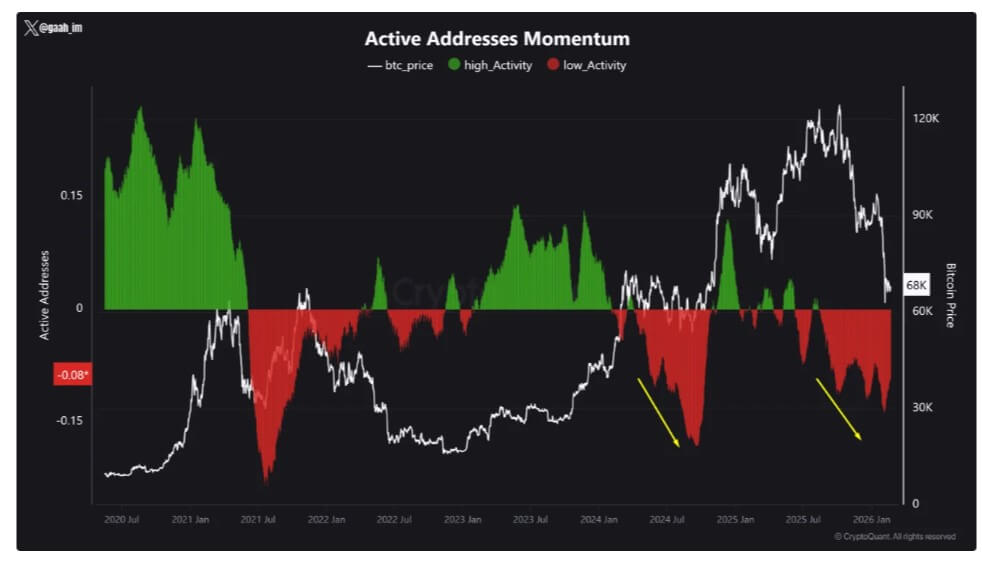
Bitcoin Active Addresses Momentum,Source: CryptoQuant
The last time the market showed a similar pattern was in 2024—Bitcoin subsequently experienced a correction of approximately 30%.
This does not mean it will necessarily repeat now, but it reinforces a historical pattern: prolonged network weakness often coincides with periods of weakening market confidence.
Breadth Declines, But Throughput Doesn't Collapse
Bitcoin's transaction count has not declined in sync with the number of active addresses.
In mid-August 2025, the average daily transaction count was approximately 444,000. Blockchain.com data shows the recent 30-day average is around 439,000.
Intraday data still fluctuates, ranging from about 289,000 to 702,000 transactions, but the overall throughput trend has not collapsed.
This divergence is key to understanding the current situation.
If transaction volume remains stable while active addresses decrease, it indicates that fewer entities are handling the same amount of on-chain activity.
This situation can have multiple causes, none of which require an influx of retail users. Exchanges and custodians can batch process withdrawals; large holders can consolidate transfers; institutional flows can be handled through fewer wallets; operational activities can also cause temporary spikes in transaction count without representing a true return of users.
The result is: the chain still looks busy, but the underlying number of participants is shrinking.
This is why the decline in breadth is more telling than raw throughput. A flat transaction count can mask a market where activity is increasingly concentrated among repeat traders, large institutions, and operational cash flows.
In this landscape, Bitcoin's chain is still functioning normally, but the breadth of user engagement it represents is becoming less genuine.
Blockchain analytics firm Santiment provides a more stark description from a longer time perspective.
The agency states that since February 2021, the number of unique addresses initiating Bitcoin transactions has decreased by 42%, and the number of new addresses created has decreased by 47%.
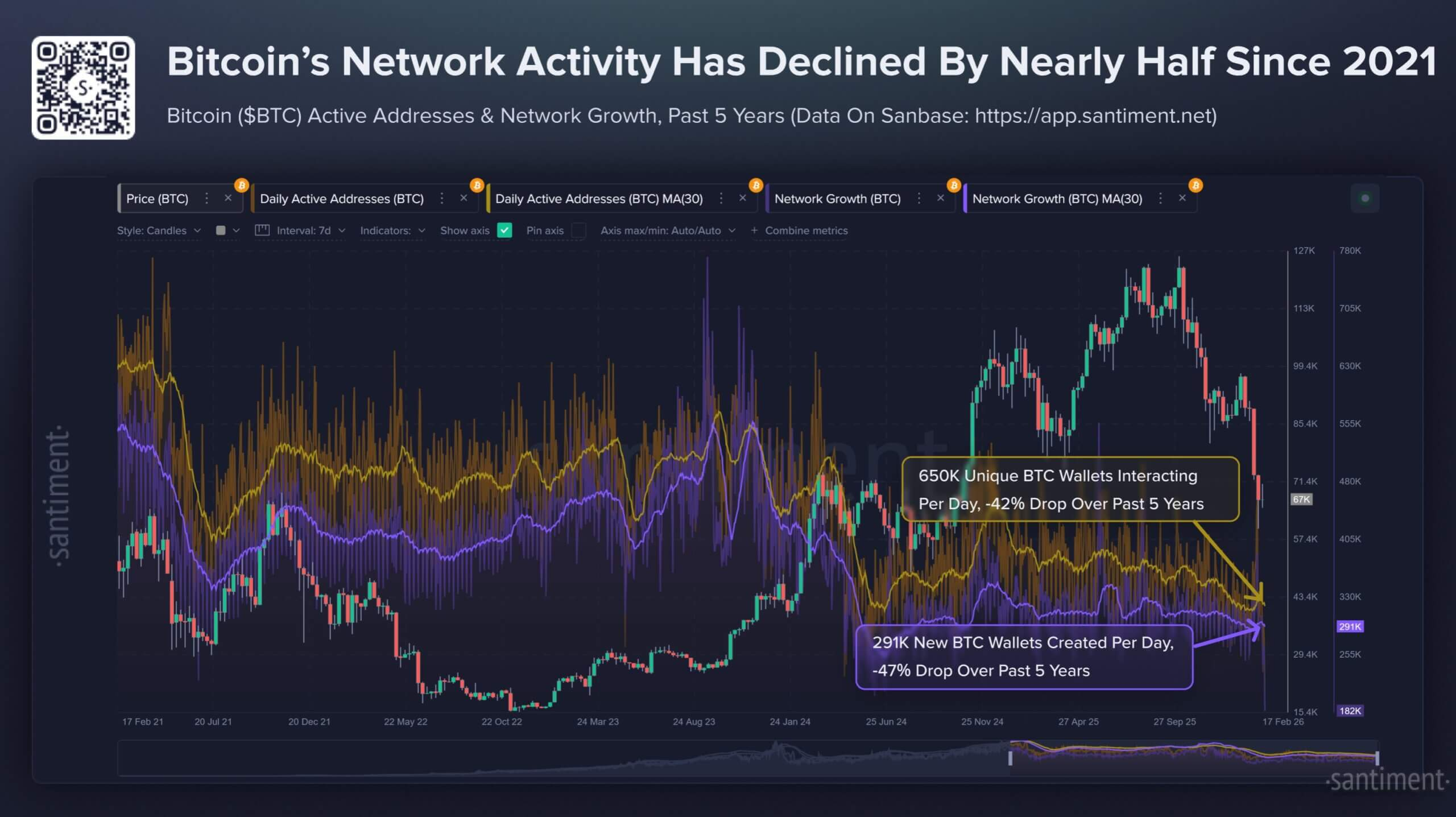
Santiment does not characterize this as evidence that crypto is dead or that a multi-year bear market is locked in, but it does describe a bearish divergence that has run through 2025—market capitalization is rising, while Bitcoin's utility metrics are weakening.
This tension is now reflected in the six-month trend. Price and market narrative can continue to hold, but the chain itself is getting quieter.
Low Fees Point to Shrinking Block Space Demand
Fee data further confirms that Bitcoin's Layer 1 is in a state of weak demand.
mempool.space data shows the network's recent average transaction fee is approximately $0.24, equivalent to about 1.8 sats/vB.
For a network that has seen sustained block space competition during past cycle peaks, this is a low level. Estimating based on the current transaction pace, this fee level implies the network's daily fee revenue is less than $100,000.
In comparison, the block subsidy is currently still approximately 450 BTC per day, with fee revenue accounting for a very small proportion.
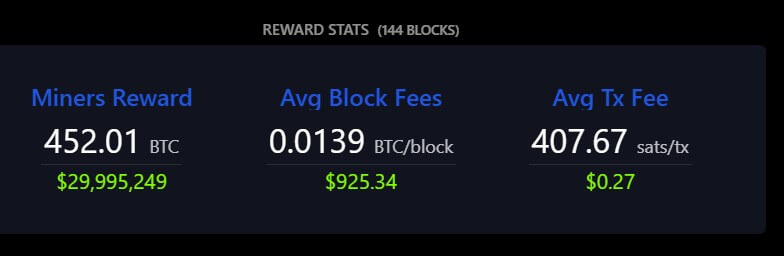
Bitcoin Average Block Fees、Source: Mempool.space
This is not an immediate security issue, nor does it mean Bitcoin's security model is under near-term pressure.
This is because the block subsidy still dominates miner revenue. But it does point to a long-term reality that Bitcoin has not yet been forced to confront at this stage of the cycle.
The topic of transitioning to a fee-supported security budget returns every cycle, but in the current environment, this transition is not being tested—because fee demand itself is weak.
Practically speaking, the quiet fee market is postponing this discussion further.
The chain is not facing sustained congestion pressure, and users are not fiercely bidding for block space. This can change quickly during volatility events, speculative waves, or new demand shocks, but it hasn't happened yet.
For now, block space is in a state of明显 low usage compared to past bull market phases, consistent with the broader background of declining participation breadth.
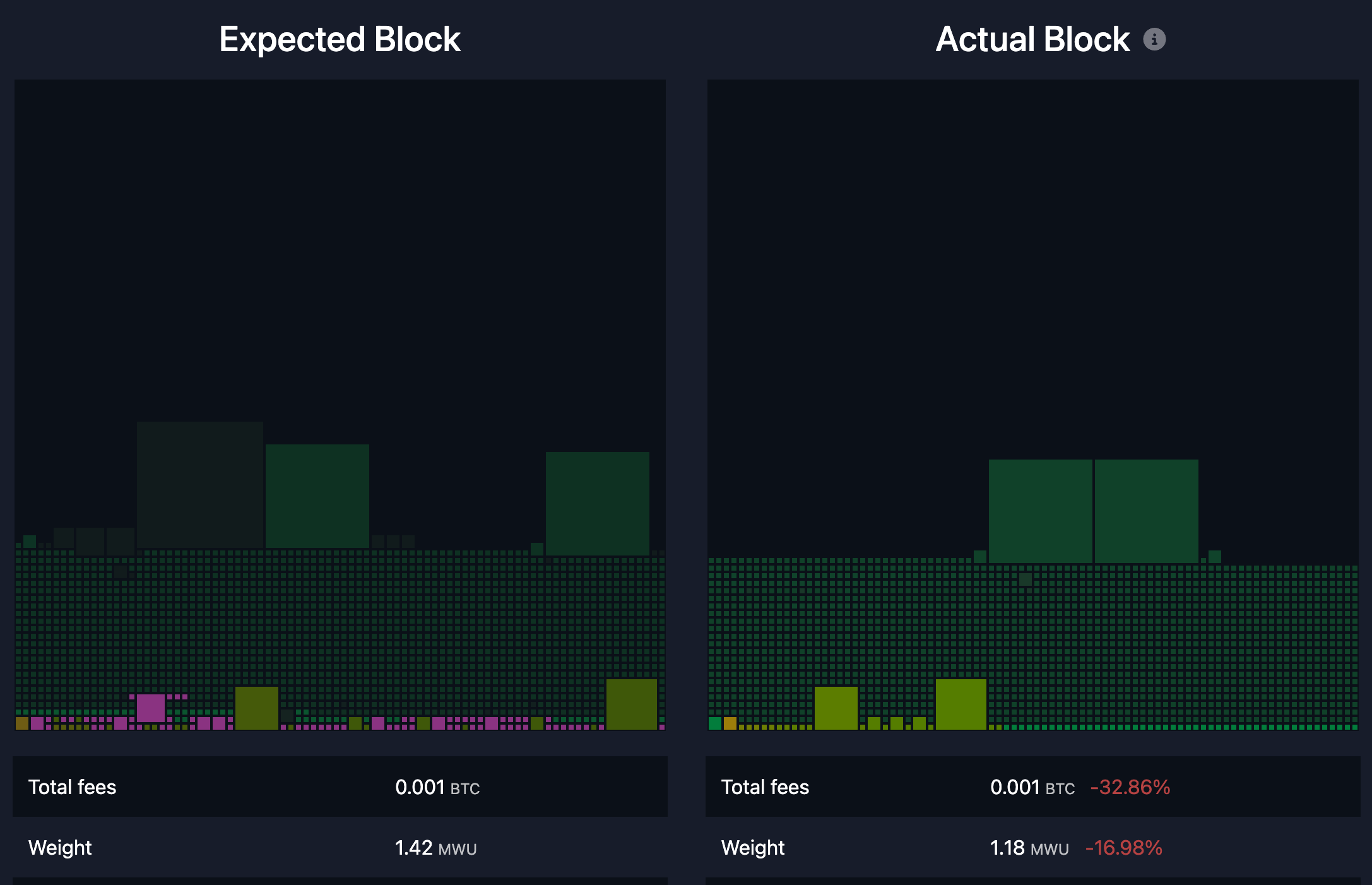
Bitcoin's Empty Mempool,Source: Mononaut
CryptoQuant's assessment also aligns with this fee environment—low network activity is typically associated with declining market interest in the asset and periods of普遍 losses.
When interest wanes, new participants decrease, self-initiated transfers减少, and fee pressure subsides.
Bitcoin can still be actively traded as a financial asset, but the chain itself no longer reflects broad user participation.
Macro Environment and ETF Flows Are Changing How Bitcoin Trades
The macro background helps explain why this trend persists.
Bitcoin is increasingly behaving like a macro-sensitive high-beta asset, especially prominent during risk-off periods.
Over the past year, US inflation has cooled, with the January 2026 CPI year-on-year growth rate at 2.4%; the Fed's target rate range was cited as 3.50% to 3.75% at the end of January.
In a simpler market environment, cooling inflation might support a clearer risk asset rally.
However, market attention is focused on multiple volatility catalysts—including uncertainty around tariff policies. This factor has driven剧烈波动 in interest rates and the US dollar, keeping overall risk appetite persistently shaky.
In such an environment, both retail and institutional investors tend to reduce their operational frequency. Retail participation declines, trader turnover decreases. Institutions can maintain exposure but prefer to adjust positions through products that don't require on-chain movement of coins.
This is precisely why spot Bitcoin ETFs have become the主角 of the key narrative.
Coinperps data shows that US Bitcoin ETFs have seen net outflows for multiple consecutive weeks, with cumulative outflows of approximately $3.8 billion over the past five weeks and about $4.5 billion year-to-date.
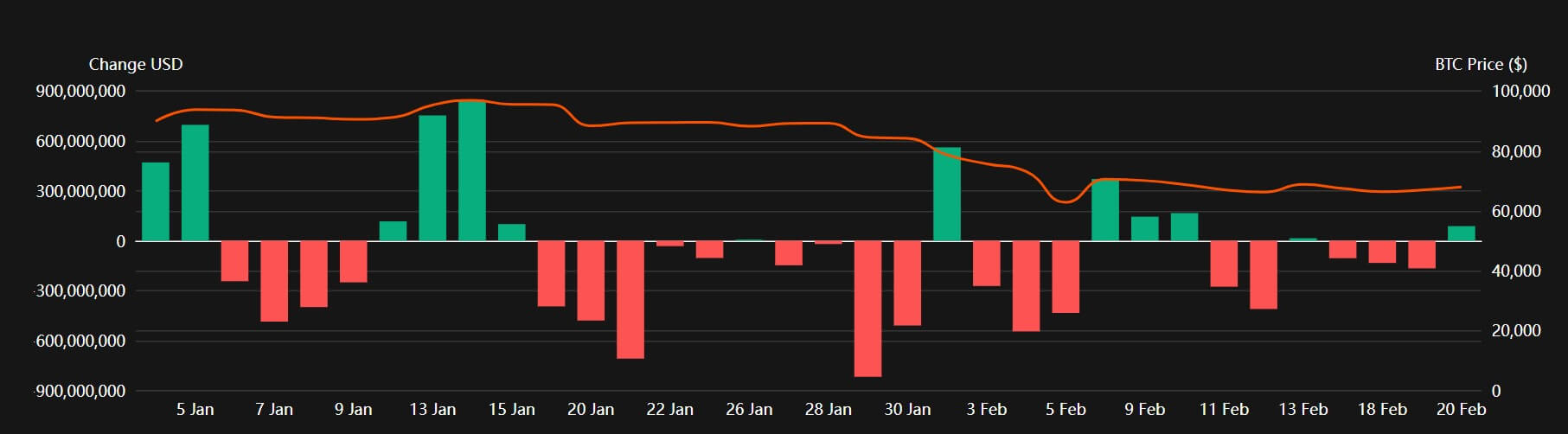
2026 US Bitcoin ETF Daily Fund Flows,Source: Coinperps
This shifts activity from self-custody wallets to brokerage accounts.
It also explains how the market can remain active while the chain gets quieter. Exposure is still changing hands, but more of the turnover is happening off-chain.
This is a significant shift in Bitcoin's role. It is increasingly resembling a financial product wrapped in an institutional shell, while Layer 1 is used more selectively for settlement, storage, and periodic transfers.
Meanwhile, the daily trading energy in the crypto space is increasingly concentrated elsewhere, particularly in stablecoins.
Coin Metrics lists stablecoins as a core driver of on-chain activity, with the total stablecoin supply nearing $300 billion and transaction volume持续攀升.
If stablecoin rails on other chains absorb more daily settlement demand, Bitcoin's Layer 1 naturally becomes more functionally singular.
This does not inherently weaken Bitcoin's investment thesis, but it does change its form.
Three Scenarios for the Next Three to Six Months
The current six-month decline in network breadth outlines three possible paths for Bitcoin's future trajectory.
The first is a continuation of apathy, which looks like the baseline scenario in a risk-averse market environment.
In this scenario, active addresses remain low (450,000 to 600,000 range), transaction counts remain volatile but don't collapse, fees stay low, and ETF flows remain flat or slightly negative.
Here, Bitcoin could still experience sharp volatility due to macro headlines, but on-chain participation does not confirm a broad recovery. The asset trades more like a macro tool than a network entering a new expansion phase.
The second is a liquidity thaw, the more optimistic path.
If inflation continues to cool and easing expectations stabilize risk appetite, ETF flows could shift from net outflows to sustained net inflows. In this environment, growth in active addresses would be a key confirmation signal.
A recovery to 650,000 to 800,000 active addresses would mean participation breadth is recovering, not just price momentum returning. This looks more like a classic cyclical recovery—price increases supported by growth in on-chain user participation.
The third is a structural substitution scenario, perhaps the one most worth watching.
In this scenario, Bitcoin's price rises, but on-chain breadth remains persistently weak. ETFs, derivatives, and custodial settlements continue to dominate, while stablecoins absorb more trading demand elsewhere in crypto.
Here, Bitcoin increasingly resembles a digital macro asset and settlement layer, rather than a chain with broad daily retail activity.
This scenario would mark an evolution in Bitcoin's role, reflecting the deep changes it has undergone compared to years past.
Twitter:https://twitter.com/BitpushNewsCN
Bitpush TG Discussion Group:https://t.me/BitPushCommunity
Bitpush TG Subscription: https://t.me/bitpush