Capital B $BTC Acquisition Strategies Strengthen The Case for $BTC Based Projects Like $HYPER

bitcoinistPublished on 2026-02-09Last updated on 2026-02-09

Abstract

The era of passive Bitcoin accumulation is ending as institutional investors, or "Capital B," seek capital efficiency and yield on Bitcoin holdings. With long-term holder supply at record highs, a utility gap has emerged: Bitcoin itself offers no native yield. This is driving a shift toward Bitcoin Layer 2 solutions that enable DeFi activity without sacrificing security. Bitcoin Hyper ($HYPER) is positioned to capitalize on this trend by integrating the Solana Virtual Machine (SVM) as a Bitcoin L2, enabling high-speed transactions and smart contracts while settling on Bitcoin’s base layer. Its architecture aims to solve Bitcoin’s scalability trilemma, allowing institutional players to use BTC as productive collateral. The project has raised over $31M in its presale, with significant whale activity indicating strong institutional interest. $HYPER’s tokenomics include staking rewards, aligning with the demand for yield-generating Bitcoin-based investments. This movement reflects a broader narrative shift from viewing Bitcoin as a store of value to using it as a network of value.

The era of passive Bitcoin accumulation is dying. In its place? A race for capital efficiency. Recent market movements indicate that Capital B, the heavy-hitting class of institutional allocators and corporate treasuries, is no longer satisfied with merely holding the asset.

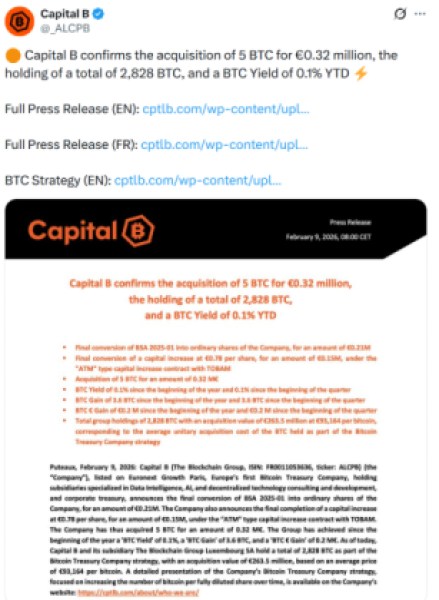
As giants like MicroStrategy and Semler Scientific vacuum up liquidity, a secondary supply shock is emerging, characterized not just by scarcity but by a desperate demand for yield on these dormant assets. This shift is exemplified by companies like Capital B (The Blockchain Group), which recently confirmed the acquisition of an additional 5 BTC for €0.32M, bringing its total holdings to 2,828 BTC while achieving a year-to-date BTC yield of 0.1%.
The numbers don’t lie. On-chain data indicates that long-term holder supply has reached historical highs, creating a squeeze that stabilizes the price floor. But there’s a catch. This massive influx of institutional capital exposes a glaring utility gap: native Bitcoin offers zero yield. Billions of dollars sit trapped in cold storage (essentially collecting dust), unable to touch decentralized finance (DeFi) without handing keys to centralized custodians.

That inefficiency is triggering the next major rotation in the crypto economy. We are witnessing a pivot from Layer 1 accumulation to Layer 2 utilization. Smart money is hunting for infrastructure that turns BTC from digital gold into productive collateral. This shift from ‘store of value’ to ‘network of value’ creates the perfect storm for Bitcoin Hyper ($HYPER), a protocol engineered to bridge the gap between Bitcoin’s security and high-speed execution.

SVM Integration Redefines Bitcoin Scalability

Historically, the bottleneck preventing institutional Bitcoin adoption in DeFi has been purely technical. The Bitcoin network’s scripting language is intentionally rigid for security, making complex smart contracts a nightmare to deploy. Bitcoin Hyper fixes this by integrating the Solana Virtual Machine (SVM) directly as a Layer 2 execution environment. It’s a radical architectural departure from older solutions like Stacks or Lightning, which rely on different consensus mechanisms or payment channels.
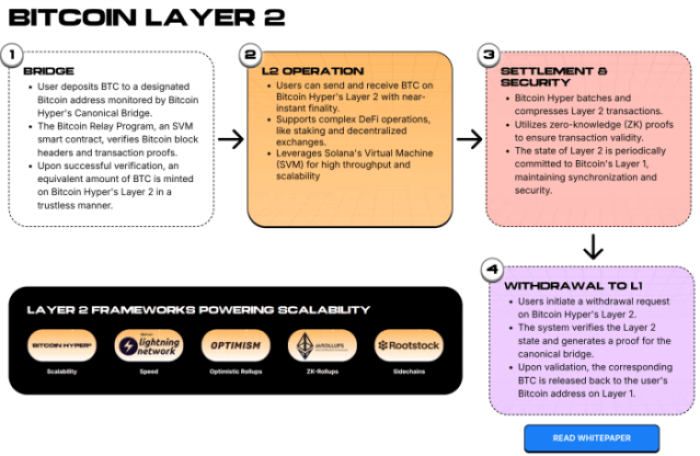
By leveraging the SVM, Bitcoin Hyper hits transaction speeds that rival traditional finance while anchoring final settlement on Bitcoin L1. Why does that matter? It allows developers to write in Rust, a language favored for safety and performance, and deploy dApps capable of handling the volume required by institutional treasuries.

Plus, the decentralized Canonical Bridge cuts down trust assumptions, letting assets move fluidly between the mainnet and the high-performance L2 without relying on risky centralized wrappers.

For a corporate treasurer, this architecture offers a compelling value prop: the ability to deploy Bitcoin holdings into yield-bearing DeFi protocols, high-speed payment rails, or lending markets without ever leaving the Bitcoin security umbrella. The project’s modular approach (separating settlement from execution) suggests they are finally cracking the “trilemma” of security, scalability, and decentralization that stalled earlier Bitcoin L2 attempts.

EXPLORE MORE OF BITCOIN HYPER ($HYPER)

Whale Accumulation Signals Confidence in The $31M Raise

While the technical architecture provides the thesis, the market data surrounding the Bitcoin Hyper presale suggests smart money is actively positioning for this L2 narrative. $HYPER has already raised over $31M, a figure that blows typical seed rounds out of the water. With tokens priced at $0.0136753, the valuation reflects a market that is pricing in substantial growth for Bitcoin-native infrastructure. But if you want in at that price, hurry, as an increase is coming today.

This capital inflow isn’t just retail speculation. On-chain analysis reveals significant wallet activity typical of high-net-worth syndicates. Etherscan records show significant whale buys, the largest being $500K. Conviction plays like this during a presale usually signal that sophisticated actors anticipate a liquidity rotation coming, moving from Ethereum L2s toward the nascent Bitcoin L2 ecosystem.

The tokenomics structure, which includes staking rewards immediately after the Token Generation Event (TGE), aligns perfectly with the broader theme of capital efficiency. Investors are evidently attracted to the dual utility of the asset: potential price appreciation from the L2 narrative plus yield generation. With the ‘Capital B’ cohort looking for productive ways to deploy BTC, protocols showing deep liquidity are poised to capture institutional mindshare.

GET YOUR $HYPER FROM THE OFFICIAL PRESALE SITE

This article is for informational purposes only and does not constitute financial advice. Cryptocurrency investments, particularly presales and Layer 2 protocols, carry inherent risks including volatility and technical uncertainty. Always conduct your own due diligence.


Related Questions

QWhat is the main shift in Bitcoin accumulation strategies mentioned in the article?

AThe main shift is from passive Bitcoin accumulation to a race for capital efficiency, where institutional allocators and corporate treasuries are no longer just holding the asset but seeking yield on dormant Bitcoin assets.

QHow does Bitcoin Hyper ($HYPER) address the technical bottleneck for Bitcoin in DeFi?

ABitcoin Hyper integrates the Solana Virtual Machine (SVM) as a Layer 2 execution environment, enabling high-speed transactions and complex smart contracts while anchoring final settlement on Bitcoin L1, thus bridging Bitcoin's security with high-speed execution.

QWhat does the $31M raise for Bitcoin Hyper indicate about market sentiment?

AThe $31M raise, significantly larger than typical seed rounds, indicates strong market confidence and smart money positioning for growth in Bitcoin-native infrastructure, with whale accumulation signaling anticipation of a liquidity rotation towards Bitcoin L2 ecosystems.

QWhy is there a 'utility gap' for institutional Bitcoin holdings according to the article?

AThe utility gap exists because native Bitcoin offers zero yield, forcing billions of dollars to sit idle in cold storage without access to decentralized finance (DeFi) unless keys are handed to centralized custodians, highlighting inefficiency in yield generation.

QWhat architectural feature of Bitcoin Hyper helps reduce trust assumptions for asset movement?

AThe decentralized Canonical Bridge in Bitcoin Hyper allows assets to move fluidly between Bitcoin mainnet and the high-performance L2 without relying on risky centralized wrappers, reducing trust assumptions.

Related Reads

Trading

Spot
Futures

Hot Articles

What is $BITCOIN

DIGITAL GOLD ($BITCOIN): A Comprehensive Analysis Introduction to DIGITAL GOLD ($BITCOIN) DIGITAL GOLD ($BITCOIN) is a blockchain-based project operating on the Solana network, which aims to combine the characteristics of traditional precious metals with the innovation of decentralized technologies. While it shares a name with Bitcoin, often referred to as “digital gold” due to its perception as a store of value, DIGITAL GOLD is a separate token designed to create a unique ecosystem within the Web3 landscape. Its goal is to position itself as a viable alternative digital asset, although specifics regarding its applications and functionalities are still developing. What is DIGITAL GOLD ($BITCOIN)? DIGITAL GOLD ($BITCOIN) is a cryptocurrency token explicitly designed for use on the Solana blockchain. In contrast to Bitcoin, which provides a widely recognized value storage role, this token appears to focus on broader applications and characteristics. Notable aspects include: Blockchain Infrastructure: The token is built on the Solana blockchain, known for its capacity to handle high-speed and low-cost transactions. Supply Dynamics: DIGITAL GOLD has a maximum supply capped at 100 quadrillion tokens (100P $BITCOIN), although details regarding its circulating supply are currently undisclosed. Utility: While precise functionalities are not explicitly outlined, there are indications that the token could be utilized for various applications, potentially involving decentralized applications (dApps) or asset tokenization strategies. Who is the Creator of DIGITAL GOLD ($BITCOIN)? At present, the identity of the creators and development team behind DIGITAL GOLD ($BITCOIN) remains unknown. This situation is typical among many innovative projects within the blockchain space, particularly those aligning with decentralized finance and meme coin phenomena. While such anonymity may foster a community-driven culture, it intensifies concerns about governance and accountability. Who are the Investors of DIGITAL GOLD ($BITCOIN)? The available information indicates that DIGITAL GOLD ($BITCOIN) does not have any known institutional backers or prominent venture capital investments. The project seems to operate on a peer-to-peer model focused on community support and adoption rather than traditional funding routes. Its activity and liquidity are primarily situated on decentralized exchanges (DEXs), such as PumpSwap, rather than established centralized trading platforms, further highlighting its grassroots approach. How DIGITAL GOLD ($BITCOIN) Works The operational mechanics of DIGITAL GOLD ($BITCOIN) can be elaborated on based on its blockchain design and network attributes: Consensus Mechanism: By leveraging Solana’s unique proof-of-history (PoH) combined with a proof-of-stake (PoS) model, the project ensures efficient transaction validation contributing to the network's high performance. Tokenomics: While specific deflationary mechanisms have not been extensively detailed, the vast maximum token supply implies that it may cater to microtransactions or niche use cases that are still to be defined. Interoperability: There exists the potential for integration with Solana’s broader ecosystem, including various decentralized finance (DeFi) platforms. However, the details regarding specific integrations remain unspecified. Timeline of Key Events Here is a timeline that highlights significant milestones concerning DIGITAL GOLD ($BITCOIN): 2023: The initial deployment of the token occurs on the Solana blockchain, marked by its contract address. 2024: DIGITAL GOLD gains visibility as it becomes available for trading on decentralized exchanges like PumpSwap, allowing users to trade it against SOL. 2025: The project witnesses sporadic trading activity and potential interest in community-led engagements, although no noteworthy partnerships or technical advancements have been documented as of yet. Critical Analysis Strengths Scalability: The underlying Solana infrastructure supports high transaction volumes, which could enhance the utility of $BITCOIN in various transaction scenarios. Accessibility: The potential low trading price per token could attract retail investors, facilitating wider participation due to fractional ownership opportunities. Risks Lack of Transparency: The absence of publicly known backers, developers, or an audit process may yield skepticism regarding the project's sustainability and trustworthiness. Market Volatility: The trading activity is heavily reliant on speculative behavior, which can result in significant price volatility and uncertainty for investors. Conclusion DIGITAL GOLD ($BITCOIN) emerges as an intriguing yet ambiguous project within the rapidly evolving Solana ecosystem. While it attempts to leverage the “digital gold” narrative, its departure from Bitcoin's established role as a store of value underscores the need for a clearer differentiation of its intended utility and governance structure. Future acceptance and adoption will likely depend on addressing the current opacity and defining its operational and economic strategies more explicitly. Note: This report encompasses synthesised information available as of October 2023, and developments may have transpired beyond the research period.

363 Total ViewsPublished 2025.05.13Updated 2025.05.13

What is $BITCOIN

Discussions

Welcome to the HTX Community. Here, you can stay informed about the latest platform developments and gain access to professional market insights. Users' opinions on the price of BTC (BTC) are presented below.

活动图片