Can Bitcoin Drop to $58,000? Veteran Trader Peter Brandt Warns of a 37% Correction

ccn.comPublished on 2026-01-20Last updated on 2026-01-20

Abstract

Veteran trader Peter Brandt warns Bitcoin could face a sharp correction, potentially falling 33–37% to the $58,000–$62,000 range. Bitcoin has already declined over 30% from its October 2025 all-time high above $126,000 and recently slipped below $91,000. Brandt cites bearish technical patterns, including a descending channel and failed breakouts below $102,000 resistance, as key reasons for his outlook. He notes that a break below current support near $80,000 could accelerate losses. While acknowledging his forecasts are wrong 50% of the time, Brandt argues such a decline would align with historical corrections during previous bull cycles. Not all analysts share this view, with some believing institutional adoption and ETF demand may lead to shallower pullbacks.

Key Takeaways

  • Veteran trader Peter Brandt warns Bitcoin could fall 33%–37% toward $58,000–$62,000.
  • Bearish chart patterns, including a descending channel and failed breakouts, point to downside risk.
  • Macro uncertainty and weakening sentiment could accelerate a correction if key resistance holds.

Bitcoin’s (BTC) recent slide has reignited fears of a deeper correction, and one of the market’s most respected chart watchers is sounding the alarm.

Peter Brandt, a veteran futures trader with more than four decades of experience, warned that Bitcoin could face another sharp leg lower, potentially falling as much as 37% from current levels.

His outlook comes as Bitcoin slipped below $91,000, extending a pullback that has already erased more than 30% from its October 2025 all-time high above $126,000.

Try Our Recommended Crypto Exchanges
Sponsored
Disclosure
We sometimes use affiliate links in our content, when clicking on those we might receive a commission at no extra cost to you. By using this website you agree to our terms and conditions and privacy policy.
"}' data-trk="67adf8d4f12aaec7e4808bf5" href="https://links.ccn.com/links?code=693291aa4a5bcb62319448b2" rel="nofollow" target="_blank">
Bitget<\/h3>"}' data-trk="67adf8d4f12aaec7e4808bf5" href="https://links.ccn.com/links?code=693291aa4a5bcb62319448b2" rel="nofollow" target="_blank">

Bitget

promotions
New user rewards up to 6,200 USDT.<\/strong>"}' data-trk="67adf8d4f12aaec7e4808bf5" href="https://links.ccn.com/links?code=693291aa4a5bcb62319448b2" rel="nofollow" target="_blank"> New user rewards up to 6,200 USDT.
Coins
88
Claim Offer
"}' data-trk="6899b9831836d97539c51aa6" href="https://links.ccn.com/links?code=693293fa4a5bcb6231949c97" rel="nofollow" target="_blank">
Bitunix<\/h3>"}' data-trk="6899b9831836d97539c51aa6" href="https://links.ccn.com/links?code=693293fa4a5bcb6231949c97" rel="nofollow" target="_blank">

Bitunix

promotions
Receive up to $100,000 worth of exclusive gifts for newcomers upon registration.<\/strong>"}' data-trk="6899b9831836d97539c51aa6" href="https://links.ccn.com/links?code=693293fa4a5bcb6231949c97" rel="nofollow" target="_blank"> Receive up to $100,000 worth of exclusive gifts for newcomers upon registration.
Coins
151
Claim Offer
"}' data-trk="68f8c175c334f42ea614a1a4" href="https://links.ccn.com/links?code=693294144a5bcb623194a054" rel="nofollow" target="_blank">
BTCC<\/h3>"}' data-trk="68f8c175c334f42ea614a1a4" href="https://links.ccn.com/links?code=693294144a5bcb623194a054" rel="nofollow" target="_blank">

BTCC

promotions
Get up to 10,055 USDT when you register, verify, and make the first deposit and the first trades.<\/strong>"}' data-trk="68f8c175c334f42ea614a1a4" href="https://links.ccn.com/links?code=693294144a5bcb623194a054" rel="nofollow" target="_blank"> Get up to 10,055 USDT when you register, verify, and make the first deposit and the first trades.
Coins
162
Claim Offer
Explore All Offers

Bitcoin Slips Below $91,000 as Brandt Flags Deeper Downside

Brandt said Bitcoin could ultimately revisit the $58,000 to $62,000 range if current technical pressures persist.

While acknowledging the uncertainty inherent in market forecasting, he made clear that the downside risk is real if buyers fail to regain control.

“$58,000 to $62,000 is where I think it is going BTC,” Brandt wrote . “If it does not go there, I will NOT be ashamed. I am wrong 50% of the time.”

That range implies a decline of roughly 33% to 37% from current prices, a magnitude Brandt argues would be consistent with historical corrections during prior Bitcoin bull cycles.

Bitcoin has struggled to sustain momentum since late 2025.

Despite a brief rebound earlier this month that pushed prices toward $97,000, BTC has largely remained capped below $95,000, suggesting waning buying pressure amid a volatile macro backdrop.

Bearish Patterns Dominate the Chart

Brandt’s warning centers on Bitcoin’s technical structure.

Since late 2025, BTC has traded within a descending channel, repeatedly failing to break above its upper boundary near $102,000.

Each rally attempt has stalled below that level, reinforcing the bearish setup.

The lower edge of the channel currently points toward support in the mid-$80,000 range.

Brandt cautions that a decisive break below that area could accelerate losses, opening the door to much deeper declines toward his $58,000–$62,000 target.
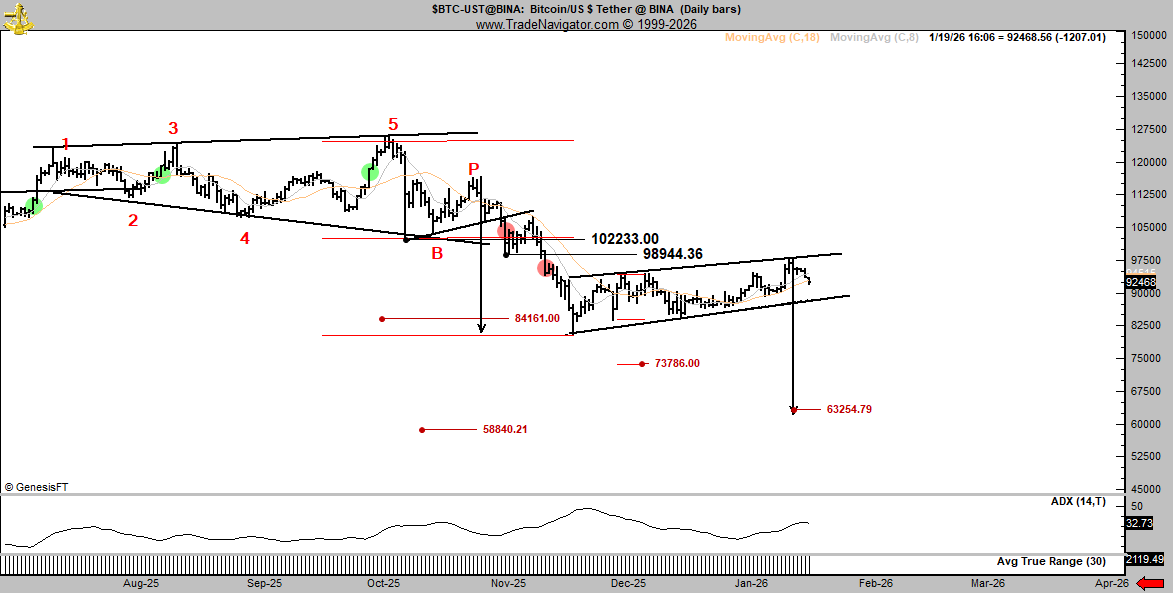
Peter Brandt warns BTC could fall below $60,000. Credit: Peter Brandt on X.

He also points to broader cycle dynamics.

According to Brandt, Bitcoin’s long-term advances have shown signs of “exponential decay,” with each successive bull run producing smaller percentage gains followed by sharp corrections.

He argues the current cycle has already violated its parabolic trend, a technical failure that historically precedes steep drawdowns.

A correction of this size would not be unprecedented.

During the 2015–2017 bull market, Bitcoin experienced multiple pullbacks averaging around 35%–37% before resuming its broader uptrend.

Not Everyone Sees a Crash Ahead

Brandt’s outlook is far from universally accepted.

Several prominent market participants continue to argue that Bitcoin’s structure has fundamentally changed, driven by institutional adoption, spot ETF demand, and broader integration into traditional finance.

Analysts such as Tom Lee and Cathie Wood have suggested that the classic four-year cycle may be breaking down, with longer expansions and shallower corrections becoming more common.

From that perspective, holding above key support levels and reclaiming resistance near $102,000 could invalidate the bearish patterns Brandt highlights.

Even Brandt himself frames his call as a risk scenario rather than a certainty. By his own admission, his forecasts are wrong as often as they are right.

For now, Bitcoin sits at a crossroads.

If sellers maintain control and macro pressures intensify, Brandt’s downside targets may come into play.

But a decisive shift in sentiment or a technical breakout could just as quickly rewrite the narrative.


Top Picks for Bitcoin
  • Best Exchanges for Bitcoin Get A Great Offer When You Join These Exchanges
  • Buy Bitcoin Fast & Easy How To Buy Bitcoin With a Credit Card Now
  • Best Online Casinos for Bitcoin See Our Picks for the Best Crypto Gambling Sites

Related Questions

QWhat is the potential downside target for Bitcoin according to veteran trader Peter Brandt?

APeter Brandt warns that Bitcoin could fall to the range of $58,000 to $62,000, which would represent a decline of roughly 33% to 37% from current levels.

QWhat technical patterns does Peter Brandt cite as reasons for his bearish outlook on Bitcoin?

ABrandt points to bearish chart patterns, including a descending channel and failed breakouts above the $102,000 resistance level, which suggest downside risk.

QHow much has Bitcoin already declined from its October 2025 all-time high?

ABitcoin has already erased more than 30% from its October 2025 all-time high above $126,000, slipping below $91,000.

QAccording to the article, what historical precedent is there for a correction of this magnitude?

ADuring the 2015-2017 bull market, Bitcoin experienced multiple pullbacks averaging around 35%-37% before resuming its broader uptrend, making a correction of this size not unprecedented.

QDoes Peter Brandt present his forecast as a certainty, and what is his stated accuracy rate?

ANo, Brandt does not present his forecast as a certainty. He explicitly states, 'I am wrong 50% of the time,' framing his call as a risk scenario rather than a guaranteed outcome.

Related Reads

Why Hasn't the U.S. Seen the Rise of 'Huabei' or 'Jiebei'?

The article explores why the U.S. lacks large-scale consumer credit products like China's "Huabei" and "Jiebei," despite having a developed financial sector. Key reasons include: 1. **Structural Barriers**: A fragmented federal and state regulatory system, reinforced by post-2008 reforms like the Dodd-Frank Act, raises compliance costs and protects traditional banks, stifling fintech innovation. 2. **Credit Card Dominance**: Credit cards, used by 70-80% of adults, form a $1.28 trillion debt market with high APRs (avg. 22.3%). This system cross-subsidizes users who pay in full with those carrying balances, creating a predatory yet entrenched ecosystem. 3. **Data Privacy Laws**: Strict regulations (e.g., FCRA, CCPA) prevent tech giants from leveraging behavioral data for credit scoring, unlike in China where such data fuels fintech models. 4. **Capital Market Disincentives**: Wall Street penalizes tech firms entering finance due to lower valuations associated with heavy regulation and risk, as seen in Apple’s failure with Apple Card. 5. **Banking Oligopoly**: Major banks control consumer lending, leveraging lobbying power and consumer habits to maintain high-cost credit, while alternatives like payday loans (400% APR) or "unbanked" services remain niche or exploitative. Ultimately, regulatory, structural, and corporate interests collectively block the emergence of accessible, low-cost digital lending in the U.S.

Odaily星球日报1h ago

Why Hasn't the U.S. Seen the Rise of 'Huabei' or 'Jiebei'?

Odaily星球日报1h ago

Trading

Spot
Futures

Hot Articles

What is $BITCOIN

DIGITAL GOLD ($BITCOIN): A Comprehensive Analysis Introduction to DIGITAL GOLD ($BITCOIN) DIGITAL GOLD ($BITCOIN) is a blockchain-based project operating on the Solana network, which aims to combine the characteristics of traditional precious metals with the innovation of decentralized technologies. While it shares a name with Bitcoin, often referred to as “digital gold” due to its perception as a store of value, DIGITAL GOLD is a separate token designed to create a unique ecosystem within the Web3 landscape. Its goal is to position itself as a viable alternative digital asset, although specifics regarding its applications and functionalities are still developing. What is DIGITAL GOLD ($BITCOIN)? DIGITAL GOLD ($BITCOIN) is a cryptocurrency token explicitly designed for use on the Solana blockchain. In contrast to Bitcoin, which provides a widely recognized value storage role, this token appears to focus on broader applications and characteristics. Notable aspects include: Blockchain Infrastructure: The token is built on the Solana blockchain, known for its capacity to handle high-speed and low-cost transactions. Supply Dynamics: DIGITAL GOLD has a maximum supply capped at 100 quadrillion tokens (100P $BITCOIN), although details regarding its circulating supply are currently undisclosed. Utility: While precise functionalities are not explicitly outlined, there are indications that the token could be utilized for various applications, potentially involving decentralized applications (dApps) or asset tokenization strategies. Who is the Creator of DIGITAL GOLD ($BITCOIN)? At present, the identity of the creators and development team behind DIGITAL GOLD ($BITCOIN) remains unknown. This situation is typical among many innovative projects within the blockchain space, particularly those aligning with decentralized finance and meme coin phenomena. While such anonymity may foster a community-driven culture, it intensifies concerns about governance and accountability. Who are the Investors of DIGITAL GOLD ($BITCOIN)? The available information indicates that DIGITAL GOLD ($BITCOIN) does not have any known institutional backers or prominent venture capital investments. The project seems to operate on a peer-to-peer model focused on community support and adoption rather than traditional funding routes. Its activity and liquidity are primarily situated on decentralized exchanges (DEXs), such as PumpSwap, rather than established centralized trading platforms, further highlighting its grassroots approach. How DIGITAL GOLD ($BITCOIN) Works The operational mechanics of DIGITAL GOLD ($BITCOIN) can be elaborated on based on its blockchain design and network attributes: Consensus Mechanism: By leveraging Solana’s unique proof-of-history (PoH) combined with a proof-of-stake (PoS) model, the project ensures efficient transaction validation contributing to the network's high performance. Tokenomics: While specific deflationary mechanisms have not been extensively detailed, the vast maximum token supply implies that it may cater to microtransactions or niche use cases that are still to be defined. Interoperability: There exists the potential for integration with Solana’s broader ecosystem, including various decentralized finance (DeFi) platforms. However, the details regarding specific integrations remain unspecified. Timeline of Key Events Here is a timeline that highlights significant milestones concerning DIGITAL GOLD ($BITCOIN): 2023: The initial deployment of the token occurs on the Solana blockchain, marked by its contract address. 2024: DIGITAL GOLD gains visibility as it becomes available for trading on decentralized exchanges like PumpSwap, allowing users to trade it against SOL. 2025: The project witnesses sporadic trading activity and potential interest in community-led engagements, although no noteworthy partnerships or technical advancements have been documented as of yet. Critical Analysis Strengths Scalability: The underlying Solana infrastructure supports high transaction volumes, which could enhance the utility of $BITCOIN in various transaction scenarios. Accessibility: The potential low trading price per token could attract retail investors, facilitating wider participation due to fractional ownership opportunities. Risks Lack of Transparency: The absence of publicly known backers, developers, or an audit process may yield skepticism regarding the project's sustainability and trustworthiness. Market Volatility: The trading activity is heavily reliant on speculative behavior, which can result in significant price volatility and uncertainty for investors. Conclusion DIGITAL GOLD ($BITCOIN) emerges as an intriguing yet ambiguous project within the rapidly evolving Solana ecosystem. While it attempts to leverage the “digital gold” narrative, its departure from Bitcoin's established role as a store of value underscores the need for a clearer differentiation of its intended utility and governance structure. Future acceptance and adoption will likely depend on addressing the current opacity and defining its operational and economic strategies more explicitly. Note: This report encompasses synthesised information available as of October 2023, and developments may have transpired beyond the research period.

363 Total ViewsPublished 2025.05.13Updated 2025.05.13

What is $BITCOIN

Discussions

Welcome to the HTX Community. Here, you can stay informed about the latest platform developments and gain access to professional market insights. Users' opinions on the price of BTC (BTC) are presented below.

活动图片