Bybit Regains Ground In 2025 After Historic Hack, CoinGecko Finds

bitcoinist2026-01-30 tarihinde yayınlandı2026-01-30 tarihinde güncellendi

Özet

Bybit made a significant recovery in 2025, handling $1.5 trillion in trades and capturing 8% market share despite a historic $1.5 billion hack in February. The exchange's decision to keep withdrawals open and cover user losses helped rebuild trust and maintain liquidity. CEO Ben Zhou's public reassurances and transparent communication were key to its comeback. Overall, trading volumes rose across major exchanges, with MEXC seeing 90% growth due to zero-fee promotions. Binance remained the largest exchange with $7.3 trillion in volume, despite a slight 0.5% decline.

Bybit’s return to heavy trading was one of the stranger comeback stories of last year. Reports say the exchange moved back toward the top of the leaderboard after a massive security breach, and traders kept coming. That did not happen by accident. Quick decisions and public reassurances played a big role.

Bybit Bounces Back

According to CoinGecko, Bybit handled $1.5 trillion in trades during 2025 and ended the year with about 8% of total market share.

That is a solid showing given what happened in February, when attackers made off with $1.5 billion worth of Ether after finding a hole in the exchange’s cold wallet setup.

The theft has been linked to North Korean actors by several sources, and it stands as one of the largest losses in crypto history.

Many firms that face breaches do not recover. Reports note nearly eight out of 10 projects hit by hacks never fully bounce back.

Bybit’s choice to keep withdrawals open and to honor user balances changed the math. That move reduced panic and kept liquidity flowing.
Market Movers And Volume Gains

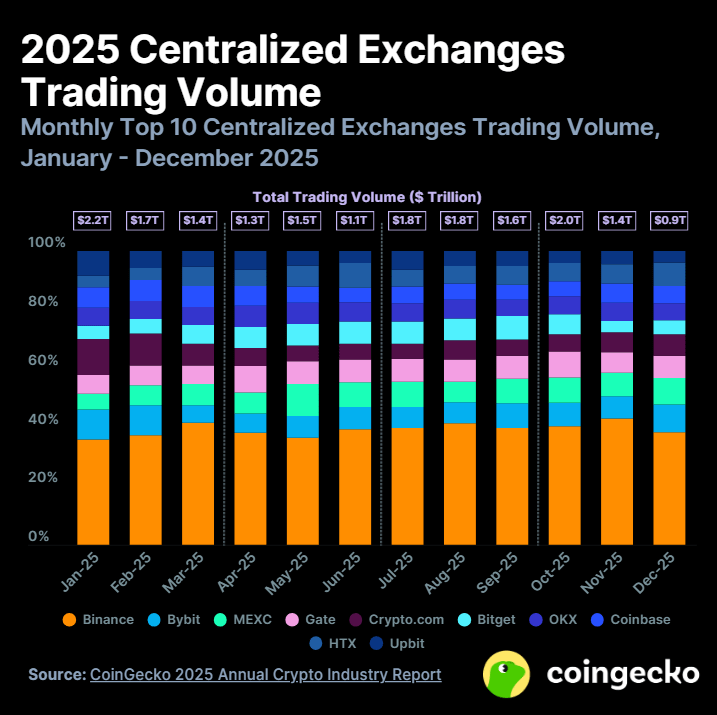
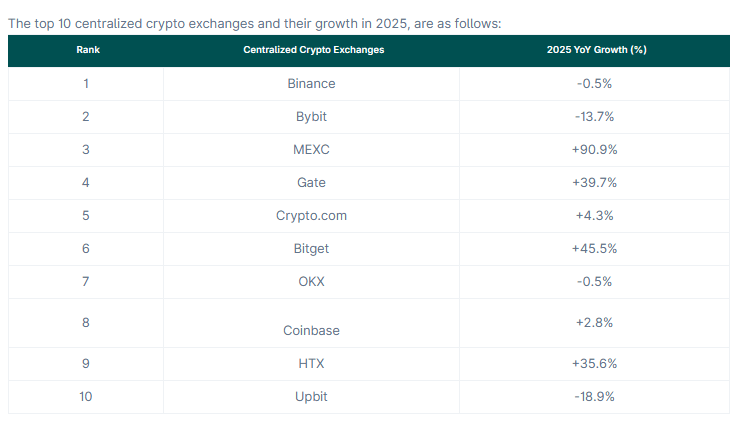
Trading volumes rose across multiple venues in 2025. CoinGecko’s research points out that six of the top 10 exchanges grew their yearly volume, and the total extra trades equaled about $1.3 trillion.

MEXC jumped sharply, reportedly rising 90% over the prior year, a gain blamed largely on aggressive zero-fee spot trading that pulled in high-frequency traders and new retail users.

Bullish price action for Bitcoin and several altcoins also pushed activity up; several coins reached fresh all-time highs during the year, which always sparks more trading and more headlines. For some platforms, promotions and fee policies had more immediate effect than brand reputation.

BTCUSD currently trading at $82,654. Chart: TradingView

How Bybit Handled The Crisis

The exchange’s leadership was visible. Ben Zhou, Bybit’s CEO, addressed customers on camera and promised the platform would cover losses and secure additional liquidity quickly.

Some of those promises were acted on behind the scenes, where external support was arranged to shore up funds.

Trust was not rebuilt overnight. It was rebuilt in small steps, transaction by transaction, and in public statements that reassured users their capital was safe.

The combination of keeping services running and having clear communication changed investor behavior.
Source: Coingecko

Binance And Rival Trends

Binance stayed the largest by a wide margin, with CoinGecko estimating about $7.3 trillion in annual volume. That massive figure hides a small drop from the prior year — a 0.5% decline — which analysts tied to a major liquidation event on October 10 that rattled markets.

Still, Binance’s user base was said to be over 300 million, and its ecosystem handles a vast range of products beyond spot trading.

Featured image from Pexels, chart from TradingView

Trend Kriptolar

İlgili Sorular

QWhat was the total trading volume handled by Bybit in 2025, according to CoinGecko?

ABybit handled $1.5 trillion in trades during 2025.

QWhat key action did Bybit take to reduce panic and maintain liquidity after the hack?

ABybit chose to keep withdrawals open and honor user balances, which reduced panic and kept liquidity flowing.

QWhich exchange saw a 90% increase in yearly volume, and what was the primary reason for this growth?

AMEXC jumped 90% over the prior year, a gain largely attributed to its aggressive zero-fee spot trading that attracted high-frequency traders and new retail users.

QHow did Bybit's CEO, Ben Zhou, respond to the security breach crisis?

ABen Zhou addressed customers on camera, promising that the platform would cover losses and secure additional liquidity quickly.

QWhat was Binance's estimated annual trading volume in 2025, and what minor change did it experience from the prior year?

ACoinGecko estimated Binance's annual volume at about $7.3 trillion, which represented a small 0.5% decline from the prior year.

İlgili Okumalar

My Coding Betting Dashboard is Profiting, but Polymarket is Truly Not a Good Place for 'Arbitrage'

The author built a custom monitoring dashboard for Polymarket, a prediction market platform, and tested it with $1,600, achieving over 30% returns. However, the core argument is that Polymarket is not a good venue for traditional arbitrage. The dashboard has two main sections: a "Portfolio Dashboard" for tracking active positions with key metrics like total capital, P&L, and a risk-control module using a tier system (T1, T2, T3), and an "Opportunity Watchlist" for monitoring markets. The article details a critical structural trap in binary markets: a bet with a high perceived probability of success still carries a 100% loss risk if wrong. The author's T1/T2/T3 system is designed to manage this by limiting position sizes based on conviction and time horizon, emphasizing that high confidence should not equal high concentration. A key insight is the danger of "pseudo-diversification"—betting on different markets driven by the same underlying variable. The author concludes that Polymarket offers few true low-risk, arbitrage opportunities. It is instead a high-risk environment where wins can create a false sense of mastery, leading to large losses. The platform is better viewed as a training ground for honing judgment through disciplined, framework-driven betting rather than a reliable income source. The tools help transform intuition into structured, rule-based decisions to mitigate the risk of catastrophic errors.

marsbit2 saat önce

My Coding Betting Dashboard is Profiting, but Polymarket is Truly Not a Good Place for 'Arbitrage'

marsbit2 saat önce

WeChat AI Card Hands-On Guide: Has the AI Shopping Era Arrived?

**"WeChat AI Card" Practical Test Guide: Has the Era of AI Shopping Arrived?** WeChat has officially launched the "AI Exclusive Card," a feature integrated into its Workbuddy AI assistant. This card is designed to handle payments for AI-initiated purchases. Our hands-on test reveals it's not yet a tool for fully autonomous AI shopping, but rather a controlled payment layer for AI agents. The AI Card functions as an isolated sub-wallet within WeChat Pay. Users must bind the card and transfer funds into it from their main wallet. Crucially, every transaction requires explicit user confirmation via smartphone scan; AI cannot spend autonomously. Currently accessible through the Workbuddy agent, the card targets specific digital consumption scenarios: purchasing paid content (reports, data), calling paid APIs/tools, and subscribing to services. Its design prioritizes security and control by separating funds and mandating approval for each payment. We tested a real-world scenario: ordering bubble tea via Workbuddy using a "Meituan Life Assistant" skill. The process encountered multiple hurdles: high "skill" usage costs (exceeding daily free credits), and most importantly, while a payment was successfully initiated, the AI purchased an incorrect product (a mismatched group-buy coupon instead of the desired drink). This highlights the current limitation: the **AI Card only solves the payment step**. The broader challenge lies in the **AI agent's execution chain**—accurately understanding intent, navigating third-party platforms, selecting the right product, and ensuring proper fulfillment. The payment succeeded, but the purchase failed to meet the user's need. In conclusion, the WeChat AI Exclusive Card is a cautious, early-step experiment in AI commerce. It provides a secure, user-controlled payment method for agent interactions but is not yet capable of reliable, end-to-end complex purchases. For now, it's best used for low-value, low-risk digital services with careful user verification at each step. The vision of AI handling complete shopping tasks remains a work in progress.

marsbit4 saat önce

WeChat AI Card Hands-On Guide: Has the AI Shopping Era Arrived?

marsbit4 saat önce

Deconstructing Notion's Growth: From a Note-taking Tool to 100 Million Users—How Notion Built a Triple Growth Flywheel Through Product, Templates, and Community

Notion's growth from a niche note-taking tool to a platform with 100 million users is powered by three interconnected flywheels: Product-Led Growth (PLG), a Template Economy, and Community-Driven Growth. First, Notion's PLG strategy relies on a highly flexible, "plastic" product that users can adapt to countless personal and team workflows. Its freemium model lowers the barrier to entry, while features like page sharing and collaboration drive organic, usage-based viral growth as users naturally invite others. Second, the Template Economy solves the "blank page" problem. Templates, created by both Notion and its community, transform abstract product capabilities into concrete, copyable solutions for specific scenarios (e.g., project management, content calendars). This dramatically lowers activation costs for new users and fuels SEO-driven discovery. Third, a vibrant Community acts as a distributed growth engine. Users and official Ambassadors create tutorials, share use cases, and host local events. This community not only educates users but also fosters a sense of identity around pursuing "better ways of working," strengthening loyalty and enabling global, low-cost expansion. Together, these flywheels create a self-reinforcing ecosystem: a great product attracts users who create templates and community content, which in turn attracts more users and deepens engagement. This system allowed Notion to scale from individuals to teams and enterprises through a bottom-up adoption path. Looking ahead, AI integration promises to accelerate these flywheels further by making templates smarter and the platform a potential AI-native work operating system. Ultimately, Notion's defensible advantage is not just its features, but this deeply entrenched network of user assets, creators, and community trust.

marsbit4 saat önce

Deconstructing Notion's Growth: From a Note-taking Tool to 100 Million Users—How Notion Built a Triple Growth Flywheel Through Product, Templates, and Community

marsbit4 saat önce

$10 Billion, Qualcomm to Acquire Chip Legend Jim Keller's Company

Global mobile chip giant Qualcomm is in advanced talks to acquire AI chip startup Tenstorrent in a deal valued between $8-10 billion, according to media reports. This potential acquisition would be one of the largest in the AI chip sector in recent years. Tenstorrent, led by legendary chip architect Jim Keller, has gained prominence for its RISC-V architecture and AI accelerator designs. The move highlights Qualcomm's strategic push to diversify beyond its core smartphone chip business. As the smartphone market matures, Qualcomm is aggressively targeting growth in automotive, data center, and cloud AI. Acquiring Tenstorrent would allow Qualcomm to rapidly enter the high-end AI computing market, bypassing lengthy in-house development cycles. Tenstorrent's cost-effective system architecture, which avoids expensive HBM memory and relies on standard Ethernet for clustering, offers a potential alternative to Nvidia's costly solutions. Furthermore, Tenstorrent's high-performance RISC-V CPU technology and its focus on the automotive and edge computing segments align with Qualcomm's strategic goals, including its "Snapdragon Digital Chassis" platform. Despite the strategic rationale, the high valuation has sparked some investor caution. The successful integration of Tenstorrent's open-source culture and independent team into Qualcomm's organization, along with the commercialization of its technology, remains a key challenge.

marsbit5 saat önce

$10 Billion, Qualcomm to Acquire Chip Legend Jim Keller's Company

marsbit5 saat önce

İşlemler

Spot
Futures

Popüler Makaleler

ONE Nasıl Satın Alınır

HTX.com’a hoş geldiniz! Harmony (ONE) satın alma işlemlerini basit ve kullanışlı bir hâle getirdik. Adım adım açıkladığımız rehberimizi takip ederek kripto yolculuğunuza başlayın. 1. Adım: HTX Hesabınızı OluşturunHTX'te ücretsiz bir hesap açmak için e-posta adresinizi veya telefon numaranızı kullanın. Sorunsuzca kaydolun ve tüm özelliklerin kilidini açın. Hesabımı Aç2. Adım: Kripto Satın Al Bölümüne Gidin ve Ödeme Yönteminizi SeçinKredi/Banka Kartı: Visa veya Mastercard'ınızı kullanarak anında Harmony (ONE) satın alın.Bakiye: Sorunsuz bir şekilde işlem yapmak için HTX hesap bakiyenizdeki fonları kullanın.Üçüncü Taraflar: Kullanımı kolaylaştırmak için Google Pay ve Apple Pay gibi popüler ödeme yöntemlerini ekledik.P2P: HTX'teki diğer kullanıcılarla doğrudan işlem yapın.Borsa Dışı (OTC): Yatırımcılar için kişiye özel hizmetler ve rekabetçi döviz kurları sunuyoruz.3. Adım: Harmony (ONE) Varlıklarınızı SaklayınHarmony (ONE) satın aldıktan sonra HTX hesabınızda saklayın. Alternatif olarak, blok zinciri transferi yoluyla başka bir yere gönderebilir veya diğer kripto para birimlerini takas etmek için kullanabilirsiniz.4. Adım: Harmony (ONE) Varlıklarınızla İşlem YapınHTX'in spot piyasasında Harmony (ONE) ile kolayca işlemler yapın.Hesabınıza erişin, işlem çiftinizi seçin, işlemlerinizi gerçekleştirin ve gerçek zamanlı olarak izleyin. Hem yeni başlayanlar hem de deneyimli yatırımcılar için kullanıcı dostu bir deneyim sunuyoruz.

385 Toplam GörüntülenmeYayınlanma 2024.12.12Güncellenme 2026.06.02

ONE Nasıl Satın Alınır

Tartışmalar

HTX Topluluğuna hoş geldiniz. Burada, en son platform gelişmeleri hakkında bilgi sahibi olabilir ve profesyonel piyasa görüşlerine erişebilirsiniz. Kullanıcıların ONE (ONE) fiyatı hakkındaki görüşleri aşağıda sunulmaktadır.

活动图片