‘Buy silver’: Schiff – How crypto community reacts to ‘biggest BTC hater’

ambcryptoPublished on 2026-03-22Last updated on 2026-03-22

Abstract

Amid Bitcoin's struggle to reclaim $70,000, prominent Bitcoin critic Peter Schiff urged investors to shift focus to silver, claiming it's entering a major bullish phase due to rising demand and tightening supply by 2026. He argued Bitcoin may be weaker than perceived while silver could outperform. The crypto community swiftly countered, highlighting that both assets have seen similar recent drawdowns from their peaks. Critics also noted the metals market lost over $1 trillion in 60 days, far exceeding crypto losses, with silver dropping 7%. Data showed Bitcoin clearly outperforming silver recently, with the BTC/XAG ratio rising over 25% in a month. Despite his criticism, Schiff's own launch of a tokenized gold product acknowledges blockchain's utility, though he maintains gold is the true store of value. The backlash underscores the deep divide between traditional asset and crypto proponents.

While the crypto market is busy watching Bitcoin struggling to get back above $70,000, long-time Bitcoin critic Peter Schiff is talking about silver.

In his recent X post, Schiff urges investors to stop focusing only on Bitcoin and pay attention to what’s happening in the silver market.

According to him, this isn’t just his usual criticism of crypto. He believes silver is entering a major phase because demand is rising while supply is tight in 2026.

In this environment, he argues that assets like Bitcoin may not be as strong as people think, while silver could benefit more.

Schiff said,

I’ve been telling people to buy silver since it was under $5. Eventually $120 buys will be ahead too.

Crypto community slams Schiff

However, the crypto community quickly pushed back, with one X user noting that Bitcoin [BTC] is down 45% from its peak, almost identical to silver’s 44% decline from its own highs.

The user argued,

Why is your scarce asset down as much as something that you constantly say has no value? Isn’t that odd to you? Especially since silver’s decline happened faster?

Additionally, other critics are pointing out that the metals market has lost around $1.1 trillion in just the last 60 days, much more than what crypto has seen recently.

Gold has fallen about 2%, wiping out $750 billion in value, while silver dropped 7%, losing another $370 billion.

As a Bitcoin supporter, this was a strong counterpoint as the user argues that even traditional assets like gold and silver are not as stable as many believe.

THE CRASH HAS STARTED. This is what I was calling. A total wipeout. However, I expect an uplift in bitcoin......

Some even directed hate comments toward Schiff, as highlighted by an X user who said,

Silver has been dead for DECADES. It’s one of those assets that spikes hard then collapses, multiple times this has happened.

The above user further added,

I’m not saying don’t buy silver but this guy is the biggest f**king bitcoin hater in existence.

Bitcoin vs Silver

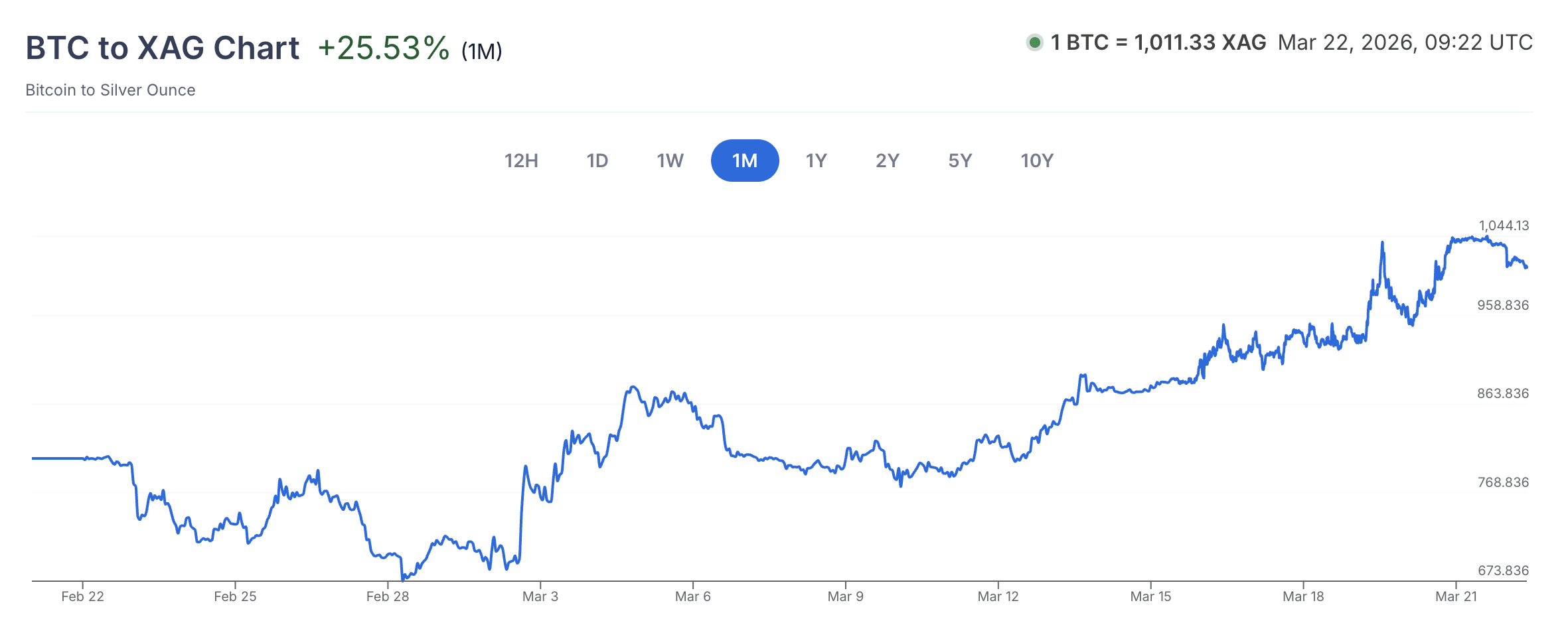
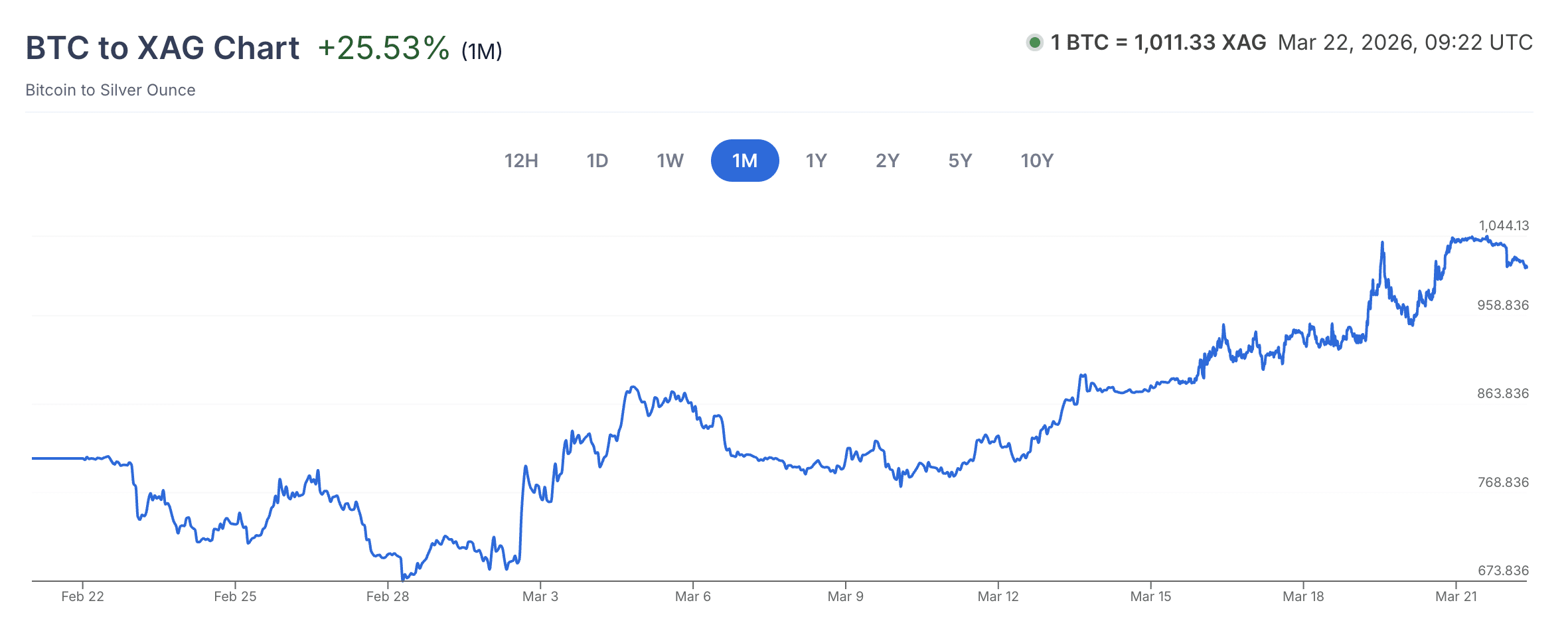
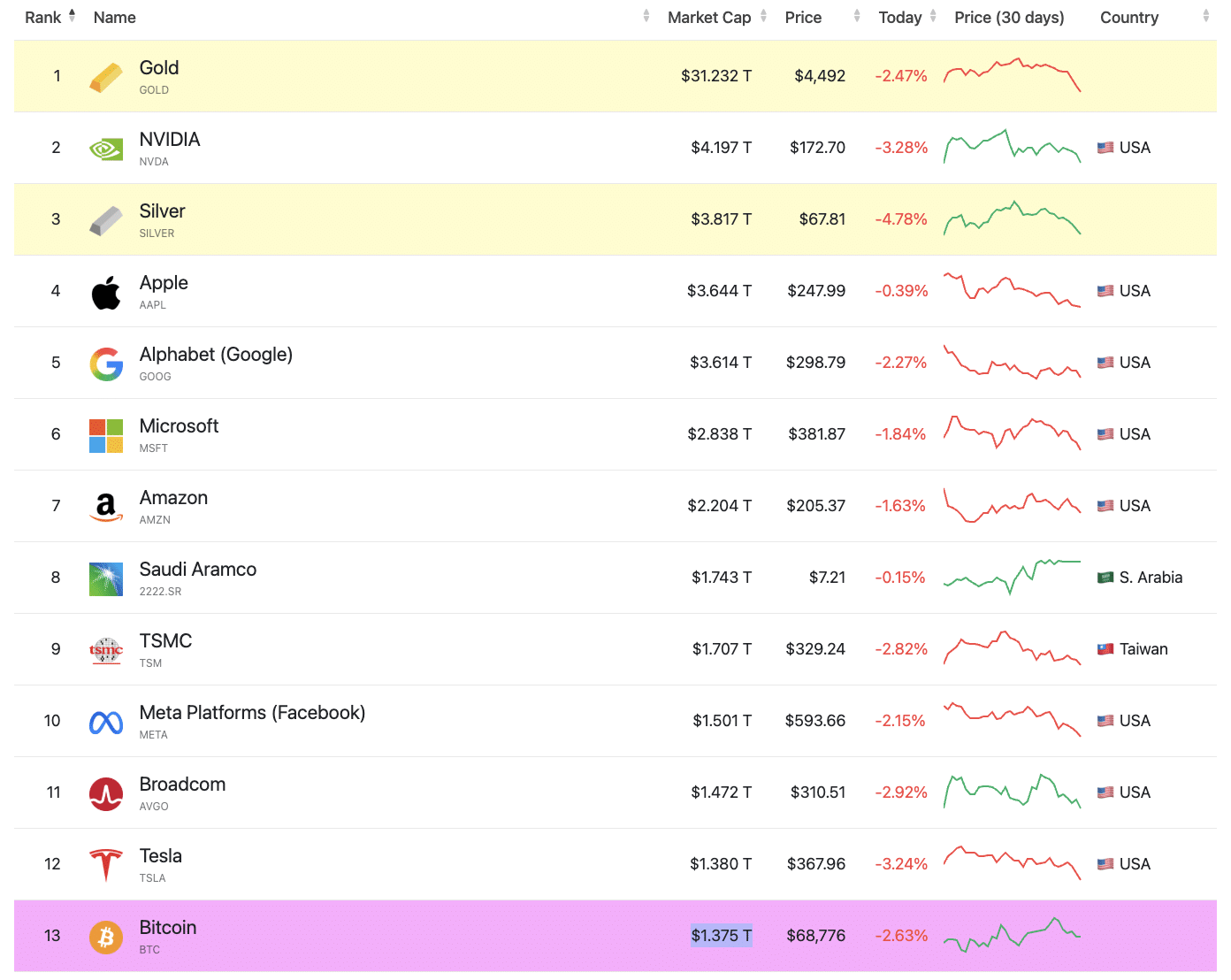
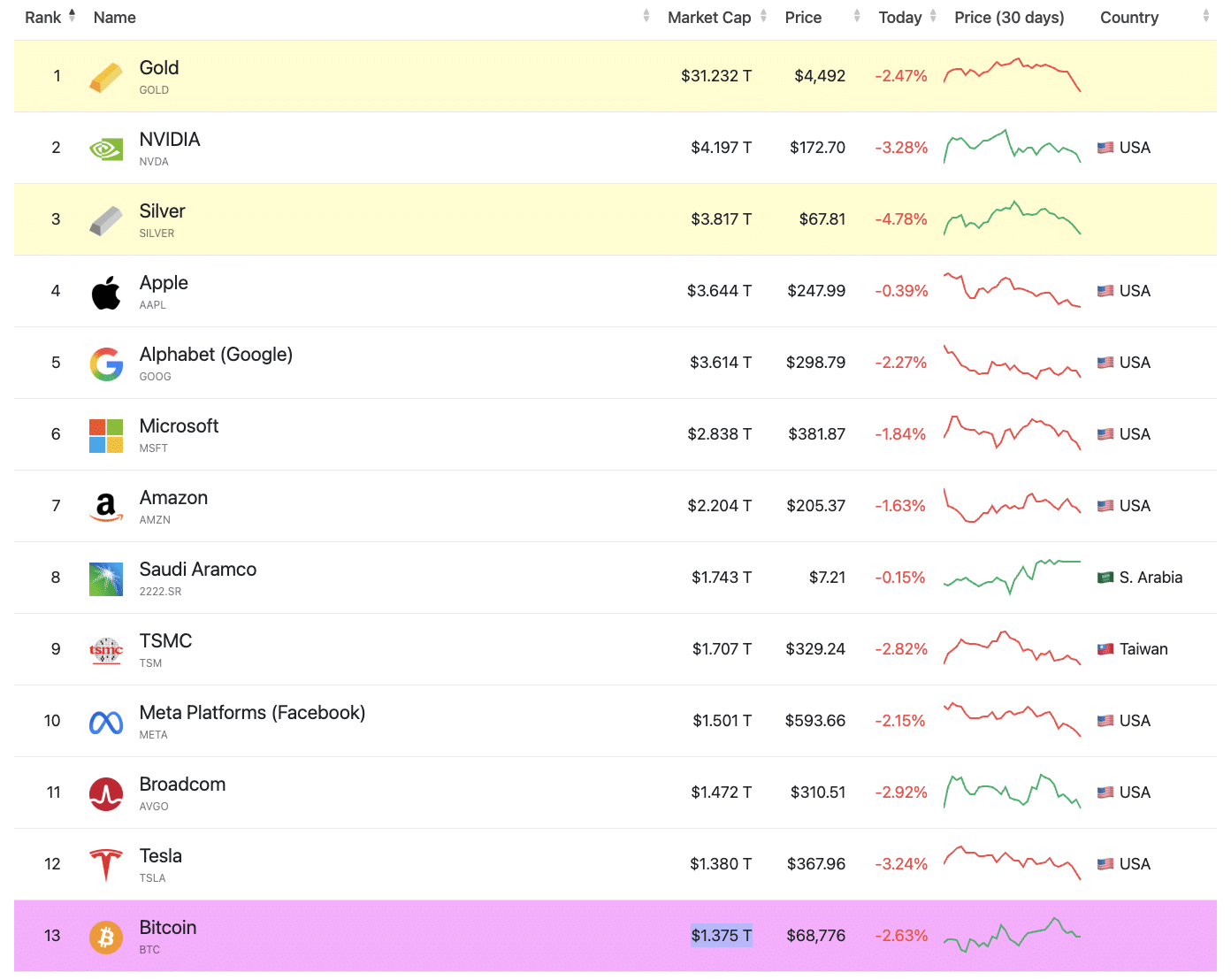
Well, the gap between Bitcoin and silver becomes even clearer when you look at the Bitcoin-to-Silver (BTC/XAG) ratio. At press time, while Bitcoin dipped slightly by 2.7% to around $68,800, silver fell much harder, down 4.5% to about $68.

In fact, over the past month, Bitcoin has clearly outperformed silver, with the ratio rising over 25%. Simply put, one Bitcoin can now buy more than 1,000 ounces of silver, compared to around 700–800 ounces just a few weeks ago.
Source: Xe

Even though silver is still the 3rd the largest asset globally by market value, its recent performance looks weak next to Bitcoin.
Source: CompaniesMarketCap

Additionally, even during periods of war, Bitcoin has shown resilience, holding up better than many traditional assets.
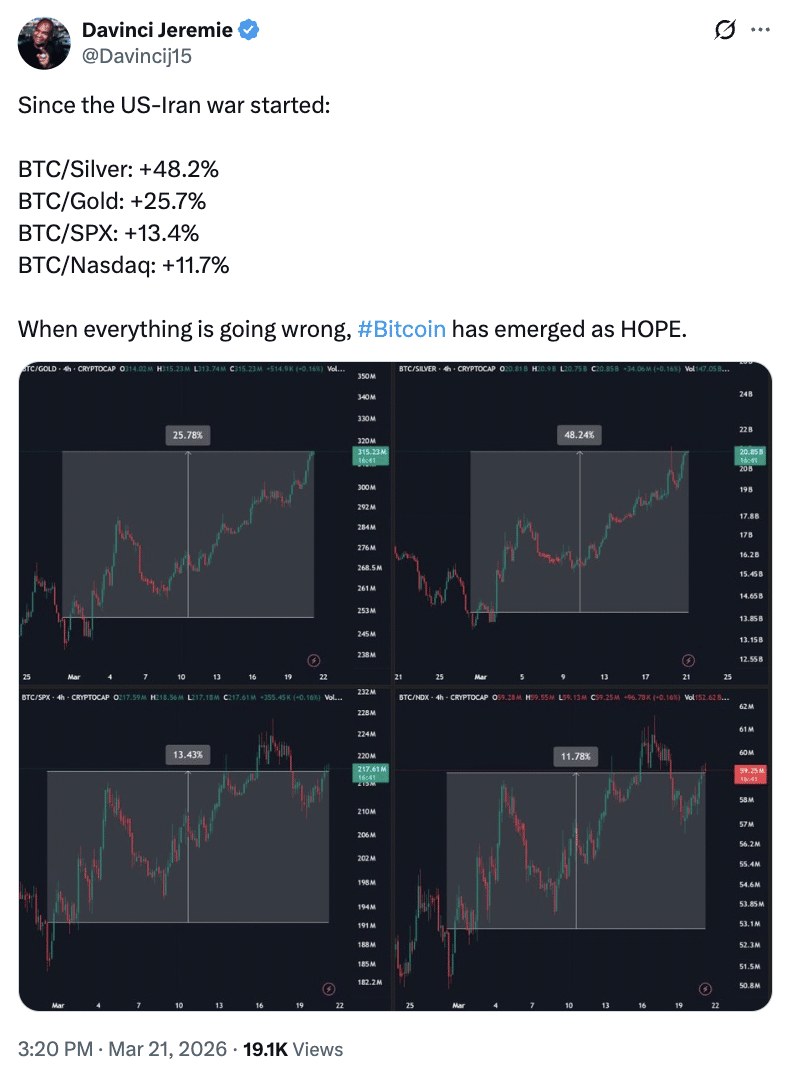
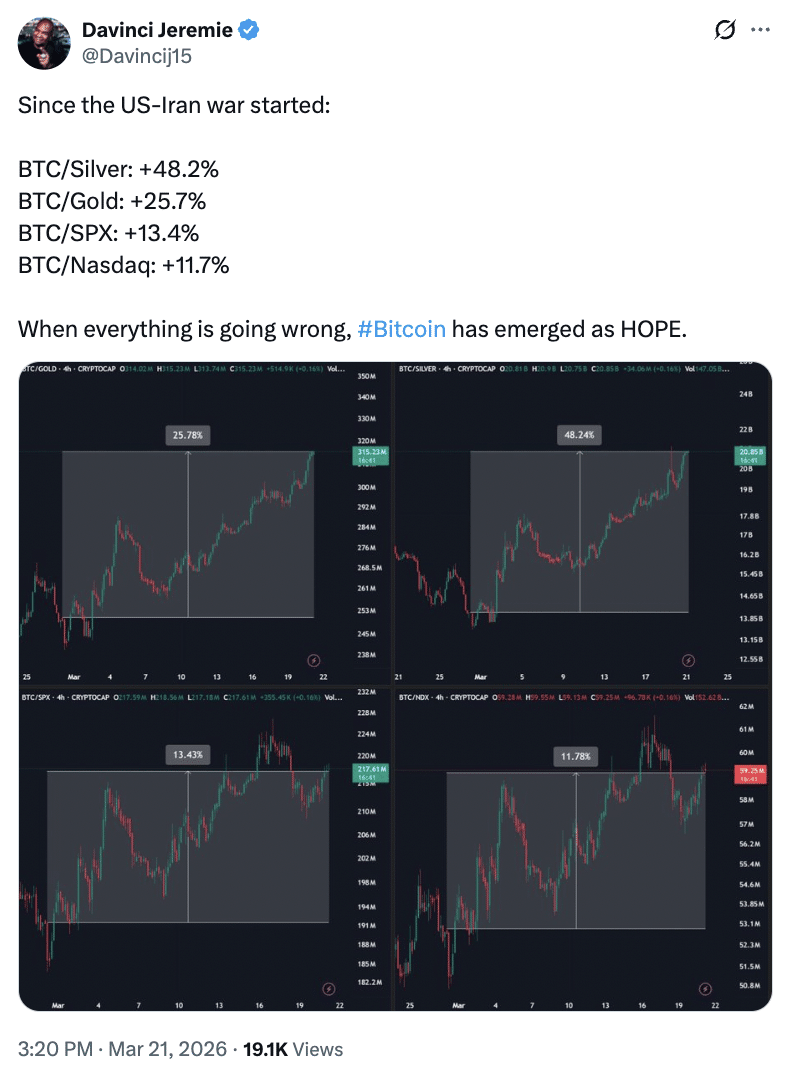
Source: X

This trend suggests that many investors are starting to see Bitcoin not just as a risky bet, but as a stronger option during uncertain market conditions.

Schiff’s confusing remarks

Interestingly, even though Schiff has always criticized Bitcoin, he recently thought of using blockchain to support gold.

During his debate with Binance founder CZ in December, he introduced a tokenized gold product (T-Gold). This shows that while he may not trust Bitcoin as an asset, he does believe in the technology behind it.

All in all, Schiff still believes gold is the real value, with blockchain just helping it.


Final Summary

  • The crypto community’s strong backlash highlights how divided sentiment remains between traditional assets and Bitcoin.
  • Silver’s sharper decline compared to Bitcoin raises questions about its resilience under pressure.


Related Questions

QWhat is Peter Schiff's main argument for investing in silver instead of Bitcoin?

APeter Schiff argues that silver is entering a major phase due to rising demand and tight supply in 2026, and that it could benefit more than assets like Bitcoin, which he believes may not be as strong as people think.

QHow did the crypto community counter Peter Schiff's claims about silver?

AThe crypto community pushed back by pointing out that Bitcoin's decline from its peak was similar to silver's, that the metals market lost over $1 trillion recently, and that silver has a history of spiking and collapsing, arguing that traditional assets are not as stable as believed.

QWhat does the Bitcoin-to-Silver (BTC/XAG) ratio demonstrate about their recent performance?

AThe BTC/XAG ratio shows that Bitcoin has significantly outperformed silver recently, with the ratio rising over 25% in a month. One Bitcoin can now buy more than 1,000 ounces of silver, compared to 700-800 ounces just weeks ago.

QWhat contradictory action did Peter Schiff take regarding blockchain technology?

ADespite being a long-time Bitcoin critic, Peter Schiff introduced a tokenized gold product (T-Gold) using blockchain technology, showing that while he distrusts Bitcoin as an asset, he believes in the underlying technology to support gold.

QAccording to the article, how has Bitcoin performed during periods of market stress compared to traditional assets?

AThe article states that Bitcoin has shown resilience during periods of war and uncertain market conditions, holding up better than many traditional assets, which has led investors to view it as a stronger option during uncertainty.

Related Reads

Will the Fed Still Cut Interest Rates? Tonight's Data Is Crucial

The core debate surrounding the Federal Reserve's potential interest rate cuts is intensifying amid geopolitical conflict and rebounding inflation. The key question is whether high energy prices will cause persistent inflation or weaken consumer demand enough to force the Fed to cut rates. Citigroup presents a bullish case for cuts, arguing that oil supply disruptions from the Strait of Hormuz are temporary and will not lead to lasting inflationary pressure. They point to receding bond yields and oil prices as evidence the market is pricing in a short-lived shock. Citi's data also shows tightening financial conditions, a stabilizing labor market, and healthy tax returns, supporting their view that the path to lower rates remains open. Conversely, Deutsche Bank offers a starkly contrasting, more hawkish outlook. They argue the Fed's current policy is already neutral and expect rates to remain unchanged indefinitely. Their view is based on stalled disinflation progress and a shift toward more hawkish rhetoric from key Fed officials like Waller, who cited risks from prolonged Middle East conflict and tariffs. Other officials, including Williams and Hammack, signaled rates would likely stay on hold for a "considerable time." The market pricing has shifted dramatically, now forecasting zero cuts in 2026. The imminent release of the March retail sales "control group" data is highlighted as a critical test. This metric, which excludes gas station sales, will reveal if high gasoline prices are eroding consumer spending in other areas. A weak reading could support the case for imminent rate cuts, while a strong one would bolster the argument for the Fed to hold steady. This data is pivotal for determining the near-term policy path.

marsbit13m ago

Will the Fed Still Cut Interest Rates? Tonight's Data Is Crucial

marsbit13m ago

The Second Half of Macro Influencer Fu Peng's Career

Fu Peng, a prominent Chinese macroeconomist and former chief economist of Northeast Securities, has joined Hong Kong-based digital asset management firm Bitfire Group (formerly New Huo Group) as its chief economist. This move, announced in April 2026, triggered an 11% surge in Bitfire's stock price. Fu, known for his accessible macroeconomic commentary and large social media following, will focus on integrating digital assets into global asset allocation frameworks, particularly combining FICC (fixed income, currencies, and commodities) with cryptocurrencies for institutional clients. His career includes roles at Lehman Brothers and Solomon International, with significant influence gained through public communication. However, in late 2024, Fu faced temporary social media bans after a controversial private speech at HSBC on China's economic challenges, though he denied regulatory sanctions. He later left Northeast Securities citing health reasons. Bitfire, a licensed virtual asset manager serving high-net-worth clients, seeks to build trust and attract traditional capital through Fu’s expertise and credibility. The partnership represents a strategic shift for both: Fu enters the crypto sector after a traditional finance peak, while Bitfire aims to leverage his macro framework for institutional adoption. Outcomes remain uncertain regarding capital inflows and compatibility within corporate structure.

marsbit1h ago

The Second Half of Macro Influencer Fu Peng's Career

marsbit1h ago

Trading

Spot
Futures

Hot Articles

What is $BITCOIN

DIGITAL GOLD ($BITCOIN): A Comprehensive Analysis Introduction to DIGITAL GOLD ($BITCOIN) DIGITAL GOLD ($BITCOIN) is a blockchain-based project operating on the Solana network, which aims to combine the characteristics of traditional precious metals with the innovation of decentralized technologies. While it shares a name with Bitcoin, often referred to as “digital gold” due to its perception as a store of value, DIGITAL GOLD is a separate token designed to create a unique ecosystem within the Web3 landscape. Its goal is to position itself as a viable alternative digital asset, although specifics regarding its applications and functionalities are still developing. What is DIGITAL GOLD ($BITCOIN)? DIGITAL GOLD ($BITCOIN) is a cryptocurrency token explicitly designed for use on the Solana blockchain. In contrast to Bitcoin, which provides a widely recognized value storage role, this token appears to focus on broader applications and characteristics. Notable aspects include: Blockchain Infrastructure: The token is built on the Solana blockchain, known for its capacity to handle high-speed and low-cost transactions. Supply Dynamics: DIGITAL GOLD has a maximum supply capped at 100 quadrillion tokens (100P $BITCOIN), although details regarding its circulating supply are currently undisclosed. Utility: While precise functionalities are not explicitly outlined, there are indications that the token could be utilized for various applications, potentially involving decentralized applications (dApps) or asset tokenization strategies. Who is the Creator of DIGITAL GOLD ($BITCOIN)? At present, the identity of the creators and development team behind DIGITAL GOLD ($BITCOIN) remains unknown. This situation is typical among many innovative projects within the blockchain space, particularly those aligning with decentralized finance and meme coin phenomena. While such anonymity may foster a community-driven culture, it intensifies concerns about governance and accountability. Who are the Investors of DIGITAL GOLD ($BITCOIN)? The available information indicates that DIGITAL GOLD ($BITCOIN) does not have any known institutional backers or prominent venture capital investments. The project seems to operate on a peer-to-peer model focused on community support and adoption rather than traditional funding routes. Its activity and liquidity are primarily situated on decentralized exchanges (DEXs), such as PumpSwap, rather than established centralized trading platforms, further highlighting its grassroots approach. How DIGITAL GOLD ($BITCOIN) Works The operational mechanics of DIGITAL GOLD ($BITCOIN) can be elaborated on based on its blockchain design and network attributes: Consensus Mechanism: By leveraging Solana’s unique proof-of-history (PoH) combined with a proof-of-stake (PoS) model, the project ensures efficient transaction validation contributing to the network's high performance. Tokenomics: While specific deflationary mechanisms have not been extensively detailed, the vast maximum token supply implies that it may cater to microtransactions or niche use cases that are still to be defined. Interoperability: There exists the potential for integration with Solana’s broader ecosystem, including various decentralized finance (DeFi) platforms. However, the details regarding specific integrations remain unspecified. Timeline of Key Events Here is a timeline that highlights significant milestones concerning DIGITAL GOLD ($BITCOIN): 2023: The initial deployment of the token occurs on the Solana blockchain, marked by its contract address. 2024: DIGITAL GOLD gains visibility as it becomes available for trading on decentralized exchanges like PumpSwap, allowing users to trade it against SOL. 2025: The project witnesses sporadic trading activity and potential interest in community-led engagements, although no noteworthy partnerships or technical advancements have been documented as of yet. Critical Analysis Strengths Scalability: The underlying Solana infrastructure supports high transaction volumes, which could enhance the utility of $BITCOIN in various transaction scenarios. Accessibility: The potential low trading price per token could attract retail investors, facilitating wider participation due to fractional ownership opportunities. Risks Lack of Transparency: The absence of publicly known backers, developers, or an audit process may yield skepticism regarding the project's sustainability and trustworthiness. Market Volatility: The trading activity is heavily reliant on speculative behavior, which can result in significant price volatility and uncertainty for investors. Conclusion DIGITAL GOLD ($BITCOIN) emerges as an intriguing yet ambiguous project within the rapidly evolving Solana ecosystem. While it attempts to leverage the “digital gold” narrative, its departure from Bitcoin's established role as a store of value underscores the need for a clearer differentiation of its intended utility and governance structure. Future acceptance and adoption will likely depend on addressing the current opacity and defining its operational and economic strategies more explicitly. Note: This report encompasses synthesised information available as of October 2023, and developments may have transpired beyond the research period.

363 Total ViewsPublished 2025.05.13Updated 2025.05.13

What is $BITCOIN

Discussions

Welcome to the HTX Community. Here, you can stay informed about the latest platform developments and gain access to professional market insights. Users' opinions on the price of BTC (BTC) are presented below.

活动图片