Bubblemaps challenges PEPE’s fair launch, alleges 30% of genesis supply bundled

cointelegraphPublished on 2025-12-11Last updated on 2025-12-11

Abstract

Bubblemaps has challenged the "fair launch" narrative of memecoin PEPE, alleging that approximately 30% of its genesis supply was bundled by a single entity at its April 2023 launch. This contradicts the project’s claim of being a "coin for the people" with no presale allocations. According to the analysis, the same wallet cluster sold $2 million worth of tokens the day after launch, creating significant sell pressure that prevented PEPE from reaching a $12 billion market cap. The token's price has fallen over 81% in the past year. The findings were uncovered using Bubblemaps' Time Travel feature, a forensic tool designed to detect insider activity and prevent rug pulls. The report highlights broader concerns about memecoin scams, citing examples like the WOLF token, which crashed 99% in hours.

Blockchain data is casting doubt on the “for the people” launch narrative of memecoin Pepe, with new analysis suggesting that nearly a third of the initial supply was held by a single entity and contributed to heavy early selling pressure.

About 30% of the Pepe (PEPE) token supply was bundled at launch in April 2023, blockchain data visualization platform Bubblemaps claimed Wednesday in a post on X, adding that investors were “lied to.”

The same wallet cluster sold $2 million worth of PEPE tokens the day after launch, adding significant sell pressure that stopped the token from surpassing the $12 billion milestone, according to Bubblemaps.

That concentration of the genesis supply contrasts with Pepe’s original branding as a “coin for the people.” The project’s website says the token launched “in stealth” with no presale allocations.

Source: Bubblemaps

Related: Silk Road-linked Bitcoin wallets move $3M to new address

PEPE’s price fell 5.7% in the past 24 hours and is down over 81% in the past year, according to CoinMarketCap data.
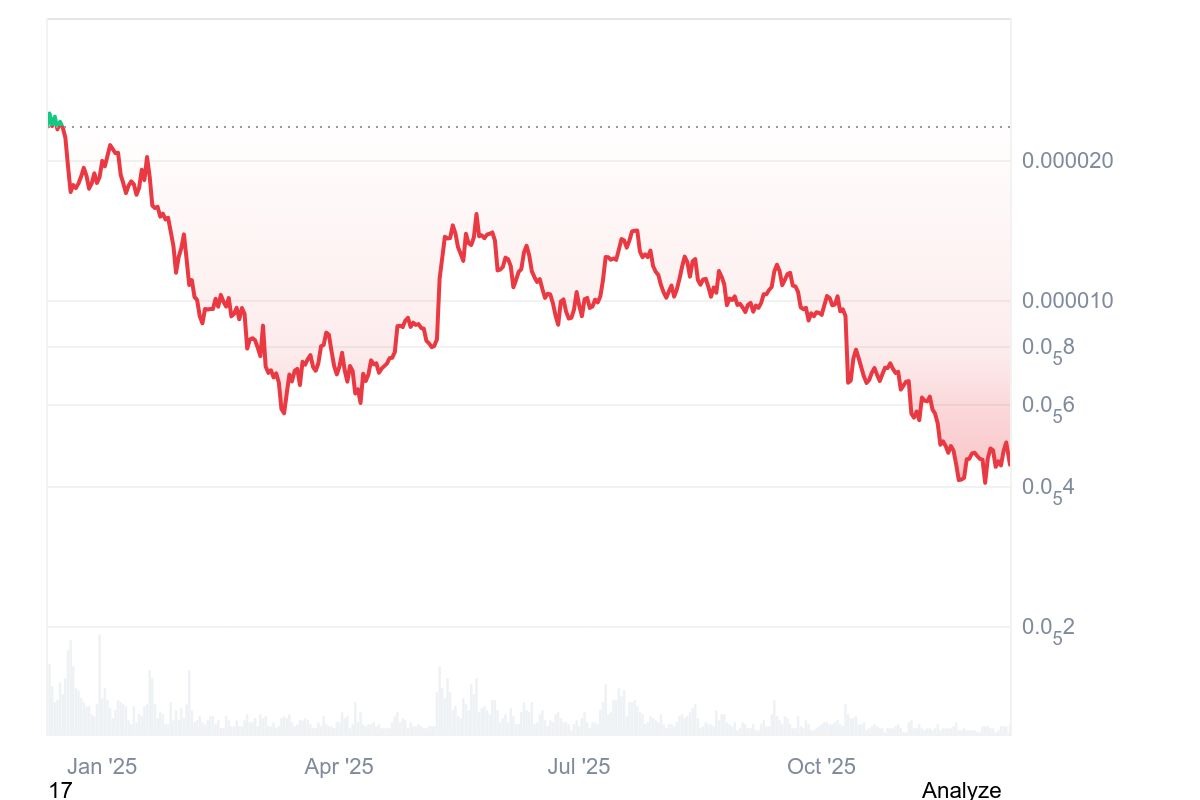
PEPE/USD, 1-year chart. Source: CoinMarketCap.com

Adding to investor concerns, Pepe’s website was exploited earlier in December, temporarily redirecting users to a malicious inferno drainer, a scam tool used for phishing attacks, wallet drainers and social engineering scams.

Despite PEPE’s downside, some crypto traders managed to make millions of dollars on the memecoin.

In March, one trader turned an initial investment of $2,000 into $43 million by holding PEPE. The trader realized a $10 million profit on his position, having held through a 74% decline from PEPE’s all-time high before selling.

Related: Crypto nears its ‘Netscape moment’ as industry approaches inflection point

Forensics tool targets insider-heavy launches

The latest findings were uncovered through Bubblemaps’ Time Travel feature, a forensic-grade analytics tool launched earlier in May, that enables Web3 users to reconstruct the historical distribution of tokens, aiming to detect early insider activity or coordinated accumulation efforts to prevent rug pulls and memecoin scams.

Spotting tokens with a large portion of the supply concentrated across a few wallets can help investors detect scams such as rug pulls, where insiders remove liquidity or stage a mass sell-off, resulting in a steep price collapse that leaves investors with worthless tokens.

Bubblemaps played a key role in uncovering suspicious wallet activity related to multiple memecoins, including the Melania token and an array of fake Eric Trump-themed memecoins.

In one of this year’s most damaging rug pulls, the Wolf of Wall Street-inspired WOLF token crashed 99% within a few hours, wiping out nearly $42 million of market capitalization on March 16.
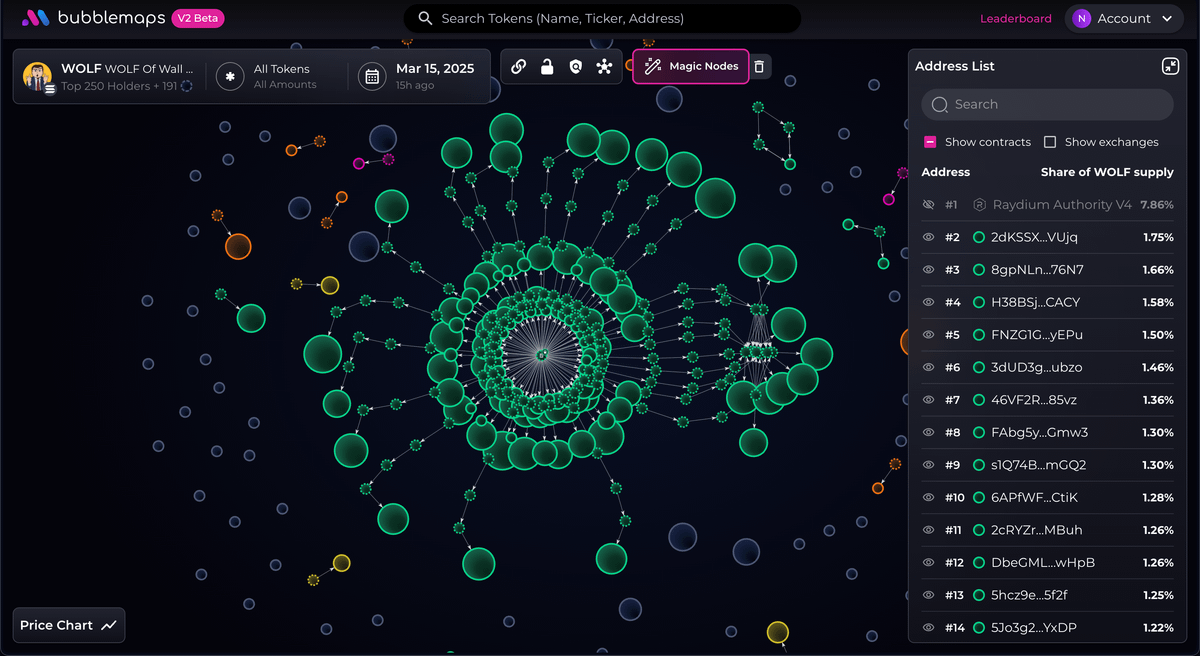
Source: Bubblemaps

The token was created by Hayden Davis, the co-creator of the Official Melania Meme (MELANIA) and the Libra token.

Magazine: Memecoin degeneracy is funding groundbreaking anti-aging research

Trending Cryptos

Related Reads

Collateral Dollars: How Does a 'Second-Layer Dollar' Above Stablecoins Form?

Collateral Dollars: How Does a "Second Layer of Dollars" Form on Top of Stablecoins? Most assume stablecoins replicate Eurodollar functions, expanding the offshore dollar system. However, stablecoins primarily replace specific functions like operational dollar balances for settlement. They do not inherently create new dollar credit; they substitute existing claims. The key question is: what happens when financial intermediaries use stablecoins as collateral to create a new layer of dollar-denominated claims? This "collateral dollar" channel operates through secured lending, not direct money creation. A money-like event only occurs when a liability issued against the controlled stablecoin is funded, rolled over, or accepted at near-par value by another balance sheet. The discount (haircut) prices the gap between "effective control over the token" and "reliable convertibility to bank dollars." Elasticity stems not from the stablecoin itself but from the liability issued against it and the willingness of third-party balance sheets to treat that liability as a near-par asset. Compared to the traditional Eurodollar system—where elasticity originates from bank deposit creation—the stablecoin collateral chain is structurally different. Eurodollar deposits are credit-expansive from inception. Stablecoins are initially substitutive; elasticity emerges later if an intermediary's liability against them gains monetary acceptance. Stablecoins disrupt specific tiers of the offshore dollar system, mainly replacing operational settlement balances. They do not replace the need for full dollar balance-sheet capacity (credit lines, hedging, maturity transformation). For systemic impact, the second-layer liability must pass three tests: transferability, funding capacity, and monetary acceptance (being fundable or held at par by others). Pressure transmission also differs. In the Eurodollar system, stress moves up a hierarchy of claims. In a stablecoin collateral chain, the second-layer liability can lose its money-like status well before the underlying stablecoin faces a run, often triggered by haircut increases and margin calls that create a dynamic spiral of falling token prices and rising discounts. In conclusion, the "collateral dollar" is not the stablecoin itself. It is the second-layer liability issued against a controlled token balance that is willing to be funded and maintained at near-par value. Its existence depends on that liability surviving the leap from "token liquidity" to "bank dollar liquidity."

marsbit1h ago

Collateral Dollars: How Does a 'Second-Layer Dollar' Above Stablecoins Form?

marsbit1h ago

Trading

Spot

Hot Articles

Discussions

Welcome to the HTX Community. Here, you can stay informed about the latest platform developments and gain access to professional market insights. Users' opinions on the price of S (S) are presented below.

活动图片