BSC Pop-up Store Style Memes: How Can They Compete with Solana?

比推Published on 2026-01-13Last updated on 2026-01-13

Abstract

The crypto market's high-beta phase has reignited the meme coin frenzy, with Solana and Binance Smart Chain (BSC) emerging as two dominant but divergent ecosystems. Solana leverages its high-speed, low-cost infrastructure (0.4s transaction time, ~$0.005 fees) and culture-first approach, epitomized by platforms like pump.fun, where memes evolve from community-driven narratives and often face rapid failure—over 98% of projects eventually collapse. Its top meme tokens, like BONK and WIF, thrive on viral momentum and decentralized innovation, but the ecosystem is highly competitive and transient. BSC, in contrast, relies heavily on central figures like CZ and He Yi, and its EVM compatibility attracts event-driven, sentiment-heavy trading—particularly within Chinese-speaking communities. While BSC memes can achieve rapid, concentrated pumps, they often lack longevity without ongoing influencer support. Data from Dexscreener (as of Jan 12, 2026) highlights key differences: Solana recorded 26.92M transactions ($8.65B volume) vs. BSC’s 5.9M ($7.80B), reflecting Solana’s retail-heavy, high-frequency trading versus BSC’s大户-dominated, narrative-centric rallies. Ultimately, Solana’s strength lies in its resilient, tool-rich culture, while BSC excels in short-term, liquidity-injected opportunities. The choice between chains depends on risk appetite: probability and algorithms on Solana, versus community sentiment and timing on BSC.

Since the beginning of this year, the crypto market has once again entered a "high-beta" phase.

With the resurgence of risk appetite, meme coins—a highly volatile, high-return asset class—have returned to the center stage, becoming the most fiercely contested direction for capital.

Unlike before, this round of meme trends has not shown a pattern of "one chain dominating." Solana and Binance Smart Chain (BSC), two mainstream public chains, are now clearly diverging in the meme track:

On one side is Solana, known for its speed, toolchain, and community culture;

On the other is BSC, which leverages the personal influence of CZ/He Yi, its infrastructure, and the sentiment of the Chinese-speaking community.

Data from CryptoQuant shows that the proportion of meme coins in the altcoin market has risen to 3.2%, hitting a record high. Against this backdrop, the meme ecosystems of Solana and BSC are evolving along two distinct paths.

Principles and Mechanisms: Speed First or Compatibility First

The divergence between the two chains' meme ecosystems first stems from differences in their underlying design philosophies.

Solana, based on a hybrid consensus mechanism of Proof of History (PoH) and Proof of Stake (PoS), emphasizes extreme performance: average transaction confirmation time is about 0.4 seconds, and the fee per transaction is as low as $0.005–0.01.

This near-instant settlement experience makes Solana a natural breeding ground for high-frequency trading and emotional diffusion.

On Solana, meme gameplay is closer to "productized issuance." Represented by pump.fun, projects use bonding curves for early price discovery and "graduate" to mainstream DEXs once热度 reaches a threshold. This mechanism encourages rapid experimentation, giving rise to representative tokens like BONK and WIF, which emerged from community memes.
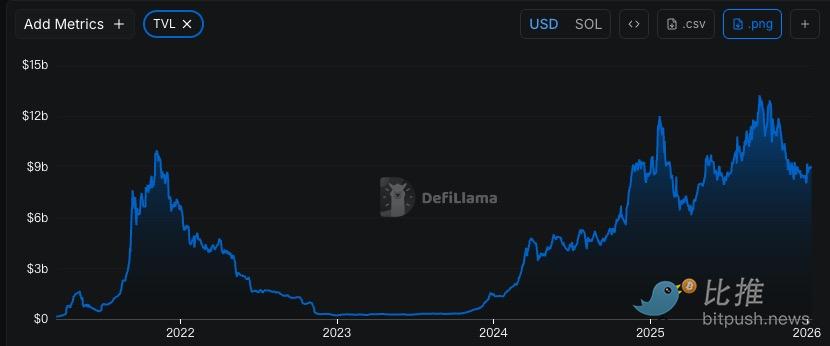
As of now, Solana's ecosystem TVL is approximately $9.0014 billion, still leading among meme-related public chains.

In contrast, BSC opts for compatibility and stability. Its EVM architecture inherits Ethereum's development habits, and with the support of the Binance ecosystem, transaction costs, though slightly higher, remain acceptable. Meme issuance on BSC is more direct—often skipping complex price curves and directly establishing liquidity pools on DEXs like PancakeSwap, making it more suitable for projects that rely on single narratives to gain momentum quickly. Currently, BSC's TVL is about $6.0932 billion, slightly lower than Solana's.
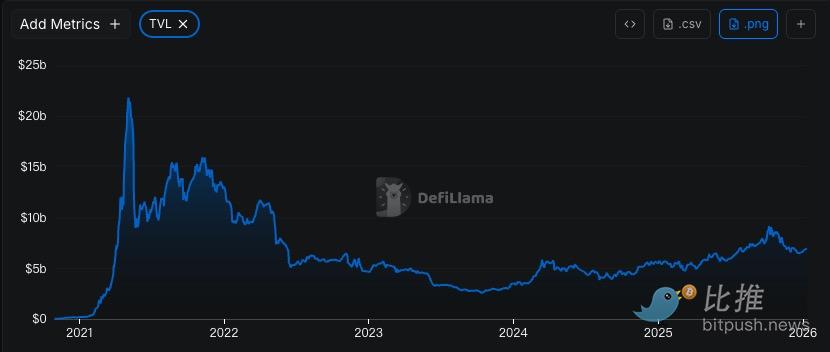
Playstyle Clash: Community Consensus vs. Event-Driven

The differences in mechanisms also shape completely different player behaviors.

On Solana, the vitality of a meme depends on "the spreadability of the meme." Narratives often ferment on X (formerly Twitter), relying on community二次创作 and meme fission to attract attention. Some projects叠加AI, NFT, and other elements to extend their lifecycle, but high freedom also means a high淘汰率—data shows that over 98% of meme projects on Solana ultimately go to zero, with the survivors being the few that have truly formed cultural认同.

BSC's gameplay is closer to "event-driven." Rallies are often ignited by statements from key figures like CZ and He Yi, characterized by straightforward narratives, concentrated情绪, and rapid price increases, but often with limited sustainability. Under the intensive interaction of the Chinese-speaking community, projects can achieve price explosions in a short time, but once the heat subsides, capital can quickly withdraw.

Data Comparison

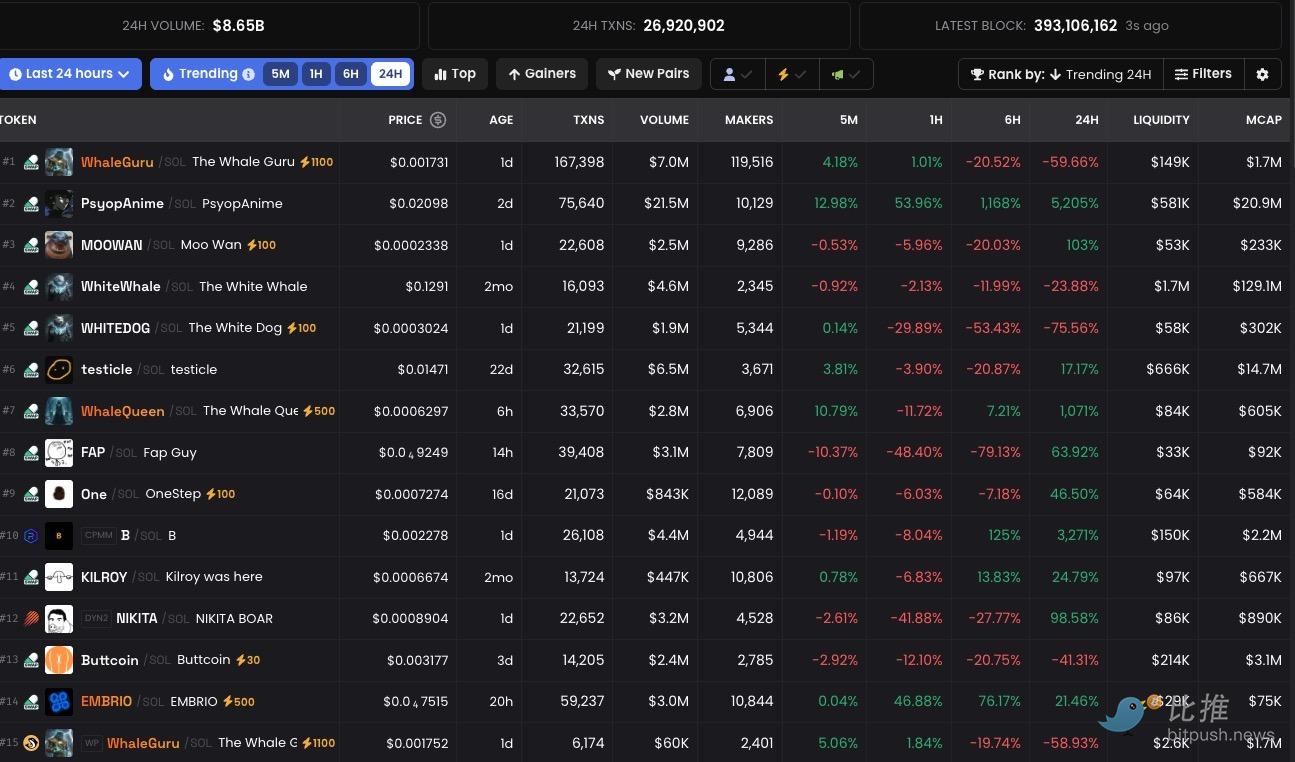
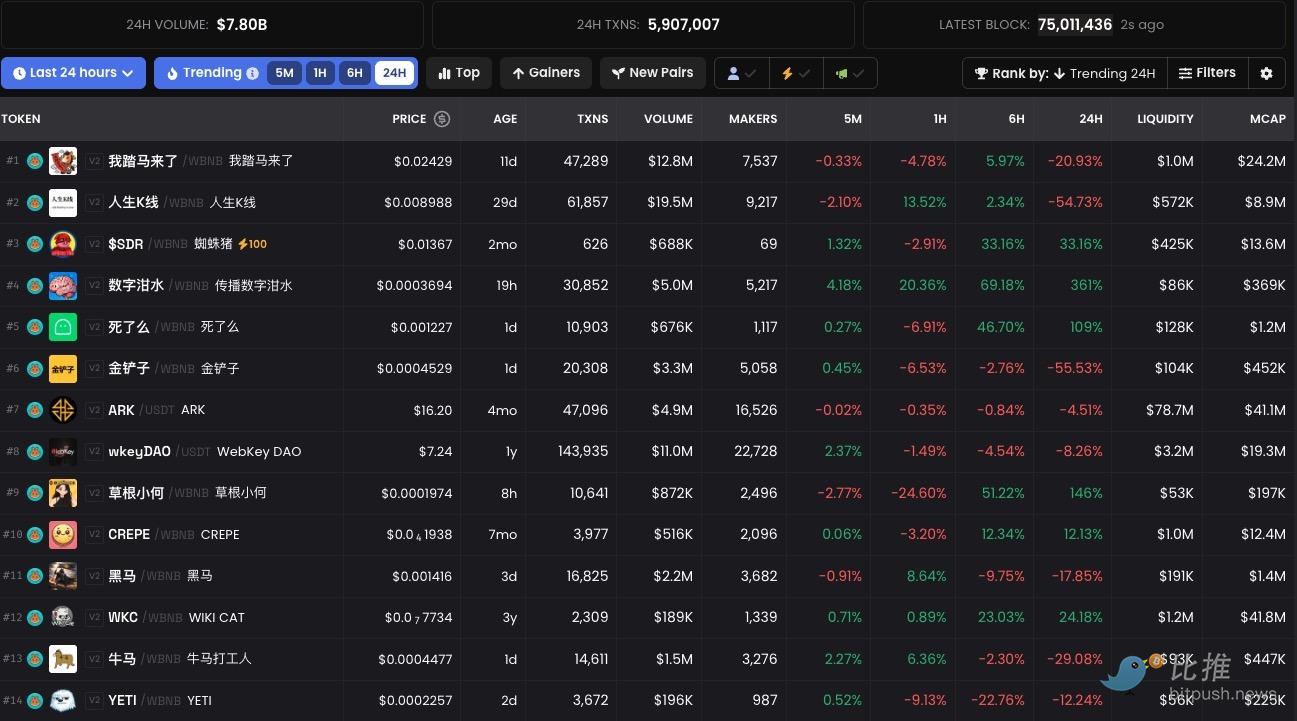
Through real-time data monitoring from Dexscreener as of the time of writing (January 12, 2026), we can clearly see the "capital性格" of the two ecosystems:
Turnover Efficiency: High-Frequency PvP vs. Whale Game

Solana (King of Turnover): 24-hour trading volume of $8.65B, supported by 26.92 million transactions.

Solana's per-transaction amount is extremely small, with the chain filled with millisecond-level sniper bots. On average, each热门代币 has over 110,000 participants (Makers). This极致PvP environment means capital flows extremely fast, with little沉淀.

BSC (Whale Hub): 24-hour trading volume of $7.80B, with only 5.9 million transactions.

The average per-transaction amount on BSC far exceeds that of Solana. Taking the热门币 "我踏马来了" (I'm F*cking Coming) as an example, it had only about 7,500 participants in 24 hours, indicating that BSC is more dominated by "whale communities," with concentrated筹码结构, making rallies more targeted when they occur.

Token Age (Days): Harvesting Machine vs. Reservoir

Solana (Extremely New): The Top 15 list is almost entirely dominated by tokens "born within 24 hours" (e.g., WhaleGuru, MOOWAN, NIKITA, etc.). This reflects Solana's极强的流量爆发力 and extremely short narrative lifespan, with capital constantly searching for the next "5-minute" opportunity.

BSC (Relatively "Long-Lived"): The list includes tokens that have survived for 3 years (WKC), 1 year (wkeyDAO), 4 months (ARK), and 11 days ("我踏马来了"). This proves that BSC's Meme tokens are relatively more resilient; once they form a community or "power narrative," they can persist longer.

Market Cap (MCAP) Distribution:

Solana:

Super Blue-Chip: WhiteWhale's market cap is as high as $129.1M, leading the pack.

Long Tail: Beyond the top four, market caps quickly fall below $1M (e.g., FAP, EMBRIO are only in the tens to hundreds of thousands of dollars). This shows that Solana's流量极度偏爱 the top "survivors," while the remaining 99% are just along for the ride.

BSC:

Strong Middle Tier: 7 of the top 15 tokens on the list have a market cap exceeding $10M (e.g., ARK, 我踏马来了, wkeyDAO, SDR). This "olive-shaped" structure indicates that BSC capital prefers to cluster in already successful mid-sized projects, offering相对更高 safety.

Who Can Go Further?

It's not hard to see that Solana's commercial value lies in "infrastructure empowering culture." It attracts global retail investors with extremely low barriers. Although highly泡沫化, its efficiency in decentralized innovation makes it more resilient in the long cycle.

BSC's business logic, however, is "opportunistic amplification." It uses centralized leverage to quickly inject liquidity and connect with the Asian market. But this logic also exposes its fragility: when hotspots fade or "core figures" go silent, the ecosystem easily falls into a "vacuum period" of discontinuity, making it hard for Memes to survive through community autonomy without official光环.

As observed by KOL miragemunny: "BSC is currently in a phase of flash-in-the-pan speculation, while Solana's meme culture and toolchain are the result of years of沉淀."
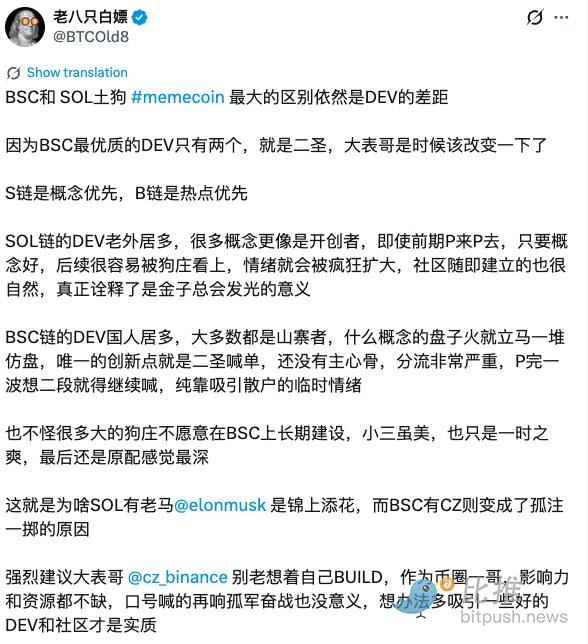
Chinese-speaking KOL 老八只白嫖 (@BTCOld8)直言 (stated bluntly) that BSC needs to attract more developers, not just rely on hotspot rotation.

In 2026, the meme track may enter a new phase of "情绪, liquidity, and toolchain叠加" (superposition of sentiment, liquidity, and toolchains).

For investors, the key may not lie in judging which chain will "definitely win," but in understanding the completely different rhythms of the two ecosystems: on Solana, you play probability and algorithms; on BSC, you play another kind of "interpersonal relations."

However, in the end, in the world of memes, the narrative determines how high you can fly, while liquidity determines how long you can last.

Author: Bootly


Twitter:https://twitter.com/BitpushNewsCN

Bitpush TG Discussion Group:https://t.me/BitPushCommunity

Bitpush TG Subscription: https://t.me/bitpush

Original article link:https://www.bitpush.news/articles/7602035

Trending Cryptos

Related Questions

QWhat are the key differences in the underlying design philosophy between Solana and BSC for meme coin ecosystems?

ASolana prioritizes speed and performance with its Proof of History (PoH) + Proof of Stake (PoS) hybrid consensus, offering near-instant settlement (0.4s) and ultra-low fees ($0.005–0.01). BSC focuses on compatibility and stability through its EVM architecture, inheriting Ethereum's development habits, with slightly higher but still acceptable costs.

QHow do the meme coin 'playstyles' differ between Solana and BSC according to the article?

AOn Solana, meme coin success depends on 'meme spreadability' and cultural identity, often starting from Twitter and relying on community creation and memetic fission. On BSC, the playstyle is more 'event-driven,' ignited by key figures like CZ or He Yi, characterized by straightforward narratives, concentrated emotion, and rapid price surges, but often with limited sustainability.

QWhat does the data reveal about the trading volume and number of transactions on Solana versus BSC?

ASolana had a 24-hour trading volume of $8.65B supported by 26.92 million transactions, indicating high-frequency, small-sized trades. BSC had a 24-hour volume of $7.80B from only 5.9 million transactions, showing larger average trade sizes and more concentrated,大户 (big player) participation.

QWhat is the contrast in the 'Age' or longevity of top meme coins between the two chains?

ASolana's top meme coins are extremely new, with the top 15 often being less than 24 hours old, reflecting fast turnover. BSC's top meme coins show more longevity, with examples surviving for 3 years, 1 year, 4 months, or 11 days, indicating a greater ability to form lasting communities or narratives.

QHow does the market capitalization (MCAP) distribution differ between Solana and BSC meme ecosystems?

ASolana's MCAP distribution is top-heavy with a 'super blue-chip' like WhiteWhale at $129.1M, followed by a steep drop-off where most other top coins have MCAPs below $1M. BSC's distribution is more robust in the middle, with 7 of the top 15 coins having MCAPs over $10M, forming a more 'olive-shaped' structure suggesting stronger community holding in mid-sized projects.

Related Reads

As Consensus Accelerates, What Are Young Investors Betting On?

Title: As Consensus Forms Faster, What Are Young Investors Betting On? In the rapid evolution of tech investment, a new generation of young investors is navigating a landscape where AI, robotics, commercial aerospace, and quantum computing are advancing simultaneously. Traditional investment logic based on financial models is giving way to a need for deep technical understanding and the ability to act before industry consensus forms. An analysis of trends from the "WAIC FUTURE TECH" list of young investment leaders reveals key shifts in focus. The first major trend is the movement of AI from the digital screen into the physical world. Investment is shifting from large language models and chatbots towards embodied AI, robotics, AI hardware, and edge computing. While demonstrations generate excitement, the real challenge lies in achieving scalable, reliable, and cost-effective delivery in complex real-world environments like factories and logistics. Success depends not just on algorithms but on the integration of sensors, actuators, and control systems. Second, the competitive focus for large models is moving beyond raw capability toward building an "intelligence flywheel." The goal is to create self-reinforcing systems where user interaction generates data, improving the model, which in turn enhances the user experience and attracts more engagement. Companies that successfully embed AI into workflows to create these closed-loop systems can build lasting value that isn't easily erased by the next model upgrade. Third, facing a potential bottleneck in high-quality human-generated data, investors are looking at new underlying technologies. Reinforcement learning and self-play, as demonstrated by AlphaGo Zero, offer paths for AI to generate its own experience. Scientific foundation models, which aim to build general AI capabilities for fields like life sciences and materials discovery, represent a non-consensus direction that could unlock new frontiers of knowledge and data. Finally, in deep-tech areas like quantum computing, commercial aerospace, and space-based infrastructure, patient capital is essential. These fields have long, uncertain development and validation cycles involving complex engineering, supply chains, and regulations. Investment here requires a long-term view, focusing on foundational team capabilities and the eventual emergence of market demand, even if commercial returns are distant. Collectively, these trends illustrate how young investors are adapting to a new era. They are learning to make earlier, technically-informed judgments, balance hype with real-world viability, and provide the patient capital needed to build the deep-tech foundations of the future.

marsbit9m ago

As Consensus Accelerates, What Are Young Investors Betting On?

marsbit9m ago

Can Japan Buy Growth with AI? Will the Bond Market Believe It?

Japan's cabinet has introduced the 2026 Basic Policy on Economic and Fiscal Management and Reform, shifting its primary fiscal target. The new framework moves away from the traditional annual primary balance goal and instead prioritizes a stable reduction of the debt-to-GDP ratio. This change is tied to a strategy of increased "responsible proactive fiscal" spending, aiming to boost long-term growth through investments in strategic sectors like AI, semiconductors, energy, and robotics. The government estimates total public and private investment in 62 key technologies could exceed 370 trillion yen by 2040. The market reaction has been mixed and cautious. While equity markets may respond to policy signals, bond markets are focused on fiscal credibility. Concerns center on whether the weakening of the clear primary balance anchor could lead to looser fiscal discipline. If investors doubt that these strategic investments will generate sufficient productivity gains, tax revenue, and nominal growth to outpace rising interest costs, they may demand higher yields on Japanese Government Bonds (JGBs). Recent volatility in the yen and JGB yields, with the 10-year yield briefly reaching 2.9%, reflects this skepticism. The success of this new framework hinges on two factors: whether Japan can achieve a nominal growth rate consistently higher than its long-term interest rates, and whether future budgets demonstrate disciplined control over bond issuance. The government's narrative is that strategic investment is essential to break Japan's cycle of low growth, aging, and labor shortages. However, the bond market will continuously assess the credibility of this plan, pricing the risk that it may represent fiscal expansion rather than a viable growth strategy.

marsbit47m ago

Can Japan Buy Growth with AI? Will the Bond Market Believe It?

marsbit47m ago

Misjudged A-Shares: Resilience, Expectations, and Confidence

China's A-share market recently faced selling pressure, especially in tech sectors, initially triggered by a global tech sell-off that began in South Korea. However, the article argues this is a case of "mistaken injury" and highlights the market's underlying resilience. This resilience stems from three main pillars: **1) Tech Sector Fundamentals:** Unlike Korea's market dominated by a few memory chip stocks, China's tech sector is diversified across computing, communications, electronics, and semiconductors, supported by dual narratives of global AI supply chains and domestic substitution. Core areas like optical modules and fiber optics continue to show strong earnings growth. **2) "National Team" Support:** State-backed institutions and large corporations have made significant market purchases and announced buybacks, providing liquidity and signaling confidence. This is seen as a stabilizing policy signal, often associated with market bottoms. **3) Broader Market Pillars:** Other major sectors are showing endogenous recovery momentum. Consumer stocks benefit from stabilizing CPI and signs of sector recovery (e.g., liquor price hikes). Cyclical sectors like aluminum have high earnings, potential price increases due to tight supply, and low valuations. The financial sector offers stable dividends and low valuations. The conclusion is that the sell-off was driven by external contagion, not a collapse in fundamentals. With strong policy support and recovering momentum across key sectors, the A-share market possesses the toughness to regain stability.

marsbit1h ago

Misjudged A-Shares: Resilience, Expectations, and Confidence

marsbit1h ago

Trading

Spot

Hot Articles

Discussions

Welcome to the HTX Community. Here, you can stay informed about the latest platform developments and gain access to professional market insights. Users' opinions on the price of SOL (SOL) are presented below.

活动图片















